The Standardization Fallacy: Why Uniform DORA Metrics Fail Heterogeneous Engineering Portfolios

The Standardization Fallacy: Why Uniform DORA Metrics Fail Heterogeneous Engineering Portfolios

A single VP overseeing cloud-native SaaS, legacy mainframe, firmware, and regulated banking teams cannot grade them all on the same DORA scale. Discover why forcing uniform "Elite" deployment frequency and lead-time targets onto heterogeneous portfolios penalizes safety-critical teams and introduces real operational risk — and how Keypup MCP builds risk-adjusted, tier-based benchmarks for every team automatically.
Arnaud Lachaume
Bridging the CFO Translation Gap: How Engineering Analytics Can Finally Speak Finance

Bridging the CFO Translation Gap: How Engineering Analytics Can Finally Speak Finance

Enterprise CFOs need financial outcomes—revenue growth, cost reduction, EBITDA impact, and R&D capitalization. Yet engineering teams track deployment frequency and PR cycle time. Discover how the Keypup MCP bridges this critical translation gap, automatically mapping technical delivery metrics to financial impact and enabling accurate CapEx/OpEx categorization for R&D tax credits.

Stephane Ibos
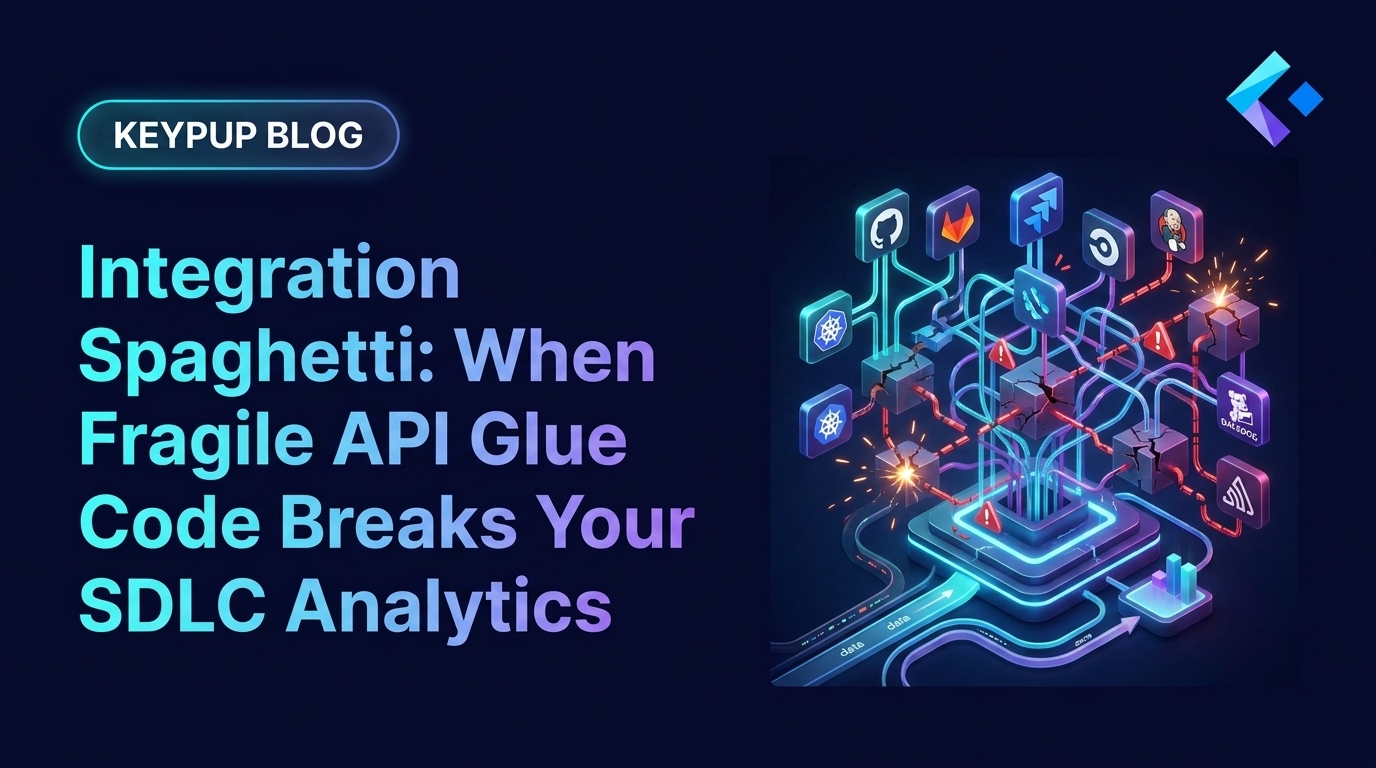
Integration Spaghetti: When Fragile API Glue Code Breaks Your SDLC Analytics

Integration Spaghetti: When Fragile API Glue Code Breaks Your SDLC Analytics

Building SDLC analytics requires integrating GitHub, Jira, Jenkins, Kubernetes, and monitoring tools. But custom API glue code is brittle, breaks constantly, and loses data. Discover how to get complete engineering insights without maintaining fragile integrations.

Thomas Williams
Goodhart's Law in Action: Why Your Dev Metrics Are Being Gamed (And How to Fix It)

Goodhart's Law in Action: Why Your Dev Metrics Are Being Gamed (And How to Fix It)

Discover why measuring individual developer performance with raw metrics leads to gaming behavior and erodes team trust. Learn how Keypup's MCP Server provides contextual benchmarking that accounts for code review, cross-team collaboration, and the role and team context you supply—transforming metrics from surveillance tools into culture-building insights that recognize real value beyond lines of code.

Liam Davis
Project Management Nightmares: How Keypup MCP Brings Clarity to Software Development Chaos

Project Management Nightmares: How Keypup MCP Brings Clarity to Software Development Chaos

Discover how to overcome the most painful project management challenges in software development. Learn how Keypup harmonizes data across Jira, Trello, and Git repositories, and how its MCP Server lets your AI assistant turn that data into actionable insights, evidence-based estimates, and up-to-date visibility—transforming chaos into clarity and helping teams deliver on time.

Thomas Williams
Achieving ISO27001 & SOC2 Type II: Continuous SDLC Audit with Keypup MCP

Achieving ISO27001 & SOC2 Type II: Continuous SDLC Audit with Keypup MCP

Learn how to achieve and maintain ISO27001 and SOC2 Type II certifications for your software development organization. Discover the specific SDLC requirements, audit processes, and how Keypup's dashboards and read-only MCP Server turn your Git and work-tracking data into on-demand evidence for code review, change management and remediation controls.

Stephane Ibos
Measuring AI Impact on Software Development: How to Track ROI and Efficiency with Data-Driven Insights

Measuring AI Impact on Software Development: How to Track ROI and Efficiency with Data-Driven Insights

AI coding assistants promise productivity gains, but are they delivering? Learn how to measure the real impact of AI tools on your SDLC—from code quality to cycle time to developer satisfaction. Discover which metrics matter for ROI analysis and how Keypup's AI Usage dataset, AI Agent and MCP Server correlate AI adoption with engineering outcomes.

Thomas Williams