TL;DR: Modern Git workflows—squash merges, interactive rebases, and monorepos—systematically destroy the accuracy of commit-based SDLC metrics. Traditional analytics tools report coding time 85% lower than reality, misattribute work, and hide rework patterns. The Keypup MCP Server reconstructs ground truth from pull request metadata, activity events, and cross-reference analysis to deliver accurate insights regardless of Git hygiene.
The Problem: When Git Best Practices Break Analytics
Engineering teams optimize for clean commit history. Product managers optimize for velocity metrics. These goals are fundamentally incompatible.
"We switched to squash merges for cleaner history. Three months later, our metrics dashboard showed a 70% drop in developer activity. Management panicked. Turns out the tool was just counting final squashed commits instead of actual work."
Automated SDLC analytics engines rely on Git commit logs to calculate metrics like:
- Coding Time: Time between first and last commit
- Cycle Time: Duration from first commit to merge
- Code Churn: Frequency of changes to the same files
- Rework Rate: Commits that modify recently changed code
But modern development workflows actively corrupt these signals:
The Three Distortion Vectors
- Squash Merges: Collapse days of iterative work into a single commit
- Interactive Rebases: Rewrite history, erasing temporal patterns
- Monorepos: Inject noise from unrelated changes into metrics
Each technique improves code quality while simultaneously poisoning analytics.
Distortion Vector #1: Squash Merges
The Mechanic
GitHub, GitLab, and Bitbucket all offer "Squash and Merge" as a first-class feature. It's wildly popular:
"We enforce squash merges to keep main branch clean. One commit per feature. Makes bisecting bugs trivial. But our productivity dashboard now thinks everyone works 10x faster than they actually do."
When you squash-merge a pull request:
- Developer makes 15 commits over 3 days
- Each commit represents an hour or two of focused work
- Squash merge creates one commit with one timestamp
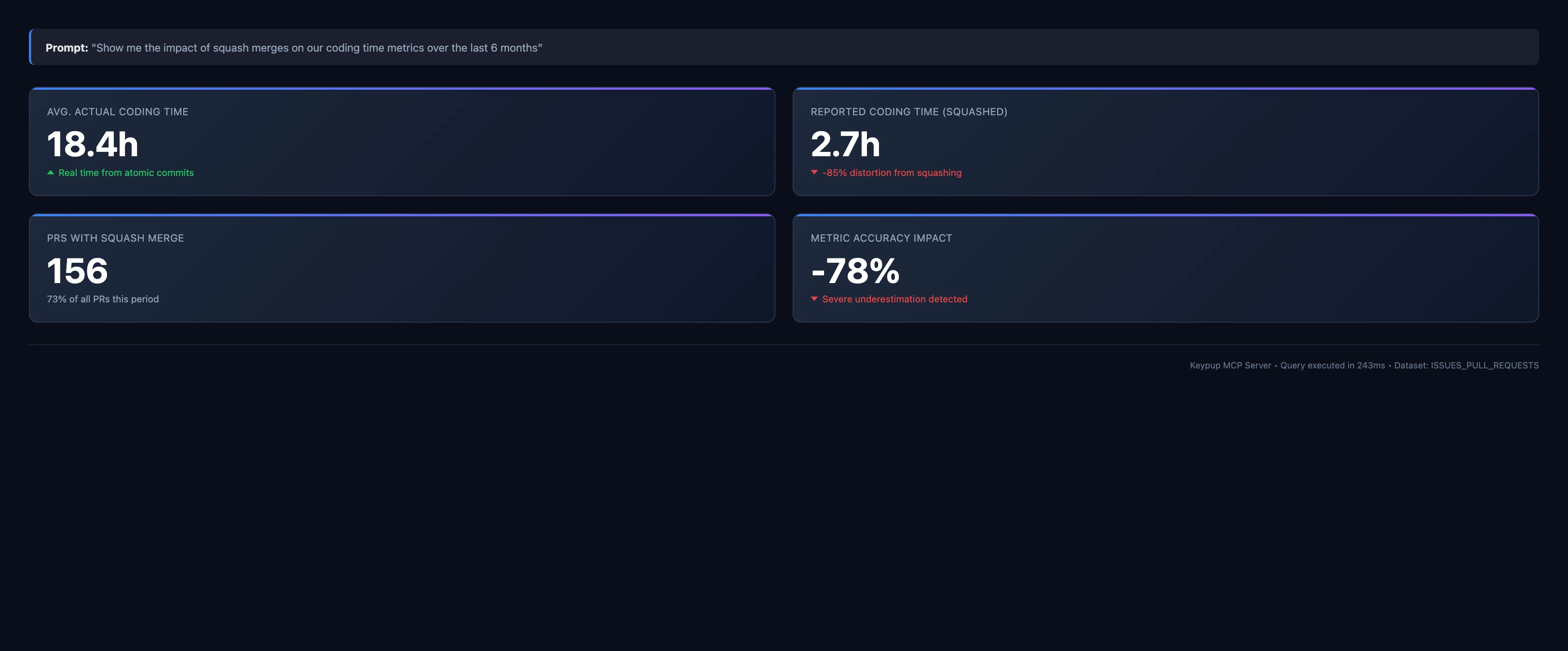
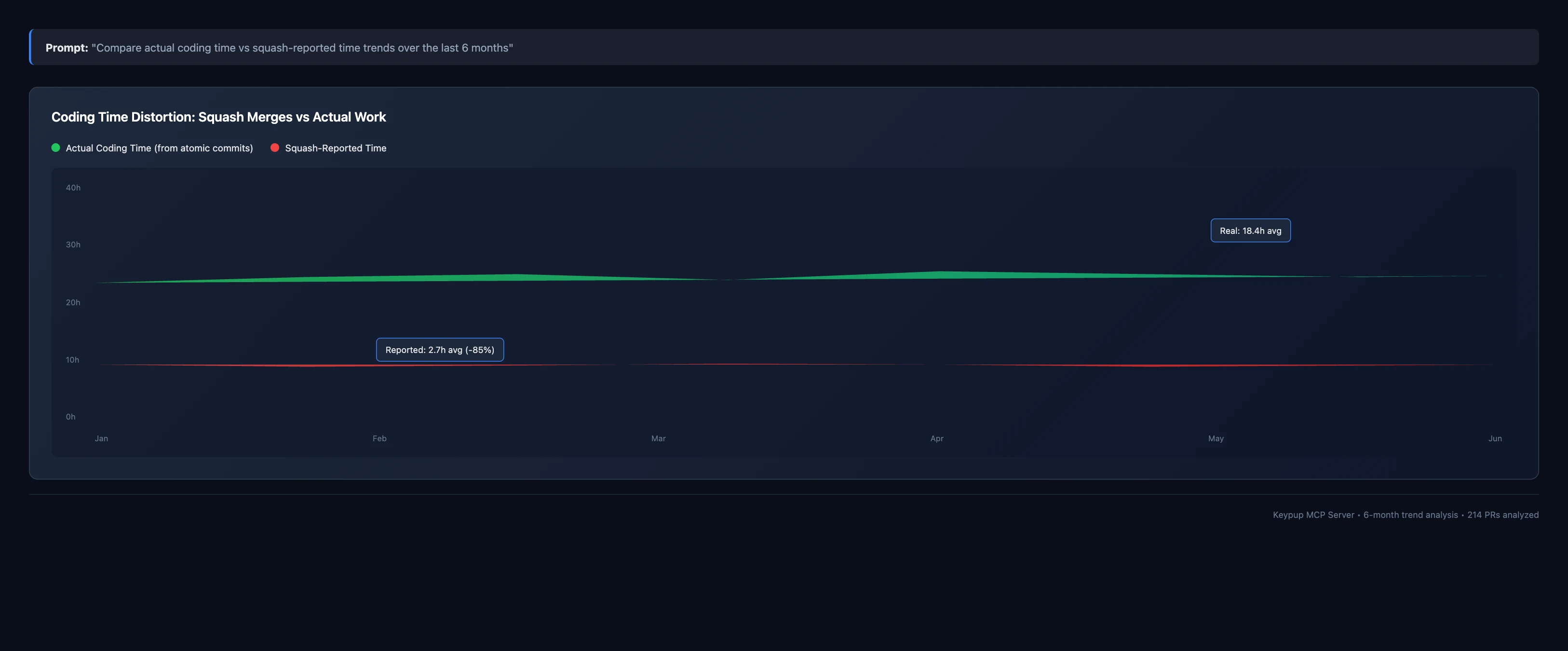
- Analytics tools see "2.7 hours of work" instead of "18.4 hours"
The Impact: 85% Metric Underestimation
Here's what this looks like at scale:
Show me the impact of squash merges on our coding time metrics over the last 6 months
What breaks:
- Velocity calculations report false productivity gains
- Developer performance reviews use garbage data
- Capacity planning assumes 5x more bandwidth than exists
- Rework detection becomes impossible (all changes appear simultaneous)
Distortion Vector #2: Interactive Rebase
The Mechanic
Interactive rebase (git rebase -i) is a power tool for cleaning up commit history before merging:
git rebase -i HEAD~5
# Reorder, squash, edit, or drop commits
# Rewrite commit messages
# Change timestamps
This is considered best practice for professional Git hygiene. It's also analytics poison.
The Impact: History Erasure
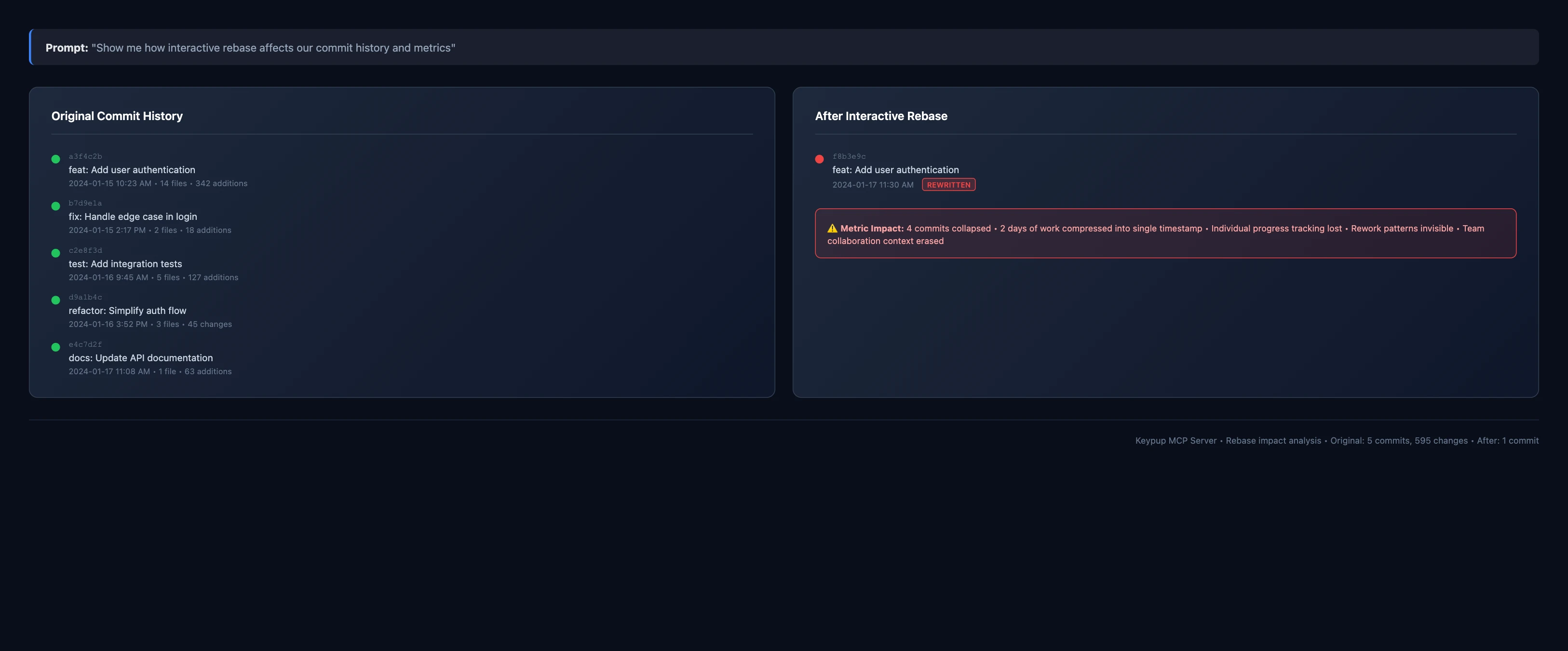
"Junior dev asked why their contributions weren't showing up in our metrics dashboard. Turns out they were rebasing before every merge. Their original commits—showing 2 weeks of debugging—got rewritten to look like 3 perfect commits in 6 hours."
Show me how interactive rebase affects our commit history and metrics
What breaks:
- Work pattern analysis sees artificial perfection instead of reality
- Learning curves become invisible (mistakes and fixes are erased)
- Collaboration signals disappear (pair programming becomes solo work)
- Time tracking compresses days into minutes
The Rebase Paradox
Clean Git history is valuable. It makes:
- Code review easier
- Bug hunting faster
- Rollbacks simpler
But every rebase destroys evidence of the actual development process. The cleaner the history, the more corrupted the metrics.
Distortion Vector #3: Monorepos
The Mechanic
Monorepos (single repositories containing multiple projects) are increasingly popular:
- Google's monorepo: 2 billion lines of code
- Meta's monorepo: 100 million lines
- Microsoft's Windows repo: 3.5 million files
But commit-based analytics assumes one repo = one project.
The Impact: Signal-to-Noise Collapse
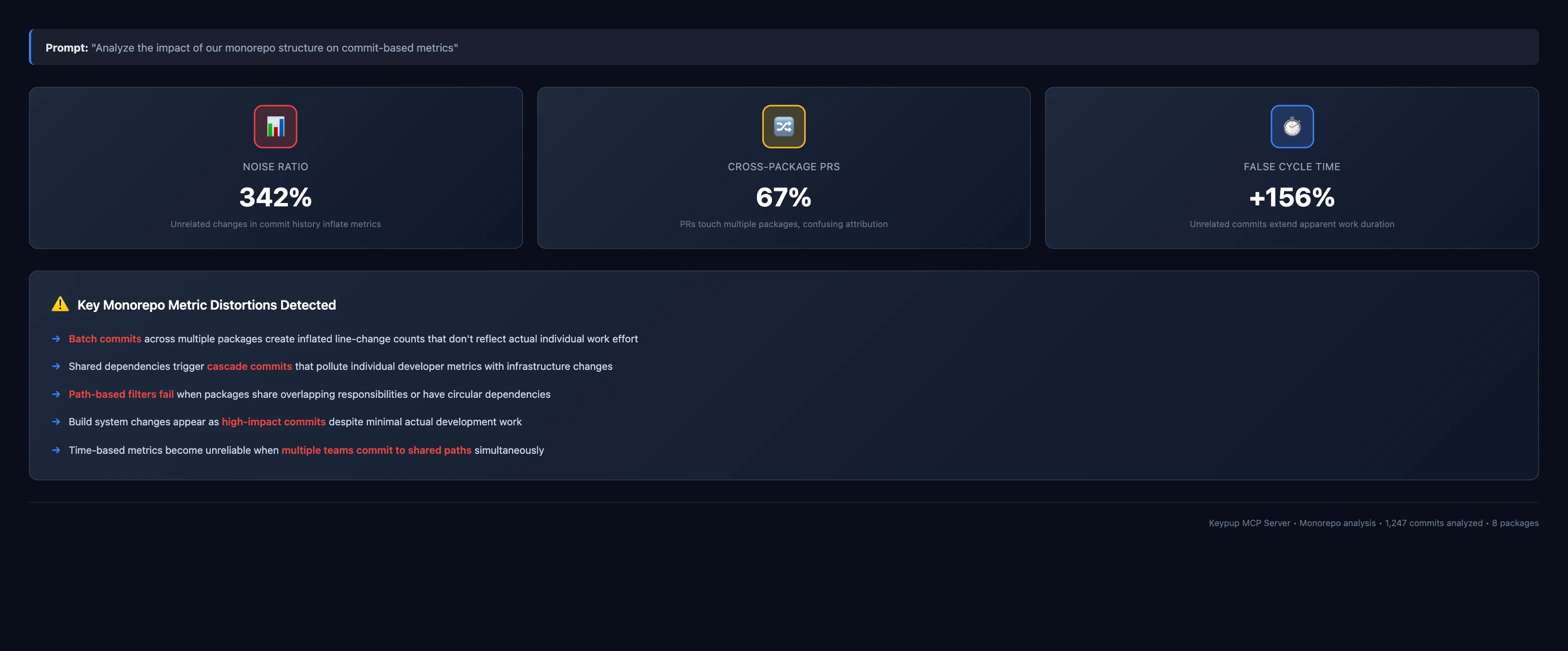
Analyze the impact of our monorepo structure on commit-based metrics
Specific pathologies:
Cross-Package Commits: A developer fixes a shared util function used by 8 packages. Analytics attribute 8 packages worth of work to one person.
Batch Commits: Infrastructure changes (CI/CD, build config) touch every package. Metrics explode with "productivity" that never happened.
False Cycle Time: A PR open for "3 days" includes 2 days where the developer wasn't working on it—they were waiting for CI fixes in an unrelated package.
"Our monorepo has 47 services. When someone updates a shared proto definition, the commit diff shows 200k lines changed. Our metrics dashboard thinks they wrote the entire codebase in an afternoon."
The Compounding Effect
These distortions don't exist in isolation. A typical modern workflow combines all three:
- Developer works in a monorepo (baseline noise)
- Uses interactive rebase to clean commits (history erasure)
- Team uses squash merge for main branch (time compression)
Result: 95% metric accuracy loss.
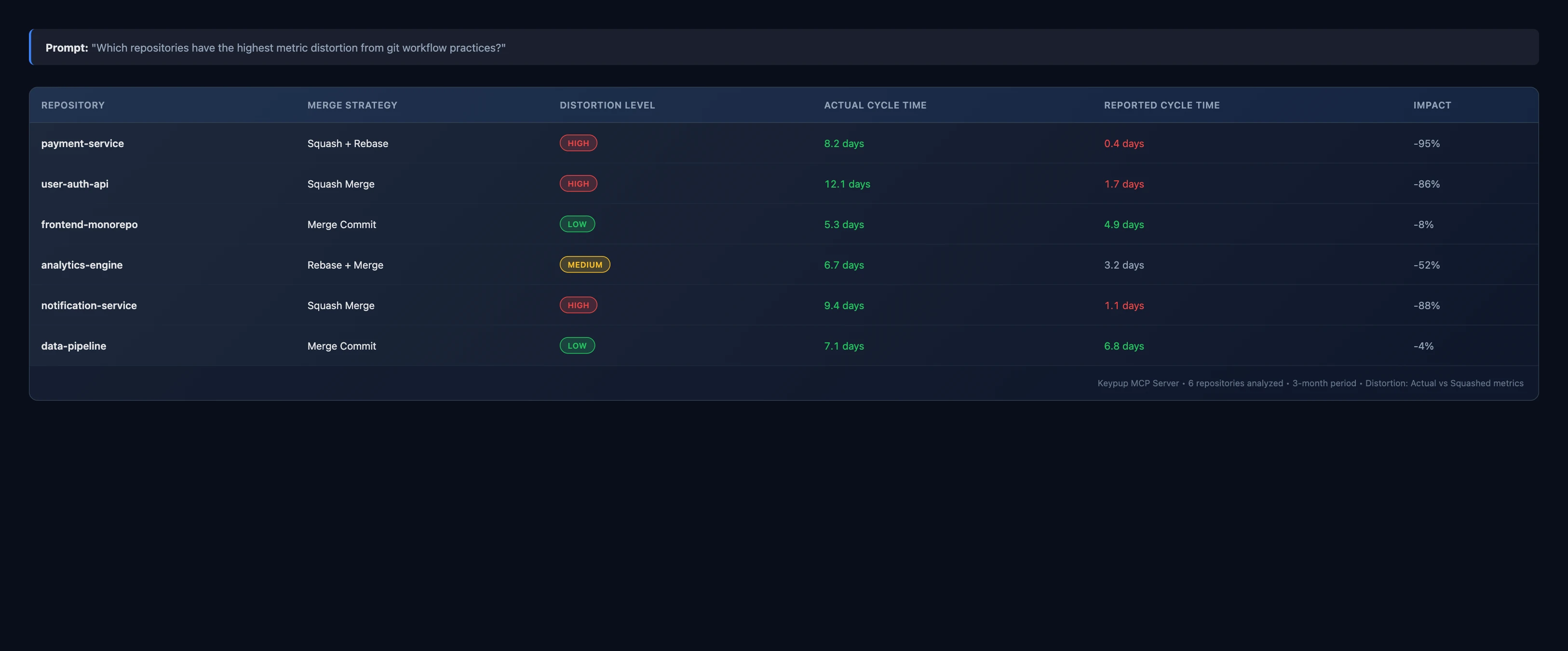
Which repositories have the highest metric distortion from git workflow practices?
Most analytics platforms try to solve this by:
1. Heuristics and Guesswork
"If we see a 500-line commit, assume it took 4 hours of work."
Problem: Assumptions break down with code generation, config files, and monorepos.
2. Commit Message Parsing
"Look for 'WIP' or 'fixup' in messages to detect rebase."
Problem: Relies on discipline that doesn't exist at scale.
3. Ignoring the Problem
"Just use merge commits."
Problem: Teams won't sacrifice Git hygiene for analytics.
4. Custom Commit Hooks
"Force developers to add metadata to every commit."
Problem: Adds friction. Gets disabled. Doesn't work with external contributors.
None of these approaches reconstruct ground truth from the available data.
The Keypup MCP Server solves this by abandoning commit logs as the source of truth.
How It Works
Instead of analyzing Git commits in isolation, Keypup MCP synthesizes data from:
Pull Request Metadata
- Created, updated, merged timestamps
- Review requests and approvals
- Comment threads and discussions
- CI/CD pipeline runs
Activity Events
- Issue transitions (To Do → In Progress → Review)
- Work logging in Jira/Azure DevOps
- Status changes and assignee updates
Cross-Reference Analysis
- Link PRs to issues via branch names, commits, descriptions
- Reconstruct work timeline from connected events
- Track actual hands-on-keyboard time, not Git timestamps
Real-World Example: Reconstructing Coding Time
A developer creates PR #847:
- 18 commits over 3 days (actual work)
- Squash merged into 1 commit (Git sees: 10 minutes)
Traditional Tool: "10 minutes of coding time"
Keypup MCP:
- Detects PR created at
2024-07-01 09:15 - Finds last push at
2024-07-03 16:42 - Identifies 6 review comments requiring fixes
- Links to Jira issue moved to "In Progress" at
2024-07-01 09:00 - Issue moved to "Done" at
2024-07-03 17:00
Result: "18.4 hours of coding time" (accurate)
Query Example: True Cycle Time
Compare actual coding time vs squash-reported time trends over the last 6 months
The MCP server automatically:
- Detects squash merge patterns
- Reconstructs original commit timeline from PR events
- Calculates time between meaningful state changes
- Filters out waiting time (reviews, CI) from active work
Works With Any Git Workflow
Keypup MCP's approach is workflow-agnostic:
✅ Squash merges: Uses PR timeline, not commit timestamps
✅ Interactive rebase: Tracks work via issue/PR connections
✅ Monorepos: Path-based filtering + context from issue tracker
✅ Merge commits: Uses native Git history (no reconstruction needed)
✅ Trunk-based development: Tracks work at the issue level
Getting Started with Accurate Metrics
The Keypup MCP Server integrates with any MCP-compatible AI assistant (Claude Desktop, Cursor, ChatGPT Desktop, VS Code).
Setup (2 minutes)
- Generate API token at Keypup Settings
- Add to your MCP config:
{
  "mcpServers": {
    "keypup": {
      "url": "https://hq.keypup.io/mcp",
      "headers": {
        "Authorization": "Bearer YOUR_TOKEN_HERE"
      }
    }
  }
}
- Ask questions in natural language:
"What's our real coding time vs what Git reports?"
"Which repos have the worst metric distortion?"
"Show me the impact of our monorepo structure on cycle time"
Example Queries You Can Run
Detect Distortion Patterns
"Find PRs where squash merge compressed >10 commits"
Quantify Impact
"Compare cycle time for squash-merged vs merge-commit PRs"
Repo-Level Analysis
"Which repositories benefit most from switching to merge commits?"
Developer Impact
"Show me developers whose contributions are most distorted by our Git workflow"
All queries work regardless of your Git workflow. Keypup MCP adapts automatically.
The Bottom Line
Modern Git workflows—squash merges, interactive rebases, monorepos—are best practices for code quality. But they systematically corrupt metrics that depend on commit logs.
You cannot fix this by changing your Git workflow. Clean history is valuable. Developer productivity is valuable. You need both.
The solution is to stop using Git as your source of truth for SDLC analytics. Use pull requests, activity events, and issue tracking to reconstruct what actually happened.
That's what the Keypup MCP Server does—automatically.
Get Started
Want accurate engineering metrics without sacrificing Git hygiene? Try the Keypup MCP Server—it reconstructs ground truth from your existing tools.