The Untraceable Merge: When a Third of Your Merged Code Has No Ticket Behind It
Enterprise change policies say every change traces back to a ticket, but in a typical organization 34% of merged pull requests resolve no Jira issue, carrying 29% of the code. Learn what engineering leaders on Reddit say about pull requests without linked issues, audit traceability and R&D capitalization, and how Keypup MCP measures the traceability gap from resolved issues, branch names, issue types, approvals and mergers.
TL;DR: Most enterprise change policies say that every change to production traces back to a ticket. Nothing enforces it. In a typical enterprise organization, 34% of merged pull requests resolve no Jira issue, and they carry 29% of the lines changed. That work is mostly not chores: 55% of it sits on feature, fix and hotfix branches. Unlinked pull requests are almost four times as likely to merge with no approval (22% against 6%), and all of the growth in merged pull requests over six months went through without a ticket. Only 42% of the code can be traced to a Story or a New Feature, the number finance needs for R&D capitalization. The Keypup MCP Server reads, for every pull request, the issues it resolves and their issue type, its branch names, repository, lines changed, approval count, author, merger and dates. Your AI assistant can then size the gap, see what the unlinked work is, find where it lives, compare how it's reviewed, trace lines to issue types, follow the trend, and list the repositories to fix first.
The request from the auditors sounded simple: "For a sample of 40 production changes from last quarter, show the approved requirement behind each one." The engineering manager opened the first pull request in the sample. Title: "fix stuff". No ticket in the title, none in the description, none in the commits. The branch was called alex/tmp-fix-2. Thirty-nine to go, and the team had two days.
The Friction: A Policy That Lives in a Wiki, Not in the Merge Button
Every enterprise has a version of the same rule: "no change without a ticket". Product needs it to know what shipped. Finance needs it to capitalize development work. Compliance needs it to prove that changes were requested and approved. And yet nothing in the merge path checks it:
The Git platform doesn't know Jira exists. Branch protection checks approvals and builds. It will happily merge a pull request that names no issue at all.
The link is a text convention. A pull request is linked to an issue because someone typed PAY-1234 in the title or "Fixes PAY-1234" in the description. Forget it once, and the change is invisible from the ticket.
The key often ends up in the wrong place. Engineers name the branch feature/PAY-1234-retry-logic and assume that's enough. For most integrations, it isn't.
Some work never gets a ticket. Infrastructure changes, quick fixes after an incident, refactors "while I'm in there": they are real work, done on real branches, with no issue to point to.
The result: the board reports epics at 100%, the release notes come from Jira, and a third of what actually shipped isn't in either.
Why This Matters: The Real Cost of Untraceable Merges
The Audit Problem
SOX, SOC 2, ISO 27001 and most internal change management policies ask the same thing: show that each change was requested, approved and tested. A pull request with no linked issue fails the first test. When auditors sample changes, every unlinked one turns into a manual investigation, and the evidence assembled after the fact is weaker than a link created at the time.
The Finance Problem
R&D capitalization (ASC 350-40, IAS 38) and R&D tax credits rely on attributing engineering effort to projects and to new capabilities. Code that resolves no issue can't be attributed to anything. Finance either estimates it, which auditors dislike, or excludes it, which understates the investment the company can capitalize or claim.
The Planning Problem
If 34% of merged pull requests sit outside Jira, the board shows two thirds of the work. Velocity, epic progress and roadmap forecasts are computed on the visible part, while the invisible part keeps eating capacity. Teams look slower than they are, and nobody can say where the rest of the time went.
The Enterprise Discussion: What Engineering Leaders Are Actually Saying
"Half our PRs don't reference a ticket", "the auditors wanted a Jira link for every production change" and "finance asked how much of our work is new features and we couldn't tell them" come up wherever engineering managers, platform leads and compliance teams compare notes. The quotes below are representative of recurring threads on r/ExperiencedDevs, r/EngineeringManagers, r/devops and r/agile.
"Our policy says no change without a ticket. Then audit season comes and we spend a week reverse-engineering Jira links for PRs titled 'quick fix'. Every single year."
Platform Lead, Healthcare SaaS (r/devops)
"Infra work basically never has a ticket. It's Terraform changes and pipeline fixes, merged ten times a day. To Jira, my team does nothing. To production, we touch everything."
Director of Engineering, Enterprise Software (r/ExperiencedDevs)
"Finance wants to capitalize feature work. We can tell them story points from Jira, but a third of the code isn't connected to any story. They end up estimating it from headcount, and nobody believes the number."
The pattern holds: organizations require a ticket behind every change, never measure whether there is one, and the unlinked changes are the ones they can least explain.
How Keypup MCP Measures the Traceability Gap
The Keypup Model Context Protocol (MCP) Server gives your AI assistant structured access to the data Keypup imports from GitHub, GitLab, Bitbucket, Azure DevOps and Jira. For this analysis, what matters is, for each pull request: the issues it resolves, with their issue type; its title, source branch and destination repository; its lines changed; its approval count; its author and merger; and its creation and merge dates. Pull requests whose author is flagged as a bot are excluded throughout.
A pull request is linked when it resolves at least one issue. Keypup detects that link from an issue key in the pull request title (for example [PAY-1234] Retry failed payouts), or from an auto-closing keyword such as "fixes", "closes" or "resolves" followed by the key or URL in the description or a commit message. Key in branch only means the pull request isn't linked, but its source branch name contains a Jira-style key. Figures cover pull requests merged in the last six full months, May to October 2026, for an organization of around 1,200 engineers in 260 repositories.
1. Sizing the Traceability Gap
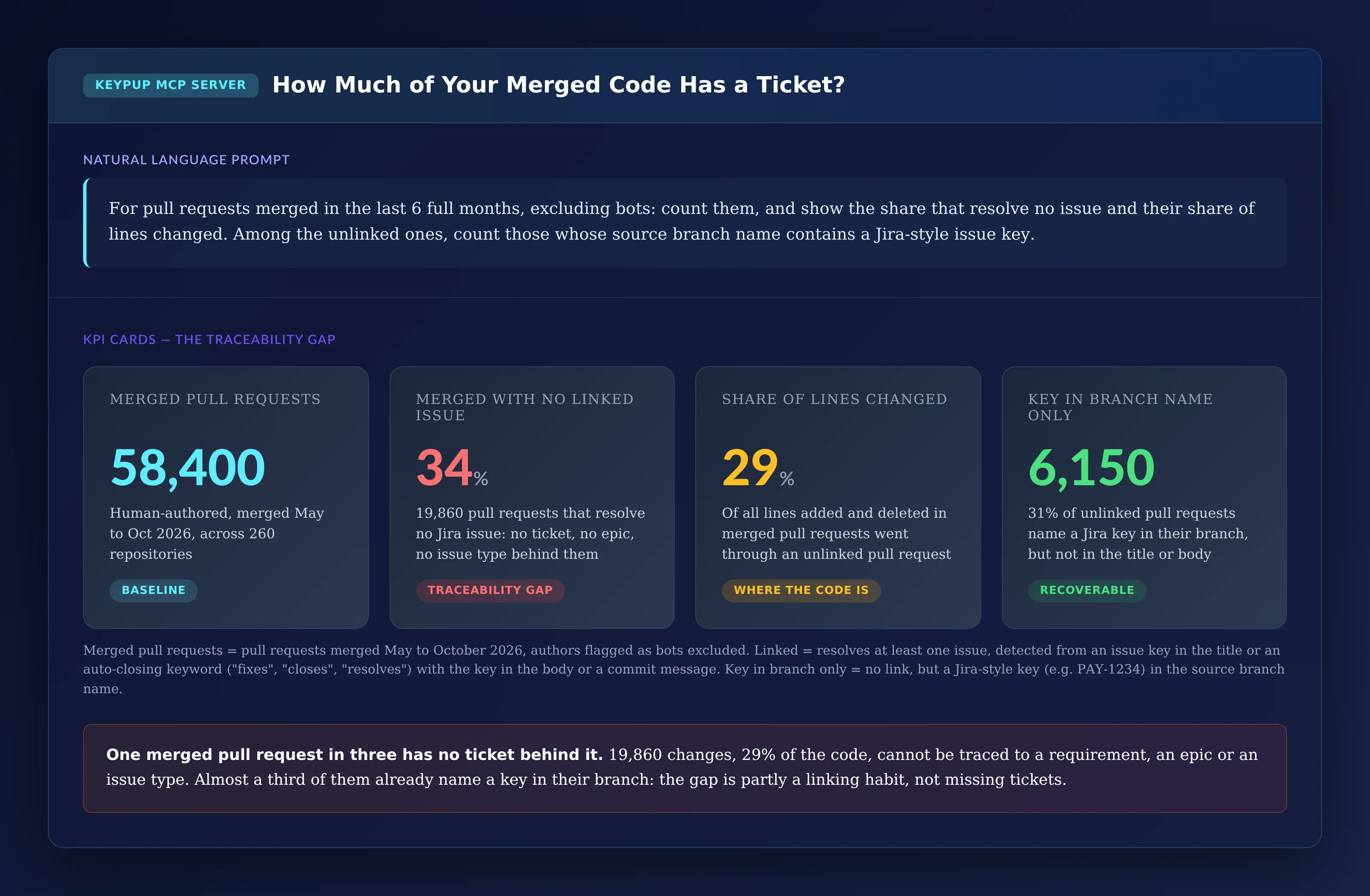
The first question: how much of what you merge has no ticket at all?
MCP Prompt:
For pull requests merged in the last 6 full months, excluding bots:
count them, and show the share that resolve no issue and their share
of lines changed. Among the unlinked ones, count those whose source
branch name contains a Jira-style issue key.
Output: The Traceability Gap
Key Insight: One merged pull request in three has no ticket behind it, and those changes carry 29% of the code. Each of them passed every merge check. Almost a third already name a key in their branch: part of the gap is a linking habit, not missing tickets, and it's the cheapest part to close.
2. Seeing What the Unlinked Work Is
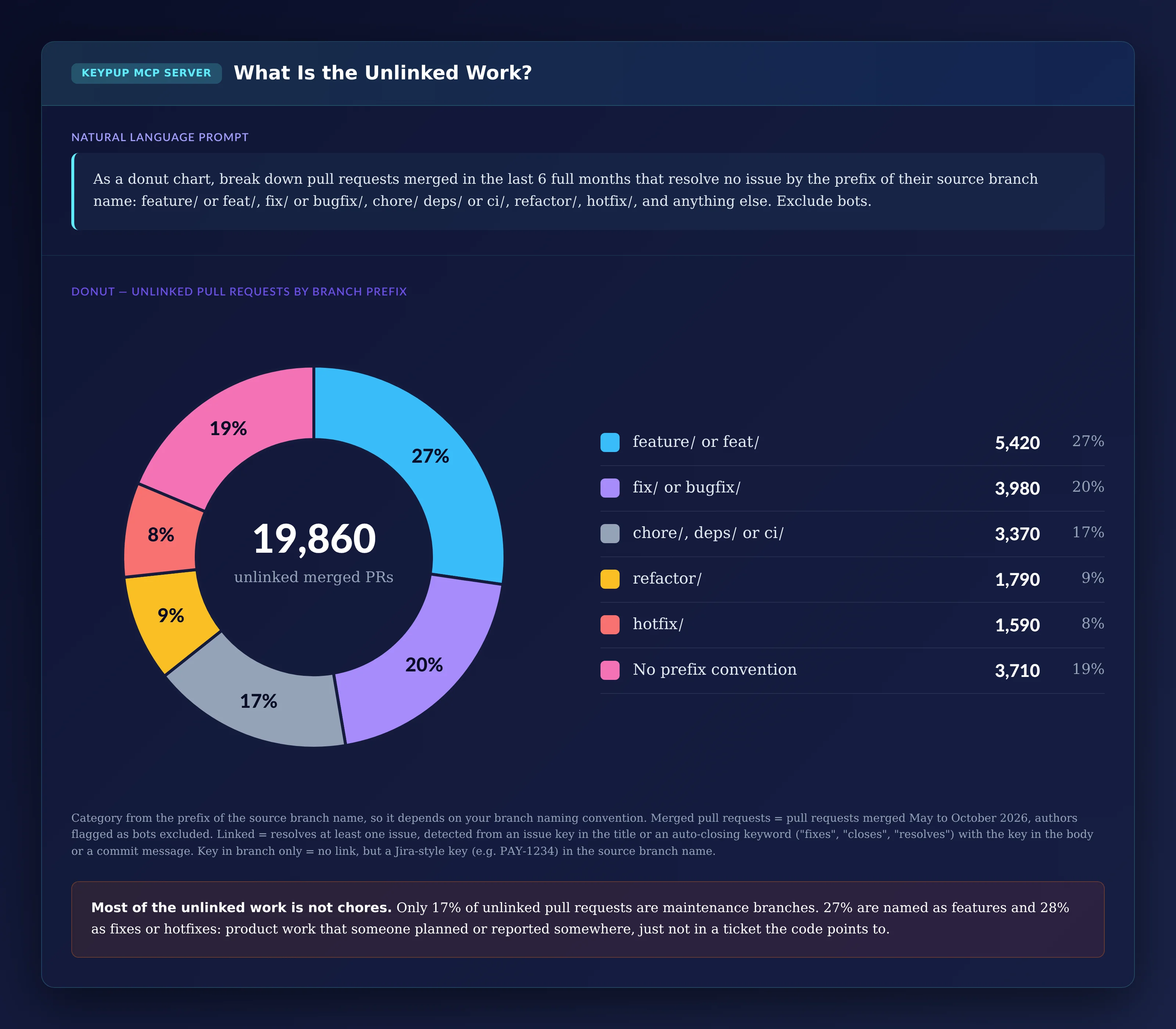
The usual answer to "why isn't it linked?" is "it's just chores". Branch names show whether that's true.
MCP Prompt:
As a donut chart, break down pull requests merged in the last 6 full
months that resolve no issue by the prefix of their source branch name:
feature/ or feat/, fix/ or bugfix/, chore/ deps/ or ci/, refactor/,
hotfix/, and anything else. Exclude bots.
Output: Unlinked Pull Requests by Branch Prefix
Key Insight: Only 17% of unlinked pull requests are maintenance branches. 27% are named as features and 28% as fixes or hotfixes: by their own branch names, product work, just not in a ticket the code points to. This breakdown depends on your branch naming convention: if your teams don't use prefixes, use pull request labels instead.
3. Finding Where the Gap Lives
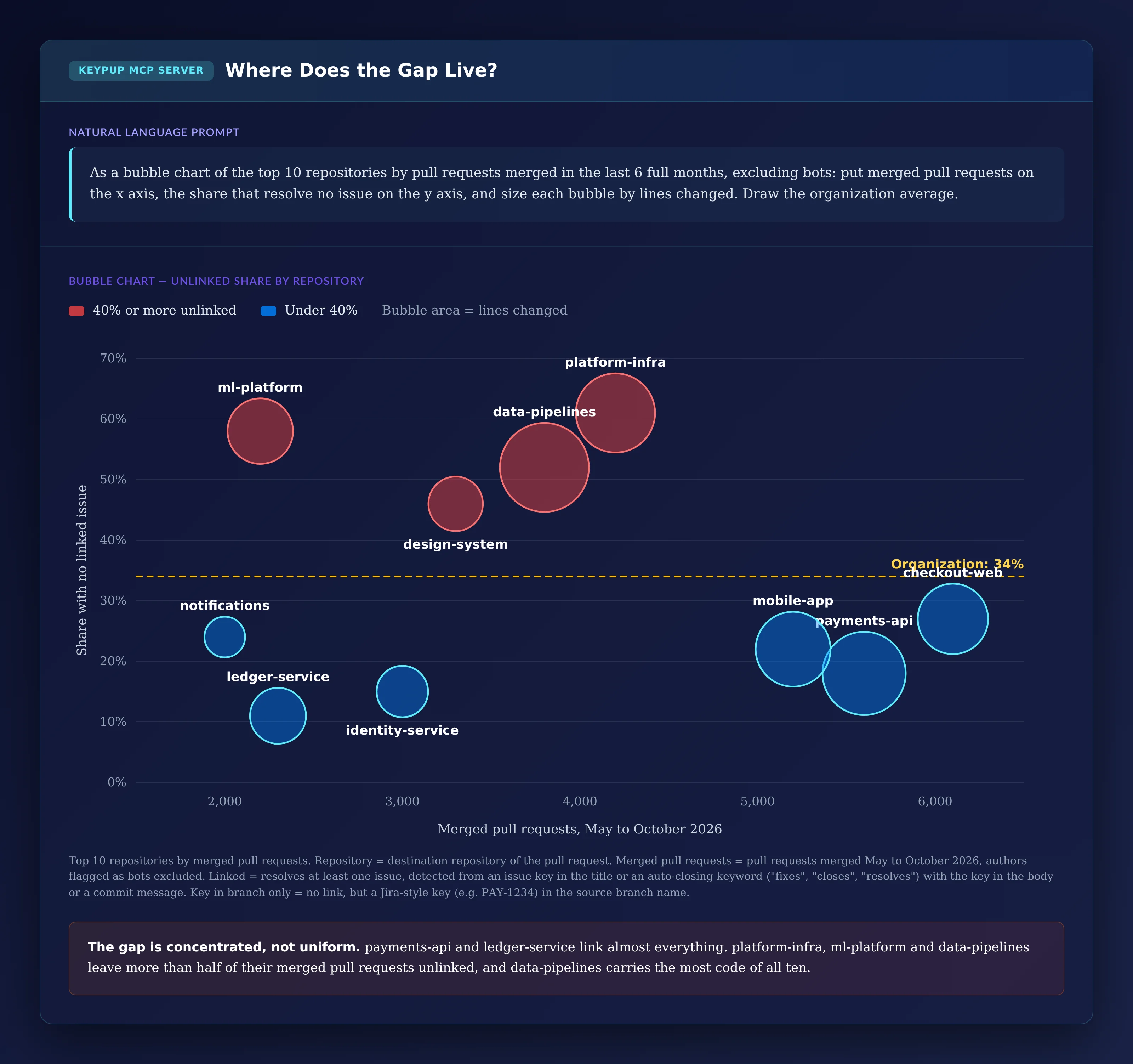
An organization-wide average hides the repositories that drive it.
MCP Prompt:
As a bubble chart of the top 10 repositories by pull requests merged in
the last 6 full months, excluding bots: put merged pull requests on the
x axis, the share that resolve no issue on the y axis, and size each
bubble by lines changed. Draw the organization average.
Output: Unlinked Share by Repository
Key Insight: The gap is concentrated. payments-api and ledger-service, which this organization already keeps in audit scope, link almost everything. Platform, data and machine learning repositories leave more than half of their merged pull requests unlinked, and data-pipelines carries more code than any of the ten. These are the teams whose work is least visible on the board.
4. Comparing How Unlinked Work Is Reviewed
A missing ticket would be a paperwork issue if everything else were equal. It usually isn't.
MCP Prompt:
Compare pull requests merged in the last 6 full months that resolve at
least one issue with those that resolve none, excluding bots: share
merged with no approval, share merged by their own author, median
business days from opening to merge, and share of 1,000 lines changed
or more.
Output: Linked vs Unlinked Pull Requests
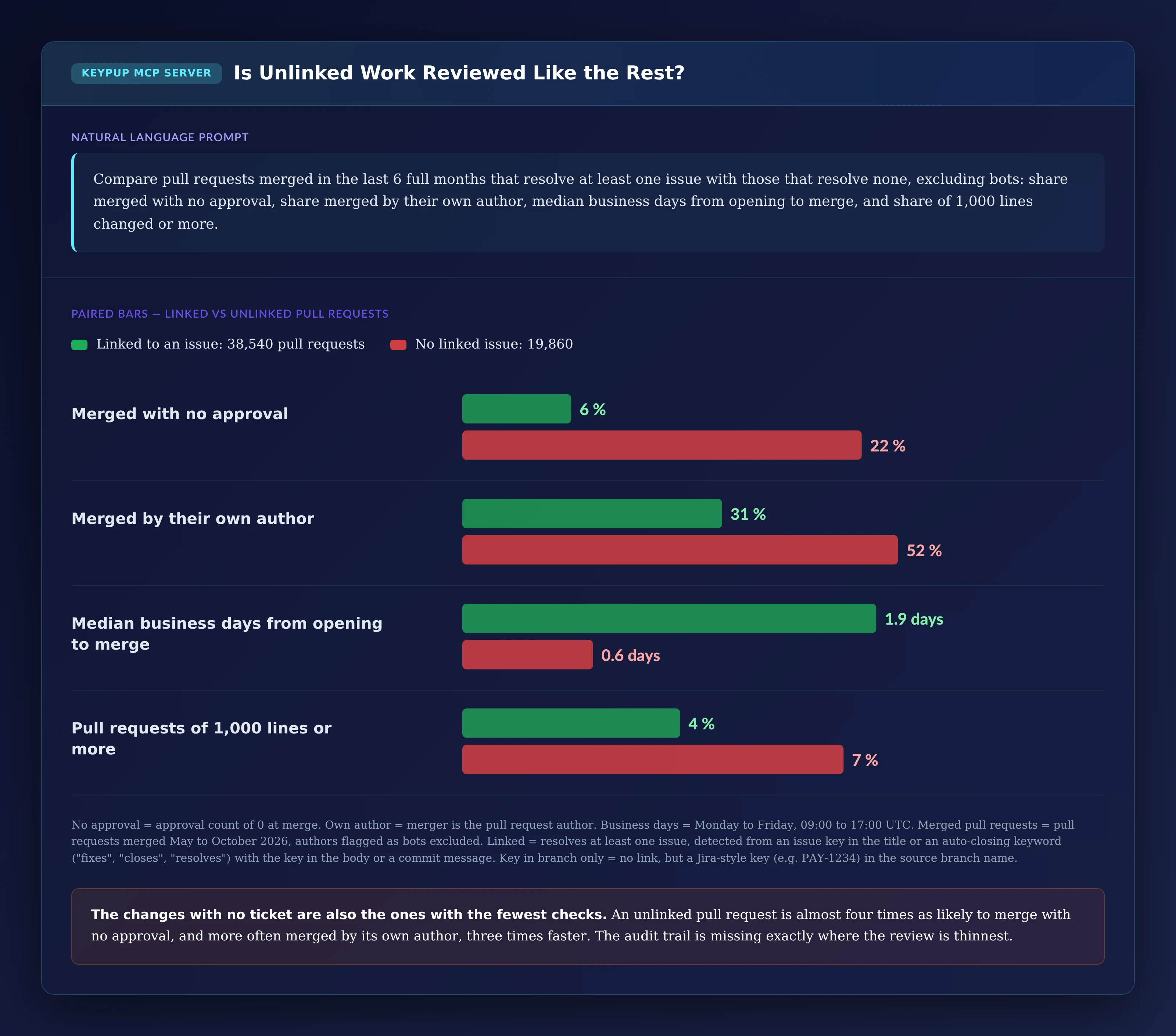
Key Insight: The changes with no ticket are also the changes with the fewest checks. An unlinked pull request is almost four times as likely to merge with no approval, more often merged by its own author, and three times faster. The audit trail is missing exactly where the review is thinnest, which is what an auditor will notice first.
5. Tracing Lines Changed to Issue Types
Finance doesn't ask how many pull requests have a ticket. It asks how much engineering went into new capabilities.
MCP Prompt:
As a waterfall of lines changed in pull requests merged in the last 6
full months, excluding bots: start from all lines changed, subtract the
pull requests that resolve no issue, then those resolving Bug issues,
then Task or Sub-task issues, and end with the lines resolving a Story
or a New Feature.
Output: Lines Changed by Linked Issue Type
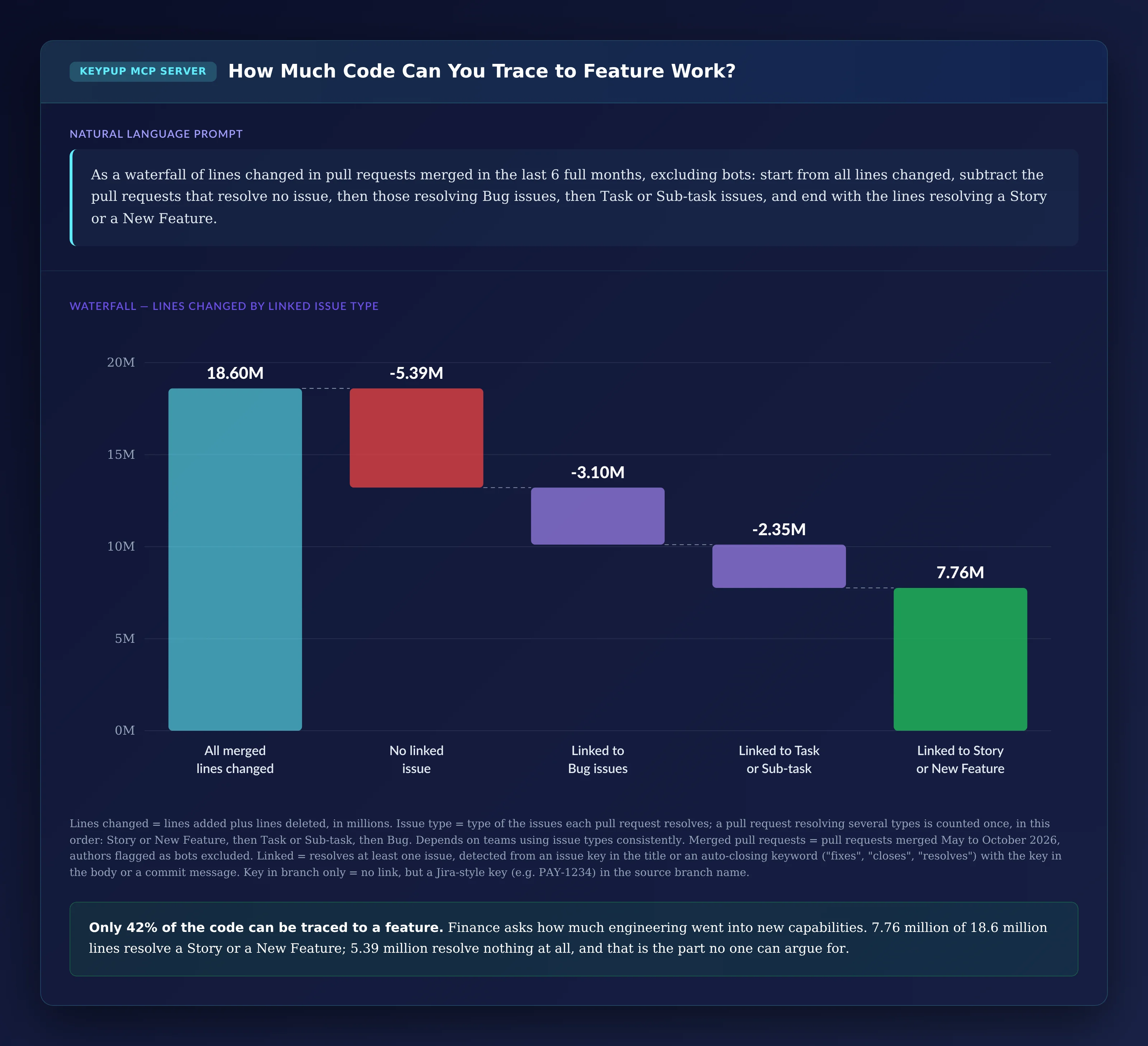
Key Insight: Only 42% of the code can be traced to a feature. 7.76 million of 18.6 million lines resolve a Story or a New Feature; 5.39 million resolve nothing at all. Lines changed are not effort, and the split depends on teams using issue types consistently, but it's a defensible, repeatable starting point for a capitalization discussion, far better than an estimate from headcount.
6. Following the Trend
Is the gap a legacy problem, or is it getting worse?
MCP Prompt:
As a stacked area chart by month of merge over the last 6 full months,
excluding bots, show merged pull requests that resolve an issue, those
that resolve none but have a Jira-style key in their branch name, and
those with no key at all. Label each month with the unlinked share.
Output: Merged Pull Requests by Link Status
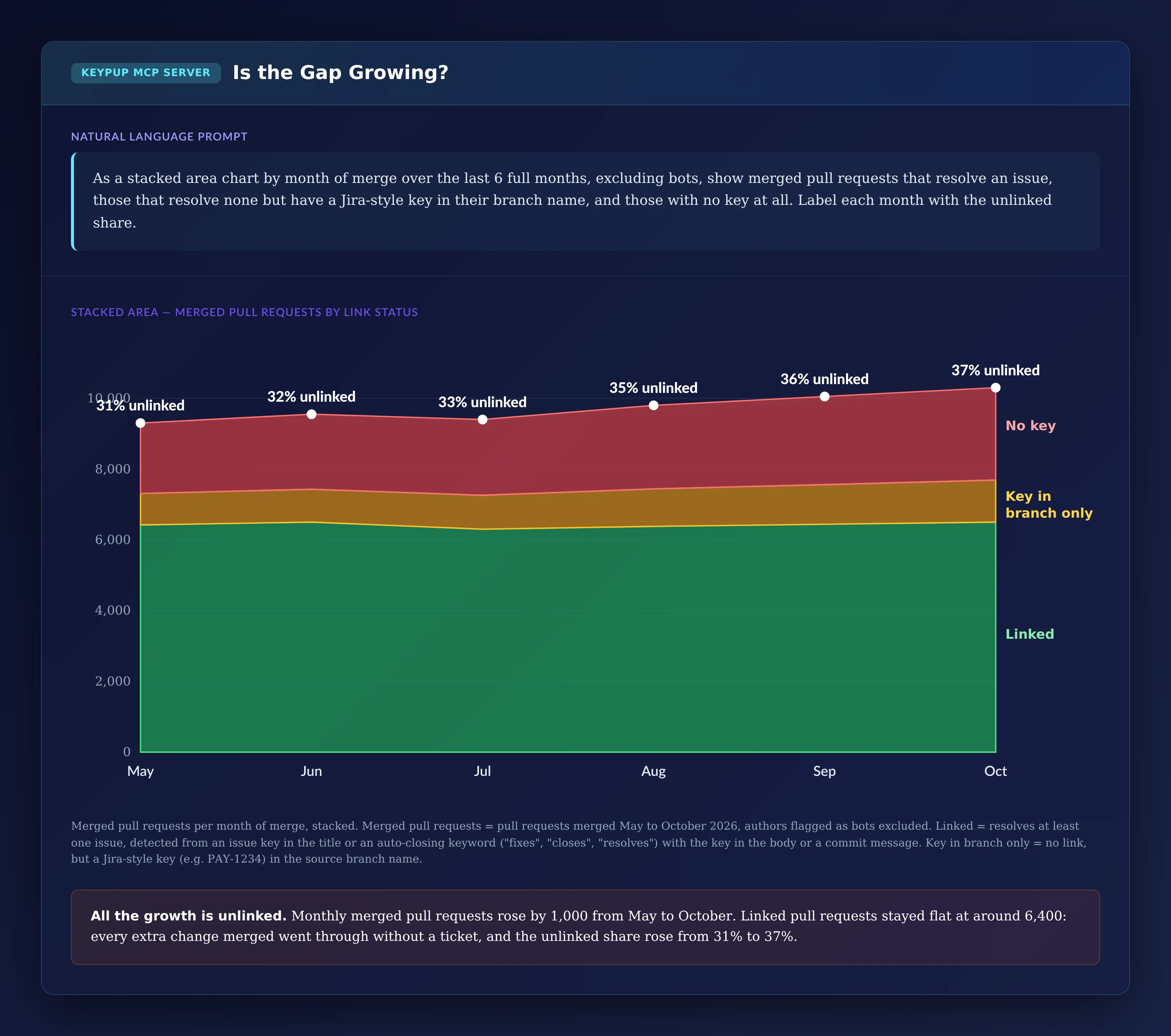
Key Insight: All the growth is unlinked. Monthly merged pull requests rose by around 1,000 from May to October, while linked pull requests stayed flat at around 6,400. Every extra change merged in that period went through without a ticket. A gap that grows with delivery volume will be larger at the next audit than at this one.
7. Listing the Repositories to Fix First
The last step turns the analysis into a remediation plan, repository by repository.
MCP Prompt:
For pull requests merged in the last 6 full months, excluding bots,
list the repositories by share of merged pull requests that resolve no
issue, with merged pull requests, unlinked count with a Jira-style key
in the branch name only, unlinked merged with no approval, share of
unlinked merged by their author, most common branch prefix and median
lines changed. Add KPI cards for the totals.
Output: Repository Remediation List
Repository
Merged PRs
Unlinked
Key in branch only
Unlinked, no approval
Unlinked, self-merged
Top branch prefix
Median lines (unlinked)
platform-infra
4,200
61%
820
690
71%
chore/ ci/
60
ml-platform
2,200
58%
310
420
66%
no prefix
140
data-pipelines
3,800
52%
690
510
58%
feature/
120
design-system
3,300
46%
640
210
49%
feature/
70
checkout-web
6,100
27%
720
260
41%
fix/
60
notifications
2,000
24%
150
90
44%
hotfix/
40
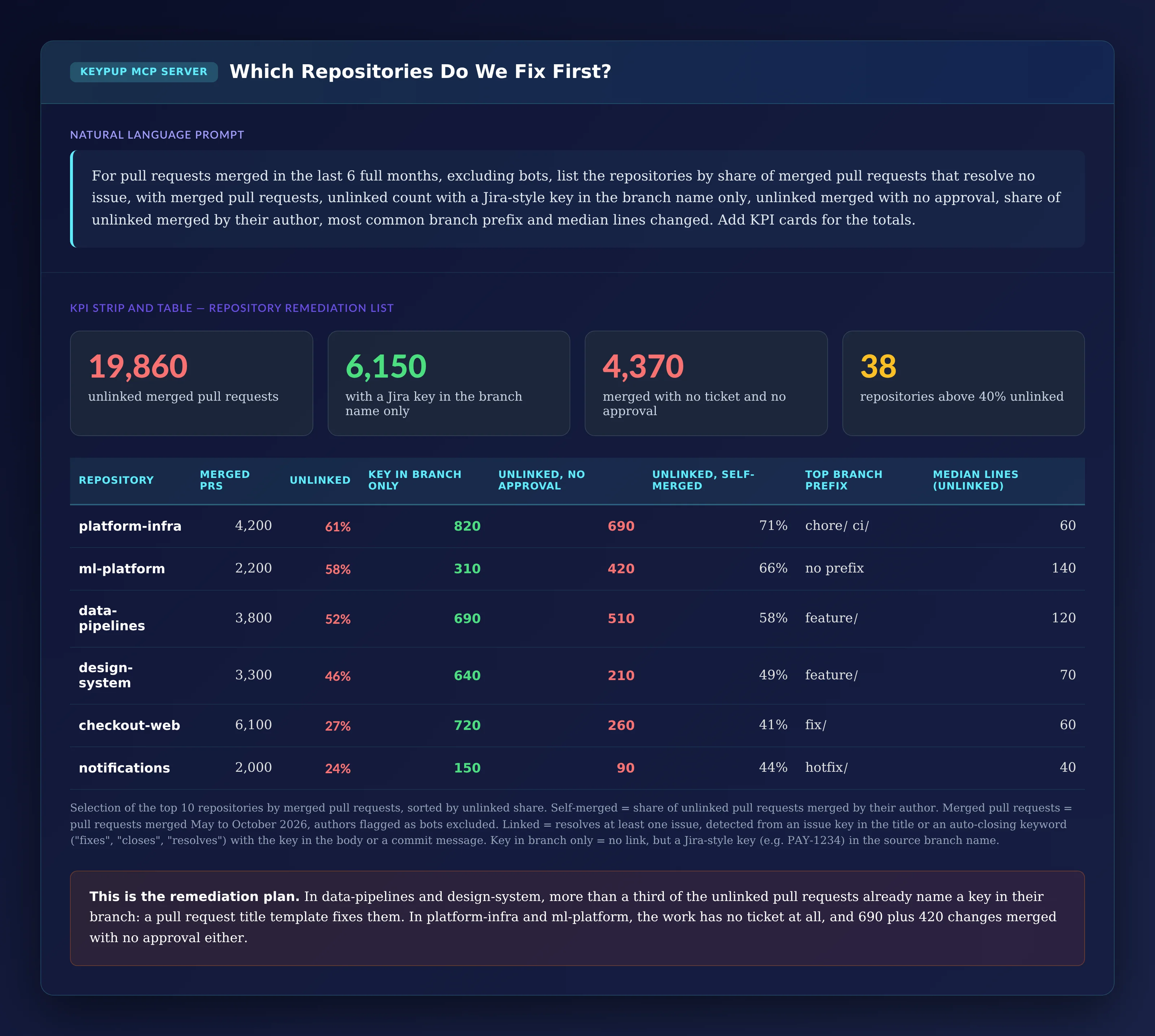
Key Insight: This is the remediation plan, and each repository needs a different fix. In data-pipelines and design-system, more than a third of unlinked pull requests already name a key in their branch: a pull request title template or a branch-to-title automation closes that part in a week. In platform-infra and ml-platform, the work has no ticket at all, and 1,110 of those changes also merged with no approval: those teams need a lightweight ticket type for operational work, and a review rule to go with it.
The Technical Implementation: What Keypup MCP Actually Reads
Every number above comes from fields Keypup already imports. It helps to be precise about what each one depends on.
Links Come From Issue Keys and Auto-Closing Keywords
Keypup links a pull request to the issues it resolves when the pull request title contains the issue key, or when its description or a commit message contains an auto-closing keyword ("fixes", "closes", "resolves") followed by the key or the issue URL. Each pull request then carries the list of resolved issues, and each issue the list of resolving pull requests. A pull request is unlinked when that list is empty. The linking guide shows the syntax for each Git platform.
Branch Keys and Prefixes Come From the Source Branch Name
Key in branch only applies a regular expression for Jira-style keys ([A-Z][A-Z0-9]+-[0-9]+) to the pull request's source branch name, with MATCH. The branch prefix breakdown uses the same field with IF_MATCH. Both are only as good as your branch naming convention: where teams don't use prefixes, the "no prefix" slice grows, and pull request labels can replace the prefix.
Review and Speed Come From Pull Request Fields
Merged with no approval uses the pull request's approval count. Self-merged compares the pull request author with its merger. Time to merge runs from the pull request's creation date to its merge date, with BUSINESS_DAYS. Lines changed are lines added plus lines deleted. Pull requests authored by accounts the platform or Keypup flags as bots are excluded with author_type != "BOT"; service accounts that act like people need to be excluded by username.
Issue Types Come From the Linked Jira Issues
The waterfall uses the issue types of the issues each pull request resolves, as named in Jira (Story, New Feature, Task, Sub-task, Bug). A pull request resolving several types is counted once, in a priority order your AI assistant applies. The split is only as reliable as your teams' use of issue types, and lines changed are a proxy for effort, not a measure of it.
What Keypup Doesn't See
Keypup doesn't read the content of the code to guess what a pull request was for, and it doesn't read Slack, incident tools or meeting notes where unticketed work is often requested. It doesn't see commits pushed directly to a branch without a pull request. And it doesn't know which repositories are in audit scope: tell your AI assistant, or filter by repository. The data shows where traceability is missing; your teams decide whether each case needs a ticket.
Real-World Impact: Enterprise Case Studies
Case Study 1: North American Insurance Group
Before Keypup MCP:
1,300 engineers, an ITGC control requiring a Jira ticket for every production change
Two weeks of manual link reconstruction before each audit sample
No view of which repositories were driving the exceptions
After Keypup MCP:
The remediation list in prompt 7 became the audit preparation plan: repositories above 40% unlinked got a named owner and a monthly target
A pull request title template prefilled from the branch name recovered most of the "key in branch only" pull requests within a month
The share of unlinked merged pull requests in audit-scope repositories fell from 29% to 6% in two quarters
"We used to discover the missing tickets when the auditors did. Now we see them every month, by repository, and the sample comes back clean because the links were made when the code was merged."
— Head of IT Controls, North American Insurance Group
Case Study 2: European Enterprise Software Vendor
Before Keypup MCP:
900 engineers, R&D capitalization estimated from headcount and team allocation
Platform and data teams with almost no Jira footprint
Finance and engineering disagreeing every quarter on the share of feature work
After Keypup MCP:
The waterfall in prompt 5 replaced the headcount estimate as the starting point of the capitalization review
Platform teams got an "Operational Change" issue type in Jira, created from a chat command, so their work stopped disappearing
The share of lines changed traceable to an issue rose from 64% to 88%, and the capitalization review shrank from three weeks to three days
"Finance never doubted that our platform team worked hard. They just couldn't see any of it. Once the work was linked, the conversation moved from 'how much do you think' to 'here is what shipped'."
— VP Engineering, European Enterprise Software Vendor
Implementation: Getting Started with Keypup MCP
1. Connect Your Git Platforms and Jira
Connect GitHub, GitLab, Bitbucket or Azure DevOps, and Jira, to Keypup. Pull requests, issues and the links between them are imported automatically.
2. Check How Your Teams Link
Ask your assistant for the share of merged pull requests with a key in the branch name only. If it's high, the fix is a title convention or a template, not a new process. Share the linking guide with your teams.
3. Agree on What Needs a Ticket
Not every change needs one: dependency updates by bots are already excluded, and some teams accept trivial chores without a ticket. Decide which branch prefixes or labels are acceptable exceptions, and measure the rest.
4. Connect the MCP Server to Your AI Assistant
Connect the MCP server to your AI assistant using the MCP documentation, and set a baseline with the unlinked share by repository, starting with the repositories in audit scope.
5. Review the Remediation List Every Month
Run prompt 7 every month with the engineering managers concerned. Track two numbers per repository: the unlinked share, and the unlinked pull requests merged with no approval. The first is a traceability problem; the second is a control problem.
Frequently Asked Questions
What is an untraceable merge?
An untraceable merge is a pull request merged into your codebase without a link to any issue, ticket or requirement. The change is real and in production, but nothing in your project management tool says why it was made, who asked for it, or which project it belongs to.
How do you link pull requests to Jira issues?
Put the Jira issue key in the pull request title, for example [PAY-1234] Retry failed payouts, or use an auto-closing keyword followed by the key in the description or a commit message, for example "Fixes PAY-1234". A key that only appears in the branch name isn't enough for most analytics tools, including Keypup.
Does every pull request need a Jira ticket for SOX or SOC 2?
Most change management controls require that production changes are requested and approved, and a linked ticket is the usual evidence. Some organizations accept documented exceptions, such as automated dependency updates. What matters is that you can measure the exceptions and explain them, rather than discover them during an audit sample.
How do you measure the share of engineering work that is feature work?
Group the lines changed, or the number, of merged pull requests by the issue type of the issues they resolve, and keep unlinked pull requests as their own category. The share linked to Stories or New Features is a defensible starting point for R&D capitalization, provided your teams use issue types consistently.
The Bottom Line
Your change policy says every change has a ticket. Your Git platform never checks it. In many enterprise organizations, a third of merged pull requests and close to a third of the code ship with no ticket behind them, with fewer approvals than the rest. Keypup MCP measures the traceability your merge button leaves out:
✅ Sizing the traceability gap across every repository ✅ Seeing what the unlinked work is, from branch names ✅ Finding where the gap lives, repository by repository ✅ Comparing how unlinked work is reviewed, against linked work ✅ Tracing lines changed to issue types for finance and R&D capitalization ✅ Following the trend as delivery volume grows ✅ Listing the repositories to fix first, with the right fix for each
Engineers on Reddit keep saying the same thing: the ticket said "fix the export" and nothing else. In a typical enterprise organization, 38% of completed Jira issues have an empty or one-line description, and once started they take twice as long, bounce back to In Progress 3.5 times as often and get changes requested in review twice as often. Learn how Keypup MCP measures ticket quality from issue descriptions, workflow history, sprints, comments and linked pull requests.
A four-eyes review policy checks that someone else approved a pull request, not who. In a typical enterprise, 168 pairs of engineers mostly approve each other, on 17% of merged pull requests and 26% of the code. Learn what engineering leaders on Reddit say about reciprocal approvals and rubber-stamp review buddies, and how Keypup MCP measures approval concentration from review authors, pull request authors, review dates, review bodies and lines changed.
Throughput counts issues, but one closed issue can hide one pull request or fifteen. In a typical enterprise, 14% of closed Jira issues need six or more pull requests, carry half the code that changed and take eight times longer to close. Learn what engineering leaders on Reddit say about tickets that never get split, and how Keypup MCP measures issue size through linked pull requests, lines changed, merge spans and story points.