The Thin Ticket Tax: How Underspecified Jira Issues Double Your Cycle Time
Engineers on Reddit keep saying the same thing: the ticket said "fix the export" and nothing else. In a typical enterprise organization, 38% of completed Jira issues have an empty or one-line description, and once started they take twice as long, bounce back to In Progress 3.5 times as often and get changes requested in review twice as often. Learn how Keypup MCP measures ticket quality from issue descriptions, workflow history, sprints, comments and linked pull requests.
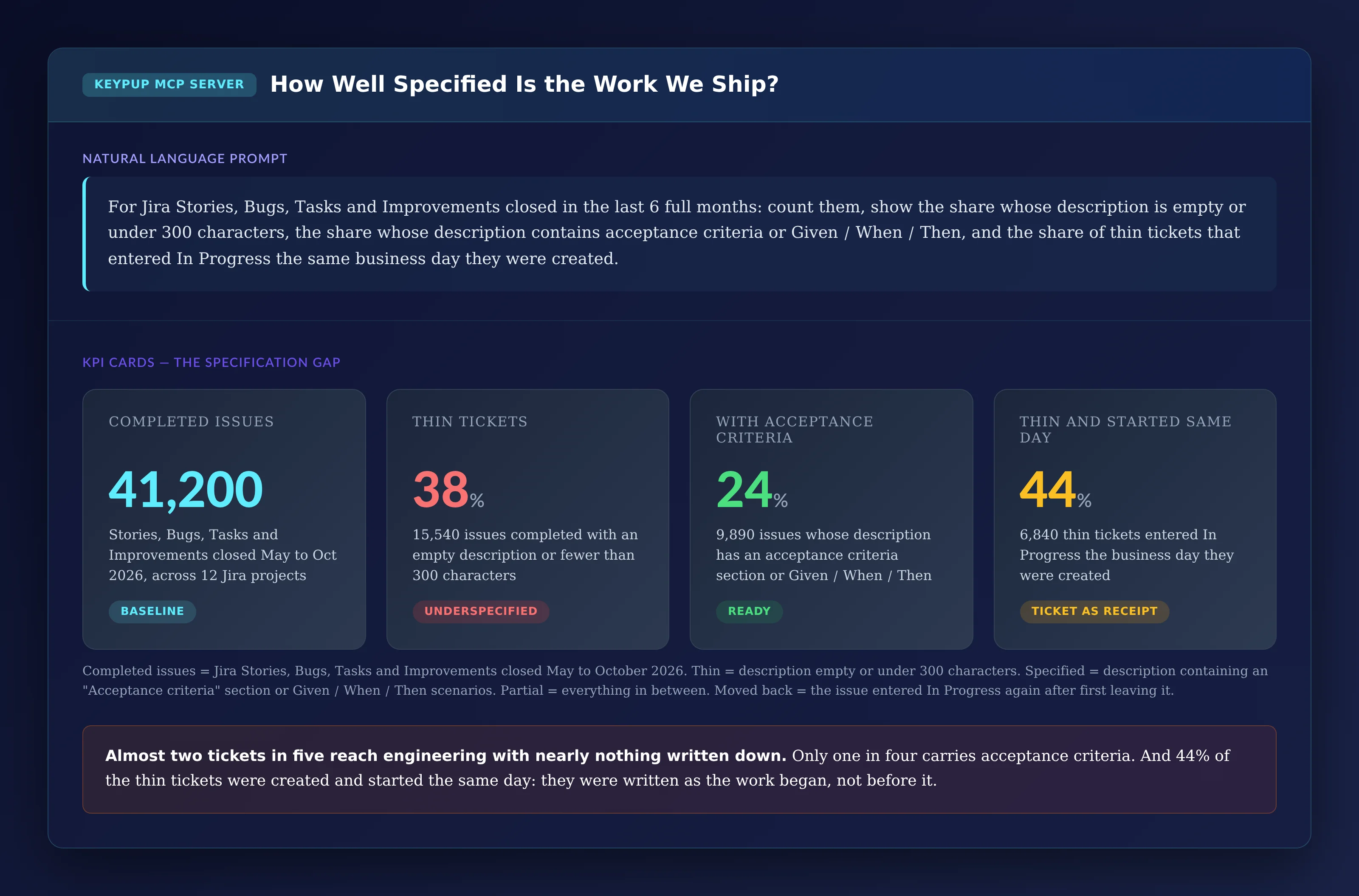
TL;DR: Most teams have a Definition of Ready. Few check it. In a typical enterprise organization, 38% of completed Jira issues reach engineering with an empty description or fewer than 300 characters, and only 24% carry acceptance criteria. Once someone starts a thin ticket, it takes twice as long to finish (8.2 business days against 4.1), is 3.5 times as likely to move back to In Progress (28% against 8%), and a pull request resolving it is twice as likely to get changes requested (38% against 19%). 44% of thin tickets are created and started the same business day: they were written as the work began, not before it. The Keypup MCP Server reads, for every Jira issue, its description, issue type, project, creation and closing dates, workflow status history, sprints, peer comment dates and resolving pull requests with their reviews. Your AI assistant can then size the specification gap, price it, see which work arrives thin, find how much writing is enough, compare projects, separate the ticket from the rush, and list where to fix ticket quality first.
The ticket said "Fix the export." That was the title. The description was empty. The engineer who picked it up spent a morning finding out which export, for which customer, in which format, and opened a pull request on day three. The reviewer asked whether the CSV should include archived records. Nobody knew. The product manager answered on day six, in a comment: "Yes, and also the new currency column." The ticket went back to In Progress. It closed on day eleven, and the sprint report showed one point delivered.
The Friction: A Definition of Ready Nobody Enforces
Every agile coach has a slide on the Definition of Ready: a ticket enters a sprint only once it has a clear description, acceptance criteria and an estimate. In practice:
Jira accepts a title and nothing else. The description field is optional on almost every issue type, and the create dialog lets you skip it.
Templates exist only for Stories. Bugs get a reproduction, if you're lucky. Tasks and Improvements get a title.
Tickets are often written after the work starts. An engineer starts on a request from a meeting or a chat thread, then creates a ticket so the work shows up on the board.
The specification gets written anyway, in the wrong place. It ends up in comments, in review threads and in direct messages, after the code that should have followed it.
The result: refinement looks done on the board, the sprint starts on time, and the real requirements show up halfway through the sprint, in the middle of a code review.
Why This Matters: The Real Cost of Thin Tickets
The Cycle Time Problem
Cycle time dashboards measure the time from In Progress to Done and treat it as engineering speed. But a large part of that time is spent finding out what to build: asking questions, waiting for answers, redoing work. That cost lands on the delivery team's numbers, while its cause sits upstream, in how tickets are written.
The Rework Problem
A ticket that moves back to In Progress, or a pull request that gets changes requested because "that's not what we meant", is work done twice. In an organization completing 40,000 issues every six months, a ten-point gap in the rework rate is thousands of tickets started a second time.
The Predictability Problem
Thin tickets can't be estimated with any confidence, so they're the ones that slip from one sprint to the next. Roadmap forecasts built on sprint velocity inherit that noise, and leaders blame the forecast instead of the input.
The Enterprise Discussion: What Engineering Leaders Are Actually Saying
"The ticket was just a title", "we found out the real requirements in code review" and "our Definition of Ready is a Confluence page nobody reads" come up wherever engineers, engineering managers and product owners compare notes. The quotes below are representative of recurring threads on r/ExperiencedDevs, r/EngineeringManagers, r/agile and r/scrum.
Senior Engineer, Fintech (r/ExperiencedDevs)
"Half my tickets are a title and a link to a Slack thread that's already been archived. I spend the first day of every task doing the product manager's job, and then my cycle time is what gets discussed in the retro."
"We have a Definition of Ready. It's on a wiki page. Nobody has ever stopped a ticket from entering a sprint because of it, and I can't prove it costs us anything, so nothing changes."
Agile Coach, Insurance (r/agile)
"The acceptance criteria get written in the PR review. The reviewer asks 'what about this case?', the PO says 'oh, good point', and the ticket goes back to In Progress. That's not a review, that's refinement happening two weeks late."
The pattern holds: organizations agree that tickets should be ready before work starts, never measure whether they are, and pay for the gap in cycle time and rework that gets blamed on engineering.
How Keypup MCP Measures the Thin Ticket Tax
The Keypup Model Context Protocol (MCP) Server gives your AI assistant structured access to the data Keypup imports from Jira and from GitHub, GitLab, Bitbucket and Azure DevOps. For this analysis, what matters is, for each Jira issue: its description (the issue body), issue type and project; its creation and closing dates; its workflow timeline, with the time of each entry into and exit from each status; the sprints it went through; the date of its last comment by someone other than its author; and the pull requests that resolve it, with their review dates.
An issue is thin when its description is empty or under 300 characters. It is specified when its description contains an "Acceptance criteria" section or Given / When / Then scenarios, detected with a regular expression. Everything in between is partial. An issue was moved back when it entered In Progress again after first leaving it. Figures cover Stories, Bugs, Tasks and Improvements closed in the last six full months, May to October 2026, for an organization of around 1,100 engineers working in 12 Jira projects. The thresholds and status names are choices: adapt them to your own workflow.
1. Sizing the Specification Gap
The first question: how much of the work reaches engineering with almost nothing written down?
MCP Prompt:
For Jira Stories, Bugs, Tasks and Improvements closed in the last 6
full months: count them, show the share whose description is empty or
under 300 characters, the share whose description contains acceptance
criteria or Given / When / Then, and the share of thin tickets that
entered In Progress the same business day they were created.
Output: The Specification Gap
Key Insight: Almost two tickets in five reach engineering with nearly nothing written down, and only one in four says what done looks like. The same-day number is the telling one: 44% of thin tickets were created and started within one business day. Those tickets were written as the work began, not before it, so no refinement could have happened.
2. Pricing the Thin Ticket
A thin ticket only matters if it costs something. The workflow history shows what happens after work starts.
MCP Prompt:
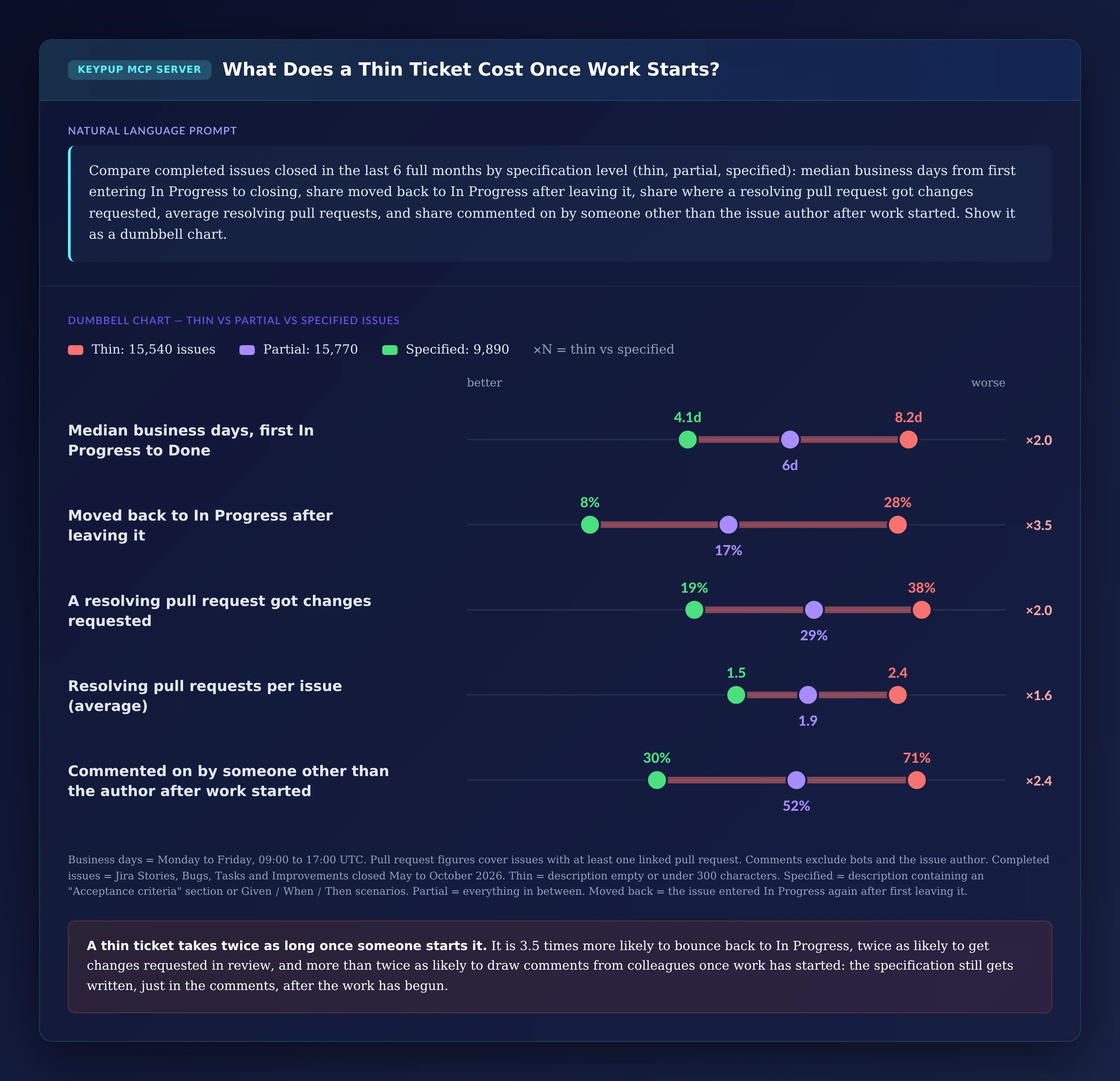
Compare completed issues closed in the last 6 full months by
specification level (thin, partial, specified): median business days
from first entering In Progress to closing, share moved back to In
Progress after leaving it, share where a resolving pull request got
changes requested, average resolving pull requests, and share commented
on by someone other than the issue author after work started. Show it
as a dumbbell chart.
Output: Thin vs Partial vs Specified Issues
Key Insight: A thin ticket takes twice as long once someone starts it, and every rework signal points the same way. It is 3.5 times as likely to bounce back to In Progress and twice as likely to get changes requested in review. And 71% of thin tickets draw comments from colleagues once work has started, against 30% of specified ones. The specification still gets written, just in the comments, after the code. The pull request figures only cover issues whose pull requests are linked to them.
3. Seeing Which Work Arrives Thin
"Our tickets are fine" usually means "our Stories are fine". The issue type shows where the gap sits.
MCP Prompt:
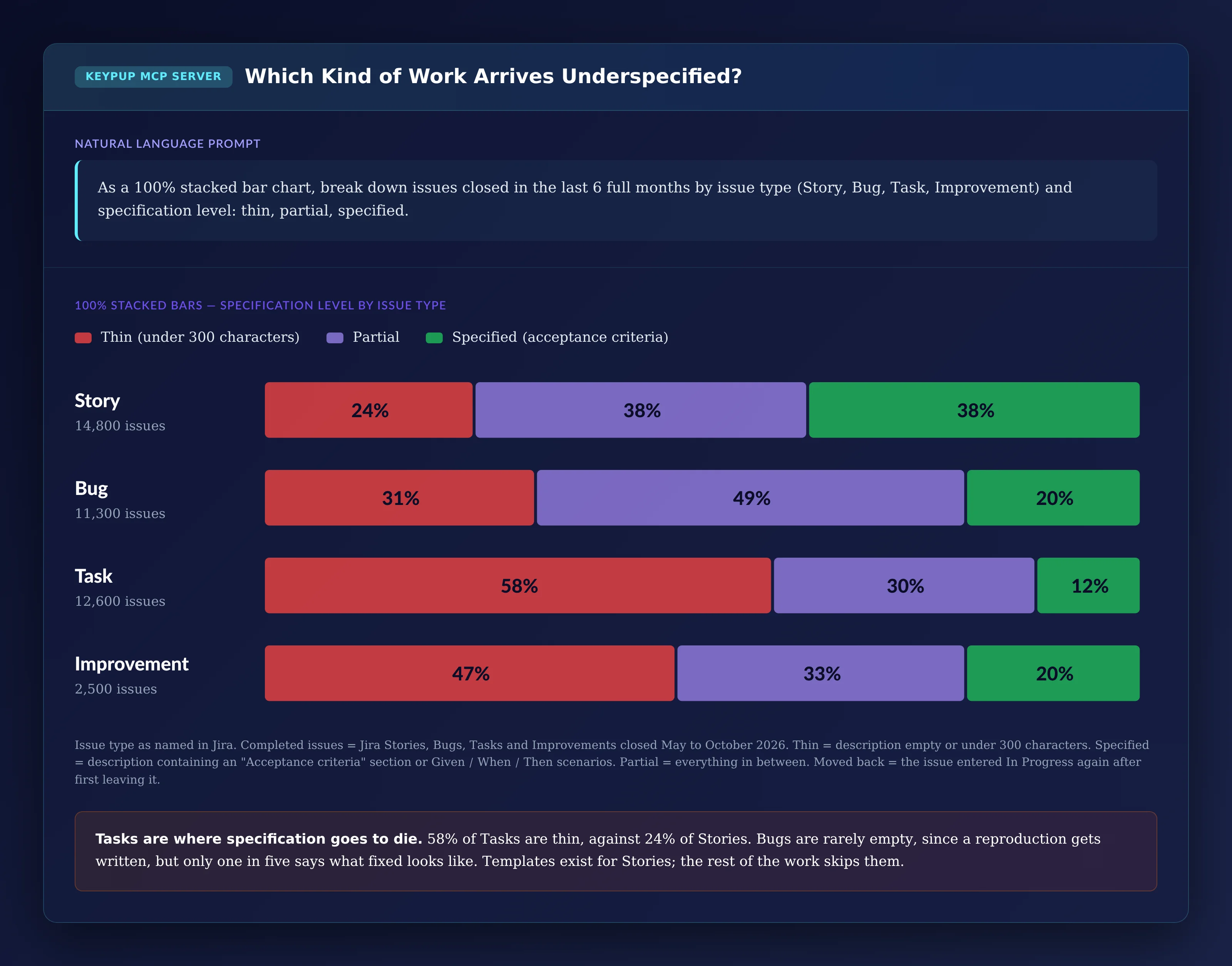
As a 100% stacked bar chart, break down issues closed in the last 6
full months by issue type (Story, Bug, Task, Improvement) and
specification level: thin, partial, specified.
Output: Specification Level by Issue Type
Key Insight: Tasks are where specification disappears: 58% are thin, against 24% of Stories. Bugs are rarely empty, since someone writes a reproduction, but only one in five says what fixed looks like. Templates and refinement rituals cover Stories, and the rest of the work skips them. This split depends on your teams using Jira issue types consistently.
4. Finding How Much Writing Is Enough
No one wants to replace thin tickets with ten-page specifications. The data shows where the returns stop.
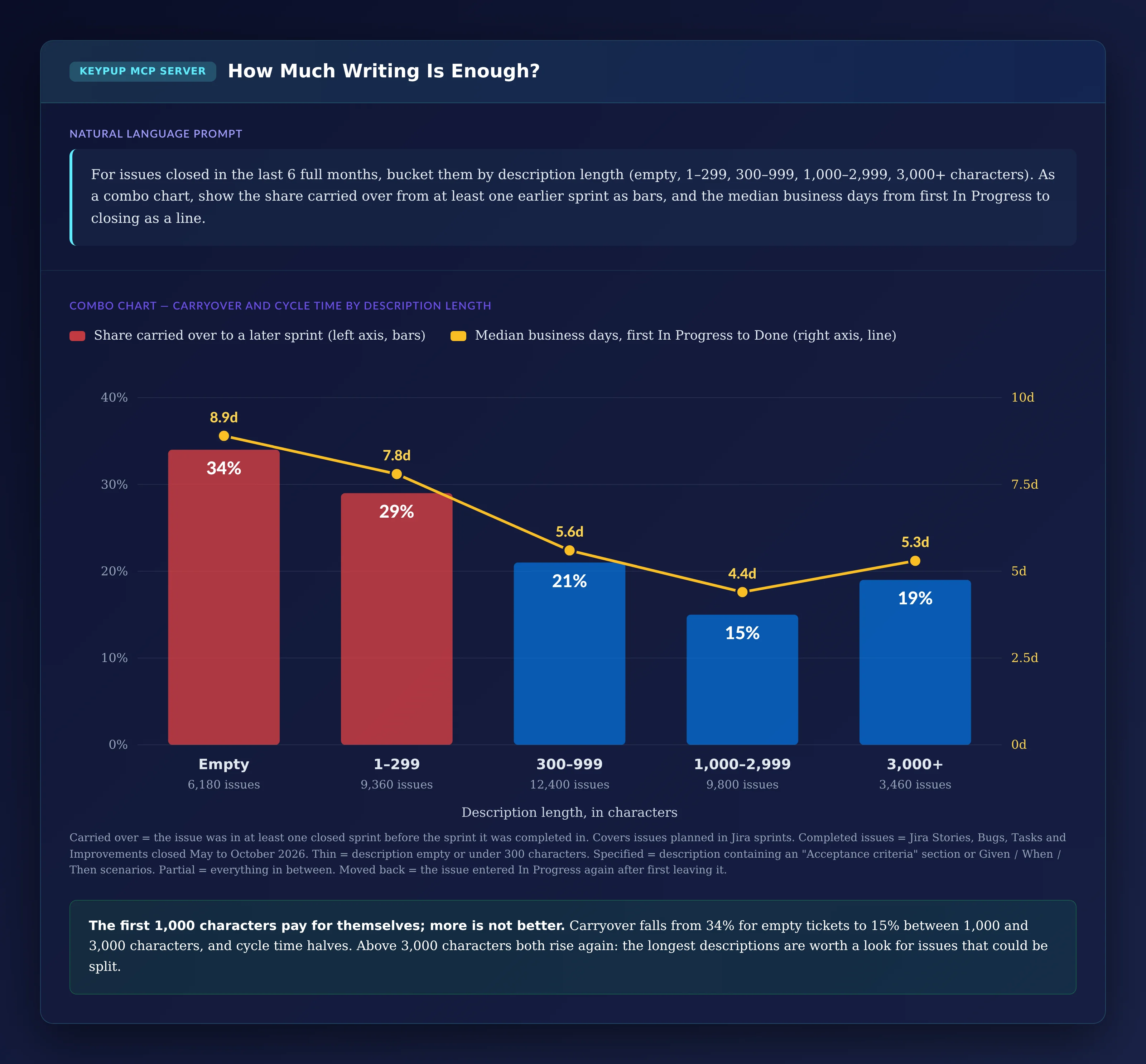
MCP Prompt:
For issues closed in the last 6 full months, bucket them by description
length (empty, 1-299, 300-999, 1,000-2,999, 3,000+ characters). As a
combo chart, show the share carried over from at least one earlier
sprint as bars, and the median business days from first In Progress to
closing as a line.
Output: Carryover and Cycle Time by Description Length
Key Insight: The first 1,000 characters pay for themselves, and more isn't better. Carryover falls from 34% for empty tickets to 15% between 1,000 and 3,000 characters, and cycle time halves. Above 3,000 characters both rise again: the longest descriptions are worth a look for issues that could be split. Carryover only applies to teams that plan in Jira sprints.
5. Comparing Projects
An organization-wide average could be one team's habit. A project-by-project view shows whether the relationship holds.
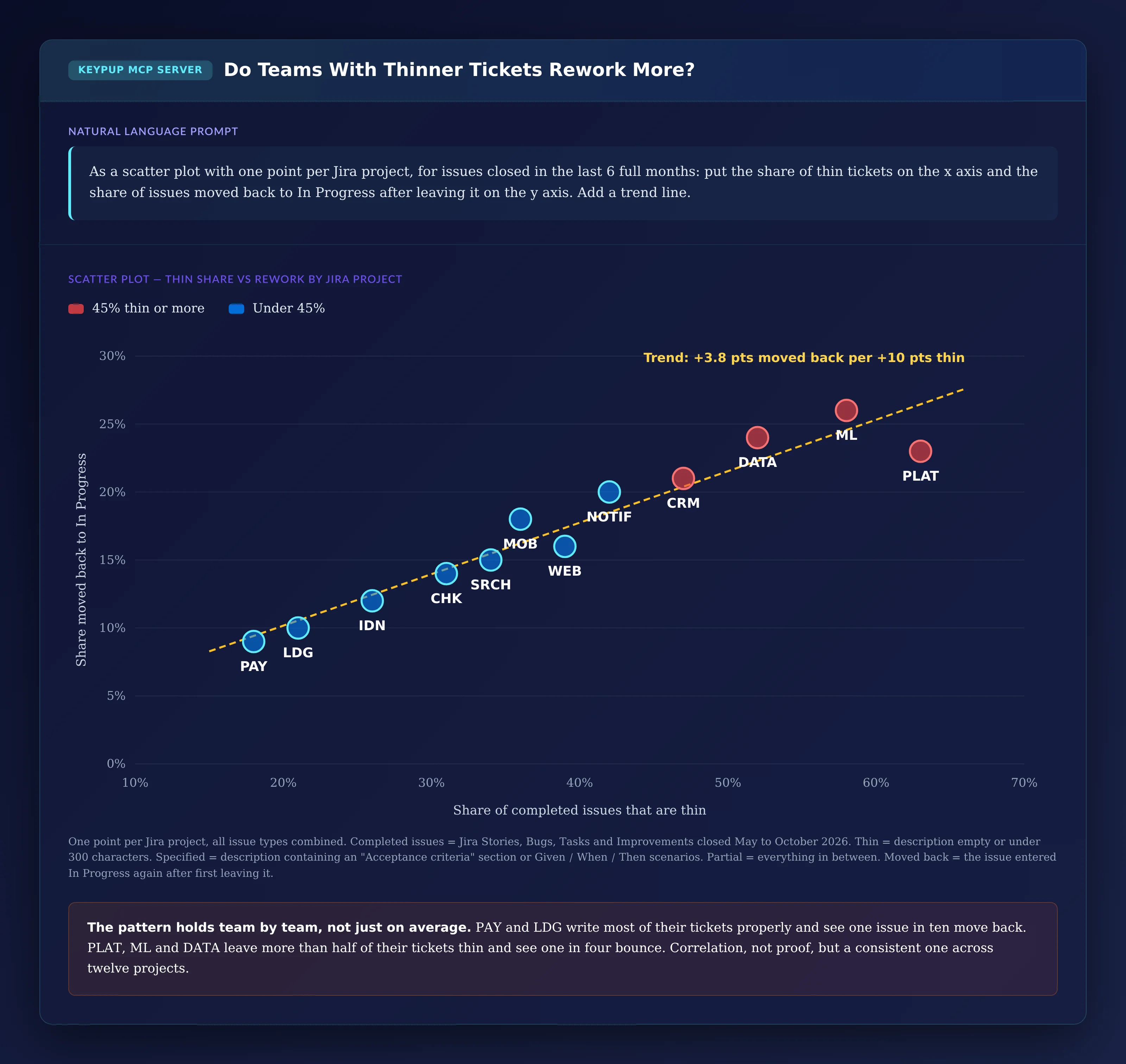
MCP Prompt:
As a scatter plot with one point per Jira project, for issues closed in
the last 6 full months: put the share of thin tickets on the x axis and
the share of issues moved back to In Progress after leaving it on the
y axis. Add a trend line.
Output: Thin Share vs Rework by Jira Project
Key Insight: The pattern holds team by team. PAY and LDG write most of their tickets properly and see one issue in ten move back. PLAT, ML and DATA leave more than half of their tickets thin and see one in four bounce. It's a correlation, not proof, but it's consistent across twelve projects with different products, people and processes.
6. Separating the Ticket From the Rush
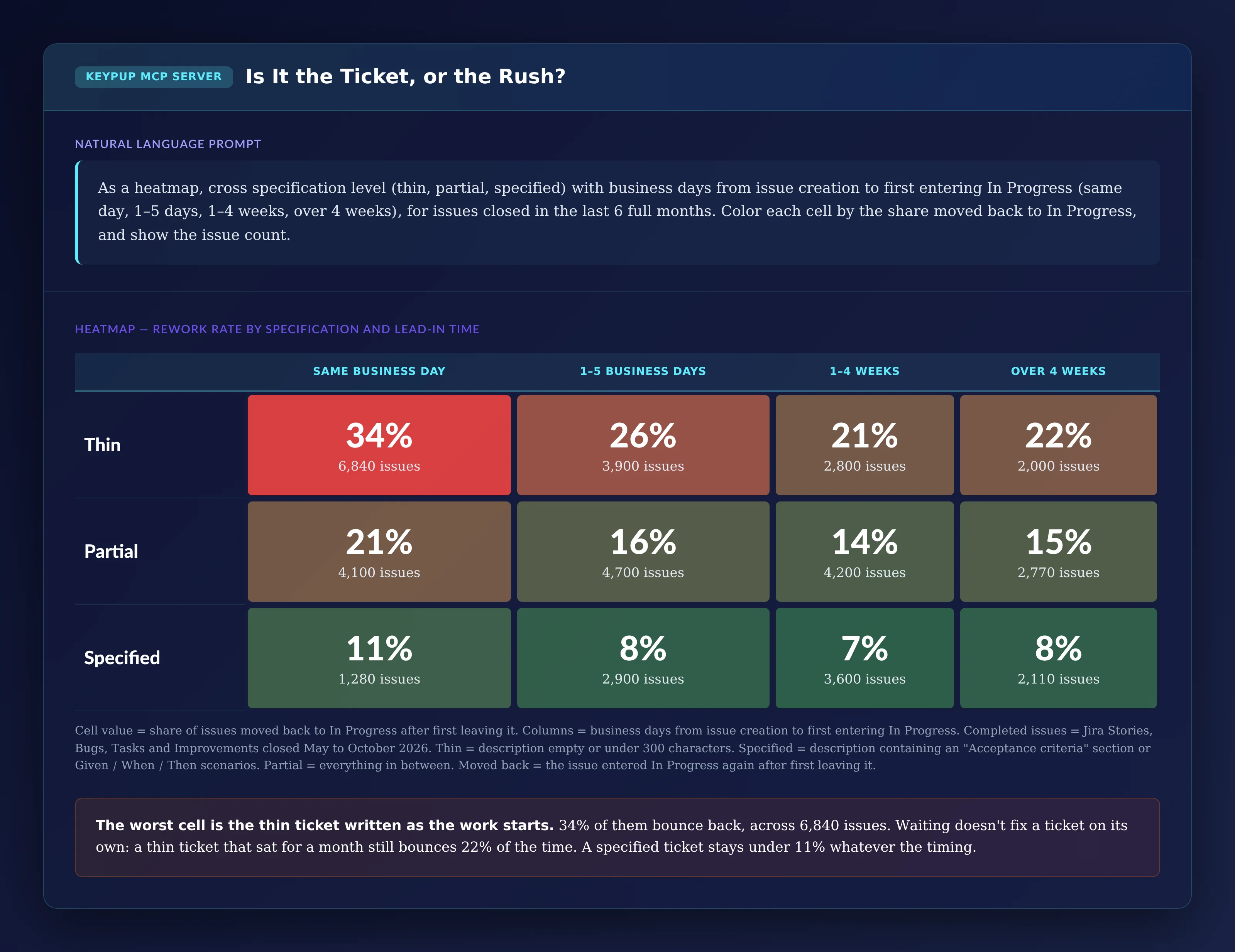
A fair objection: maybe thin tickets bounce because they're urgent, not because they're thin. Crossing specification with the time between creation and start tests that.
MCP Prompt:
As a heatmap, cross specification level (thin, partial, specified) with
business days from issue creation to first entering In Progress (same
day, 1-5 days, 1-4 weeks, over 4 weeks), for issues closed in the last
6 full months. Color each cell by the share moved back to In Progress,
and show the issue count.
Output: Rework Rate by Specification and Lead-In Time
Key Insight: Both matter, but the ticket matters more. The worst cell is the thin ticket written as the work starts: 34% bounce back, across 6,840 issues. Waiting doesn't fix a ticket on its own: a thin ticket that sat for a month still bounces 22% of the time. A specified ticket stays at 11% or below, however fast it was started.
7. Listing Where to Fix Ticket Quality First
The last step turns the analysis into a plan, project by project.
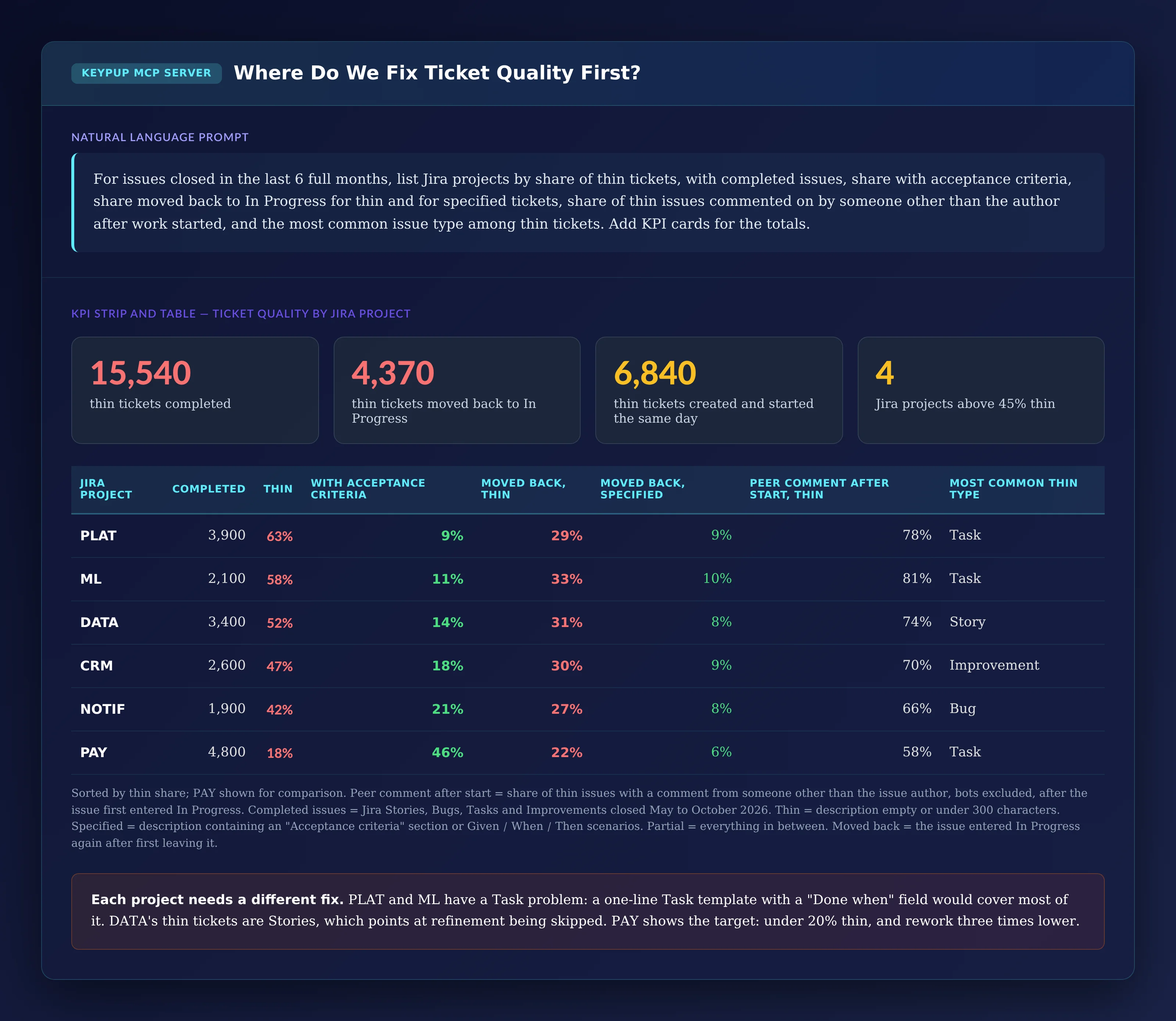
MCP Prompt:
For issues closed in the last 6 full months, list Jira projects by share
of thin tickets, with completed issues, share with acceptance criteria,
share moved back to In Progress for thin and for specified tickets,
share of thin issues commented on by someone other than the author
after work started, and the most common issue type among thin tickets. Add KPI cards for the totals.
Output: Ticket Quality by Jira Project
Jira project
Completed
Thin
With acceptance criteria
Moved back, thin
Moved back, specified
Peer comment after start, thin
Most common thin type
PLAT
3,900
63%
9%
29%
9%
78%
Task
ML
2,100
58%
11%
33%
10%
81%
Task
DATA
3,400
52%
14%
31%
8%
74%
Story
CRM
2,600
47%
18%
30%
9%
70%
Improvement
NOTIF
1,900
42%
21%
27%
8%
66%
Bug
PAY
4,800
18%
46%
22%
6%
58%
Task
Key Insight: Each project needs a different fix. PLAT and ML have a Task problem: a short Task template with a "Done when" line would cover most of it. DATA's thin tickets are Stories, which points at refinement being skipped rather than templates missing. In every project, specified tickets bounce back three times less often than thin ones, so the target is the same everywhere: PAY shows it is reachable at enterprise scale.
The Technical Implementation: What Keypup MCP Actually Reads
Every number above comes from fields Keypup already imports. It helps to be precise about what each one depends on.
Specification Levels Come From the Issue Description
Thin uses the length of the issue's description, with LENGTH, and treats an empty description as thin. Specified applies a regular expression to the same field, with MATCH, looking for "Acceptance criteria", "Definition of done" or Given / When / Then. Keypup doesn't judge whether a description is good; it measures whether one exists and whether it follows your format. If your teams keep acceptance criteria in a Jira custom field instead of the description, point the check at that field: custom fields are imported too.
Rework Comes From the Workflow Timeline
The workflow timeline records each entry into and exit from each status. Moved back compares the last time an issue entered In Progress with the first time it left it, using TIMELINE_LAST_START_AT and TIMELINE_FIRST_END_AT. Cycle time runs from the first entry into In Progress to the closing date, with BUSINESS_DAYS. Created and started the same day compares the creation date with the first entry into In Progress. These depend on your status names: if your teams use "In Development" or "Doing", use that name.
Review Signals Come From Linked Pull Requests
Changes requested and resolving pull requests per issue come from the pull requests linked to each issue, through an issue key in the pull request title or an auto-closing keyword in its description or commits. Issues with no linked pull request are left out of those two measures, so they're only as complete as your linking habits. The linking guide shows the syntax for each Git platform.
Carryover and Comments Come From Sprints and Comment Dates
Carried over uses the list of past sprints an issue went through before the one it was completed in, so it only applies to teams that plan in Jira sprints. Commented on after work started compares the issue's last peer comment date, the latest comment by someone other than the issue author with bots excluded, with its first entry into In Progress. Keypup reads when comments were posted and by whom; it doesn't classify what they say.
What Keypup Doesn't See
Keypup doesn't read Confluence pages, Slack threads, Figma files or meeting notes, which is often where the real specification lives when the ticket is thin. A ticket that links to a detailed design document will count as thin if its own description is short: check a sample before drawing conclusions about a team. And Keypup doesn't know your Definition of Ready: tell your AI assistant what yours requires, and it builds the checks from the fields above.
Real-World Impact: Enterprise Case Studies
Case Study 1: European Retail Group
Before Keypup MCP:
1,000 engineers in 10 product teams, a Definition of Ready on a wiki page
Cycle time targets missed every quarter, with delivery teams blamed
Product and engineering disagreeing on whether ticket quality was a real problem
After Keypup MCP:
The dumbbell chart in prompt 2 ended the debate: thin tickets were measurably taking twice as long, in every team
Jira issue templates were added for Tasks and Bugs, with a "Done when" section prefilled
The thin share fell from 41% to 19% in two quarters, and the share of issues moved back to In Progress fell from 18% to 11%
"For years, we argued about whether our tickets were good enough. Once we could show that a one-line ticket took twice as long and came back three times as often, product owners started writing the acceptance criteria themselves."
— VP Engineering, European Retail Group
Case Study 2: North American Healthcare Software Provider
Before Keypup MCP:
700 engineers, regulated software, acceptance criteria required for validation
Platform and data teams creating most of their tickets after starting the work
Sprint carryover of around 30% in the teams with the thinnest tickets
After Keypup MCP:
The heatmap in prompt 6 showed the same-day thin ticket was the worst case, so teams agreed that work started from a chat request gets two lines of "done when" before it enters In Progress
The project table in prompt 7 became a monthly review item for each engineering manager and product owner pair
Carryover in the three worst teams fell from 31% to 17%, and validation reviews stopped finding tickets with no acceptance criteria
"We used to discover missing acceptance criteria during validation, weeks after the code was written. Now we see the thin tickets the month they happen, team by team, and the fix is a two-line habit, not a new process."
— Director of Product Operations, North American Healthcare Software Provider
Implementation: Getting Started with Keypup MCP
1. Connect Jira and Your Git Platforms
Connect Jira and GitHub, GitLab, Bitbucket or Azure DevOps to Keypup. Issues, their workflow history, sprints, comments, pull requests and the links between them are imported automatically.
2. Write Down Your Definition of Ready as Checks
Turn your Definition of Ready into rules the data can test: a minimum description length, an acceptance criteria heading, an estimate. Tell your AI assistant the thresholds and the heading your teams use.
3. Check Your Status Names and Links
Confirm which workflow status means work has started in each project, and check the share of issues with a linked pull request. If it's low, the review measures will be incomplete: share the linking guide with your teams first.
4. Connect the MCP Server to Your AI Assistant
Connect the MCP server to your AI assistant using the MCP documentation, and set a baseline with prompts 1 and 2.
5. Review Ticket Quality With Product, Not Just Engineering
Run prompt 7 every month with each engineering manager and product owner pair. Track two numbers per project: the thin share, and the gap in rework between thin and specified tickets. The first shows the habit; the second shows what it costs.
Frequently Asked Questions
What is a thin ticket?
A thin ticket is an issue that reaches engineering with little or no description: a title, maybe a link, and no statement of what done looks like. The work still needs a specification, so it gets written later, in comments, review threads and messages, after the code has started.
What should a Definition of Ready include?
At minimum: a description of the problem or the need, acceptance criteria or a "done when" statement, and enough context to estimate. Many teams add dependencies and designs. What matters most is that the checks are measurable, so you can see how often tickets meet them.
How do underspecified tickets affect cycle time?
In a typical enterprise organization, tickets with an empty or one-line description take about twice as long from In Progress to Done as tickets with acceptance criteria, and are around three times as likely to be moved back to In Progress. The extra time is spent clarifying requirements and redoing work, but it shows up as slower engineering.
How do you measure ticket quality in Jira?
Measure the length of each issue's description, whether it contains acceptance criteria, and compare these groups on cycle time, the share moved back to In Progress, sprint carryover and review outcomes of the linked pull requests. Jira has the raw data; an analytics layer such as Keypup combines it with Git data and runs the comparison.
The Bottom Line
Your Definition of Ready says tickets are specified before work starts. Jira never checks it. In many enterprise organizations, close to two tickets in five reach engineering with almost nothing written down, and they take twice as long once started. Keypup MCP measures the specification gap your board leaves out:
✅ Sizing the specification gap across every Jira project ✅ Pricing the thin ticket in cycle time, rework and review ✅ Seeing which work arrives thin, by issue type ✅ Finding how much writing is enough before returns fall off ✅ Comparing projects to confirm the pattern team by team ✅ Separating the ticket from the rush with the time before work starts ✅ Listing where to fix ticket quality first, with the right fix for each
Enterprise change policies say every change traces back to a ticket, but in a typical organization 34% of merged pull requests resolve no Jira issue, carrying 29% of the code. Learn what engineering leaders on Reddit say about pull requests without linked issues, audit traceability and R&D capitalization, and how Keypup MCP measures the traceability gap from resolved issues, branch names, issue types, approvals and mergers.
A four-eyes review policy checks that someone else approved a pull request, not who. In a typical enterprise, 168 pairs of engineers mostly approve each other, on 17% of merged pull requests and 26% of the code. Learn what engineering leaders on Reddit say about reciprocal approvals and rubber-stamp review buddies, and how Keypup MCP measures approval concentration from review authors, pull request authors, review dates, review bodies and lines changed.
Throughput counts issues, but one closed issue can hide one pull request or fifteen. In a typical enterprise, 14% of closed Jira issues need six or more pull requests, carry half the code that changed and take eight times longer to close. Learn what engineering leaders on Reddit say about tickets that never get split, and how Keypup MCP measures issue size through linked pull requests, lines changed, merge spans and story points.