The Approval Ring: When the Same Two Engineers Keep Approving Each Other's Pull Requests
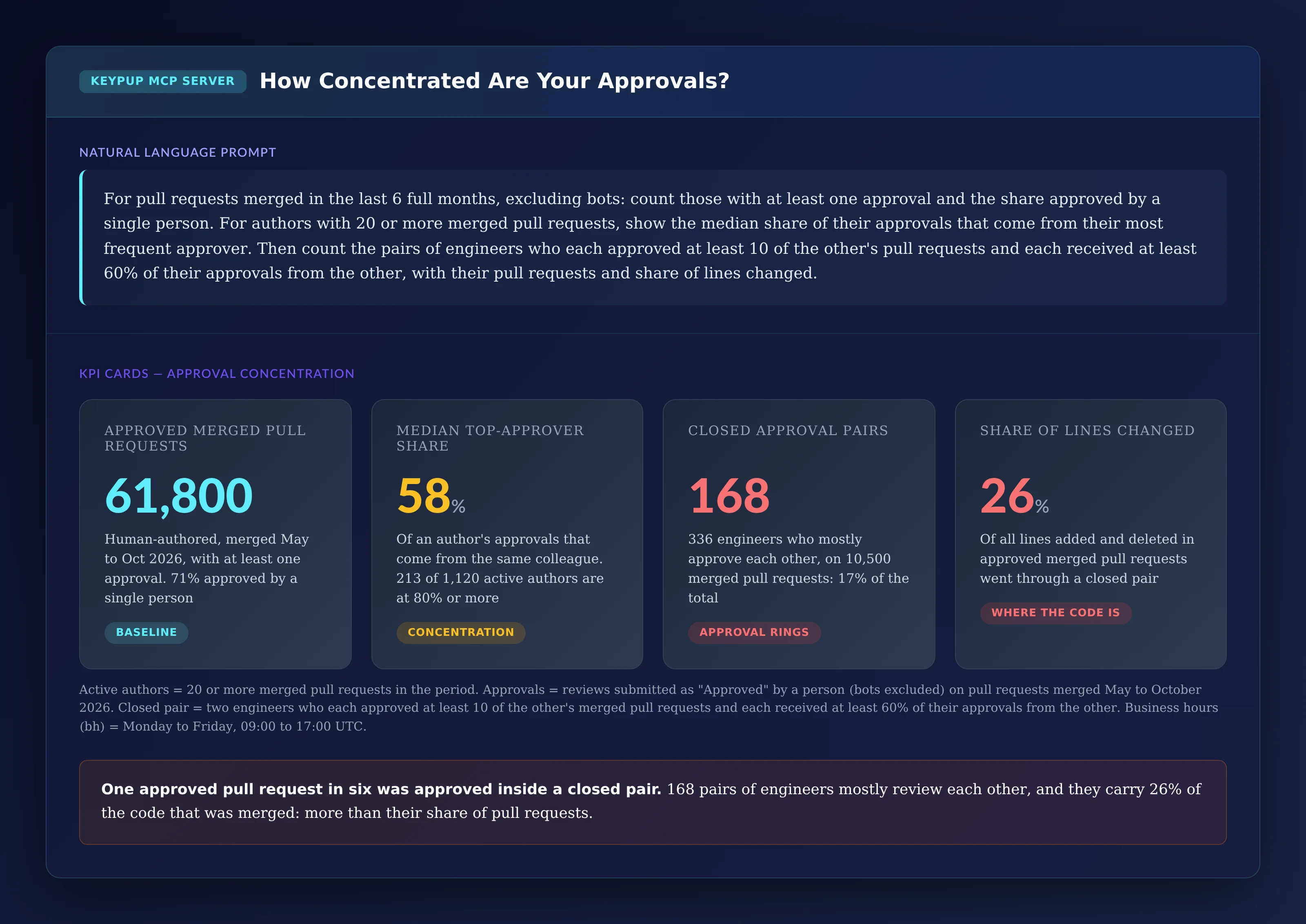
A four-eyes review policy checks that someone else approved a pull request, not who. In a typical enterprise, 168 pairs of engineers mostly approve each other, on 17% of merged pull requests and 26% of the code. Learn what engineering leaders on Reddit say about reciprocal approvals and rubber-stamp review buddies, and how Keypup MCP measures approval concentration from review authors, pull request authors, review dates, review bodies and lines changed.
Liam Davis
•13 min read
Table of Contents
TL;DR: Branch protection checks that someone other than the author approved a pull request. It never checks who, or how often it's the same person. In a typical enterprise organization, the median active author gets 58% of their approvals from one colleague, and 168 pairs of engineers mostly approve each other: they approved 17% of merged pull requests and 26% of the lines changed. Inside those pairs, approval comes eight times faster (0.4 against 3.2 business hours from the review request), 78% of approvals have an empty review, and changes are requested on 4% of pull requests, against 17% elsewhere. The Keypup MCP Server reads every review, with its reviewer, state, request and submission dates and body, and the author, repository, lines changed and merger of the pull request it belongs to. Your AI assistant can then measure how concentrated your approvals are, draw who approves whom, find the closed pairs, compare how they review, see where the largest changes get approved, follow the trend, and list the pairs that need a third reviewer.
The audit finding was one line long: "Peer review control operating effectively, 100% of production changes approved by a second person." Two weeks later, an incident review traced a broken ledger migration to a 1,400-line pull request approved in nine minutes. The approver had approved 140 of the author's pull requests that half-year. The author had approved 128 of the approver's. Nobody else had reviewed either of them since spring. The control was green the whole time.
The Friction: A Control That Counts Approvals, Not Independence
Every enterprise review policy rests on the same idea: a second person looks at the change before it ships. Every Git platform enforces it the same way: at least one approval, from anyone but the author. Between the two, the independence the policy is about disappears:
The rule checks a count, not a relationship. One approval from the author's desk neighbour satisfies it exactly as well as one from the owner of the service the change touches.
Pairs form for good reasons. Two engineers who know a codebase best review each other because they're fastest. After six months, nobody else knows it well enough to step in.
Reciprocity turns review into a trade. When I approve yours and you approve mine, a "changes requested" costs both of us a day. Approvals get faster and quieter.
Nobody sees the pattern. Each approval is legitimate. Only the graph of who approved whom shows that some engineers' code has had a single reader for months.
The result: audits report full review coverage, managers see fast review times, and the biggest changes in the most critical repositories get merged with the same single, silent approval.
Why This Matters: The Real Cost of Approval Rings
The Compliance Problem
SOX, SOC 2, ISO 27001 and PCI DSS all ask for segregation of duties on production changes. A pair that approves each other's work satisfies the letter of the control and none of its purpose. When an auditor samples pull requests and asks "who reviewed this, and who else could have?", the answer has to come from data, not from the branch protection screen.
The Quality Problem
A reviewer who sees the same author's code every day stops reading it fresh. A reviewer whose own pull requests that author will approve tomorrow has a reason not to push back. The defects that get through are not in the small pull requests: closed pairs approve the large ones.
The Knowledge Problem
If only two people have reviewed a repository for six months, it has a bus factor of two, and both are often on the same team, on the same holidays. The rest of the organization can't review it, can't take it over, and learns about it during the incident.
The Enterprise Discussion: What Engineering Leaders Are Actually Saying
"My PRs only ever get approved by the same guy", "we just approve each other's stuff to get it merged" and "the auditors asked who reviews whom and we had no idea" come up wherever engineering managers, staff engineers and security and compliance leads compare notes on code review. The quotes below are representative of recurring threads on r/ExperiencedDevs, r/EngineeringManagers, r/devops and r/cybersecurity.
Staff Engineer, Fintech (r/ExperiencedDevs)
"Two of our seniors have approved each other's PRs for a year. Fast, no comments, always green. Nobody else even gets tagged anymore. It works until it really doesn't."
"Leadership loves our review time. What they don't see is that half the team has a review buddy, and the buddy approves in five minutes because they know theirs will be approved in five minutes too."
"Our SOX control says every change has a second approver. The auditor asked how many different people approved changes to the payments service last quarter. Answering took us two weeks of scripts against the GitHub API."
The pattern holds: organizations enforce that someone else approves, never measure who, and the approvals that matter most end up concentrated in a few closed pairs.
How Keypup MCP Measures Approval Concentration
The Keypup Model Context Protocol (MCP) Server gives your AI assistant structured access to the data Keypup imports from GitHub, GitLab, Bitbucket and Azure DevOps. For this analysis, what matters is, for each review: its reviewer, state (approved, changes requested, commented, dismissed), review request date, submission date and body; and, for the pull request it belongs to, its author, repository, lines changed, merger, merge date and its list of past reviewers. Reviewers flagged as bots are excluded throughout; bot-authored pull requests, such as dependency updates, are excluded by author username.
A closed pair is two engineers who each approved at least 10 of the other's merged pull requests, and each received at least 60% of their approvals from the other. A silent approval is an approval with an empty review body. Business hours run 09:00 to 17:00 UTC, Monday to Friday. Figures cover pull requests merged in the last six full months, May to October 2026, for an organization of around 1,300 engineers in 240 repositories. In the screenshots, engineers are anonymized with SHA1 and shown as letters.
1. Sizing Approval Concentration
The first question: how much of your review rests on the same few relationships?
MCP Prompt:
For pull requests merged in the last 6 full months, excluding bots:
count those with at least one approval and the share approved by a
single person. For authors with 20 or more merged pull requests, show
the median share of their approvals that come from their most frequent
approver. Then count the pairs of engineers who each approved at least
10 of the other's pull requests and each received at least 60% of
their approvals from the other, with their pull requests and share of
lines changed.
Output: Approval Concentration
Key Insight: One approved pull request in six was approved inside a closed pair, and those pull requests carry a quarter of the code. Every one of them had an approval from someone other than its author. None of them would show up in a review coverage report, because coverage is 100%.
2. Drawing Who Approves Whom
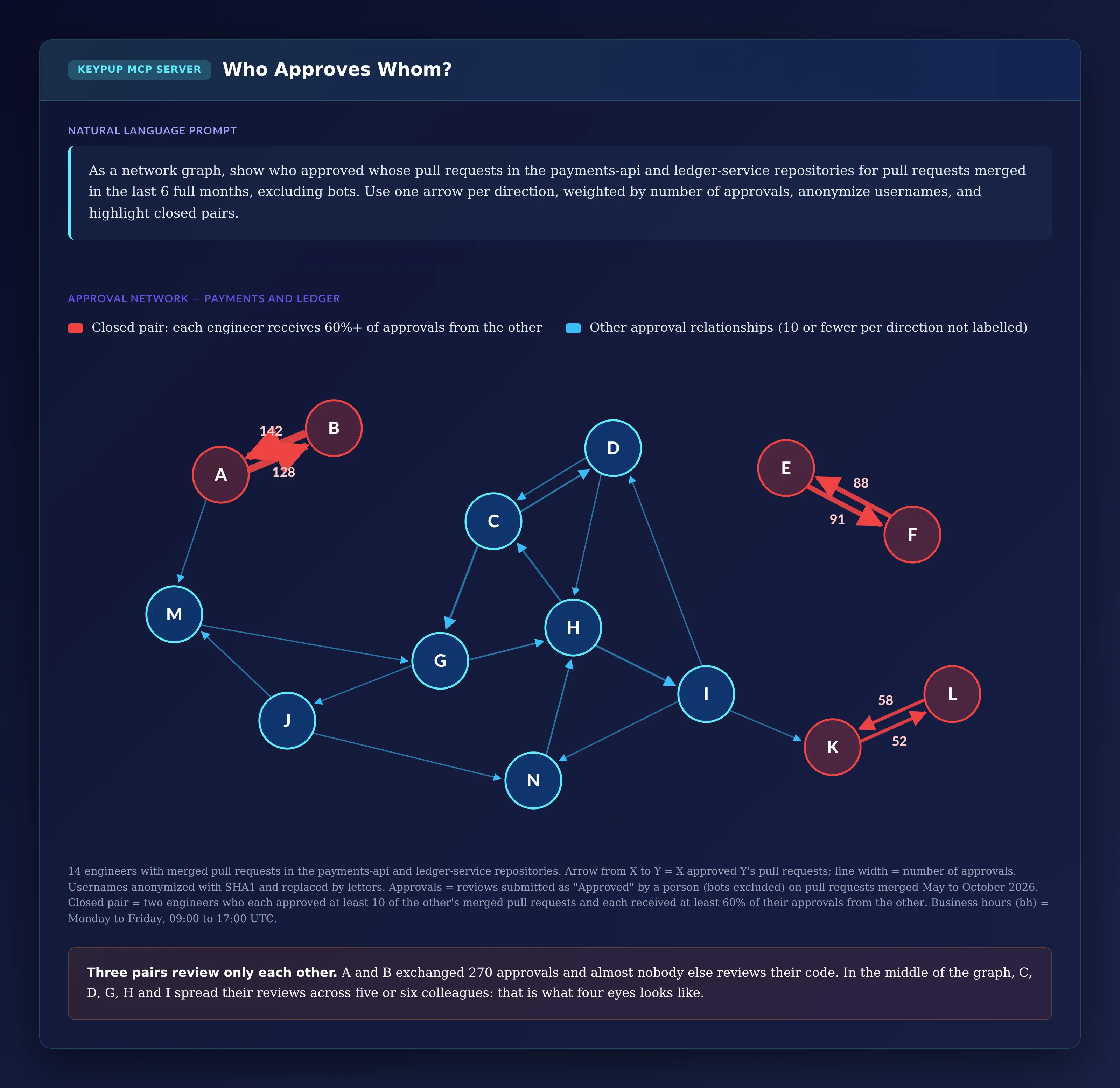
Numbers describe the problem; a graph shows it. Run on the repositories that matter most to an audit, the approval network makes closed pairs obvious.
MCP Prompt:
As a network graph, show who approved whose pull requests in the
payments-api and ledger-service repositories for pull requests merged
in the last 6 full months, excluding bots. Use one arrow per direction,
weighted by number of approvals, anonymize usernames, and highlight
closed pairs.
Output: Approval Network, Payments and Ledger
Key Insight: Three pairs review only each other. A and B exchanged 270 approvals, and almost nobody else reviews their code. In the middle of the graph, five engineers spread their reviews across five or six colleagues each: that is what the four-eyes principle is supposed to look like.
3. Counting the Authors Who Depend on One Approver
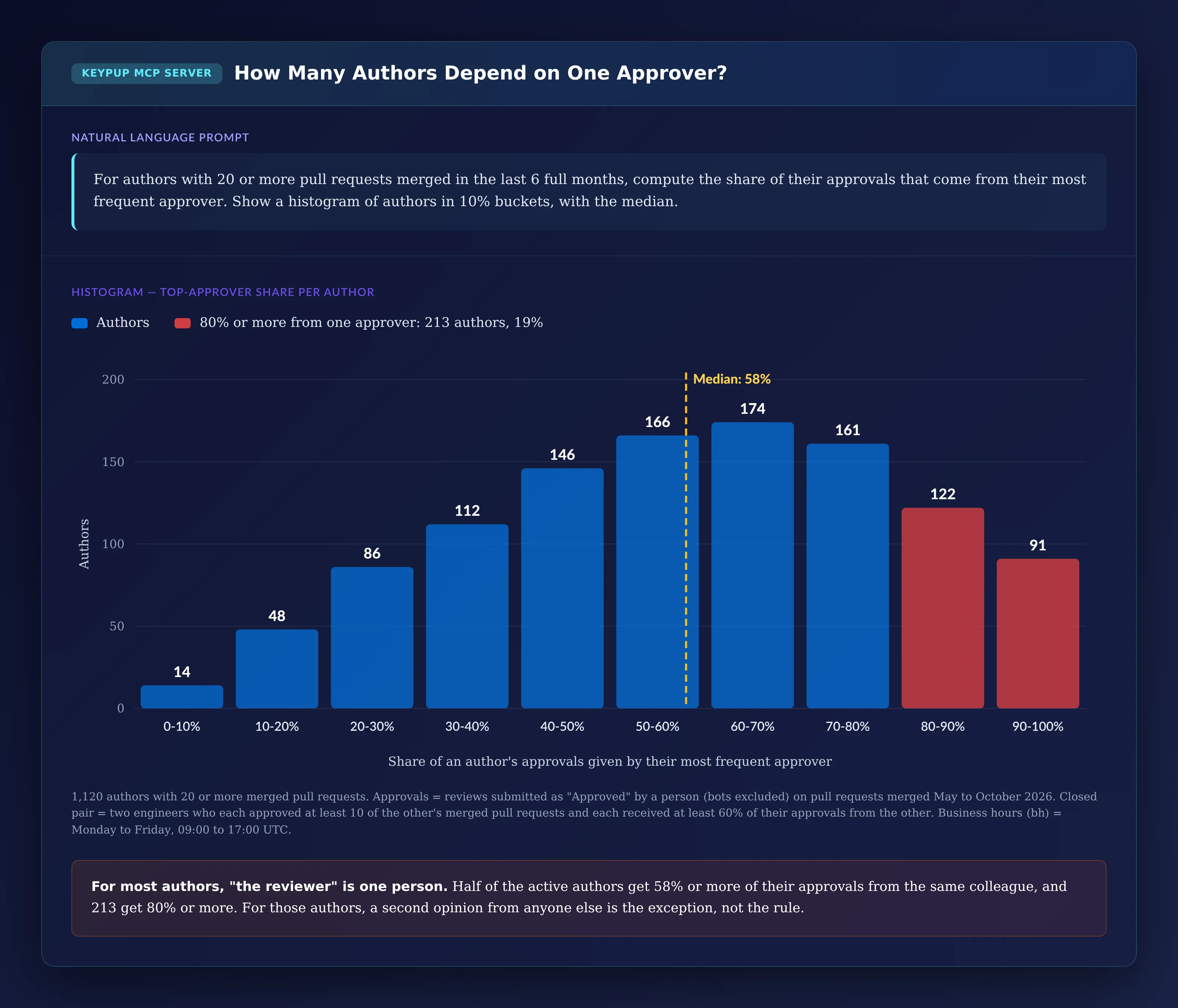
Not every concentrated author is in a closed pair. Some have one approver who doesn't depend on them in return, which is a knowledge risk even when it isn't a reciprocity one.
MCP Prompt:
For authors with 20 or more pull requests merged in the last 6 full
months, compute the share of their approvals that come from their most
frequent approver. Show a histogram of authors in 10% buckets, with
the median.
Output: Top-Approver Share per Author
Key Insight: For most authors, "the reviewer" is one person. Half of the active authors get 58% or more of their approvals from the same colleague, and 213 get 80% or more. For those authors, a second opinion from anyone else is the exception, not the rule.
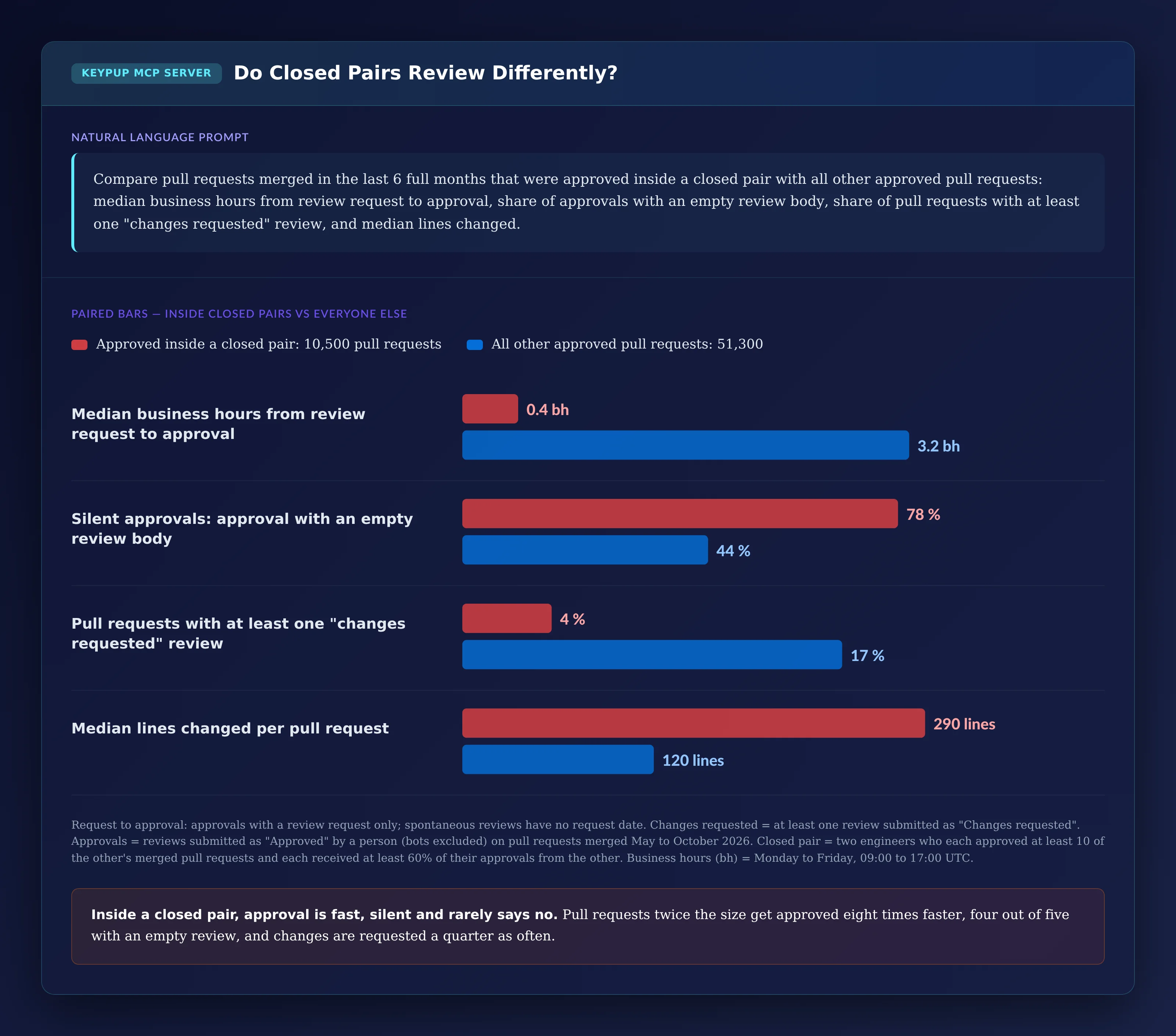
4. Comparing How Closed Pairs Review
Concentration alone could mean expertise: the two people who know the code best. The question is whether review inside a pair looks like review.
MCP Prompt:
Compare pull requests merged in the last 6 full months that were
approved inside a closed pair with all other approved pull requests:
median business hours from review request to approval, share of
approvals with an empty review body, share of pull requests with at
least one "changes requested" review, and median lines changed.
Output: Inside Closed Pairs vs Everyone Else
Key Insight: Inside a closed pair, approval is fast, silent and rarely says no. Pull requests more than twice the size get approved eight times faster, four out of five with an empty review, and changes are requested a quarter as often. Expertise makes review faster; it doesn't usually make it wordless.
5. Finding Where the Largest Changes Get Approved
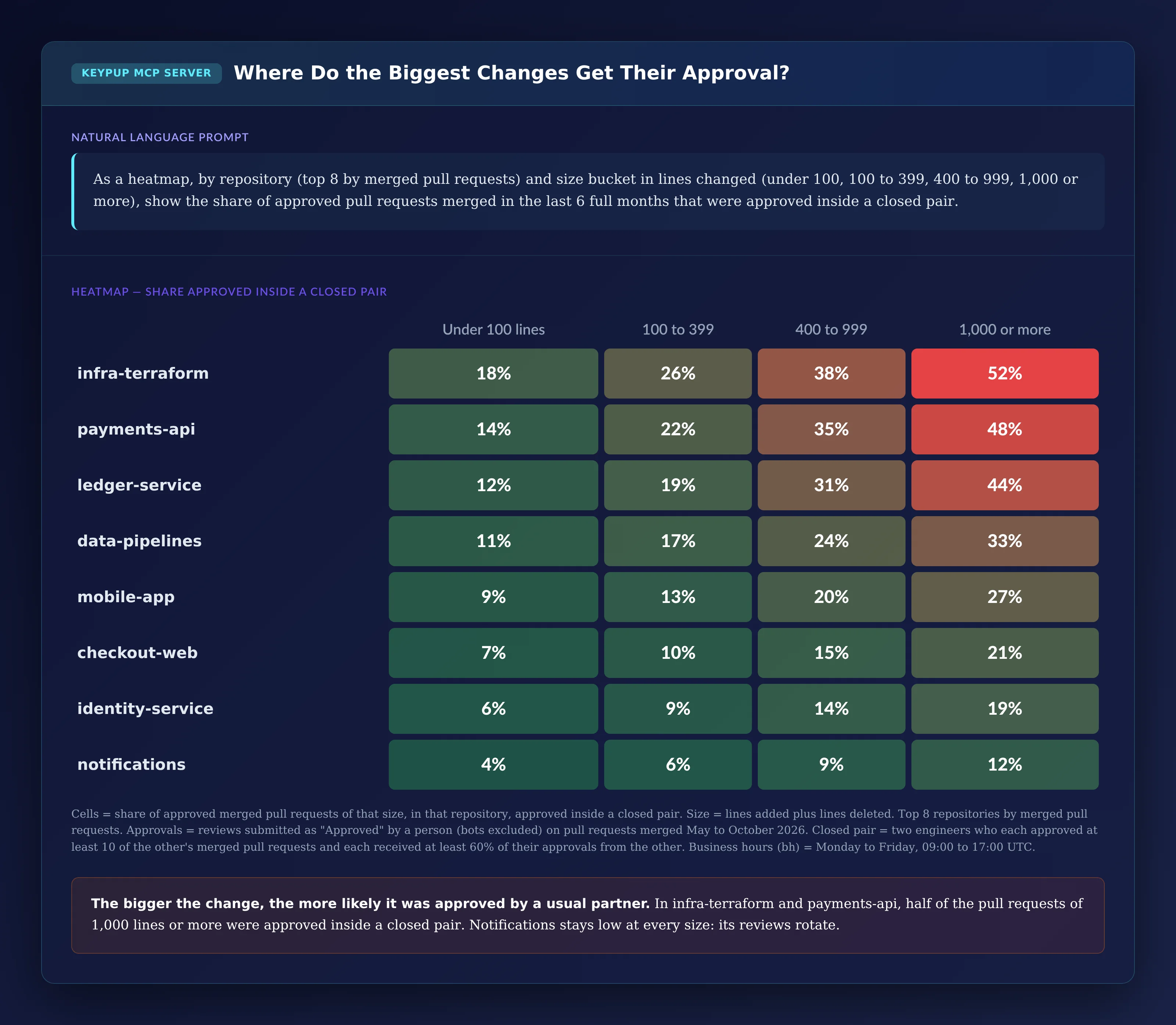
Risk depends on what gets approved inside the pairs. A heatmap by repository and pull request size shows where the biggest changes depend on a usual partner.
MCP Prompt:
As a heatmap, by repository (top 8 by merged pull requests) and size
bucket in lines changed (under 100, 100 to 399, 400 to 999, 1,000 or
more), show the share of approved pull requests merged in the last 6
full months that were approved inside a closed pair.
Output: Share Approved Inside a Closed Pair
Key Insight: The bigger the change, the more likely it was approved by a usual partner. In infra-terraform and payments-api, around half the pull requests of 1,000 lines or more were approved inside a closed pair: the changes that most need a fresh reader are the ones least likely to get one.
6. Following the Trend
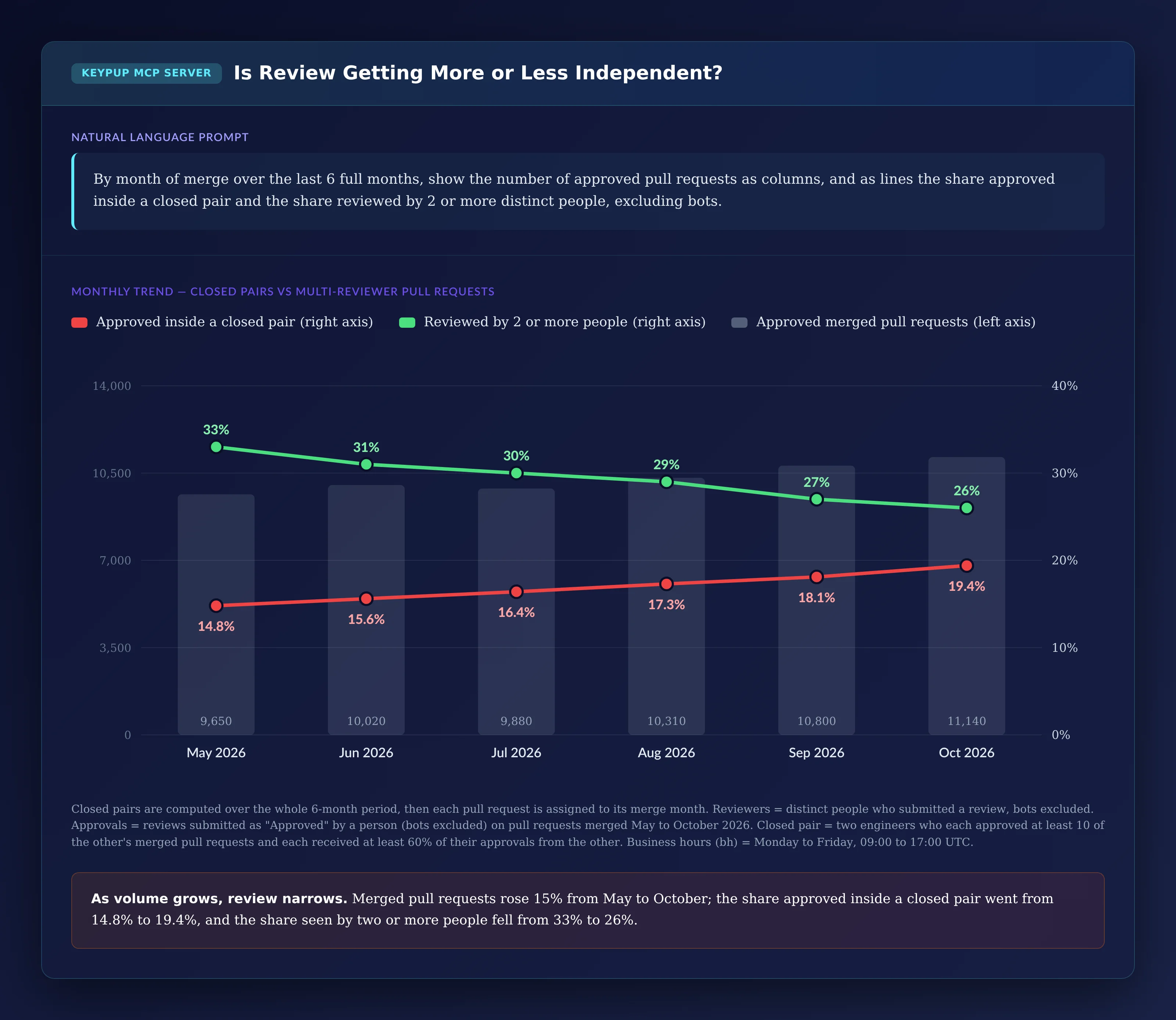
Closed pairs rarely form by decision. The trend shows whether review is getting more or less independent as delivery pressure grows.
MCP Prompt:
By month of merge over the last 6 full months, show the number of
approved pull requests as columns, and as lines the share approved
inside a closed pair and the share reviewed by 2 or more distinct
people, excluding bots.
Output: Closed Pairs vs Multi-Reviewer Pull Requests
Key Insight: As volume grows, review narrows. Merged pull requests rose 15% from May to October; the share approved inside a closed pair went from 14.8% to 19.4%, and the share seen by two or more people fell from 33% to 26%. The review policy stayed the same; the independence behind it eroded month after month.
7. Listing the Pairs That Need a Third Reviewer
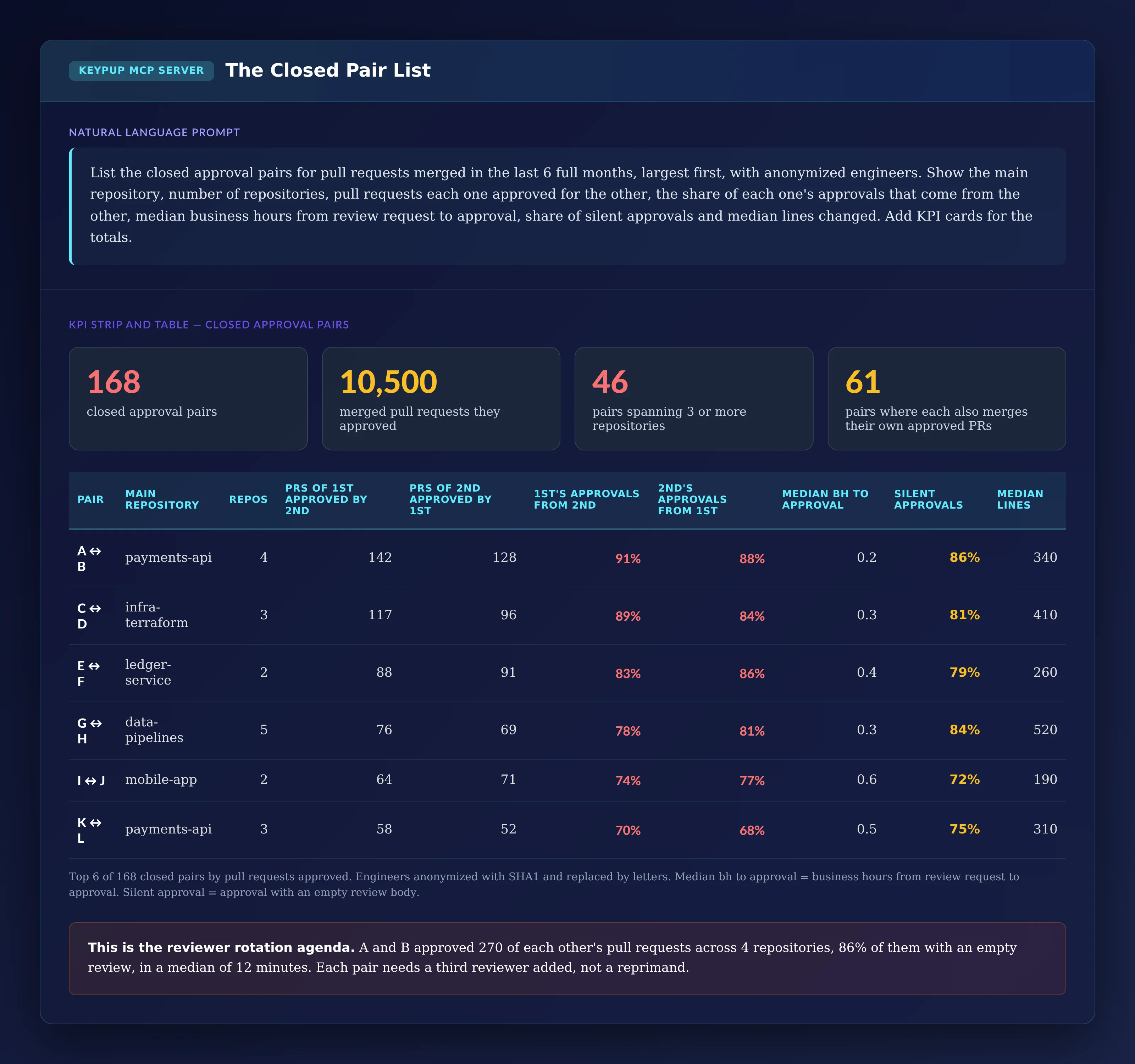
Measurement only helps if it ends with a list someone can act on: here, a reviewer rotation plan.
MCP Prompt:
List the closed approval pairs for pull requests merged in the last 6
full months, largest first, with anonymized engineers. Show the main
repository, number of repositories, pull requests each one approved
for the other, the share of each one's approvals that come from the
other, median business hours from review request to approval, share
of silent approvals and median lines changed. Add KPI cards for the
totals.
Output: Closed Approval Pairs
Pair
Main repository
Repos
1st approved by 2nd
2nd approved by 1st
1st's approvals from 2nd
2nd's approvals from 1st
Median bh to approval
Silent approvals
Median lines
A ↔ B
payments-api
4
142
128
91%
88%
0.2
86%
340
C ↔ D
infra-terraform
3
117
96
89%
84%
0.3
81%
410
E ↔ F
ledger-service
2
88
91
83%
86%
0.4
79%
260
G ↔ H
data-pipelines
5
76
69
78%
81%
0.3
84%
520
I ↔ J
mobile-app
2
64
71
74%
77%
0.6
72%
190
K ↔ L
payments-api
3
58
52
70%
68%
0.5
75%
310
Key Insight: This is the reviewer rotation agenda. A and B approved 270 of each other's pull requests across 4 repositories, 86% with an empty review, in a median of 12 business minutes. 61 pairs also merge their own pull requests once approved. Each pair needs a third reviewer added to its repositories' rotation, not a reprimand.
The Technical Implementation: What Keypup MCP Actually Reads
Every number above comes from fields Keypup already imports from your Git platforms. It helps to be precise about what each one depends on.
Who Approved Whom Comes From the Reviews Dataset
Keypup imports each review as its own record, with its reviewer, state and dates, linked to its pull request and that pull request's author, repository, lines changed and merge date. Grouping approvals by reviewer and author gives every edge of the network; grouping by the two usernames in alphabetical order (with LEAST and GREATEST) puts both directions of a pair on the same row. Reviewers that the platform or Keypup flag as bots are excluded with author_type != "BOT". The reviews dataset carries the pull request author's username but not their type, so bot-authored pull requests (Dependabot, Renovate, release automation) are excluded by username: list your bot accounts once and reuse the filter.
Closed Pairs Need Two Queries
A pair's share of each engineer's approvals divides the approvals between them by that engineer's total approvals. Your AI assistant runs one query for the pairs and one for each author's totals, then applies the thresholds. 10 approvals and 60% are choices, not standards: start there, and adjust to your team sizes. Prompts 5 and 6 filter on the list of pairs from that first step.
Speed, Silence and Pushback Come From Review Fields
Time to approval runs from the review's request date to its submission date, with BUSINESS_HOURS. Reviews submitted without a request have no request date and are left out of that median. A silent approval is an approved review with an empty body. Inline comments left with a review are separate records in the comments dataset, linked to their review: add them as a condition if your reviewers comment inline and approve with an empty summary. Keypup doesn't judge what a comment says, or see a discussion held elsewhere. Changes requested come from reviews submitted in that state: a team that asks for changes in comments and never uses the state will show none, so compare repositories that review the same way.
Multi-Reviewer and Self-Merge Come From Pull Request Fields
Reviewed by 2 or more people counts the distinct usernames in each pull request's list of past reviewers. That list carries usernames only, so review bots are removed from it by username, with the same list of bot accounts as above. Self-merge compares the pull request's author with its merger. Only reviews in the approved state count as approvals: a dismissed approval has its own state, and drops out.
What Keypup Doesn't See
Keypup doesn't know your org chart: whether a pair sits on the same team or reports to the same manager isn't in the data, so add that context yourself. It doesn't see reviews done in a pairing session, a call or a chat, only those submitted on the pull request. And it doesn't judge review quality: a short, empty approval from the service owner can be a thorough one. The data points to where independence is thin; people decide what it means.
Real-World Impact: Enterprise Case Studies
Case Study 1: European Payments Processor
Before Keypup MCP:
1,100 engineers, a SOX control requiring one independent approval per production change
Audit sampling every quarter, done by hand against the GitHub API
No view of who reviewed whom across 300 repositories
After Keypup MCP:
The closed pair list became an audit artefact: the compliance team runs prompt 7 every quarter and attaches it to the control evidence
Repositories in scope for SOX got a rotation rule: every pull request of 400 lines or more needs an approval from outside the author's top approver
The share of in-scope pull requests approved inside a closed pair fell from 31% to 9% in two quarters
"The control said 100% of changes had a second approver. It never said that for a third of them, it was the same second approver every time. Now we can show the auditor both."
— Head of Engineering Governance, European Payments Processor
Case Study 2: North American Health Insurance Platform
Before Keypup MCP:
1,400 engineers, review time on the leadership dashboard, celebrated as fast
Two incidents in a quarter traced to large pull requests approved within minutes
Knowledge of core services concentrated in a handful of senior engineers
After Keypup MCP:
The comparison in prompt 4 reframed the review time metric: the fastest reviews were the closed pairs, not the best teams
Each closed pair in a critical repository got a third reviewer, chosen from the engineers already reviewing nearby code in the approval network
The share of pull requests reviewed by two or more people rose from 24% to 41%, and median time to approval stayed under three business hours
"We were proud of our review times. Half of that speed was two people trusting each other a little too much. The network graph made the conversation easy, because nobody was being accused, the graph just showed who nobody else was reading."
— VP Engineering, North American Health Insurance Platform
Implementation: Getting Started with Keypup MCP
1. Connect Your Git Platforms
Connect GitHub, GitLab, Bitbucket or Azure DevOps to Keypup. Pull requests, reviews, reviewers, review requests and mergers are imported automatically.
2. Check Your Bots and Service Accounts
Ask your assistant for the top approvers by number of approvals. If a service account or an automation shows up as a person, exclude it by username in your prompts before computing any share, along with the bot accounts that author pull requests.
3. Agree on What a Closed Pair Is
Run prompt 3 on your own data and set your thresholds. Small teams of three or four will naturally concentrate approvals: compare a pair's share with the size of the group reviewing the same repositories.
4. Connect the MCP Server to Your AI Assistant
Connect the MCP server to your AI assistant using the MCP documentation, and set a baseline with the share of pull requests approved inside a closed pair, by repository.
5. Turn the Pair List Into a Rotation Plan
Review the closed pair list every month with the engineering managers concerned, starting with the repositories in audit scope. Add a third reviewer to each pair's repositories, and update your code owner rules so that large changes need someone from outside the pair.
Frequently Asked Questions
What is an approval ring in code review?
An approval ring is a small group of engineers, most often two, who approve most of each other's pull requests. Each approval satisfies the review rule, but the code of the people in the ring gets read by one person, and that person's own code is approved by the author in return.
How do you detect reciprocal code review approvals?
Group approvals by reviewer and pull request author over a period, put both directions of each pair on the same row, and compare the approvals between the two with each engineer's total approvals. Pairs where each engineer gets most of their approvals from the other are reciprocal approval pairs.
Does a closed approval pair break SOX or SOC 2 controls?
Not by itself: most controls ask for an approval by someone other than the author, and a closed pair provides one. But auditors increasingly ask whether approvals are independent. Being able to show how concentrated approvals are, and what you do about closed pairs in in-scope repositories, makes that conversation far easier.
How many reviewers should approve a pull request?
One independent approval is enough for most changes. What matters is that it's not always the same person: rotating reviewers, or requiring an approval from outside the author's most frequent approver for large or sensitive changes, keeps the four-eyes principle meaningful without slowing every pull request down.
The Bottom Line
Branch protection checks that someone else approved a change. It doesn't check that it's someone different from last time. In many enterprise organizations, one approved pull request in six, and a quarter of the code, comes out of a closed pair. Keypup MCP measures the independence the control leaves out:
✅ Sizing approval concentration across every author and repository ✅ Drawing who approves whom, with closed pairs highlighted ✅ Counting the authors who depend on one approver ✅ Comparing how closed pairs review, against everyone else ✅ Finding where the largest changes get approved by a usual partner ✅ Following the trend as delivery pressure grows ✅ Listing the pairs that need a third reviewer, with their numbers
Throughput counts issues, but one closed issue can hide one pull request or fifteen. In a typical enterprise, 14% of closed Jira issues need six or more pull requests, carry half the code that changed and take eight times longer to close. Learn what engineering leaders on Reddit say about tickets that never get split, and how Keypup MCP measures issue size through linked pull requests, lines changed, merge spans and story points.
Cycle time is measured on closed work, so the items stuck in Blocked, In Review or QA for weeks never appear in it. In a typical enterprise, the median open item is twice as old as the median closed one, and a third of work in progress is already older than the 85th percentile the dashboard reports. Learn what engineering leaders on Reddit say about green cycle time charts and stuck work, and how Keypup MCP measures the age of open Jira issues, where they sit still and what code is behind them.
In a typical enterprise, the Jira board trails Git by almost two business days per issue: code is written before tickets reach "In Progress", and tickets stay open days after their pull requests merge. Learn what engineering leaders on Reddit say about stale boards, status-chasing standups and sprint carryover that exists only on paper, and how Keypup MCP compares each issue's workflow timeline with the commits and merges of its linked pull requests to measure the lag and list the tickets to close.