Strategic Vendor Selection and Platform Fatigue: How to Add an SEI Platform Without Adding Another Dashboard
Enterprises already juggle dozens of tools for project management, CI/CD, monitoring, and HR. Before adding a Software Engineering Intelligence platform, IT architects and procurement teams need to weigh true integration cost, training burden, and vendor lock-in risk — not just the license fee. Discover how Keypup MCP delivers engineering insight through the tools your teams already use, with no new dashboard, no new login, and a fraction of the total cost of ownership.
TL;DR: Enterprises evaluating a Software Engineering Intelligence (SEI) platform face a real trade-off: the promised insight is genuine, but the integration cost, training burden, and vendor lock-in risk of adding yet another standalone dashboard are just as real. Procurement teams are right to scrutinize Total Cost of Ownership beyond the license fee, and engineers are right to resist yet another tool to log into. The Keypup MCP Server solves both problems at once — it delivers engineering intelligence directly inside the tools your teams already use (Slack, Teams, the IDE), reading from your existing toolchain instead of duplicating it, with no new dashboard to learn and a fraction of the integration and training cost of a standalone platform.
Enterprises already manage a dense, often decades-deep ecosystem of tools: project management in Jira or Azure Boards, CI/CD in GitHub Actions or Jenkins, monitoring in Datadog or PagerDuty, HR systems, and a long tail of internal and legacy platforms layered on top. Every new "Software Engineering Intelligence" (SEI) platform proposal adds another layer to that already-dense landscape — and senior IT architects know it.
The Friction: Another Vendor, Another Dashboard, Another Login
Two problems collide the moment an SEI platform lands on the procurement roadmap.
The integration problem. Enterprises rarely run a clean, homogeneous toolchain. A new vendor has to integrate seamlessly with legacy systems, heavily customized workflows, and internal tools that were never designed to be queried by a third party. That integration work — connector development, data mapping, edge-case handling — is where SEI rollouts quietly blow past their original budget and timeline.
The platform fatigue problem. Developers and engineering managers already interact with a dozen or more systems every single day. Adding a new dashboard to check, a new login to remember, and a new UI to learn is not a neutral addition — it's friction on top of friction. The result is predictable: initial mandatory-training adoption, followed by a slow decline into "yet another tab nobody opens."
A platform engineering team is asked to stand up and maintain integrations for a tool that duplicates half of what their existing CI/CD dashboards already show
A VP of Engineering has to justify a six-figure license fee for a platform that, three months in, has 30% weekly active usage and falling
A procurement lead discovers that the "implementation included" line item in the contract meant 40 hours of vendor consulting — and 400 hours of internal engineering time to actually wire it up
A security and compliance team has to review a new vendor's data access scope, retention policy, and exit terms — for a system whose core insight could have come from data they already collect
Why This Matters: The Real Cost Isn't the License
The Total Cost of Ownership Problem
Senior IT architects and procurement teams have learned, often the hard way, that the sticker price of an SEI platform is a fraction of its real cost. Integration engineering, data migration, custom connector maintenance, and the ongoing training burden as teams onboard and turn over all add up — frequently to more than the license itself. A platform that looks like a $180K/year decision on the vendor's slide deck can easily become a $600K three-year commitment once every cost center is honestly accounted for.
The Vendor Lock-in Problem
Committing to another large enterprise vendor is a strategic decision, not just a purchasing one. Once engineering data, historical benchmarks, and custom dashboards live inside a proprietary platform, migrating away becomes its own multi-quarter project. Architects are right to ask: does this platform offer genuinely unique insight, or does it simply re-package data we already have, behind a new interface we now depend on?
The Enterprise Discussion: What IT Architects and Procurement Teams Are Actually Saying
This exact tension — real insight vs. real integration cost — shows up constantly wherever engineering leaders and IT procurement compare notes.
Director of Engineering (r/ExperiencedDevs)
"We ran the numbers after our SEI platform's first renewal came up. The license was the smallest line item. Between the custom Jira field mapping, the Jenkins plugin nobody else could maintain, and the onboarding sessions we had to keep re-running for new hires, the 'total cost' was almost 3x the quote we signed. Nobody flagged that at the demo stage."
Principal IT Architect (r/devops)
"My honest pushback in every SEI vendor evaluation now is: 'show me the one insight you provide that I can't already get by combining data I already have in GitHub and Jira.' Half the vendors can't answer that cleanly. The other half want to sell us a new dashboard to answer it — which just adds another system my team has to keep alive."
The pattern is consistent: the insight isn't the problem — the delivery mechanism is. Engineering leaders don't reject the idea of engineering intelligence. They reject paying integration-and-training tax for a new interface layered on top of data they already own.
How Keypup MCP Solves Strategic Vendor Selection and Platform Fatigue
The Keypup Model Context Protocol (MCP) Server is built around a different premise: augment your existing toolchain instead of replacing its interface. It reads directly from the systems you already run and surfaces insight through the tools your teams already have open — no new dashboard, no new login, no forced UI migration.
1. Proving the Integration Footprint Before You Sign Anything
Before any procurement conversation goes further, architects need a clear answer on integration scope and time-to-value — not a vendor's roadmap promise.
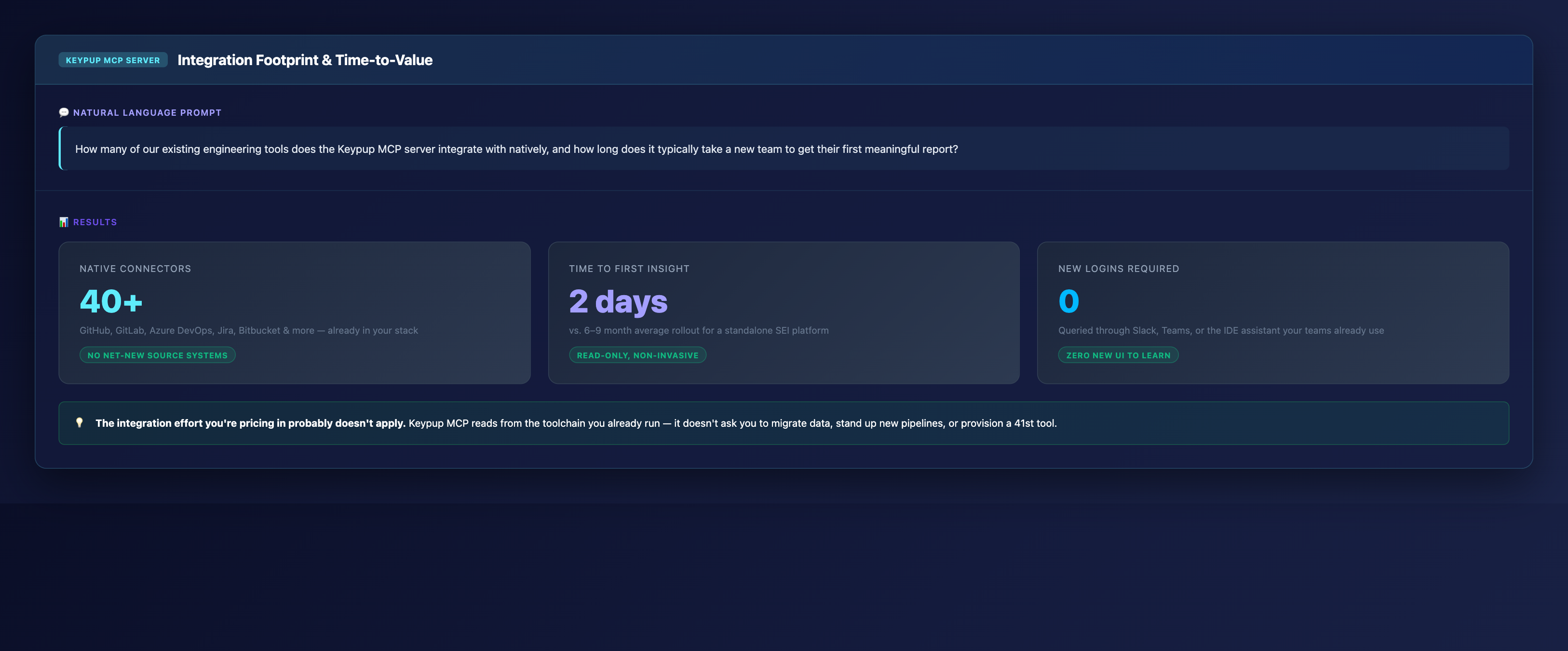
MCP Prompt:
How many of our existing engineering tools does the Keypup MCP server
integrate with natively, and how long does it typically take a new
team to get their first meaningful report?
Output: Integration Footprint KPI Cards
Key Insight: The integration effort you're pricing in probably doesn't apply. Keypup MCP reads from the toolchain you already run — it doesn't ask you to migrate data, stand up new pipelines, or provision a 41st tool.
2. Making the Real Total Cost of Ownership Visible
Procurement needs the fully-loaded number, not the license quote, to compare options honestly.
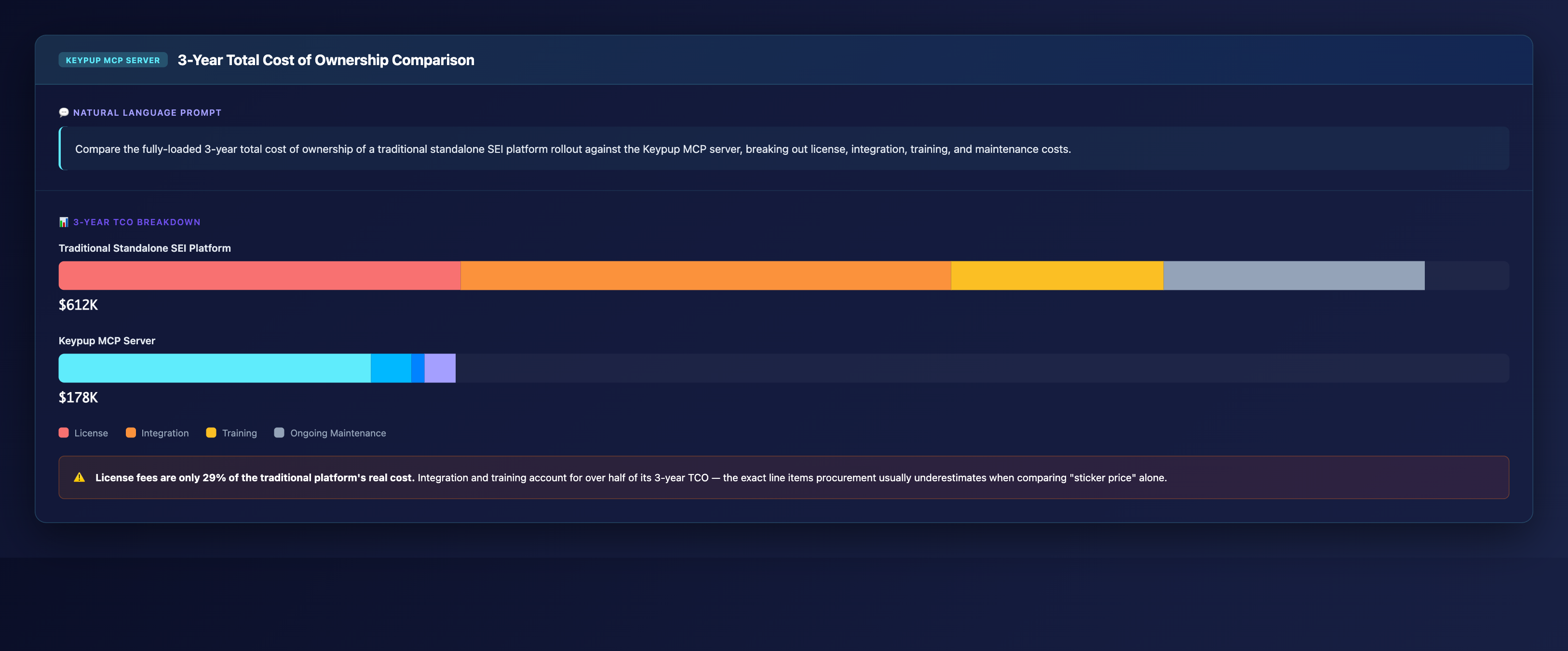
MCP Prompt:
Compare the fully-loaded 3-year total cost of ownership of a
traditional standalone SEI platform rollout against the Keypup MCP
server, breaking out license, integration, training, and
maintenance costs.
Output: Stacked TCO Comparison Chart
Key Insight: License fees are only 29% of the traditional platform's real cost. Integration and training account for over half of its 3-year TCO — the exact line items procurement usually underestimates when comparing sticker price alone.
3. Confirming You're Not Buying Duplicate Functionality
The most direct way to answer "does this just duplicate what we have?" is to map every capability against the systems that already produce it.
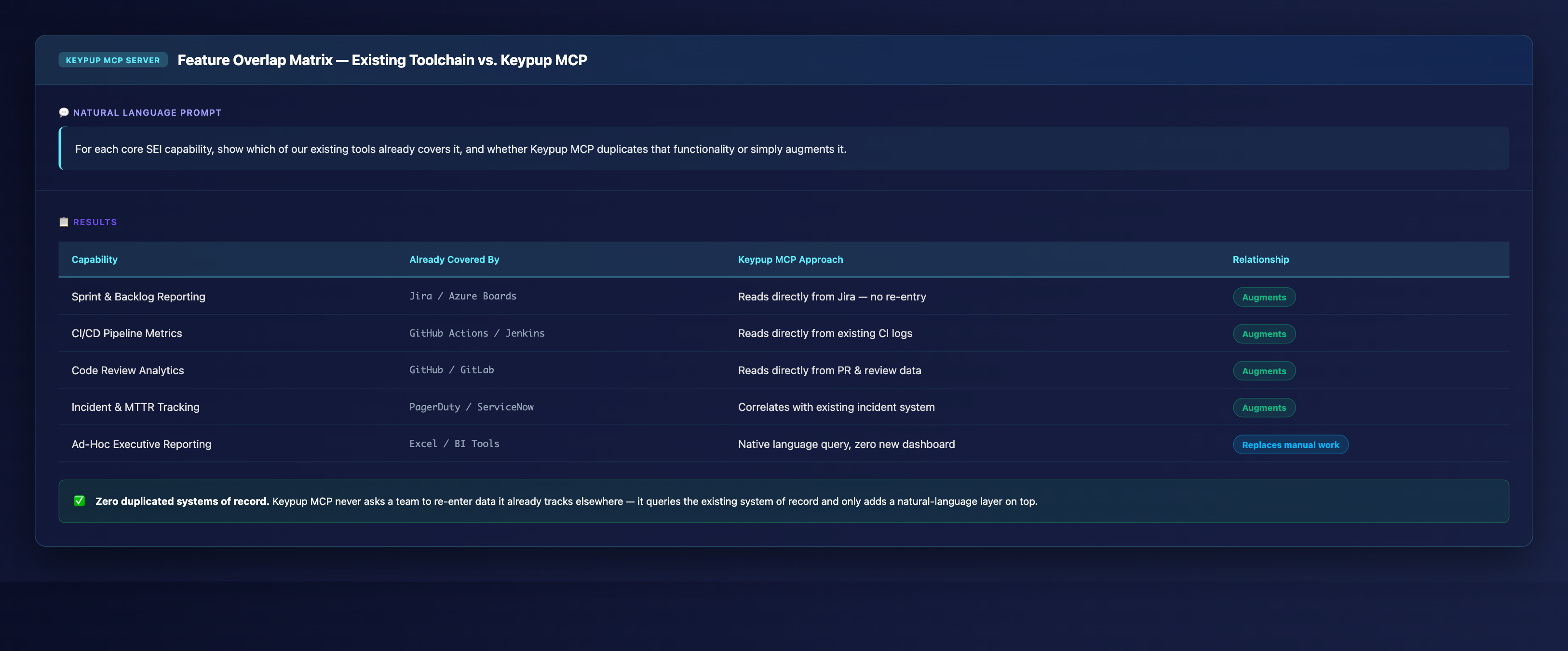
MCP Prompt:
For each core SEI capability, show which of our existing tools
already covers it, and whether Keypup MCP duplicates that
functionality or simply augments it.
Output: Feature Overlap Matrix
Capability
Already Covered By
Keypup MCP Approach
Relationship
Sprint & Backlog Reporting
Jira / Azure Boards
Reads directly from Jira — no re-entry
Augments
CI/CD Pipeline Metrics
GitHub Actions / Jenkins
Reads directly from existing CI logs
Augments
Code Review Analytics
GitHub / GitLab
Reads directly from PR & review data
Augments
Incident & MTTR Tracking
PagerDuty / ServiceNow
Correlates with existing incident system
Augments
Ad-Hoc Executive Reporting
Excel / BI Tools
Native language query, zero new dashboard
Replaces manual work
Key Insight: Zero duplicated systems of record. Keypup MCP never asks a team to re-enter data it already tracks elsewhere — it queries the existing system of record and only adds a natural-language layer on top.
4. Showing What Actually Happens to Adoption After Rollout
The best argument against "just add a dashboard" is what historical adoption curves actually look like once mandatory training ends.
MCP Prompt:
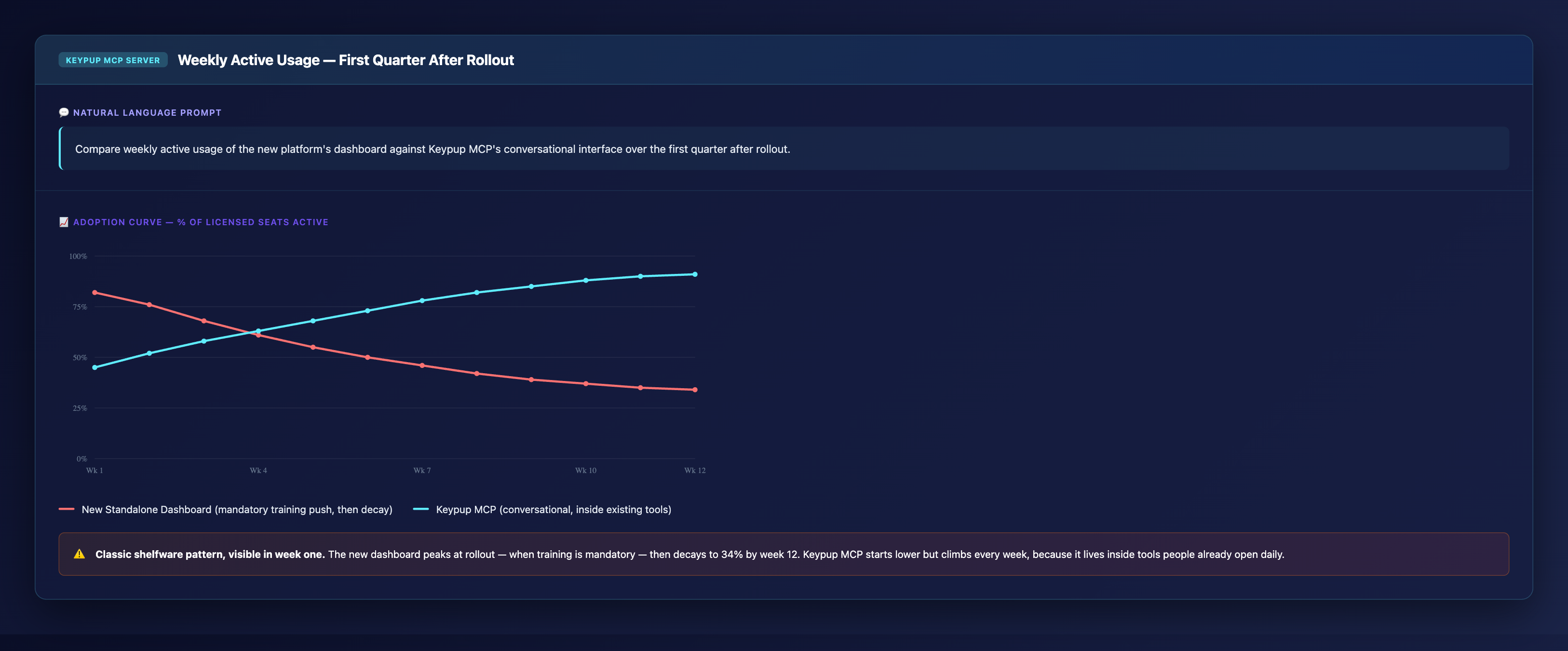
Compare weekly active usage of the new platform's dashboard against
Keypup MCP's conversational interface over the first quarter after
rollout.
Output: Adoption Curve Line Chart
Key Insight: Classic shelfware pattern, visible in week one. The new dashboard peaks at rollout — when training is mandatory — then decays to 34% by week 12. Keypup MCP starts lower but climbs every week, because it lives inside tools people already open daily.
5. Scoring the Strategic Decision, Not Just the Line Items
Once integration cost, TCO, overlap, and adoption are on the table, leadership needs a single risk-adjusted view to make the final call.
MCP Prompt:
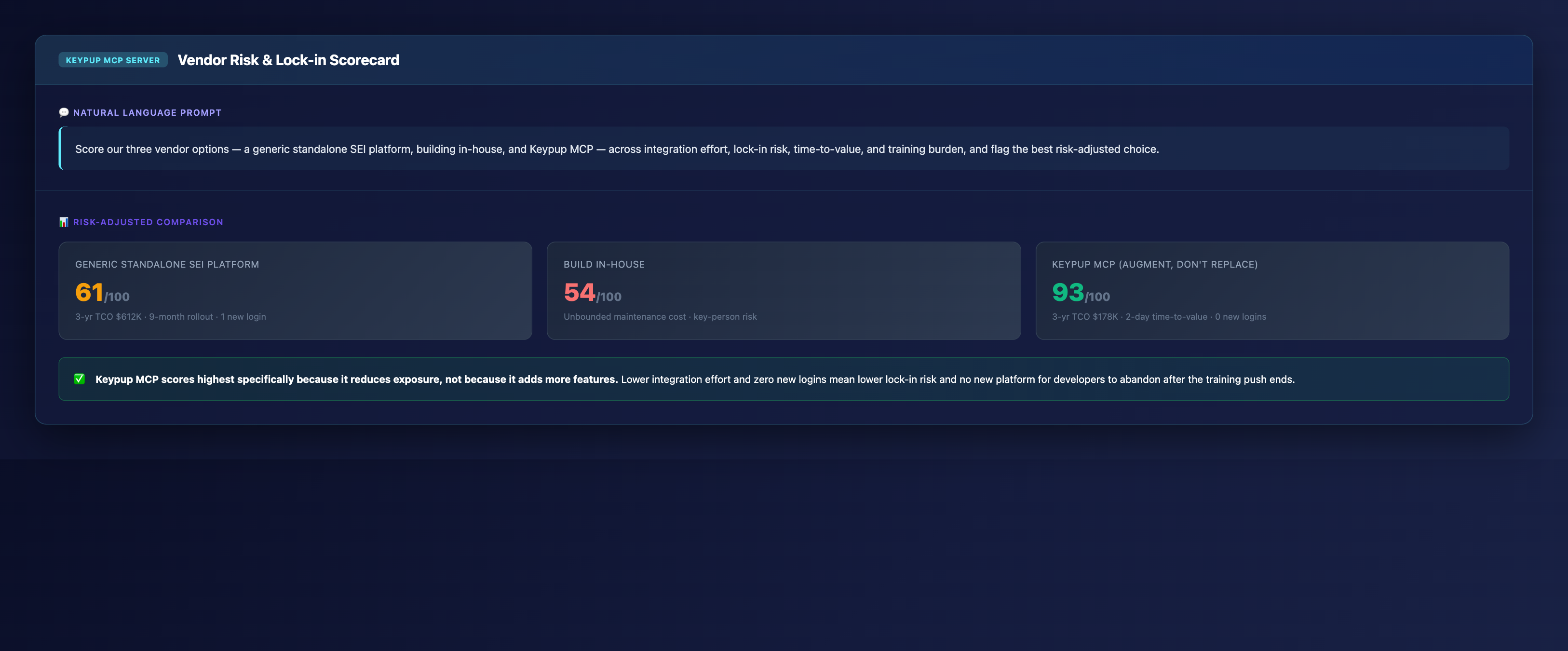
Score our three vendor options — a generic standalone SEI platform,
building in-house, and Keypup MCP — across integration effort,
lock-in risk, time-to-value, and training burden, and flag the best
risk-adjusted choice.
Output: Vendor Risk & Lock-in Scorecard
Key Insight: Keypup MCP scores highest specifically because it reduces exposure, not because it adds more features. Lower integration effort and zero new logins mean lower lock-in risk and no new platform for developers to abandon after the training push ends.
The Technical Implementation: How Keypup MCP Avoids Adding to Platform Fatigue
Read-Only, Non-Invasive Integration
Keypup MCP connects to your existing systems — GitHub, GitLab, Bitbucket, Azure DevOps, Jira, and dozens more — as a read-only consumer of data you already generate. There is no data migration, no new system of record, and no risky write-path integration to maintain.
Delivered Through Interfaces Your Teams Already Use
Rather than shipping a new web dashboard, Keypup MCP surfaces insight through the Model Context Protocol directly inside Slack, Microsoft Teams, and IDE-based AI assistants. Engineers and managers ask questions in natural language from tools they already have open — there is no separate login, no separate UI to learn, and no separate habit to build.
Bounded, Predictable Total Cost of Ownership
Because there's no custom connector development, no data warehouse to stand up, and minimal training curve, the ongoing maintenance burden stays predictable — a stark contrast to the open-ended integration and training costs that make standalone SEI platforms expensive well beyond their license fee.
Real-World Impact: Enterprise Case Studies
Case Study 1: Global Financial Services IT Organization
Before Keypup MCP:
A standalone SEI platform evaluation stalled for two quarters over integration scope for a legacy mainframe change-control system
Procurement's 3-year TCO model, once integration and training were fully loaded, came in 3.4x higher than the vendor's initial quote
Engineering leadership could not get a clean answer on which insights were genuinely new versus already available in existing JIRA and GitHub dashboards
After Keypup MCP:
Integration completed in under two weeks using existing native connectors — no custom development required
3-year TCO dropped by roughly two-thirds compared to the standalone platform being evaluated
Zero new dashboards added — insights delivered through the Slack channels and IDE assistants teams already used daily
"We spent two quarters trying to scope a platform that would have added a system we'd have to maintain forever. Keypup MCP answered the same strategic questions in two weeks, using data we already had, through tools our teams never had to be retrained on."
— VP Engineering, Financial Services
Case Study 2: Multi-Product Enterprise SaaS Company
Before Keypup MCP:
A newly-purchased SEI dashboard saw 80%+ adoption during its mandatory rollout training, then fell below 35% weekly active usage within one quarter
IT architecture flagged the new platform as a genuine vendor lock-in risk, since dashboards and historical trend data lived exclusively inside its proprietary format
Engineering managers reported "dashboard fatigue" as a top complaint in internal tooling surveys
After Keypup MCP:
Adoption climbed steadily instead of decaying — because queries happened inside Slack and the IDE, not a separate login
No proprietary data lock-in — Keypup MCP's read-only model meant all underlying data remained in the original systems of record
Internal tooling survey complaints about "too many dashboards" dropped the following quarter, the first measurable improvement in two years
"The lesson we learned is that engineers don't resist insight — they resist logging into one more place to get it. The moment the insight showed up inside Slack instead of a new dashboard, usage went in the opposite direction from every other tool we'd rolled out that year."
— Director of Engineering, Enterprise SaaS
Implementation: Getting Started with Keypup MCP
1. Connect Your Existing Data Sources
Keypup MCP integrates with your existing toolchain regardless of how legacy or customized it is:
GitHub, GitLab, Bitbucket, Azure DevOps, and legacy version control systems
JIRA, Azure Boards, and other project management tools
CI/CD pipelines and incident management systems already in place
2. Scope the True Integration Cost Up Front
Before signing anything, ask any SEI vendor — including Keypup — for the same numbers used in this article: native connector coverage, time-to-first-insight, and fully-loaded 3-year TCO including training and maintenance.
3. Query in Natural Language, From Tools You Already Use
No new dashboard required:
"What's our real integration cost for the next fiscal year?"
"Which of our current tools would this capability duplicate?"
"Show weekly active usage of every tool we rolled out in the last 12 months"
"Score our top three vendor options on lock-in risk and time-to-value"
4. Automate Portfolio-Wide Vendor Reviews
Schedule recurring queries for:
Annual TCO re-validation ahead of renewal negotiations
Quarterly adoption tracking for any recently rolled out tool
Ad-hoc feature-overlap checks whenever a new vendor proposal arrives
The Bottom Line: Real Insight Without a New Dashboard to Maintain
Strategic vendor selection for engineering intelligence doesn't have to mean choosing between real insight and platform fatigue. IT architects and procurement teams should:
✅ Demand the fully-loaded TCO — integration and training, not just the license line item ✅ Confirm what's genuinely new versus what simply duplicates an existing system of record ✅ Weigh vendor lock-in risk as a strategic cost, not an afterthought in the contract's exit clause ✅ Watch adoption curves, not launch-day usage, when judging whether a tool earns its seat ✅ Prefer insight delivered through existing interfaces over insight that requires a new one
Keypup MCP makes the strategic case straightforward: it doesn't ask your organization to adopt another platform — it asks your organization to keep using the tools it already has, just with better questions answered inside them.
Get Started
Ready to get engineering intelligence without adding another dashboard to your portfolio?
Start Free Trial — Connect your existing engineering stack in minutes, no new login required for your teams.
Request Demo — See how enterprise IT architects and procurement teams evaluate Keypup MCP against standalone SEI platforms.
View MCP Documentation — Technical details for engineering and IT teams scoping integration effort.
Keywords: software engineering intelligence platform vendor selection, SEI platform total cost of ownership, platform fatigue engineering tools, enterprise SEI vendor evaluation, engineering tool consolidation strategy, SEI platform integration cost, vendor lock-in engineering tools, engineering dashboard adoption rate, IT procurement engineering platform TCO, MCP server engineering intelligence
Ready to Transform Your Analytics?
Join teams already using AI to make data-driven decisions faster than
ever.
Why do some Jira tickets bounce between engineers and teams for weeks before anyone fixes them? Learn what engineering leaders on Reddit say about ticket reassignment churn at enterprise scale, and how Keypup MCP uses previous assignees, assignment dates, issue types, projects and linked pull request authors to measure how often tickets change hands, what each hand-off costs in cycle time, who actually wrote the code and which open tickets are being passed around right now.
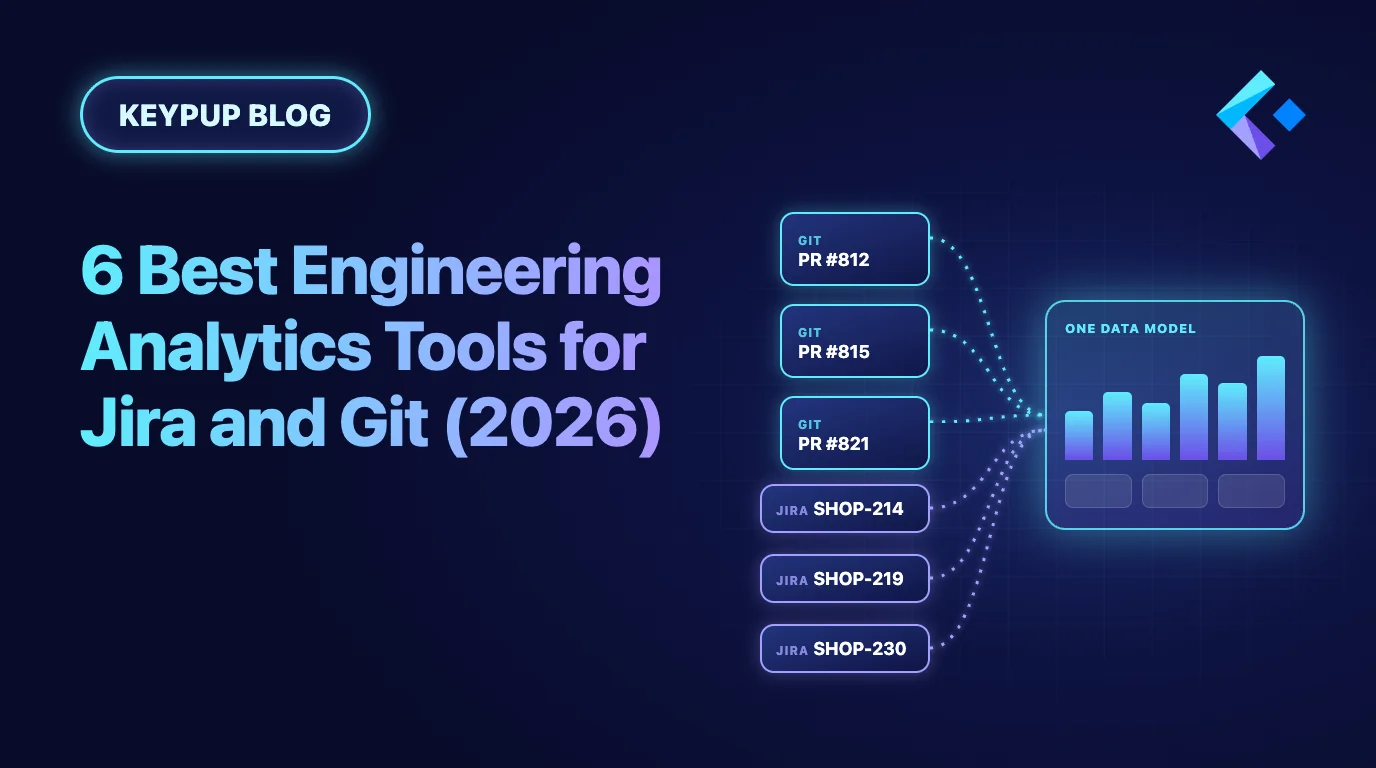
Compare the 6 best engineering analytics tools for Jira and Git in 2026 — Keypup, LinearB, Jellyfish, Swarmia, Faros AI and Pluralsight Flow — across Git and Jira unification, DORA Metrics and cycle time, dashboard customization, AI and natural language, integration breadth, setup speed and security. Find out which platform turns your code and ticketing data into one reporting layer with prescriptive recommendations.
Why do pull requests sit for days before anyone reviews them? Learn what engineering leaders on Reddit say about code review bottlenecks at enterprise scale, and how Keypup MCP uses review request dates, first review dates, approvals, reviewers and lines changed to measure your wait for first review, break cycle time into phases, find when requests get stuck, show who carries the review load and list the pull requests waiting right now.