The Reviewer Bystander Effect: Why More Reviewers Make Pull Requests Wait Longer
In a typical enterprise, a pull request sent to five reviewers waits 3.4 times longer for its first review than one sent to a single reviewer, and 69% of the people asked never respond. Learn what engineering leaders on Reddit say about review requests nobody owns, and how Keypup MCP measures the reviewer bystander effect, from panel size to the people who actually review.
TL;DR: Adding reviewers to a pull request feels like a way to get it reviewed faster and more safely. The data says the opposite. In a typical enterprise organization, a pull request sent to one reviewer gets its first review in 3.2 business hours at the median; one sent to five or more waits 10.8, and 69% of the people asked never respond. Pull requests sent to five people still get 1.92 reviews on average, the same as those sent to four. Over a year, the average panel grew from 2.6 to 3.7 reviewers, and the share of unanswered requests from 38% to 54%. The Keypup MCP Server reads each pull request's requested reviewers, past reviewers, review request and first review dates, approvals, size, repository and recommended next action, every reviewer assignment event, and every submitted review with its author and state. Your AI assistant can then show how panel size drives the wait, who actually reviews and who never does, which repositories over-request, and which open pull requests need a single owner today.
It's Tuesday afternoon, and a pull request opened on Monday morning still has no review. It has six reviewers on it: four added automatically for the folders it touches, one the author's tech lead, and one added this morning "to get some eyes on it". All six got the notification. Each of them saw five other names and moved on to something else. Nobody is late, because nobody was ever really asked.
The Friction: Everyone Is Asked, So Nobody Owns It
Social psychologists call it the bystander effect: the more people witness a problem, the less likely any one of them is to act. Code review at enterprise scale reproduces it almost perfectly:
Ownership rules multiply reviewers. Code ownership files and auto-assignment rules add a reviewer for every folder a change touches. A cross-cutting change in a monorepo can pull in five teams by default.
Reviewer lists are copied, not chosen. Authors reuse the list from their last pull request, or add their whole team "for visibility". Nobody removes a name.
A request isn't a commitment. A review request on GitHub, GitLab, Bitbucket or Azure DevOps is a notification, not an assignment. With six names on it, each reviewer reasonably assumes someone closer to the change will take it.
Escalation adds more bystanders. When a pull request is stuck, the reflex is to add another reviewer, which makes the group larger and the responsibility thinner.
The result: pull requests that look well covered on paper, and wait the longest in practice.
Why This Matters: The Real Cost of the Bystander Effect
The Flow Problem
Time to first review is usually the largest single phase of pull request cycle time. When it triples for a third of all changes, lead time for changes, sprint commitments and release dates all slip, while every review dashboard shows plenty of reviewers assigned.
The Fairness Problem
Unanswered requests don't disappear: the work falls on the few people who reliably respond. They become the review bottleneck and burn out, while the engineers who ignore requests appear in the reviewer lists of hundreds of pull requests they never read.
The Assurance Problem
A six-name reviewer list tells auditors and leadership that changes get broad scrutiny. If two of those six actually review, the control is weaker than it looks, and nobody knows which pull requests got the scrutiny the list implies.
The Enterprise Discussion: What Engineering Leaders Are Actually Saying
"Everyone's tagged, nobody reviews", "CODEOWNERS made our reviews slower" and "I ignore anything with more than three reviewers" come up again and again wherever engineering managers, staff engineers and platform leads compare notes. The quotes below are representative of recurring threads on r/ExperiencedDevs, r/EngineeringManagers, r/devops and r/softwareengineering.
"I get added to 40 pull requests a week through ownership rules. I can't review them all, so I review the ones where I'm the only name. If there are five other people on it, I assume one of them has it. So do they."
Engineering Manager, E-commerce Group (r/EngineeringManagers)
"Our monorepo adds four or five teams to any change that touches shared code. The pull requests with the most reviewers are the ones that sit for days. When I ask who owns the review, everyone points at someone else."
Platform Lead, Enterprise SaaS (r/devops)
"When something's stuck, people just add more reviewers. I've seen pull requests with nine names on them and zero comments. The fix was one person saying 'I've got it', which no tool ever asked for."
The pattern holds: organizations add reviewers to make reviews faster and safer, but nobody measures whether those reviewers respond, or what the extra names cost in waiting time.
How Keypup MCP Measures the Reviewer Bystander Effect
The Keypup Model Context Protocol (MCP) Server gives your AI assistant structured access to the data Keypup imports from GitHub, GitLab, Bitbucket and Azure DevOps, and from Jira. For this analysis, three datasets matter. Each pull request carries its requested reviewers (still pending), its past reviewers (who submitted a review), its review request and first review dates, its approval count, its lines changed, its repository and, while open, Keypup's recommended next action. Each activity event records when a reviewer was assigned or unassigned, and to whom. Each review records its author, state, request date and submission date.
The panel of a pull request is the number of reviewers requested on it: those still pending at merge plus those who submitted a review. All figures cover pull requests merged in the last 12 full months, November 2025 to October 2026, with at least one requested reviewer, for an organization of around 1,100 engineers in 52 repositories.
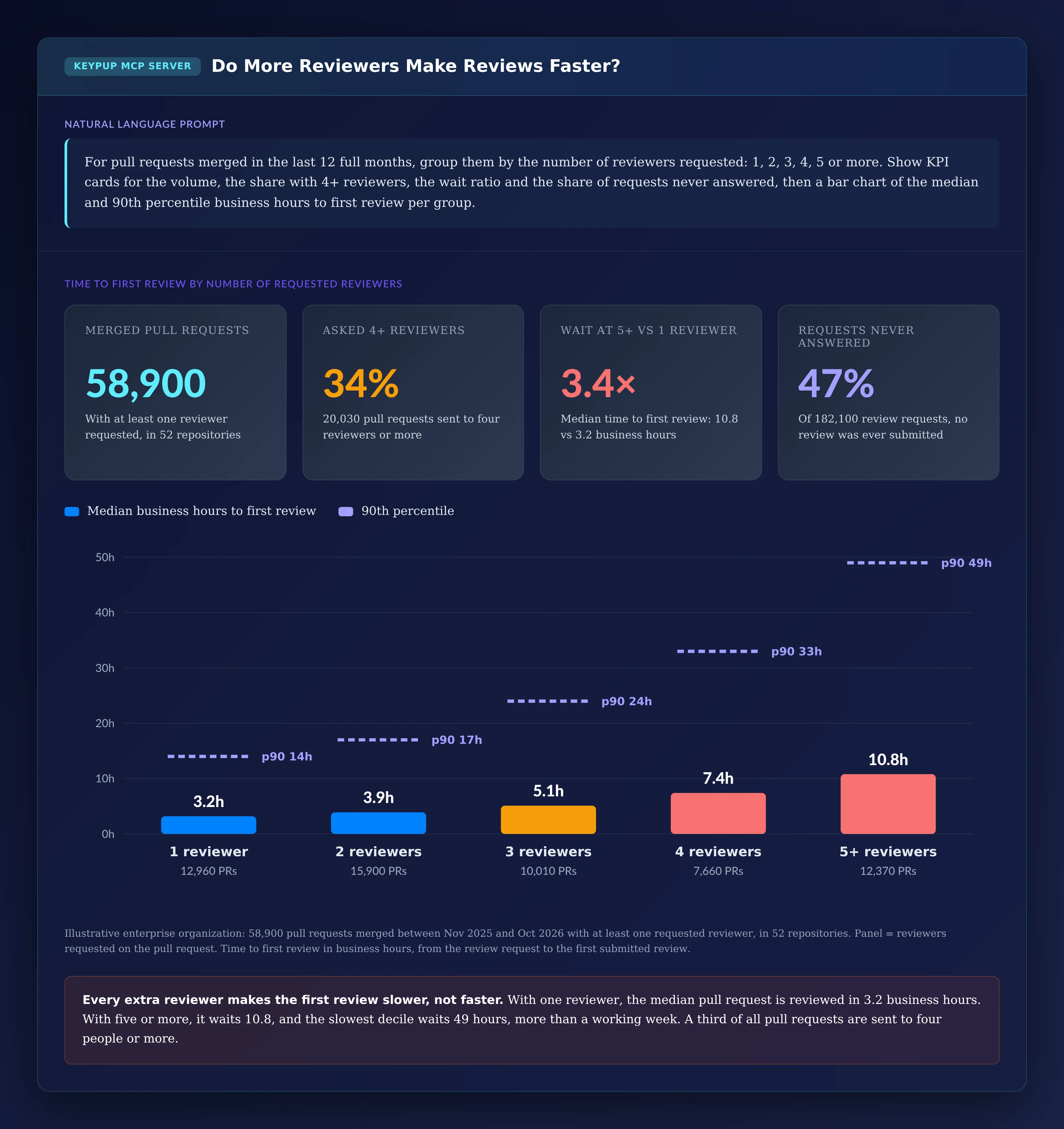
1. Measuring Whether More Reviewers Make Reviews Faster
The first question: does adding reviewers shorten the wait for a first review, or lengthen it?
MCP Prompt:
For pull requests merged in the last 12 full months, group them by
the number of reviewers requested: 1, 2, 3, 4, 5 or more. Show KPI
cards for the volume, the share with 4+ reviewers, the wait ratio
and the share of requests never answered, then a bar chart of the
median and 90th percentile business hours to first review per group.
Output: Do More Reviewers Make Reviews Faster?
Key Insight: Every extra reviewer makes the first review slower, not faster. With one reviewer, the median pull request is reviewed in 3.2 business hours. With five or more, it waits 10.8, and the slowest decile waits 49 hours, more than a working week. A third of all pull requests are sent to four people or more.
2. Seeing What Requested Reviewers Actually Do
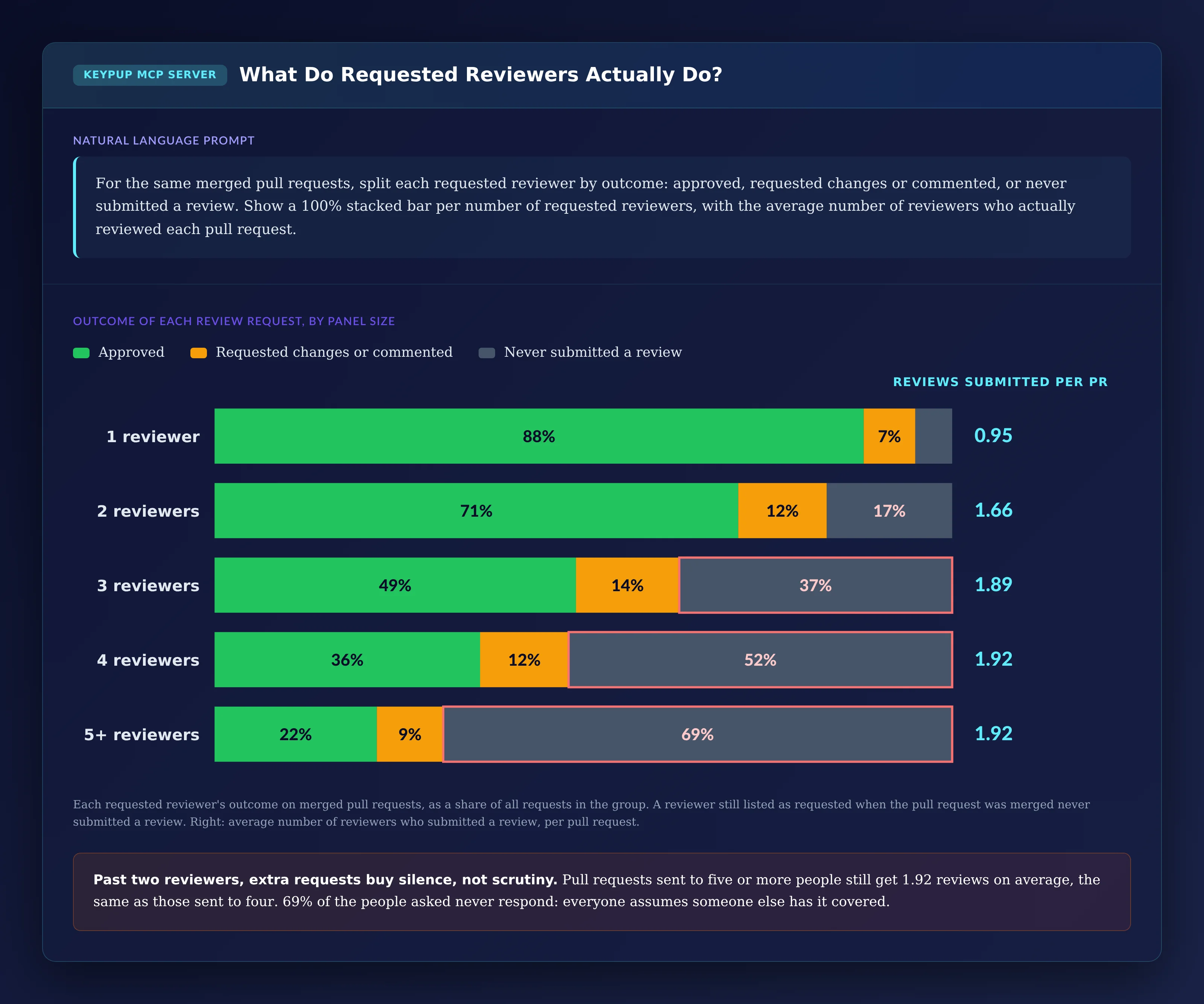
A long wait could mean reviewers are slow. Splitting each request by its outcome shows whether they respond at all.
MCP Prompt:
For the same merged pull requests, split each requested reviewer by
outcome: approved, requested changes or commented, or never submitted
a review. Show a 100% stacked bar per number of requested reviewers,
with the average number of reviewers who actually reviewed each
pull request.
Output: What Do Requested Reviewers Actually Do?
Key Insight: Past two reviewers, extra requests buy silence, not scrutiny. Pull requests sent to five or more people still get 1.92 reviews on average, the same as those sent to four. 69% of the people asked never respond: everyone assumes someone else has it covered.
3. Following the Panel Size Over Time
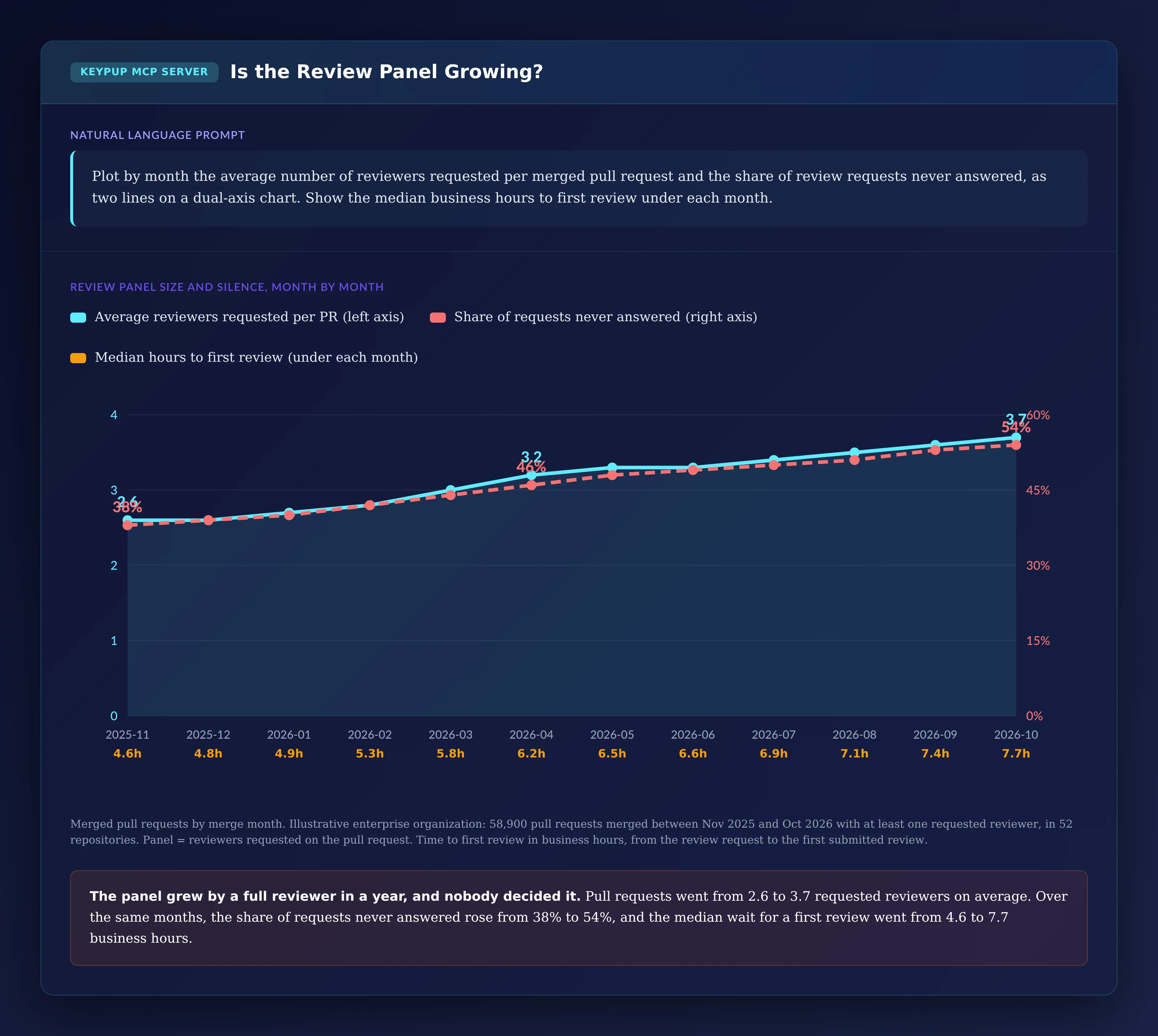
Reviewer lists rarely shrink. A monthly view shows whether the panel is drifting, and what that drift costs.
MCP Prompt:
Plot by month the average number of reviewers requested per merged
pull request and the share of review requests never answered, as two
lines on a dual-axis chart. Show the median business hours to first
review under each month.
Output: Is the Review Panel Growing?
Key Insight: The panel grew by a full reviewer in a year, and nobody decided it. Pull requests went from 2.6 to 3.7 requested reviewers on average. Over the same months, the share of requests never answered rose from 38% to 54%, and the median wait for a first review went from 4.6 to 7.7 business hours.
4. Finding Who Answers Review Requests
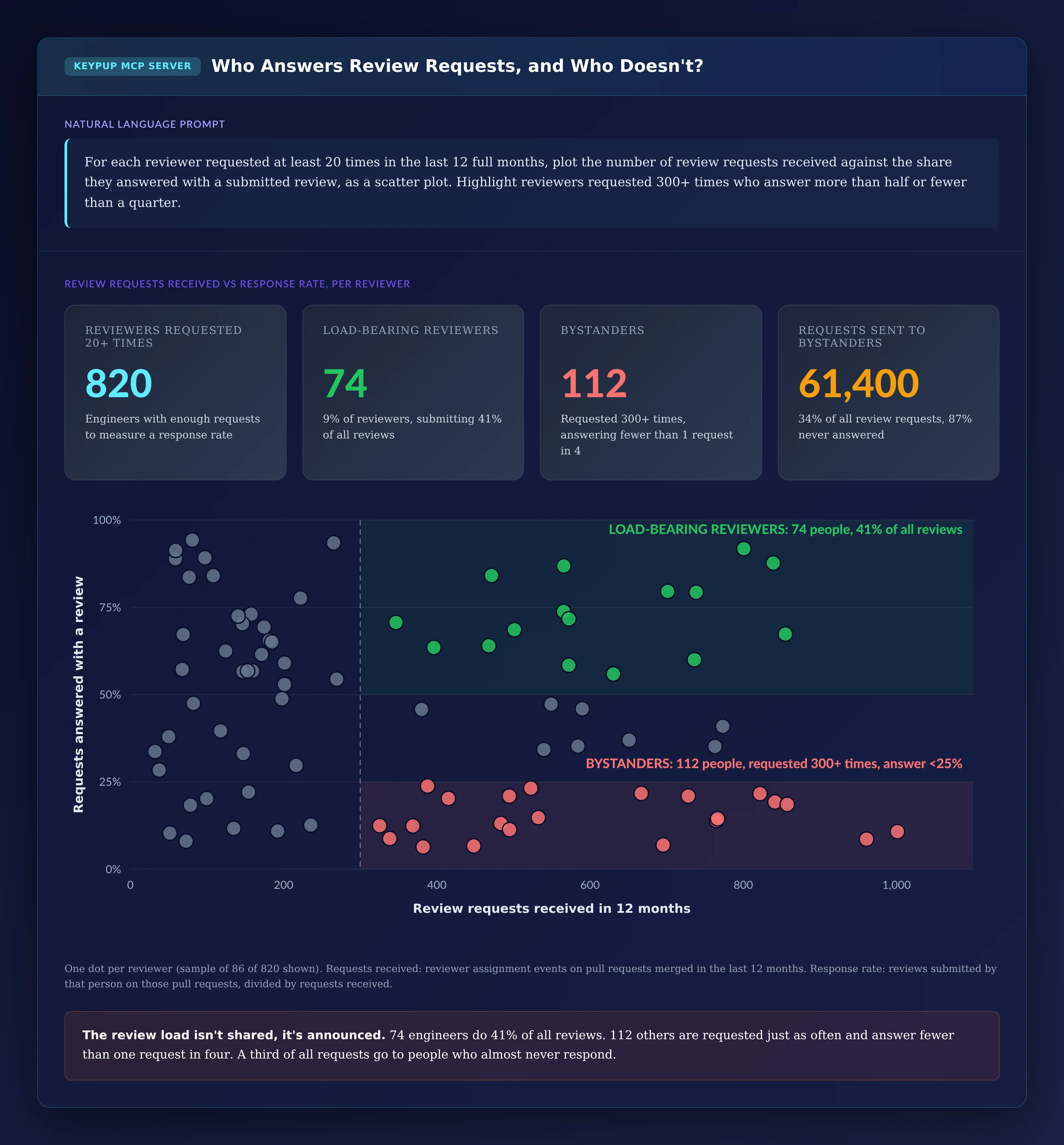
The bystander effect is a group behavior, but it shows up person by person. Crossing the requests each engineer receives with the reviews they submit separates the people carrying the load from those who are only notified.
MCP Prompt:
For each reviewer requested at least 20 times in the last 12 full
months, plot the number of review requests received against the share
they answered with a submitted review, as a scatter plot. Highlight
reviewers requested 300+ times who answer more than half or fewer
than a quarter.
Output: Who Answers Review Requests, and Who Doesn't?
Key Insight: The review load isn't shared, it's announced. 74 engineers do 41% of all reviews. 112 others are requested just as often and answer fewer than one request in four. A third of all requests go to people who almost never respond. This isn't a performance ranking: being requested on a pull request isn't the same as being the right person to review it.
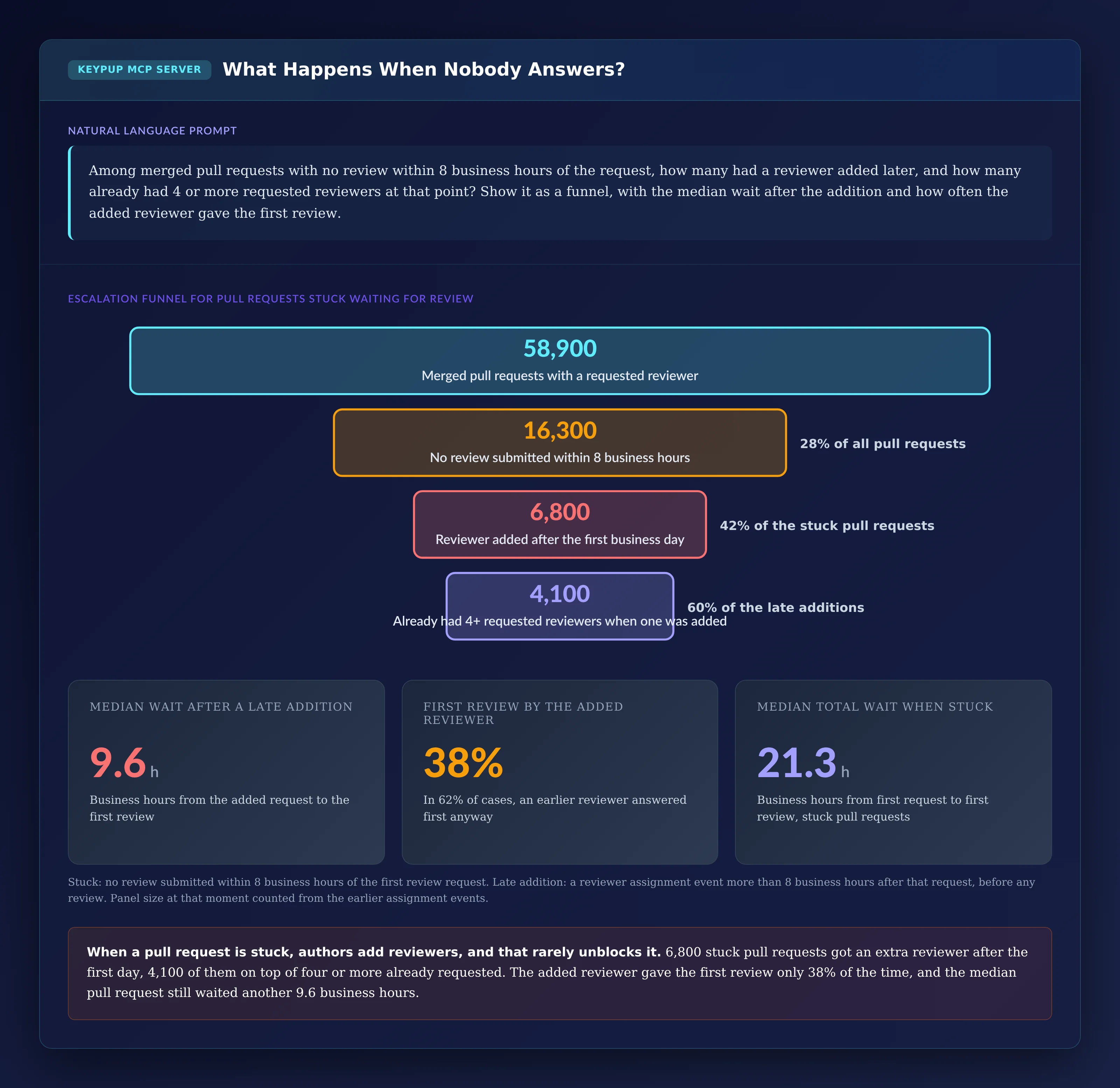
5. Checking What Happens When Nobody Answers
When a pull request is stuck, authors often add another reviewer. Activity events show when each reviewer was added, so you can test whether that works.
MCP Prompt:
Among merged pull requests with no review within 8 business hours of
the request, how many had a reviewer added later, and how many already
had 4 or more requested reviewers at that point? Show it as a funnel,
with the median wait after the addition and how often the added
reviewer gave the first review.
Output: What Happens When Nobody Answers?
Key Insight: When a pull request is stuck, authors add reviewers, and that rarely unblocks it. 6,800 stuck pull requests got an extra reviewer after the first day, 4,100 of them on top of four or more already requested. The added reviewer gave the first review only 38% of the time, and the median pull request still waited another 9.6 business hours.
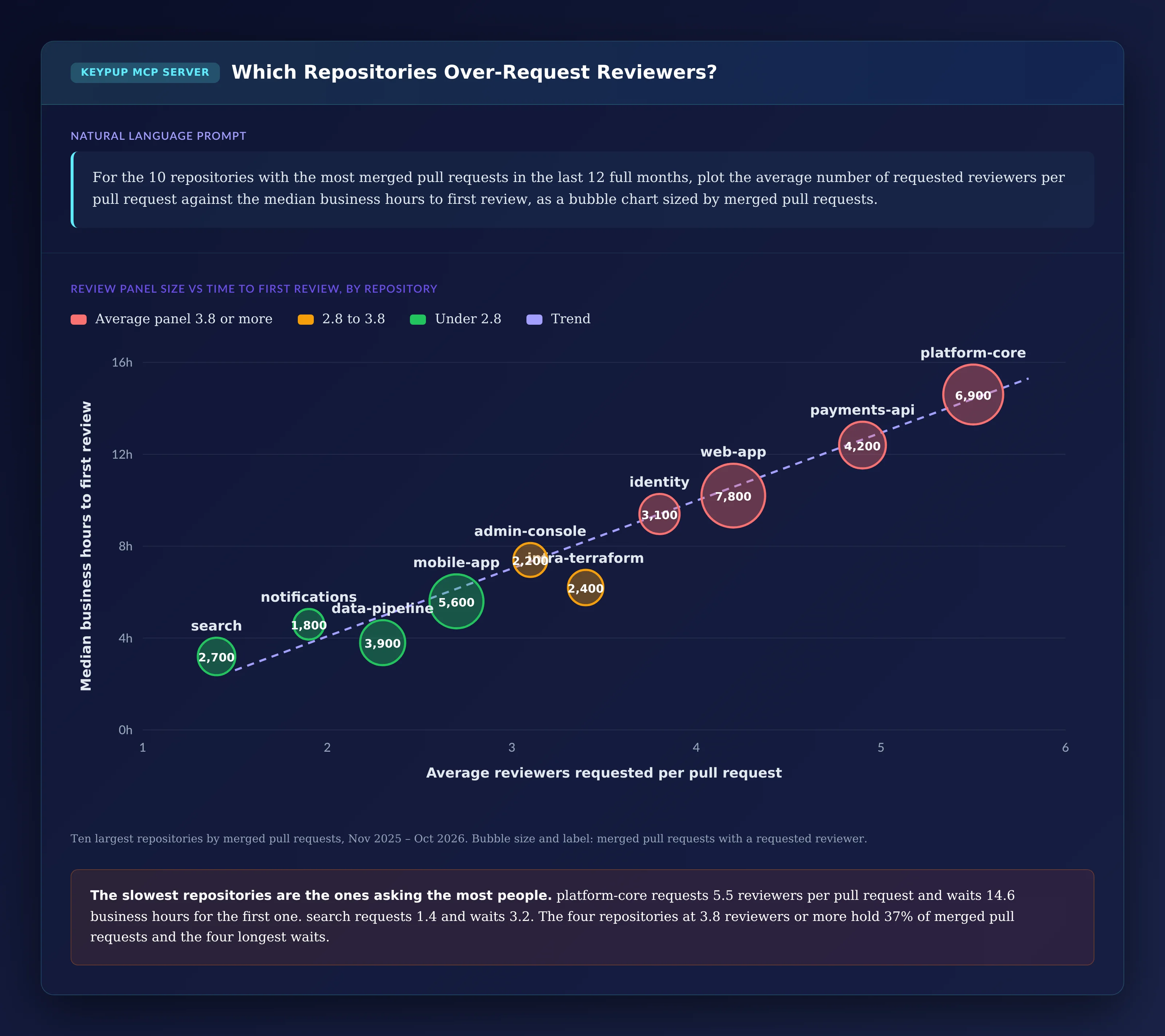
6. Comparing Repositories
Panel size is usually set by repository: its ownership rules, its auto-assignment settings, its habits. A repository view shows where to change them first.
MCP Prompt:
For the 10 repositories with the most merged pull requests in the last
12 full months, plot the average number of requested reviewers per
pull request against the median business hours to first review, as a
bubble chart sized by merged pull requests.
Output: Which Repositories Over-Request Reviewers?
Key Insight: The slowest repositories are the ones asking the most people. platform-core requests 5.5 reviewers per pull request and waits 14.6 business hours for the first one. search requests 1.4 and waits 3.2. The four repositories at 3.8 reviewers or more hold 37% of merged pull requests and the four longest waits.
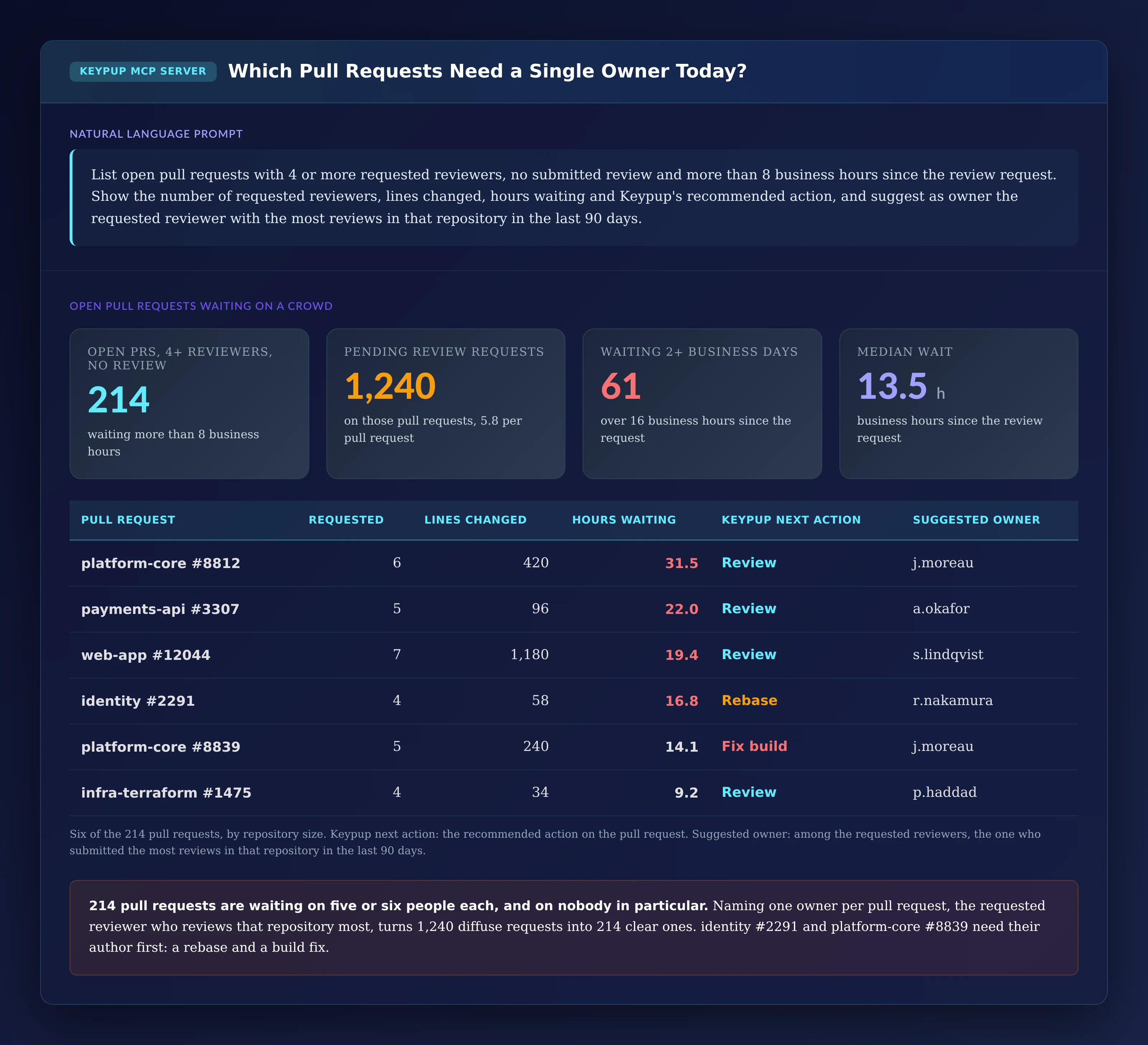
7. Naming a Single Owner for Each Waiting Pull Request
The last step turns the analysis into a daily routine: which open pull requests are waiting on a crowd, and who should own each review?
MCP Prompt:
List open pull requests with 4 or more requested reviewers, no
submitted review and more than 8 business hours since the review
request. Show the number of requested reviewers, lines changed, hours
waiting and Keypup's recommended action, and suggest as owner the
requested reviewer with the most reviews in that repository in the
last 90 days.
Output: Which Pull Requests Need a Single Owner Today?
Pull request
Requested
Lines changed
Hours waiting
Keypup next action
Suggested owner
platform-core #8812
6
420
31.5
Review
j.moreau
payments-api #3307
5
96
22.0
Review
a.okafor
web-app #12044
7
1,180
19.4
Review
s.lindqvist
identity #2291
4
58
16.8
Rebase
r.nakamura
platform-core #8839
5
240
14.1
Fix build
j.moreau
infra-terraform #1475
4
34
9.2
Review
p.haddad
Key Insight: 214 pull requests are waiting on five or six people each, and on nobody in particular. Naming one owner per pull request, the requested reviewer who reviews that repository most, turns 1,240 diffuse requests into 214 clear ones. identity #2291 and platform-core #8839 need their author first: a rebase and a build fix.
The Technical Implementation: What Keypup MCP Actually Reads
Every number above comes from fields Keypup already imports from your Git platforms. It helps to be precise about what they are, and what they depend on.
Panel Size Comes From Requested and Past Reviewers
Each pull request carries two lists: the reviewers still requested, and the people who submitted a review, even one later dismissed. On merged pull requests, a reviewer still in the requested list never submitted a review, because GitHub removes a reviewer from that list once they review. Check that your platform behaves the same way before relying on the "never answered" share: if it keeps reviewers in the list after they review, count silent reviewers as requested reviewers absent from the past reviewers instead. The panel is the sum of both lists. A reviewer who reviewed without being asked also appears in the past reviewers, so the panel slightly overstates requests on teams where spontaneous reviews are common.
Team Requests Count as One Reviewer
When a whole team is requested, for example through a code ownership rule that names a team, the platform records one request for the team, and Keypup counts it as one entry. If your ownership rules name teams rather than people, the panel undercounts the people notified, and the per-person view in section 4 only covers individual requests. Keypup doesn't read your code ownership files themselves: it sees the requests they produce.
Wait Times Come From Pull Request and Review Dates
Time to first review is the business hours between the review request date and the first submitted review on the pull request. The REVIEWS dataset gives each review's author, state (approved, changes requested, commented or dismissed), request date and submission date, which is how the assistant counts reviews per pull request and per person, and finds who gave the first review.
Late Additions Come From Assignment Events
The activity events dataset records every reviewer assignment and unassignment with its date and the person concerned, when your Git platform exposes these events. Comparing those dates with the first review request and the first submitted review shows which reviewers were added while a pull request was waiting, how many were already on it, and whether the added reviewer answered first. These measures combine two datasets, matched on the pull request, which your assistant does across queries.
Suggested Owners and Next Actions
The suggested owner is computed by the assistant from the REVIEWS dataset: among the requested reviewers, the one who submitted the most reviews in that repository in the last 90 days. The next action is Keypup's recommended action on the pull request, such as review, rebase or fix the build, based on its review state, build status and mergeability.
What Keypup Doesn't See
Keypup doesn't import notifications, so it can't tell whether a reviewer saw a request. It doesn't import calendars or time off: a reviewer on leave counts as silent. And it doesn't read review comments to judge their depth, so a review is counted when it's submitted, whatever its content.
Real-World Impact: Enterprise Case Studies
Case Study 1: European Retail Technology Group
Before Keypup MCP:
1,200 engineers in a large monorepo, with ownership rules adding four teams to most shared-code changes
Review wait blamed on "not enough reviewers", answered by adding more names to ownership rules
A handful of senior engineers doing most reviews, two of whom left within a year
After Keypup MCP:
The panel size chart changed the diagnosis: the problem wasn't too few reviewers, but too many per pull request
Ownership rules were narrowed: shared folders now request one owning team, and auto-assignment picks one person within it
The scatter plot rebalanced the load: load-bearing reviewers were removed from rules where they rarely reviewed, and their review share fell from half to under a third
"We kept adding reviewers because reviews were slow, and reviews were slow because we kept adding reviewers. Seeing the wait triple past four names ended a debate we'd been having for two years."
— VP Engineering, European Retail Technology Group
Case Study 2: North American Insurance Software Provider
Before Keypup MCP:
700 engineers across 40 repositories, with a policy of "at least two teams on every change"
Pull requests with six or seven reviewers waiting days, then approved by the first person who looked
Audit reports listing reviewer counts as evidence of control
After Keypup MCP:
One named owner per pull request: the daily open queue now names a single owner for every pull request waiting on four or more reviewers
The policy was rewritten around reviews, not requests: two submitted approvals are required, instead of two teams requested
Escalation changed: stuck pull requests go to the suggested owner rather than to a new reviewer, and late additions dropped sharply
"Our auditors liked the reviewer counts. When we showed them that more than half of those reviewers never opened the pull request, we agreed to report reviews submitted instead. It's a smaller number, and a true one."
— Director of Engineering, North American Insurance Software Provider
Implementation: Getting Started with Keypup MCP
1. Connect Your Git Platforms
Connect GitHub, GitLab, Bitbucket or Azure DevOps to Keypup. Pull requests and reviews are imported automatically, along with reviewer assignment events where your platform provides them.
2. Check How Reviewers Are Requested
Ask your assistant for the share of merged pull requests with a review request date, by repository. Where reviews happen without an explicit request, wait times can't be measured, so agree that every pull request requests its reviewers. If your ownership rules name teams, consider configuring team requests to assign one person, which most platforms support.
3. Agree on Your Working Hours
Business hours depend on your teams' working days. State them, and the threshold you consider "stuck", such as 8 business hours, in your prompts so every team reads the same numbers.
4. Connect the MCP Server to Your AI Assistant
Connect the MCP server to your AI assistant using the MCP documentation, and run the panel size analysis for your last 12 months to set a baseline.
5. Make the Open Queue a Daily Routine
Run the open queue every morning, name one owner per pull request, and review the panel size trend and the repository bubble chart every quarter, when ownership rules and auto-assignment settings are revisited.
Frequently Asked Questions
How many reviewers should a pull request have?
For most changes, one or two. Beyond two requested reviewers, the number of reviews actually submitted barely increases, while the wait for the first one grows. Changes that need several areas of expertise are better served by one named owner who brings in others when needed than by a long list of equally responsible reviewers.
What is the bystander effect in code review?
It's the tendency of each requested reviewer to act less when more reviewers are requested, because everyone assumes someone else will take the review. It shows up as longer waits for a first review and a growing share of review requests that are never answered as the number of reviewers grows.
Do code ownership rules slow down code review?
They can. Ownership rules that request every team owning a touched folder make large and cross-cutting changes go to many reviewers by default. Requesting one owning team per change, and having the platform assign one person within it, keeps the benefit of ownership without the crowd.
How do you measure code review responsiveness?
Measure the business hours from the review request to the first submitted review, and the share of review requests answered with a review, by number of requested reviewers, by repository and by reviewer. Follow both over time to see whether changes to ownership rules and team habits are working.
The Bottom Line
Adding a reviewer feels free, and it's the most common response to a slow review. But every name added to a pull request dilutes the responsibility of the others, and past two reviewers, the extra names buy silence, not scrutiny. Keypup MCP makes the reviewer bystander effect visible:
✅ Measuring whether more reviewers make reviews faster, panel size by panel size ✅ Seeing what requested reviewers actually do, from approval to silence ✅ Following the panel size over time, and what its drift costs ✅ Finding who answers review requests, and who is only notified ✅ Checking what happens when nobody answers, and whether adding reviewers helps ✅ Comparing repositories, to know which rules to change first ✅ Naming a single owner for each waiting pull request, every day
Ready to find out how many of your reviewers are bystanders? Connect the Keypup MCP Server and ask your AI assistant.
Ready to Transform Your Analytics?
Join teams already using AI to make data-driven decisions faster than
ever.
In a typical enterprise, a pull request sent to another team's repository waits 3.8 times longer for a first review, takes almost five working days to merge and is three times more likely to be abandoned. Learn what engineering leaders on Reddit say about cross-team contributions, and how Keypup MCP measures the inner source tax, from which owning teams are bottlenecks to which cross-team pull requests to unblock today.
In a typical enterprise, the longest phase of a pull request's life starts after it is approved: a median of 9.6 business hours from last approval to merge, and 31% of approved pull requests waiting two business days or more. Learn what engineering leaders on Reddit say about approved code that doesn't ship, and how Keypup MCP measures merge limbo, from who holds the merge button to which approved pull requests can be merged today.
In a typical enterprise that supports several versions of its product, one merged pull request in five targets an older release line, and customers on the oldest line wait ten business days for fixes already merged on main. Learn what engineering leaders on Reddit say about backports and LTS maintenance, and how Keypup MCP measures the backport tax, line by line.