In a typical enterprise that supports several versions of its product, one merged pull request in five targets an older release line, and customers on the oldest line wait ten business days for fixes already merged on main. Learn what engineering leaders on Reddit say about backports and LTS maintenance, and how Keypup MCP measures the backport tax, line by line.
TL;DR: Every enterprise that ships versioned software, on-premise products, SDKs, mobile apps or platforms with LTS contracts, pays a backport tax: the same fix, written, reviewed and merged again on every supported release line. In a typical organization, 21% of merged pull requests target a release branch, and the share rose from 16% to 25% in a year. The oldest line gets its fixes 9.8 business days after main at the median. 1,440 Medium and Low priority bugs were backported to two lines or more, against a "critical fixes only" policy, and backports are merged with no approval nearly five times as often as changes on main. The Keypup MCP Server reads each pull request's base branch, repository, title, merge date, merger, review dates, approvals and size, and each Jira issue's priority and Fix versions. Your AI assistant can then measure how much capacity goes into older versions, which lines and repositories absorb it, how long customers wait, whether the backport policy is followed, and which critical fixes are still missing on a supported version.
It's Thursday morning, and a security fix merged on main nine days ago. The release manager has just been asked by a large customer on version 7.2 when they'll get it. Nobody knows. The fix was cherry-picked to 8.4 the same day, to 8.2 two days later, and the 7.6 backport is approved but stuck on a merge conflict. For 7.2, nobody opened a pull request at all: the code there was refactored two years ago, and the engineer who knew it moved teams.
The Friction: One Fix, Many Versions
When a product supports several versions at once, every fix is a set of fixes. Teams manage the backport tax with a branching model and a support policy, but at enterprise scale it escapes both:
Support commitments outlive the code. Sales sign multi-year LTS contracts, while the main branch keeps moving. The older the line, the more each backport has to be rewritten instead of cherry-picked.
Backports are invisible in planning. They rarely get their own Jira ticket. The original issue is "Done" when it's merged on main, and the work on three older lines is never estimated or planned.
The policy isn't enforced by anything. "Critical and security fixes only" is written in the support policy, but any engineer can open a backport, and a customer escalation turns a Medium bug into a five-line backport campaign.
"It's just a cherry-pick" lowers the review bar. Backports are seen as already reviewed, so they get merged quickly, often by their own author, even when the patch was rewritten to fit older code.
The result: a growing share of engineering capacity goes into versions the roadmap no longer mentions, and nobody can say how much.
Why This Matters: The Real Cost of the Backport Tax
The Capacity Problem
Every backport is a pull request: it needs a branch, a build, a review and a merge, and on old lines, real engineering to adapt the patch. When a fifth of merged pull requests go to older versions, a fifth of the delivery pipeline is serving the past, and roadmap forecasts built on total throughput are wrong by that much.
The Customer Exposure Problem
A fix merged on main only protects customers running main. Customers on LTS versions stay exposed until the backport is merged, and nobody tracks that gap: Jira says "Done", the security team says "fixed", and the customer's version is still vulnerable.
The Risk Problem
Backports to drifted code are new code. When they skip review because they "were already reviewed on main", the riskiest changes in the organization get the lightest scrutiny, on the versions with the least test coverage.
The Enterprise Discussion: What Engineering Leaders Are Actually Saying
"We spend more time backporting than building", "nobody knows if the fix made it to 7.x" and "our LTS promise is killing us" come up again and again wherever release managers, engineering managers and staff engineers compare notes. The quotes below are representative of recurring threads on r/ExperiencedDevs, r/devops, r/softwareengineering and r/EngineeringManagers.
"We support four versions. Every security fix means four pull requests, four builds, four reviews. Half my week is chasing backports, and when a customer asks if they're patched, I have to go check branches by hand."
"The policy says we only backport critical fixes. In practice, every account manager with a big customer on the old version gets their bug backported. Nobody ever counted what that costs us, so nobody ever said no."
Staff Engineer, Industrial Software Group (r/ExperiencedDevs)
"Cherry-picks to the LTS branch get rubber-stamped because 'it's the same change'. It isn't. Half the time the code around it is completely different, and that's exactly where our regressions come from."
The pattern holds: organizations sign long support commitments and write backport policies, but nobody measures how much capacity backports take, how long older versions wait for fixes, or whether the policy is followed.
How Keypup MCP Measures the Backport Tax
The Keypup Model Context Protocol (MCP) Server gives your AI assistant structured access to the data Keypup imports from GitHub, GitLab, Bitbucket and Azure DevOps, and from Jira. For this analysis, what matters is that each pull request carries its base branch (the branch it merges into), its repository, its title, its merge date and who merged it, its review request, first review and approval dates, its approval count, its lines changed, its last commit date, and for open ones, its build status, mergeability and a recommended next action. Each Jira issue carries its type, priority and Fix versions.
Two conventions make the analysis possible. A backport is a merged pull request whose base branch is a release line, here any branch matching release/, support/ or hotfix/. A backport family is the set of pull requests sharing the same Jira key in their title, which is how most teams name cherry-picks ([8.2] PLAT-7712 Fix token refresh). Both are written into the prompts, so they can be adapted to your branching model. All figures cover pull requests merged in the last 12 full months, November 2025 to October 2026, for an organization of around 900 engineers shipping an on-premise platform with four supported release lines, in 46 repositories.
1. Measuring How Much Engineering Goes Into Older Versions
The first question: what share of merged work never reaches the next version, and is it growing?
MCP Prompt:
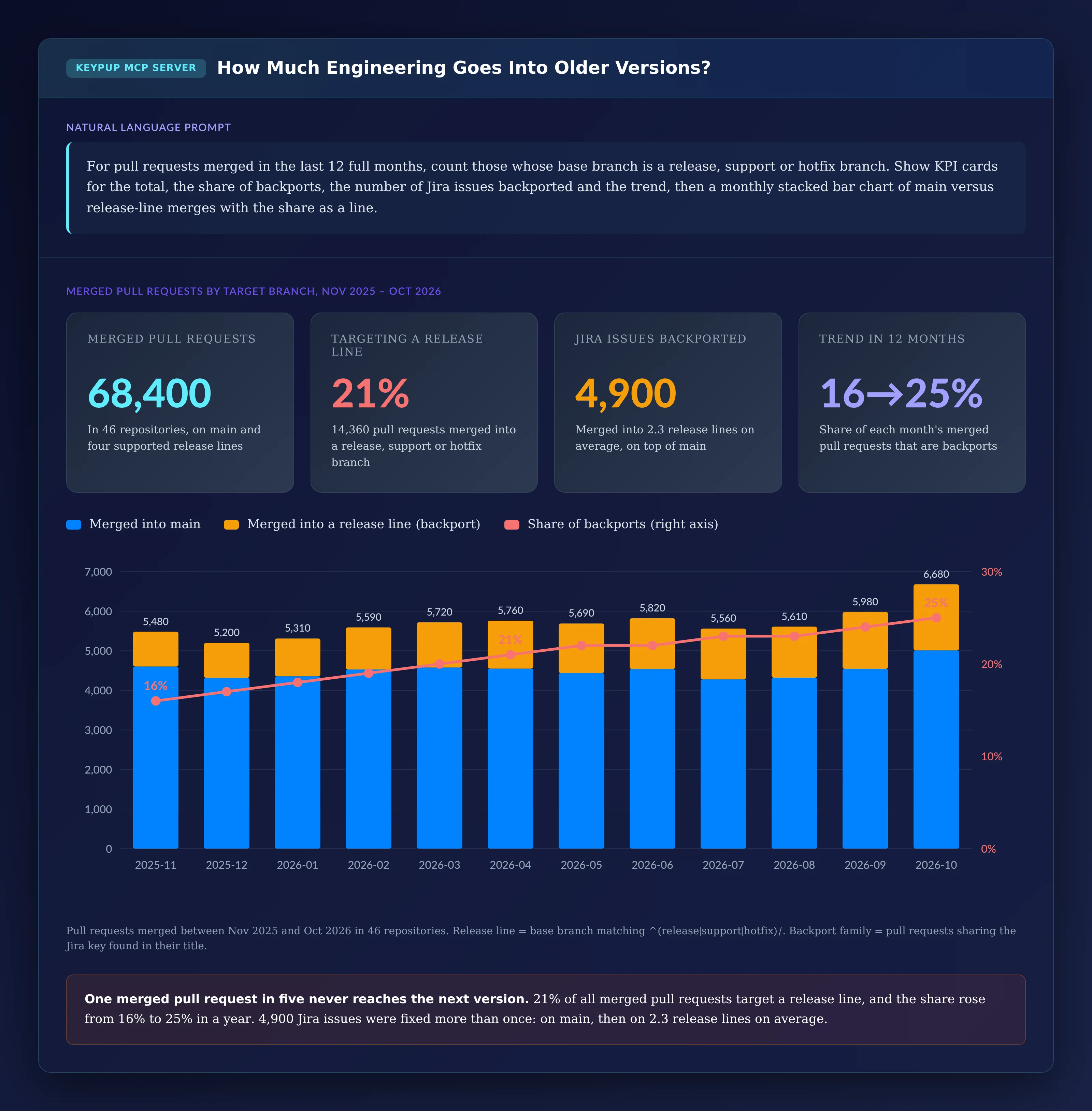
For pull requests merged in the last 12 full months, count those
whose base branch is a release, support or hotfix branch. Show KPI
cards for the total, the share of backports, the number of Jira
issues backported and the trend, then a monthly stacked bar chart
of main versus release-line merges with the share as a line.
Output: How Much Engineering Goes Into Older Versions?
Key Insight: One merged pull request in five never reaches the next version. 21% of all merged pull requests target a release line, and the share rose every quarter, from 16% to 25%. 4,900 Jira issues were fixed more than once: on main, then on 2.3 release lines on average.
2. Finding Which Release Lines Absorb the Backports
Not every line costs the same. The base branch shows where backports go, and lines changed show how much each one has to be adapted.
MCP Prompt:
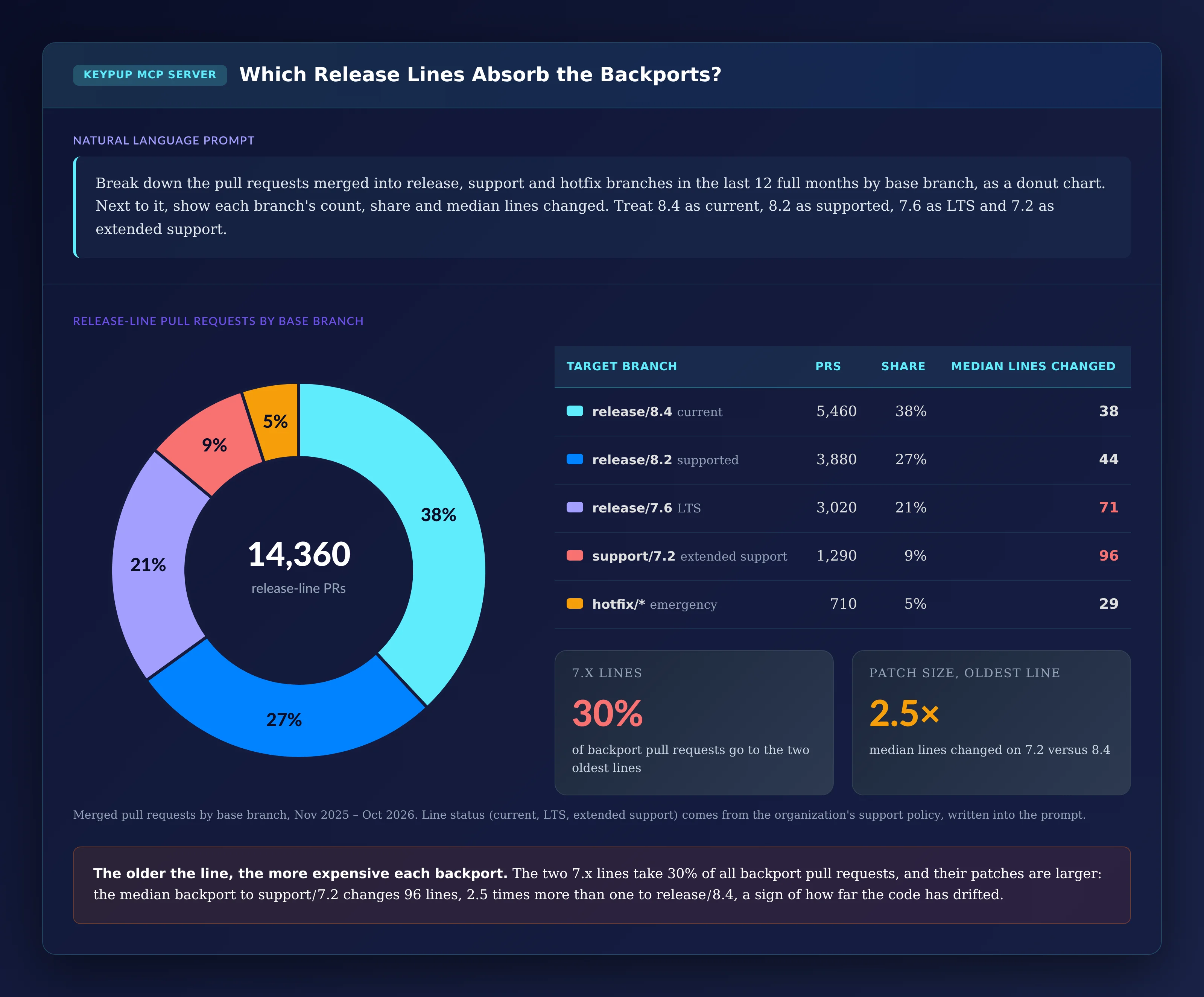
Break down the pull requests merged into release, support and hotfix
branches in the last 12 full months by base branch, as a donut chart.
Next to it, show each branch's count, share and median lines changed.
Treat 8.4 as current, 8.2 as supported, 7.6 as LTS and 7.2 as
extended support.
Output: Which Release Lines Absorb the Backports?
Key Insight: The older the line, the more expensive each backport. The two 7.x lines take 30% of all backport pull requests, and their patches are larger: the median backport to support/7.2 changes 96 lines, 2.5 times more than one to release/8.4, a sign of how far the code has drifted.
3. Measuring How Long Older Versions Wait for a Fix
A fix on main protects only the customers running main. The time between the main merge and each release-line merge is the window during which customers on that line remain exposed.
MCP Prompt:
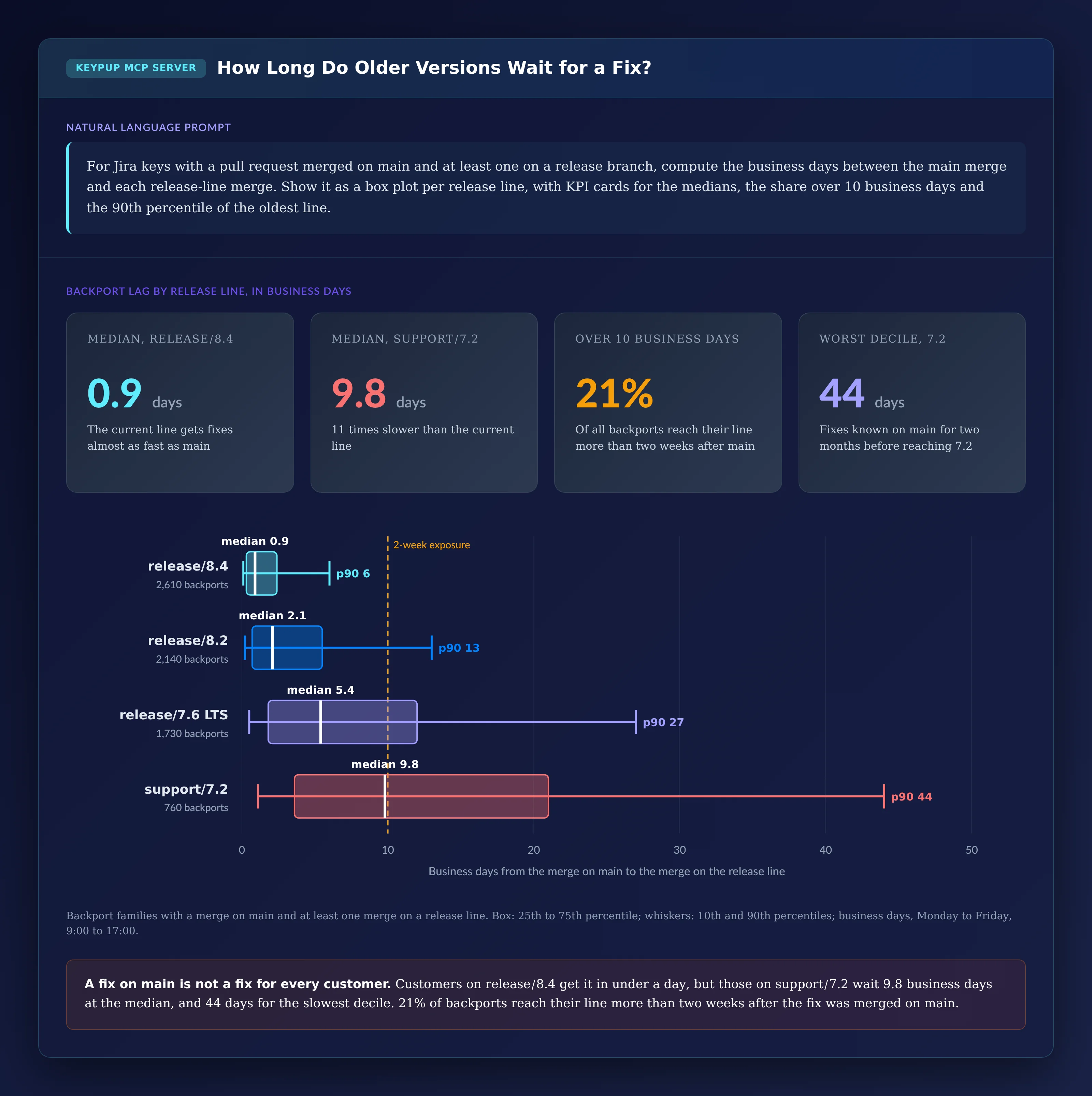
For Jira keys with a pull request merged on main and at least one on
a release branch, compute the business days between the main merge
and each release-line merge. Show it as a box plot per release line,
with KPI cards for the medians, the share over 10 business days and
the 90th percentile of the oldest line.
Output: How Long Do Older Versions Wait for a Fix?
Key Insight: A fix on main isn't a fix for every customer. Customers on release/8.4 get it in under a day, but those on support/7.2 wait 9.8 business days at the median, and 44 days for the slowest decile. 21% of backports reach their line more than two weeks after the fix was merged on main.
4. Checking Whether the Backport Policy Is Followed
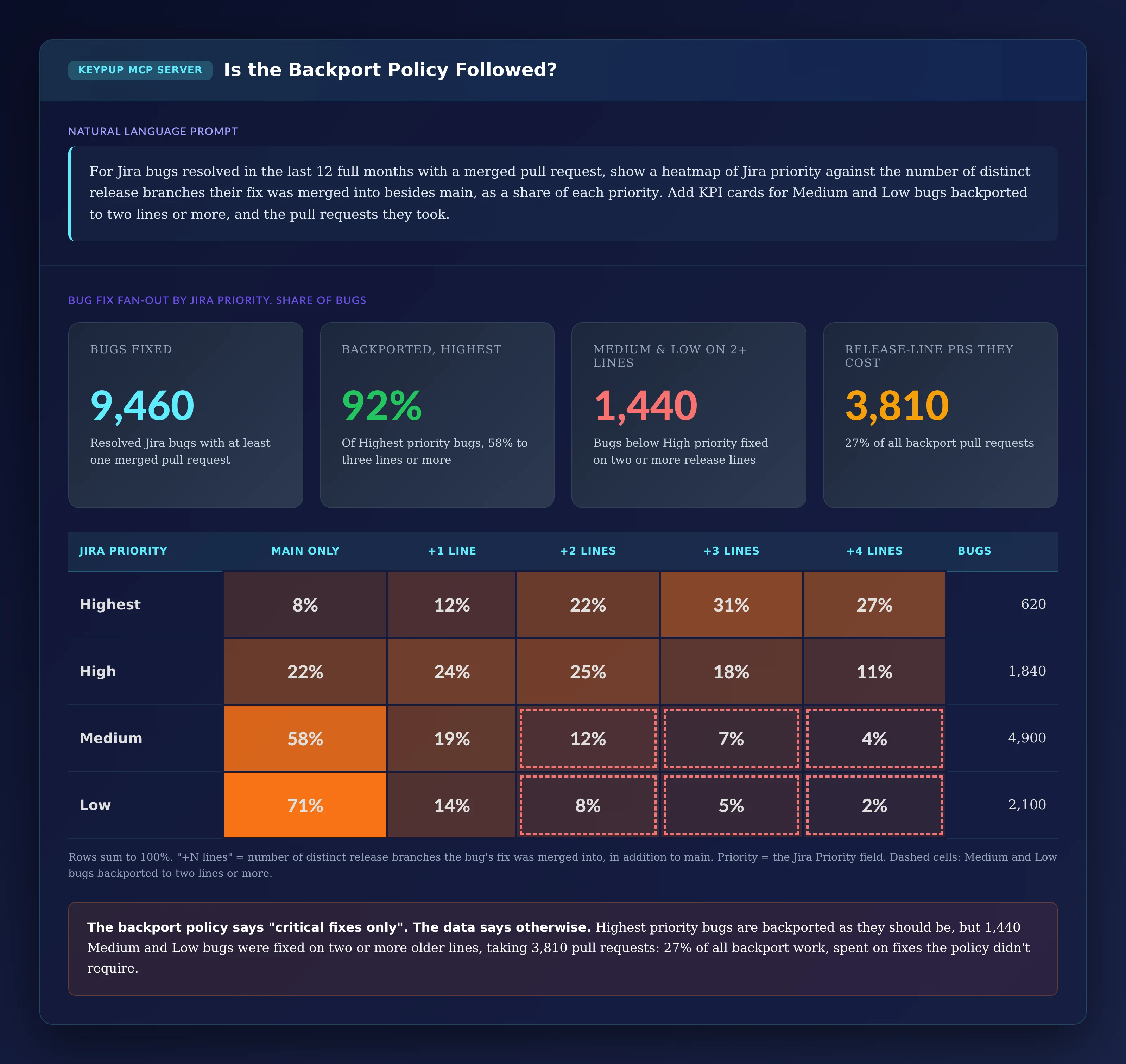
Most support policies limit backports to critical fixes. Crossing the Jira priority of each bug with the number of release lines its fix reached shows whether that holds.
MCP Prompt:
For Jira bugs resolved in the last 12 full months with a merged pull
request, show a heatmap of Jira priority against the number of
distinct release branches their fix was merged into besides main, as
a share of each priority. Add KPI cards for Medium and Low bugs
backported to two lines or more, and the pull requests they took.
Output: Is the Backport Policy Followed?
Key Insight: The backport policy says "critical fixes only". The data says otherwise. Highest priority bugs are backported as they should be, but 1,440 Medium and Low bugs were fixed on two or more older lines, taking 3,810 pull requests: 27% of all backport work, spent on fixes the policy didn't require.
5. Comparing How Backports Are Reviewed
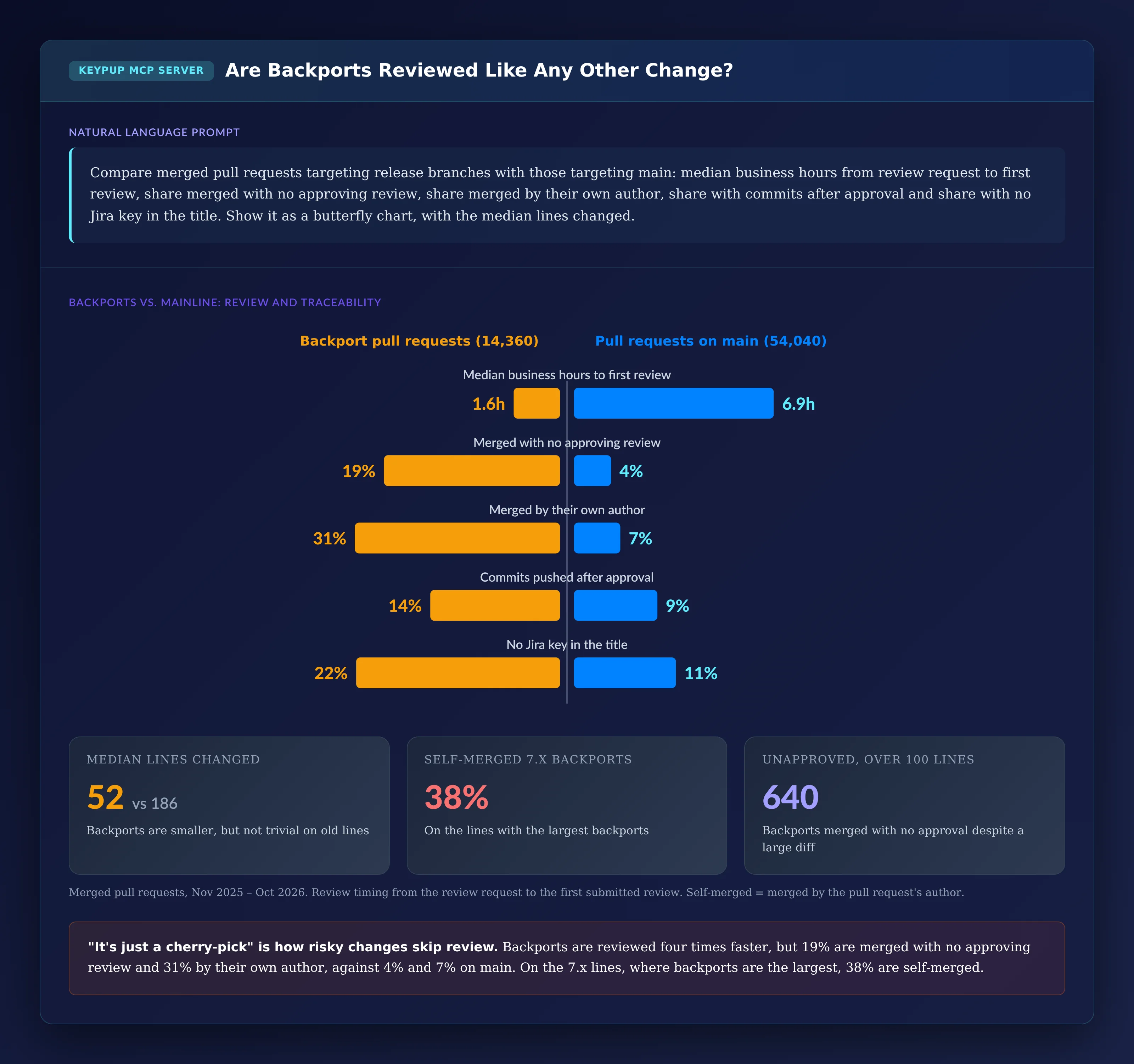
"It's the same change" is the usual argument for a light review. Comparing backports with pull requests on main shows what that means in practice.
MCP Prompt:
Compare merged pull requests targeting release branches with those
targeting main: median business hours from review request to first
review, share merged with no approving review, share merged by their
own author, share with commits after approval and share with no Jira
key in the title. Show it as a butterfly chart, with the median
lines changed.
Output: Are Backports Reviewed Like Any Other Change?
Key Insight: "It's just a cherry-pick" is how risky changes skip review. Backports are reviewed four times faster, but 19% are merged with no approving review and 31% by their own author, against 4% and 7% on main. On the 7.x lines, where backports are the largest, 38% are self-merged, and 640 backports of more than 100 lines went in with no approval at all.
6. Finding Where the Backport Tax Is Paid
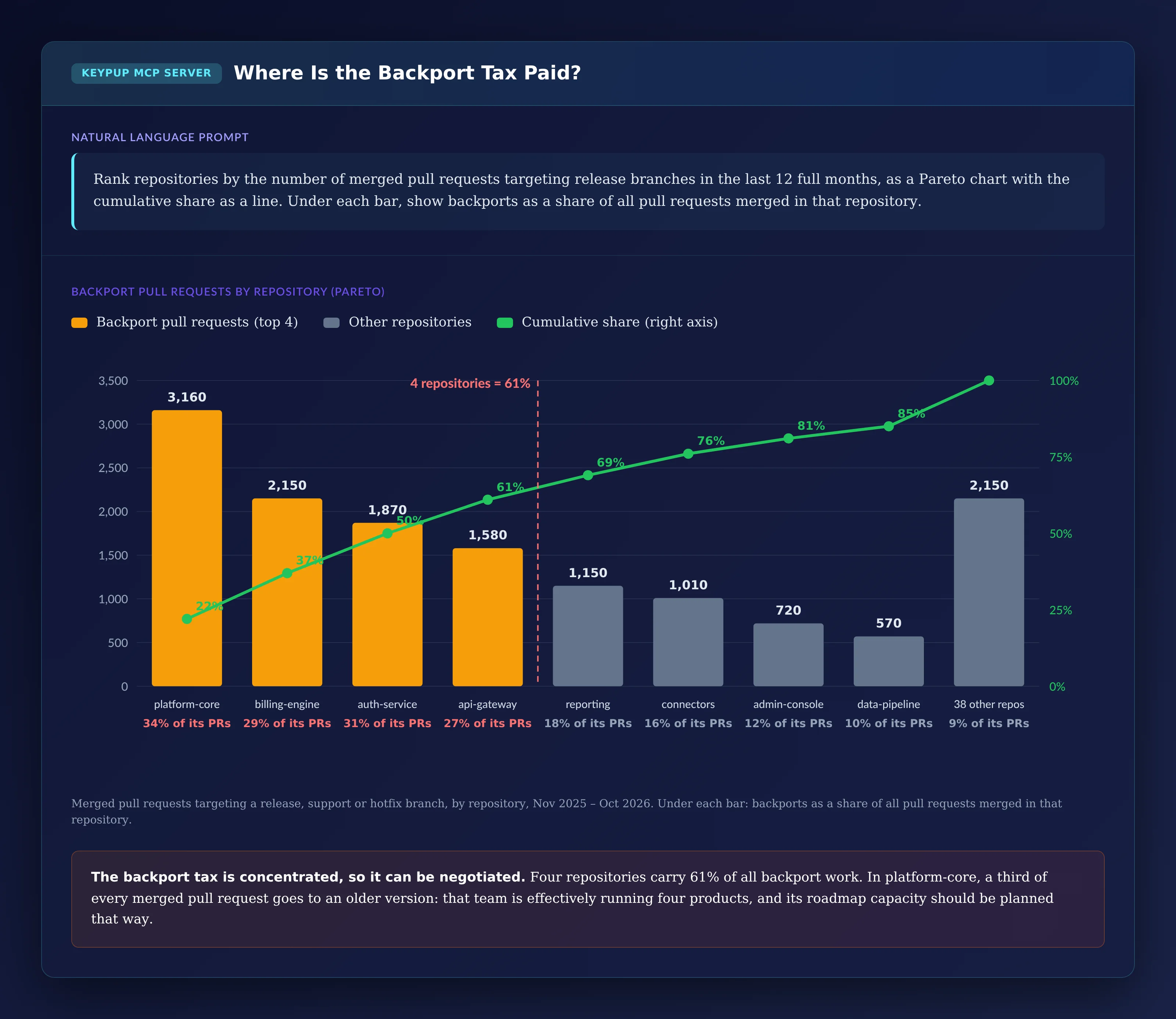
The tax is rarely spread evenly. Ranking repositories by backport volume shows which teams are effectively maintaining several products.
MCP Prompt:
Rank repositories by the number of merged pull requests targeting
release branches in the last 12 full months, as a Pareto chart with
the cumulative share as a line. Under each bar, show backports as a
share of all pull requests merged in that repository.
Output: Where Is the Backport Tax Paid?
Key Insight: The backport tax is concentrated, so it can be negotiated. Four repositories carry 61% of all backport work. In platform-core, a third of every merged pull request goes to an older version: that team is effectively running four products, and its roadmap capacity should be planned that way.
7. Checking Which Critical Fixes Haven't Reached Every Version
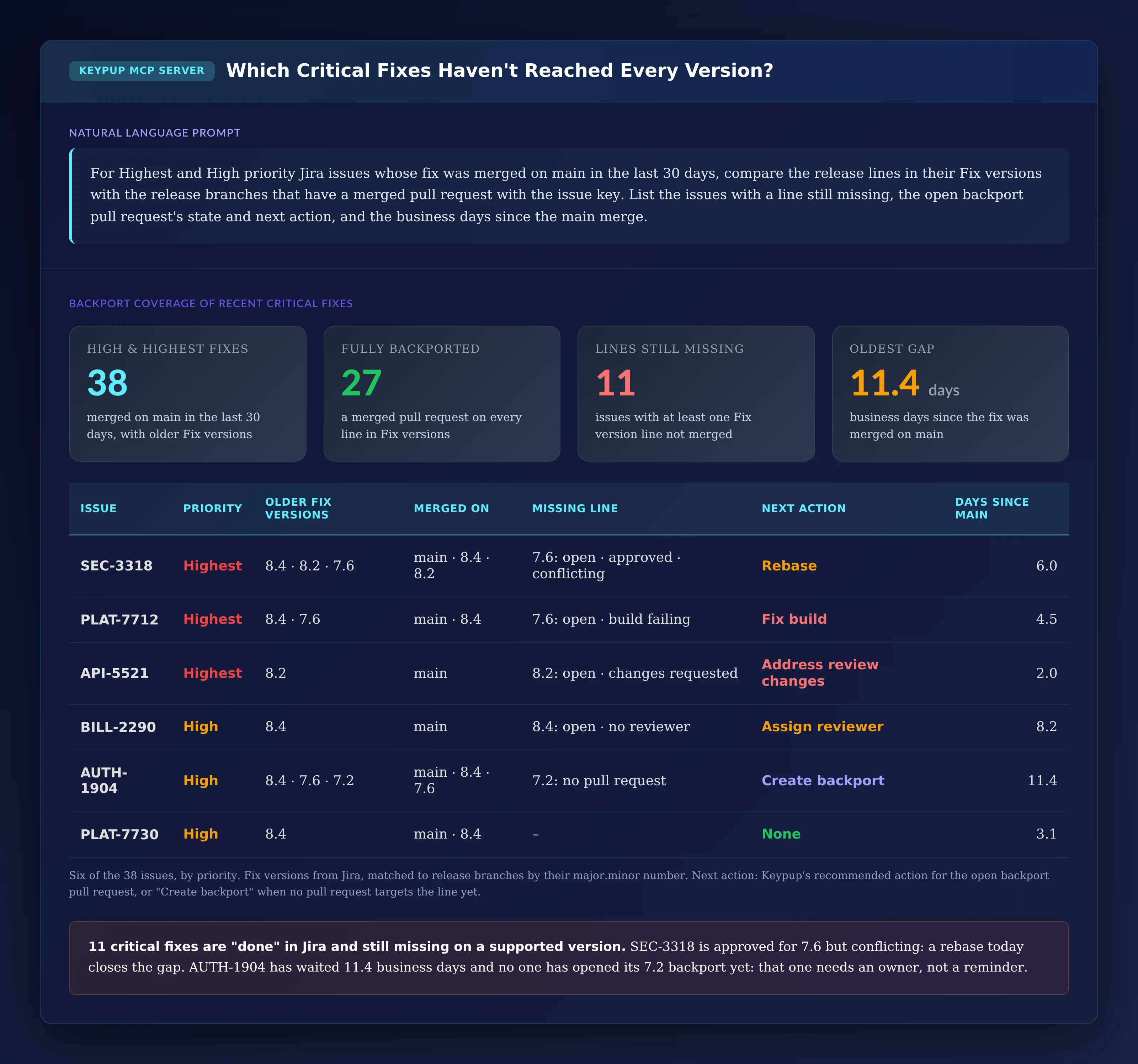
The last step turns the analysis into a weekly release check: which critical fixes merged on main are still missing on a version they're meant to ship in, and what's blocking them?
MCP Prompt:
For Highest and High priority Jira issues whose fix was merged on
main in the last 30 days, compare the release lines in their Fix
versions with the release branches that have a merged pull request
with the issue key. List the issues with a line still missing, the
open backport pull request's state and next action, and the business
days since the main merge.
Output: Which Critical Fixes Haven't Reached Every Version?
Issue
Priority
Older Fix versions
Merged on
Missing line
Next action
Days since main
SEC-3318
Highest
8.4 · 8.2 · 7.6
main · 8.4 · 8.2
7.6: open · approved · conflicting
Rebase
6.0
PLAT-7712
Highest
8.4 · 7.6
main · 8.4
7.6: open · build failing
Fix build
4.5
API-5521
Highest
8.2
main
8.2: open · changes requested
Address review changes
2.0
BILL-2290
High
8.4
main
8.4: open · no reviewer
Assign reviewer
8.2
AUTH-1904
High
8.4 · 7.6 · 7.2
main · 8.4 · 7.6
7.2: no pull request
Create backport
11.4
PLAT-7730
High
8.4
main · 8.4
–
None
3.1
Key Insight: 11 critical fixes are "Done" in Jira and still missing on a supported version. SEC-3318 is approved for 7.6 but conflicting: a rebase today closes the gap. AUTH-1904 has waited 11.4 business days and no one has opened its 7.2 backport yet: that one needs an owner, not a reminder.
The Technical Implementation: What Keypup MCP Actually Reads
Every number above comes from fields Keypup already imports from your Git platforms and Jira. It helps to be precise about what they are, and what they depend on.
Release Lines Come From Base Branches
Each pull request carries its base branch and repository. Classifying a pull request as a backport is a pattern on the branch name, such as release/, support/ or hotfix/, and the release line is the version number in that name. This works if your release branches follow a naming convention: write yours into the prompt. Which line is "current", "LTS" or "extended support" comes from your support policy, not from Keypup, so state it in the prompt as well.
Backport Families Depend on Jira Keys in Titles
Keypup doesn't record that a pull request was cherry-picked from another one. Pull requests are grouped into a backport family by the Jira key extracted from their title. If your teams name backports with the original key, as most cherry-pick tools and conventions do, the grouping is reliable. Backports without a key, 22% in the example above, count as backport volume but can't be tied to a fix on main, so they're excluded from the lag and fan-out measures.
Lag, Size and Review Come From Pull Request Dates
The merge date of each pull request in a family gives the lag between main and each release line, in business days. Lines changed, the review request date, the first review date, the approval count, the last commit and approval dates, and the user who merged the pull request give the size, review speed, unapproved merges, commits after approval and self-merges. For open backports, Keypup provides the build status, mergeability, review state and a recommended next action, such as rebase, fix the build, address review changes or assign a reviewer. "Create backport" isn't a Keypup action: it's how the assistant labels a Fix version line with no pull request at all.
Priority and Fix Versions Come From Jira Fields
Issue type is a standard field Keypup imports from Jira. Priority and Fix versions are Jira fields Keypup exposes alongside your custom fields, so their values are your own. The policy check needs your teams to set priorities on bugs. The coverage check needs Fix versions to list the versions a fix must ship in, with names that contain the release number, such as 8.2.5 for release/8.2. If your teams don't maintain Fix versions, use the release lines a fix reached instead, and the check becomes a list of backports in flight rather than a list of gaps.
What Keypup Doesn't See
Keypup doesn't import your support contracts, which customers run which version, or your deployments: it can say when a fix was merged on a release branch, not when that version was shipped or installed. It also doesn't compare the content of two pull requests, so it can't tell a clean cherry-pick from a rewritten patch. Lines changed is the proxy used above.
Real-World Impact: Enterprise Case Studies
Case Study 1: European Industrial Software Vendor
Before Keypup MCP:
850 engineers shipping an on-premise platform, with five supported versions and multi-year LTS contracts
A roadmap that slipped every quarter, blamed on "maintenance", with no number attached to it
Release managers checking branches by hand when a customer asked whether a fix was in their version
After Keypup MCP:
The backport share became a product decision: the monthly trend went to the product council, which used it to end support for one LTS line six months early
The priority heatmap enforced the policy: Medium and Low bugs now need the product owner's approval to go beyond the current line, and backport volume fell by a quarter
The weekly coverage check replaced the hand checks: every Monday, the release manager gets the list of critical fixes missing on a line, with the next action for each
"We knew maintenance was expensive. We didn't know it was a quarter of our merged work, or that a third of it was bugs our own policy said we shouldn't backport. Once we had the numbers, the conversation about retiring old versions took one meeting instead of a year."
— CTO, European Industrial Software Vendor
Case Study 2: North American Healthcare Platform
Before Keypup MCP:
600 engineers, a regulated product with three supported versions per hospital customer
Security fixes declared "fixed" when merged on main, while older versions waited weeks
Two regressions in a year traced back to backports merged without review
After Keypup MCP:
Backport lag became a security metric: Highest priority fixes must reach every supported line within five business days, measured with the box plot every month
Review rules were extended to release branches: backports over 50 lines need an approval from someone other than their author, and self-merges on release lines dropped sharply
Platform teams got planned maintenance capacity: the four repositories carrying most backports reserve a fixed share of each sprint for them
"Our auditors asked how long it took for a security fix to reach every version we support. For the first time, we answered with a distribution, not a promise."
— VP Engineering, North American Healthcare Platform
Implementation: Getting Started with Keypup MCP
1. Connect Your Git Platforms and Jira
Connect GitHub, GitLab, Bitbucket or Azure DevOps, and Jira, to Keypup. Pull requests, reviews and issues are imported automatically, on every branch.
2. Write Down Your Branching Convention
List the patterns your release branches follow, and map each to a release line and its support status. You'll paste this into your prompts so every team reads the same numbers.
3. Check Your Backport Naming
Ask your assistant for the share of release-branch pull requests with a Jira key in their title, by repository. Where it's low, agree on a naming rule for backports, such as [8.2] KEY-123 original title, before relying on lag or coverage figures.
4. Check Priorities and Fix Versions
Ask for the share of resolved bugs with a priority and with Fix versions, by project. Where Fix versions are empty, run the coverage check on the lines a fix reached, and treat the gaps as a tagging problem first.
5. Make It a Release Ritual
Connect the MCP server to your AI assistant using the MCP documentation, run the coverage check every week, and review the backport share, the lag per line and the priority heatmap every quarter, when support policy and end-of-life dates are decided.
Frequently Asked Questions
What is a backport in software development?
A backport is a change, usually a bug or security fix, first made on the main development branch and then applied to an older, still-supported release branch, so that customers on that version get the fix without upgrading. It's often done with a cherry-pick, but on older code the patch frequently has to be rewritten.
How do you measure the cost of maintaining multiple release versions?
Count the merged pull requests whose base branch is a release branch, as a share of all merged pull requests, and follow it over time, by release line and by repository. Add the lines changed per backport, and the time between the merge on main and the merge on each line, to see where the cost and the customer exposure are.
How long should a backport take?
There's no universal target, but it should be defined per priority and per line in your support policy. A common rule is that critical and security fixes reach every supported line within a few business days. What matters is that the lag is measured, and that the oldest lines, where it's usually the longest, aren't left out.
How do you reduce the backport burden?
Enforce a written backport policy by priority, review backports like any other change, end support for old lines when their cost is known, and plan explicit maintenance capacity for the repositories that carry most of the work. Measuring the backport share is what makes each of these decisions possible.
The Bottom Line
Supporting several versions is a commercial promise, and every promise has a cost. When a fifth of merged work goes to older versions, slipping roadmaps, exposed customers and unreviewed changes are the predictable result, not bad luck. Keypup MCP makes the backport tax visible:
✅ Measuring how much engineering goes into older versions, and whether it's growing ✅ Finding which release lines absorb the backports, and how much each patch has to be adapted ✅ Measuring how long older versions wait for a fix, line by line ✅ Checking whether the backport policy is followed, by Jira priority ✅ Comparing how backports are reviewed with changes on main ✅ Finding where the backport tax is paid, repository by repository ✅ Checking which critical fixes haven't reached every version, with the next action
In a typical enterprise, more than one sprint issue in five is created after the sprint has started, and projects that take in the most of it close as little as half of their planned story points. Learn what engineering leaders on Reddit say about mid-sprint scope injection, and how Keypup MCP measures what comes through the sprint backdoor, what it displaces and what to push back today.
In a typical two-week sprint, 49% of the work gets its final merge on the last two days, reviews shrink to 1.6 hours and over a quarter of last-minute "Done" has no merged code. Learn what engineering leaders on Reddit say about the end-of-sprint merge rush at enterprise scale, and how Keypup MCP measures the curve, its cost and the work about to pile up.
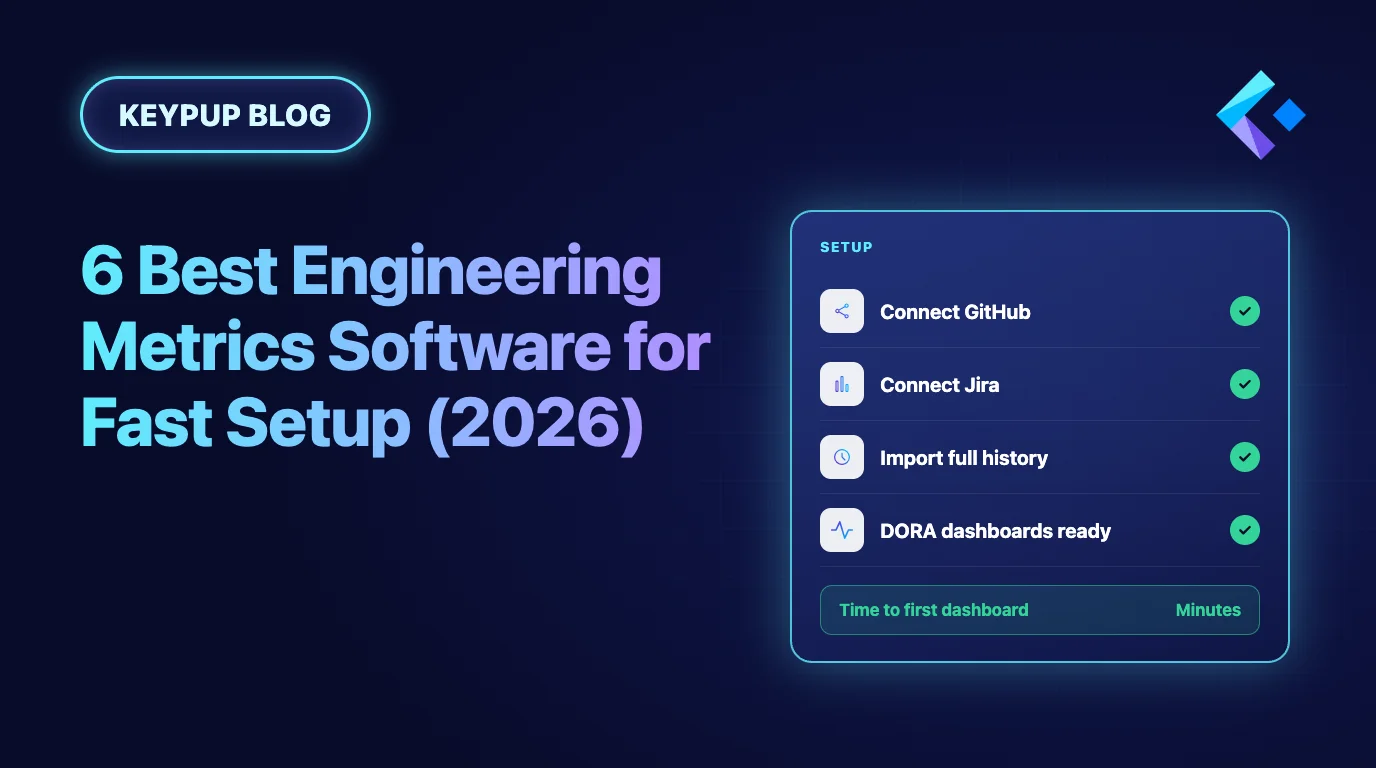
Compare the 6 best engineering metrics software for fast setup in 2026 — Keypup, LinearB, Swarmia, Jellyfish, Faros and Harness SEI — across setup speed, integration overhead, dashboard flexibility, delivery metrics coverage, AI capabilities and data security. Find out which platform gets a mid-market engineering team from connecting Git and Jira to actionable delivery metrics in minutes, not months.