Merge Limbo: Why Approved Pull Requests Wait Days to Ship
In a typical enterprise, the longest phase of a pull request's life starts after it is approved: a median of 9.6 business hours from last approval to merge, and 31% of approved pull requests waiting two business days or more. Learn what engineering leaders on Reddit say about approved code that doesn't ship, and how Keypup MCP measures merge limbo, from who holds the merge button to which approved pull requests can be merged today.
TL;DR: Most efforts to speed up delivery focus on code review. But in many enterprise organizations, the longest wait comes after the review is done. In a typical enterprise, the median pull request waits 9.6 business hours between its last approval and its merge, longer than coding or waiting for the first review, and 31% wait two business days or more. Over a year, the median wait after approval went from 6.1 to 11.8 business hours. Approvals on Friday afternoon wait four times longer than on Tuesday morning, and repositories where a handful of people hold the merge button carry 44% of all the waiting time. The Keypup MCP Server reads each pull request's review request, first review, last approval and merge dates, its author and merger, its mergeability, build status and remaining required approvals, and Keypup's recommended next action and suggested mergers. Your AI assistant can then show where cycle time goes after approval, when and where approved code gets stuck, who holds the merge button, and which approved pull requests can be merged today.
It's Thursday morning. A pull request was approved on Monday afternoon: two reviewers, green checkmarks, nothing left to discuss. It still isn't merged. The author assumed the tech lead would merge it, because in this repository the tech lead always does. The tech lead assumed the author would ping them when it was ready. On Wednesday, another change landed on the same files, and now the pull request conflicts with the main branch. Nobody did anything wrong. The code was finished on Monday, and it will ship next week.
The Friction: Approved Isn't Merged
Approval feels like the finish line, so nobody watches what happens after it. In enterprise organizations, several habits turn the last click into the longest wait:
Merge rights are concentrated. In regulated or critical repositories, only maintainers or release managers can merge. Their calendars, not the code, set the pace.
Nobody owns the click. Some teams expect the author to merge, others the reviewer, others the tech lead. When the rule isn't written down, everyone waits for someone else.
Merge windows and freezes. "No merges on Friday", release trains and change approval windows hold back approved code for days, often for good reasons that nobody revisits.
Approved code decays. While it waits, the main branch moves on. The pull request starts to conflict, or the build breaks against newer code, and the approval may no longer mean much.
The result: review times look healthy on every dashboard, while finished code sits for days between "approved" and "merged".
Why This Matters: The Real Cost of Merge Limbo
The Flow Problem
Approval to merge is part of lead time for changes, but it is rarely reported on its own. When it is the largest phase, every effort to speed up code review optimizes the wrong step, and release dates keep slipping for reasons nobody can name.
The Rework Problem
The longer an approved pull request waits, the more likely it is to conflict with the main branch. A rebase after approval means new code nobody reviewed, or a second review round for a change that was finished days ago.
The Morale Problem
Engineers who finish their work and then wait days for someone to press a button lose their momentum and switch to something else. When the merge finally happens, the context is gone, and so is any fast feedback from production.
The Enterprise Discussion: What Engineering Leaders Are Actually Saying
"Approved but not merged", "who is supposed to merge?" and "our PRs rot after approval" come up again and again wherever engineering managers, staff engineers and platform leads compare notes. The quotes below are representative of recurring threads on r/ExperiencedDevs, r/EngineeringManagers, r/devops and r/softwareengineering.
"Our review SLA is four hours and we hit it. Then the pull request sits approved for three days because only two people can merge to that repo, and they're in planning meetings. Nobody measures that part."
"Half my team thinks the reviewer merges, the other half thinks the author does. I found twelve approved pull requests sitting there on a Monday. Three of them had conflicts by the time anyone noticed."
Platform Lead, Insurance Group (r/devops)
"We have a no-merge-on-Friday rule. Fine. But it means everything approved Thursday afternoon lands Monday at the same time, conflicts with everything else, and Monday becomes a merge party."
The pattern holds: organizations measure how long it takes to review code, but not how long approved code waits to be merged, or what that wait costs.
How Keypup MCP Measures Merge Limbo
The Keypup Model Context Protocol (MCP) Server gives your AI assistant structured access to the data Keypup imports from GitHub, GitLab, Bitbucket and Azure DevOps, and from Jira. For this analysis, what matters is each pull request: its first commit, review request, first review, last approval and merge dates, its author and the person who merged it, its repository, its lines changed, and, while it's open, its mergeability, build status, remaining required approvals, Keypup's recommended next action and its suggested mergers.
All figures cover pull requests merged in the last 12 full months, November 2025 to October 2026, with at least one approval, for an organization of around 1,300 engineers in 64 repositories. Times are in business hours, 09:00 to 17:00, Monday to Friday.
1. Finding Where Cycle Time Goes
The first question: once a pull request is opened, which phase takes the longest?
MCP Prompt:
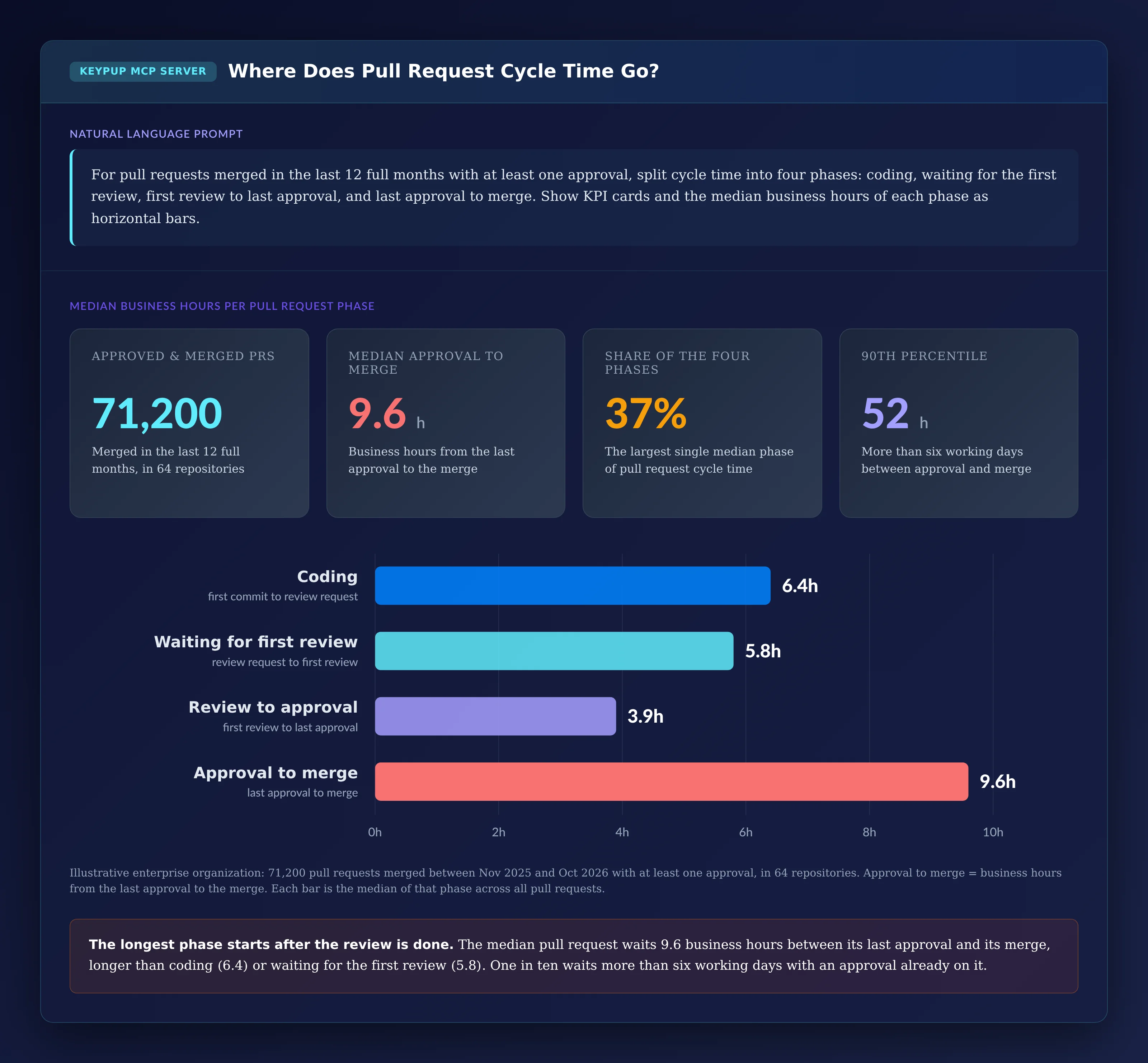
For pull requests merged in the last 12 full months with at least one
approval, split cycle time into four phases: coding, waiting for the
first review, first review to last approval, and last approval to
merge. Show KPI cards and the median business hours of each phase as
horizontal bars.
Output: Where Does Pull Request Cycle Time Go?
Key Insight: The longest phase starts after the review is done. The median pull request waits 9.6 business hours between its last approval and its merge, longer than coding (6.4) or waiting for the first review (5.8). One in ten waits more than six working days with an approval already on it.
2. Seeing How Long Approved Pull Requests Wait
A median hides two very different behaviors. A distribution shows them.
MCP Prompt:
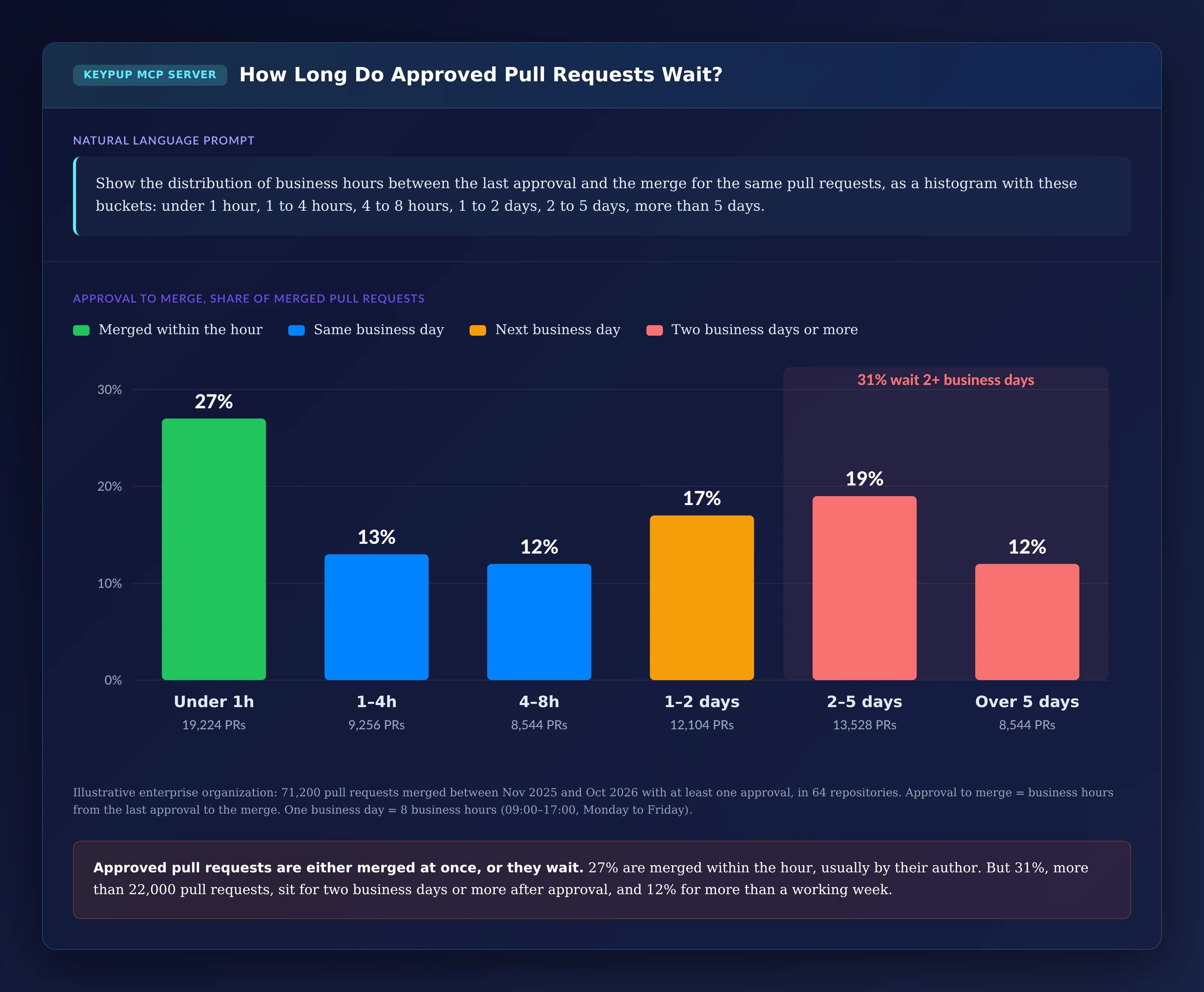
Show the distribution of business hours between the last approval and
the merge for the same pull requests, as a histogram with these
buckets: under 1 hour, 1 to 4 hours, 4 to 8 hours, 1 to 2 days,
2 to 5 days, more than 5 days.
Output: How Long Do Approved Pull Requests Wait?
Key Insight: Approved pull requests are either merged at once, or they wait. 27% are merged within the hour, usually by their author. But 31%, more than 22,000 pull requests, sit for two business days or more after approval, and 12% for more than a working week.
3. Following Merge Limbo Over Time
A single year hides the direction. A monthly view shows whether the wait after approval is growing.
MCP Prompt:
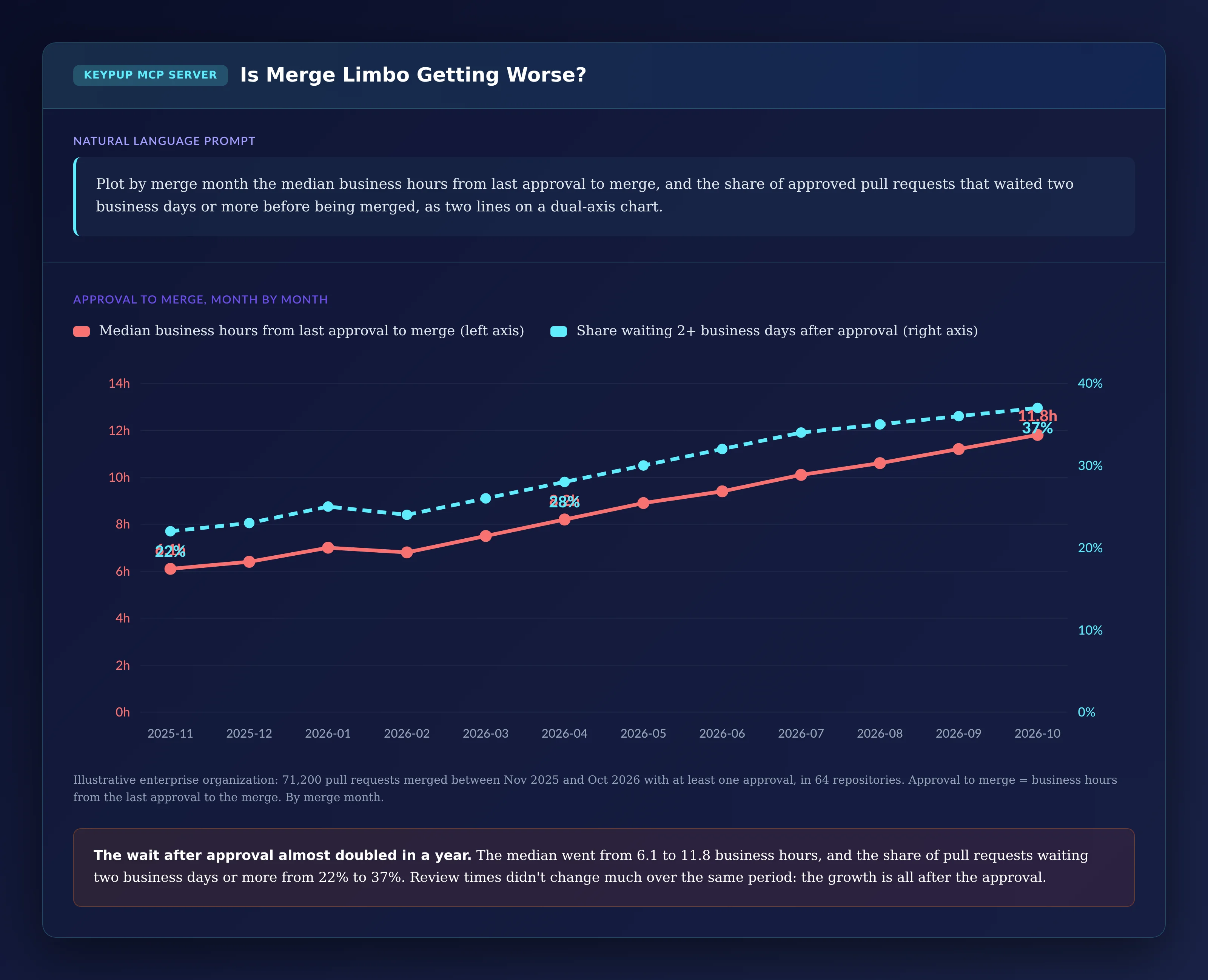
Plot by merge month the median business hours from last approval to
merge, and the share of approved pull requests that waited two
business days or more before being merged, as two lines on a
dual-axis chart.
Output: Is Merge Limbo Getting Worse?
Key Insight: The wait after approval almost doubled in a year. The median went from 6.1 to 11.8 business hours, and the share of pull requests waiting two business days or more from 22% to 37%. Review times didn't change much over the same period: the growth is all after the approval.
4. Seeing When Approvals Get Stuck
Merge windows and team habits are tied to the calendar. Crossing the weekday and the time of the approval shows them.
MCP Prompt:
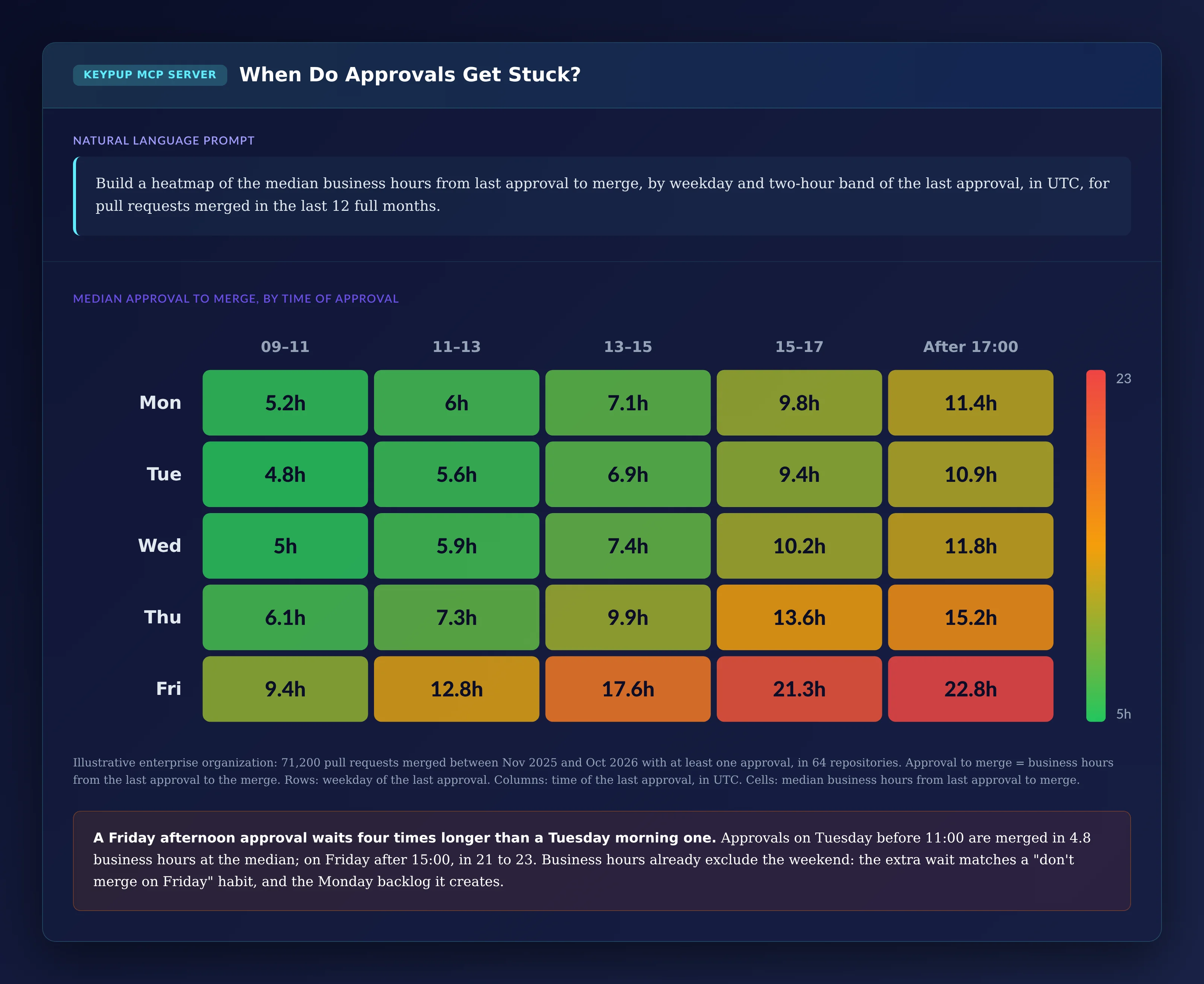
Build a heatmap of the median business hours from last approval to
merge, by weekday and two-hour band of the last approval, in UTC, for
pull requests merged in the last 12 full months.
Output: When Do Approvals Get Stuck?
Key Insight: A Friday afternoon approval waits four times longer than a Tuesday morning one. Approvals on Tuesday before 11:00 are merged in 4.8 business hours at the median; on Friday after 15:00, in 21 to 23. Business hours already exclude the weekend: the extra wait matches a "don't merge on Friday" habit, and the Monday backlog it creates.
5. Finding Who Holds the Merge Button
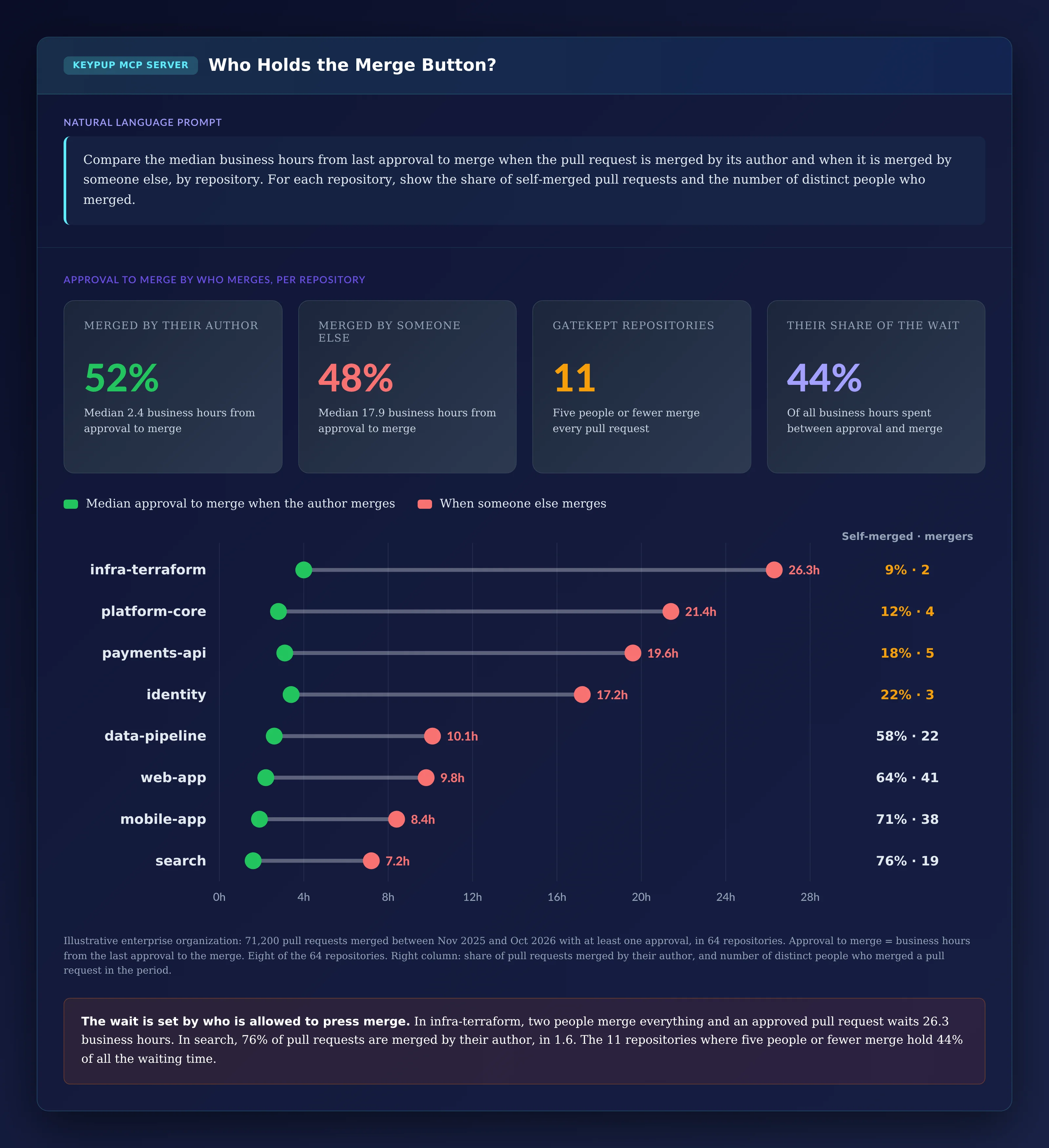
The wait often depends less on the code than on who is allowed, or expected, to merge it. Comparing the author's merges with everyone else's shows where the merge is a handoff.
MCP Prompt:
Compare the median business hours from last approval to merge when
the pull request is merged by its author and when it is merged by
someone else, by repository. For each repository, show the share of
self-merged pull requests and the number of distinct people who
merged.
Output: Who Holds the Merge Button?
Key Insight: The wait is set by who is allowed to press merge. In infra-terraform, two people merge everything and an approved pull request waits 26.3 business hours. In search, 76% of pull requests are merged by their author, in 1.6. The 11 repositories where five people or fewer merge hold 44% of all the waiting time. Gatekeeping can be a deliberate control: the point is to know what it costs.
6. Checking What Blocks Approved Pull Requests Right Now
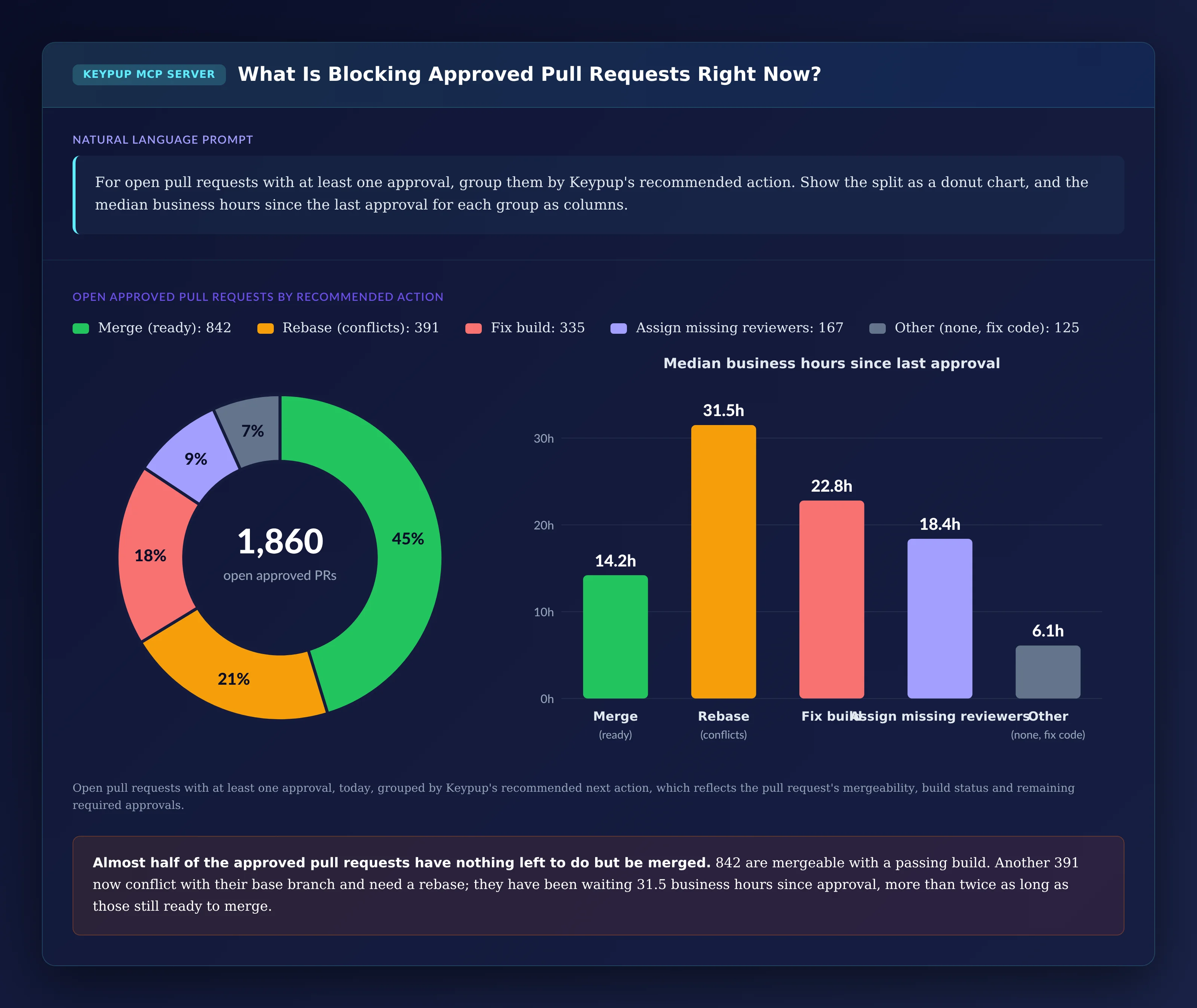
Some approved pull requests are waiting for a click. Others can't be merged yet. Keypup's recommended action tells them apart.
MCP Prompt:
For open pull requests with at least one approval, group them by
Keypup's recommended action. Show the split as a donut chart, and the
median business hours since the last approval for each group as
columns.
Output: What Is Blocking Approved Pull Requests Right Now?
Key Insight: Almost half of the approved pull requests have nothing left to do but be merged. 842 are mergeable with a passing build. Another 391 now conflict with their base branch and need a rebase; they have been waiting 31.5 business hours since approval, more than twice as long as those still ready to merge. Approved code that waits, decays.
7. Listing the Approved Pull Requests to Merge Today
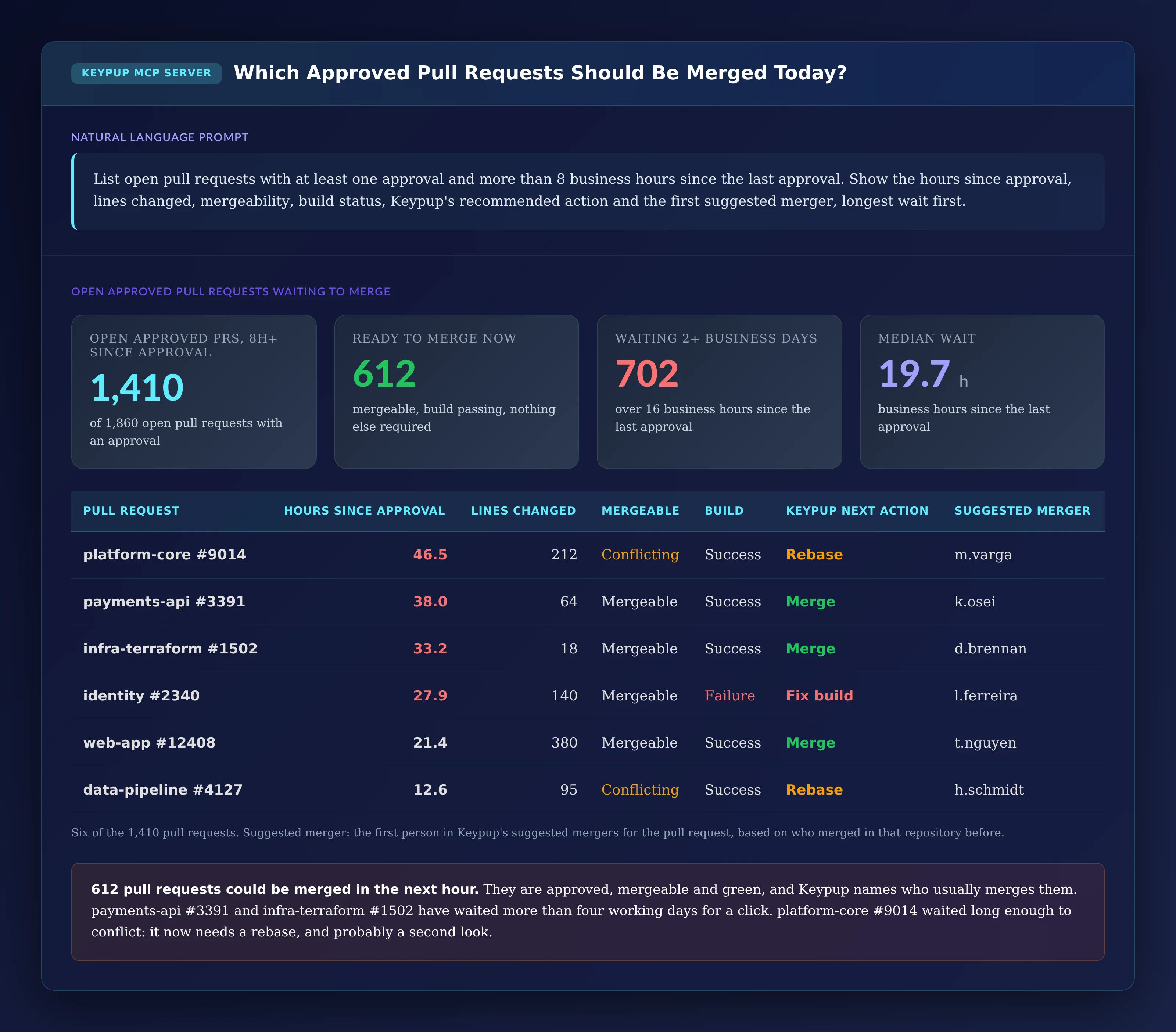
The last step turns the analysis into a daily routine: which approved pull requests are waiting, what do they need, and who usually merges them?
MCP Prompt:
List open pull requests with at least one approval and more than 8
business hours since the last approval. Show the hours since
approval, lines changed, mergeability, build status, Keypup's
recommended action and the first suggested merger, longest wait first.
Output: Which Approved Pull Requests Should Be Merged Today?
Pull request
Hours since approval
Lines changed
Mergeable
Build
Keypup next action
Suggested merger
platform-core #9014
46.5
212
Conflicting
Success
Rebase
m.varga
payments-api #3391
38.0
64
Mergeable
Success
Merge
k.osei
infra-terraform #1502
33.2
18
Mergeable
Success
Merge
d.brennan
identity #2340
27.9
140
Mergeable
Failure
Fix build
l.ferreira
web-app #12408
21.4
380
Mergeable
Success
Merge
t.nguyen
data-pipeline #4127
12.6
95
Conflicting
Success
Rebase
h.schmidt
Key Insight: 612 pull requests could be merged in the next hour. They are approved, mergeable and green, and Keypup names who usually merges them. payments-api #3391 and infra-terraform #1502 have waited more than four working days for a click. platform-core #9014 waited long enough to conflict: it now needs a rebase, and probably a second look.
The Technical Implementation: What Keypup MCP Actually Reads
Every number above comes from fields Keypup already imports from your Git platforms. It helps to be precise about what they are, and what they depend on.
Phases Come From Pull Request Dates
Each pull request carries its first commit date, its review request date, its first submitted review date, its last approval date and its merge date. Each phase is the business hours between two of them, computed by Keypup with your working hours and time zone. Pull requests without an explicit review request, or merged without any approval, have no value for the phases that need those dates, so the analysis is limited to approved pull requests.
Mergers Come From the Merge Event
Keypup records who merged each pull request and who authored it, so the assistant can compare the two, count distinct mergers per repository and split the wait by who pressed the button. Keypup doesn't read your branch protection settings or merge permissions: a "gatekept" repository is one where few people merged in practice, whatever the rules say.
Blockers Come From Keypup's Recommended Action
For open pull requests, Keypup reads the mergeability (mergeable, conflicting or unknown), the build status reported by your Git platform, and the number of required approvals still missing, and derives a recommended next action: merge, rebase, fix the build, assign missing reviewers and so on. The build status depends on your CI reporting its checks to the Git platform.
Suggested Mergers Come From Merge History
Keypup suggests mergers for each pull request based on who merged pull requests before in that repository. It's a suggestion from past behavior, not a permission check: confirm that the person suggested can merge to the target branch.
What Keypup Doesn't See
Keypup doesn't import deployment events, so the analysis stops at the merge, not at production. It doesn't import calendars, merge freeze schedules or change approval windows: the heatmap shows when approvals wait, and you supply the reason. And it doesn't read merge queue tools as such: a pull request waiting in a merge queue counts as waiting.
Real-World Impact: Enterprise Case Studies
Case Study 1: Nordic Payments Provider
Before Keypup MCP:
900 engineers, with merges to critical repositories reserved to a group of maintainers per repository
A four-hour review target met every month, and lead time for changes still rising
Approved pull requests chased in chat, one by one, by their authors
After Keypup MCP:
The phase chart changed the diagnosis: approval to merge was the largest phase, not review
Merge rights were widened where the risk was low: authors can now merge in non-critical repositories once approved and green, and the share of self-merged pull requests there tripled
The daily merge list replaced chat reminders: maintainers start each morning with the approved, mergeable pull requests in their repositories
"We spent a year making reviews faster and lead time didn't move. The day we split cycle time by phase, we saw where it went: approved code waiting for four people to find time to click merge."
— VP Engineering, Nordic Payments Provider
Case Study 2: North American Healthcare Software Company
Before Keypup MCP:
1,100 engineers across 70 repositories, with a "no merge after Thursday noon" policy
A flood of merges every Monday, followed by conflicts and broken builds
No agreement on whether the author or the reviewer merges
After Keypup MCP:
The heatmap reopened the policy: the freeze now applies to the release branches only, and feature branches merge until Friday noon
One rule for the click: the author merges once approved and green, unless the repository is listed as maintainer-only
Fewer commits after approval: the share of merged pull requests with a commit after their last approval fell as approved code stopped waiting over the weekend
"Our Thursday rule was there to protect the weekend. It was also creating Monday. Seeing the Friday column of the heatmap was enough to rewrite it."
— Director of Engineering, North American Healthcare Software Company
Implementation: Getting Started with Keypup MCP
1. Connect Your Git Platforms
Connect GitHub, GitLab, Bitbucket or Azure DevOps to Keypup. Pull requests, reviews, approvals and merges are imported automatically, along with mergeability and build status where your platform provides them.
2. Check That Approvals Are Recorded
Ask your assistant for the share of merged pull requests with at least one approval, by repository. Where reviewers comment instead of approving, or where approvals aren't required, the last approval date is missing and approval to merge can't be measured.
3. Agree on Your Working Hours and Time Zone
Business hours depend on your teams' working days and time zone. State them in your prompts, along with the threshold you consider "waiting", such as 8 business hours, so every team reads the same numbers.
4. Write Down Who Merges
List the repositories where only maintainers may merge, and the rule everywhere else. It turns the "who holds the merge button" chart from a surprise into a check against your own policy.
5. Connect the MCP Server to Your AI Assistant
Connect the MCP server to your AI assistant using the MCP documentation, run the phase analysis for your last 12 months to set a baseline, then run the merge list every morning.
Frequently Asked Questions
What is approval to merge time?
It's the time between the last approval of a pull request and its merge. It's part of pull request cycle time and lead time for changes, and measures how long finished, reviewed code waits before it reaches the main branch.
Why do approved pull requests take so long to merge?
The most common reasons are concentrated merge rights, unclear ownership of the merge between author and reviewer, merge windows or freezes, and pull requests that start to conflict or fail their build while they wait. Measuring the wait by repository, by merger and by time of approval shows which one applies.
Should the author or the reviewer merge a pull request?
Either works, as long as the rule is explicit. Many teams let the author merge once the pull request is approved and its build is green, and reserve merges to maintainers in critical repositories. What slows teams down is when nobody knows who is expected to click.
How do you reduce the time between approval and merge?
Make the merge owner explicit, widen merge rights where the risk is low, revisit freezes that hold back more than release branches, and review the list of approved, mergeable pull requests every day. Follow the median approval to merge time monthly to see whether it works.
The Bottom Line
Approval feels like the end of the work, so nobody watches what comes after it. But in many enterprise organizations, the wait between "approved" and "merged" is now the longest phase of a pull request's life, and it grows quietly while review metrics look fine. Keypup MCP makes merge limbo visible:
✅ Finding where cycle time goes, phase by phase ✅ Seeing how long approved pull requests wait, beyond the median ✅ Following merge limbo over time, month by month ✅ Seeing when approvals get stuck, by weekday and time ✅ Finding who holds the merge button, repository by repository ✅ Checking what blocks approved pull requests, from conflicts to failed builds ✅ Listing the approved pull requests to merge today, with who usually merges them
In a typical enterprise, a pull request sent to another team's repository waits 3.8 times longer for a first review, takes almost five working days to merge and is three times more likely to be abandoned. Learn what engineering leaders on Reddit say about cross-team contributions, and how Keypup MCP measures the inner source tax, from which owning teams are bottlenecks to which cross-team pull requests to unblock today.
In a typical enterprise, a pull request sent to five reviewers waits 3.4 times longer for its first review than one sent to a single reviewer, and 69% of the people asked never respond. Learn what engineering leaders on Reddit say about review requests nobody owns, and how Keypup MCP measures the reviewer bystander effect, from panel size to the people who actually review.
In a typical enterprise that supports several versions of its product, one merged pull request in five targets an older release line, and customers on the oldest line wait ten business days for fixes already merged on main. Learn what engineering leaders on Reddit say about backports and LTS maintenance, and how Keypup MCP measures the backport tax, line by line.