The AI Review Tax: How Copilot-Generated Pull Requests Are Quietly Overloading Your Senior Engineers
Enterprise AI coding mandates promised a productivity windfall — instead they moved the bottleneck from writing code to reviewing it, and dumped the extra load on the exact senior and staff engineers your org can least afford to burn out. Discover how Keypup MCP separates AI-authored review load from real velocity gains, exposes rubber-stamp risk, and gives leadership the data to fix a review pipeline that's quietly going net-negative.
TL;DR: Enterprise AI coding mandates are hitting their adoption targets — 58% of merged pull requests are now majority AI-generated in some organizations — but the productivity story leadership was told is only half true. AI-authored PRs are larger, arrive faster, and get approved in a fraction of the time human-authored code takes, which looks like a win until you check who's actually reviewing them: a small group of senior and staff engineers now absorbing 74% of total review hours, with comment density collapsing to rubber-stamp levels. Reported velocity is up. Net capacity, once the hidden review tax is subtracted back out, is flat or negative for the teams that adopted AI fastest. The Keypup MCP Server decomposes AI-authored review load from genuine throughput gains, scores review depth to flag rubber-stamping before it ships a production incident, and shows leadership exactly which teams are burning out their most senior engineers to hit an AI adoption metric.
Ask a VP of Engineering at a large enterprise how the AI coding assistant rollout is going, and the slide deck answer is almost always some version of "great — PR volume is up 40%, adoption targets are met, developers love it." Ask the three staff engineers who now spend their Tuesday and Thursday afternoons exclusively reviewing AI-generated diffs how it's going, and you'll get a very different answer — one that never makes it into the board deck, because nobody's dashboard is built to capture it.
The Friction: A Productivity Win That Only Measures Half the Pipeline
Every enterprise AI coding rollout is instrumented the same way: track adoption (percentage of developers using the tool), track output (lines of code, PRs opened, PRs merged), declare victory when both numbers go up. That instrumentation was designed for a world where writing code was the bottleneck. It wasn't updated for a world where the bottleneck moved.
AI-authored PRs are bigger, not just faster. A developer using Copilot or Cursor to scaffold an entire feature produces a pull request that's 2-3x the size of what a human would have submitted for the same ticket, because generating more code costs the author nothing extra — but every one of those extra lines still has to be read by a human before it merges.
Review capacity didn't scale with authoring capacity. The tools made writing code dramatically faster. They did nothing to make reading and evaluating code faster — reviewing a 400-line AI-generated diff for correctness, security issues, and architectural fit takes exactly as long as reviewing a 400-line human-written one, sometimes longer because the author can't always explain why the code does what it does.
The load concentrates on the few people qualified to catch what AI gets wrong. Junior and mid-level engineers increasingly rubber-stamp AI-generated PRs because they lack the context to spot subtle logic errors or architectural drift — which pushes real scrutiny onto the smaller pool of senior and staff engineers who can actually catch those issues, and only them.
Approval speed is quietly substituting for approval depth. When a PR gets approved in 11 minutes instead of 6 hours, leadership reads that as the AI tool working as intended. Nobody is asking whether an 11-minute review of a 400-line diff constitutes a review at all, or whether it constitutes a rubber stamp with an audit trail.
The result: PR volume and velocity dashboards report exactly what leadership hoped an AI mandate would deliver, while the actual bottleneck — and the actual risk — moved somewhere the dashboard was never built to look.
Why This Matters: Three Ways the Untracked Review Tax Bites Back
The False Productivity Narrative
Leadership is making board-level ROI claims about AI coding tools based on PR volume and lines-of-code metrics that were never designed to capture review cost. When those claims are challenged — by a slower-than-expected release, or by a senior engineer quitting from burnout — there's no data to explain what actually happened, because the metric that would show it was never built.
The Burnout Concentration Problem
AI coding tools don't distribute review load evenly; they concentrate it on the handful of people with enough system context to catch what a model gets wrong. Those are, by definition, some of the most expensive, hardest-to-replace, and most retention-critical engineers in the organization — and they're the ones absorbing the largest, least-visible increase in workload from a mandate that was supposed to make everyone's life easier.
The Rubber-Stamp Risk
As review time compresses toward "approved in minutes," the actual depth of scrutiny a PR receives before merging degrades — and it degrades exactly where the code volume is highest and the review capacity is most stretched. That's precisely the condition under which a subtle, AI-introduced defect slips into production and shows up as an incident three sprints later, with nobody able to trace it back to a review that was technically completed but never actually happened.
The Enterprise Discussion: What Engineers Are Actually Saying
This tension — AI making code cheap to write and expensive to review — is one of the most consistently repeated frustrations wherever senior engineers at large organizations compare notes on their post-AI-mandate workload.
"Since the Copilot mandate, my calendar is just code review now. Every junior on the team ships 3x the PRs they used to, because the AI writes most of it for them, and every single one of those PRs still needs someone who actually understands the payment reconciliation logic to check it. That someone is me, for basically every PR on three different squads. My own coding output has gone down because I don't have time to write anything anymore — I just read what the AI wrote for other people all day."
Principal Engineer, Large SaaS Platform (r/ExperiencedDevs)
"Leadership keeps citing our PR throughput numbers as proof the AI rollout is working. What they don't see is that half of those 'reviews' are a senior engineer looking at a 300-line diff for four minutes and hitting approve because they're buried and the code looks plausible. Nobody has measured how much actual scrutiny is happening versus how much is just an approval button being clicked fast enough to keep the metric green."
The pattern is consistent: the people qualified to catch what AI-generated code gets wrong are the ones being asked to review the most of it, in the least time, with the least recognition that it's happening at all. Engineers already feel this shift acutely — what's missing is a way to put a number on it before it costs the organization a senior engineer or a production incident.
How Keypup MCP Solves the AI Review Tax
The Keypup Model Context Protocol (MCP) Server treats AI-authored code review as its own measurable category — separating reported velocity gains from the hidden review cost they generate, scoring review depth to catch rubber-stamping before it ships a defect, and identifying exactly which senior engineers are absorbing a disproportionate share of the load, all through natural-language prompts against your existing GitHub, GitLab, or Azure DevOps data.
1. Comparing AI-Authored PR Volume Against the Review Hours It Actually Consumes
Before anything else, leadership needs to see whether the AI adoption metric they're reporting is telling the whole story.
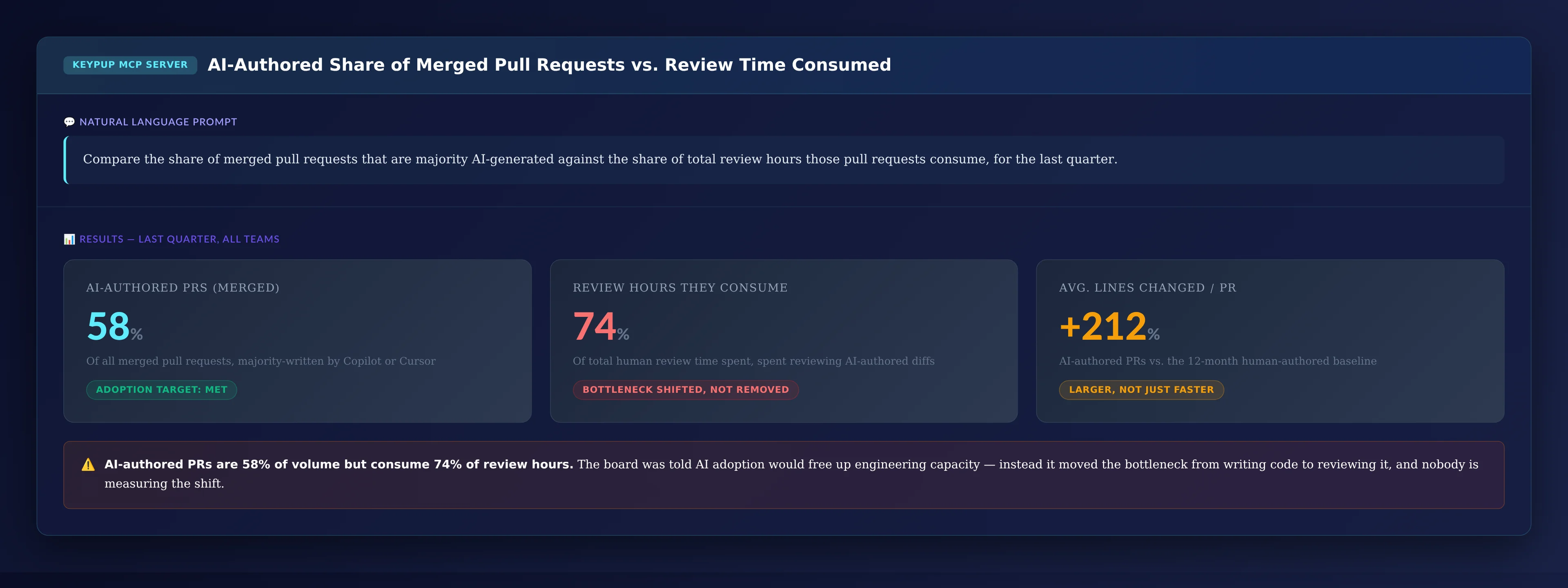
MCP Prompt:
Compare the share of merged pull requests that are majority AI-generated
against the share of total review hours those pull requests consume,
for the last quarter.
Output: AI-Authored Share of Merged PRs vs. Review Time Consumed
Key Insight: AI-authored PRs are 58% of volume but consume 74% of review hours. The board was told AI adoption would free up engineering capacity — instead it moved the bottleneck from writing code to reviewing it, and nobody is measuring the shift.
2. Scoring Review Depth to Catch Rubber-Stamping Before It Ships a Defect
Once the review-hour imbalance is visible, the next question is whether those hours represent genuine scrutiny or an approval button being clicked fast enough to keep the metric green.
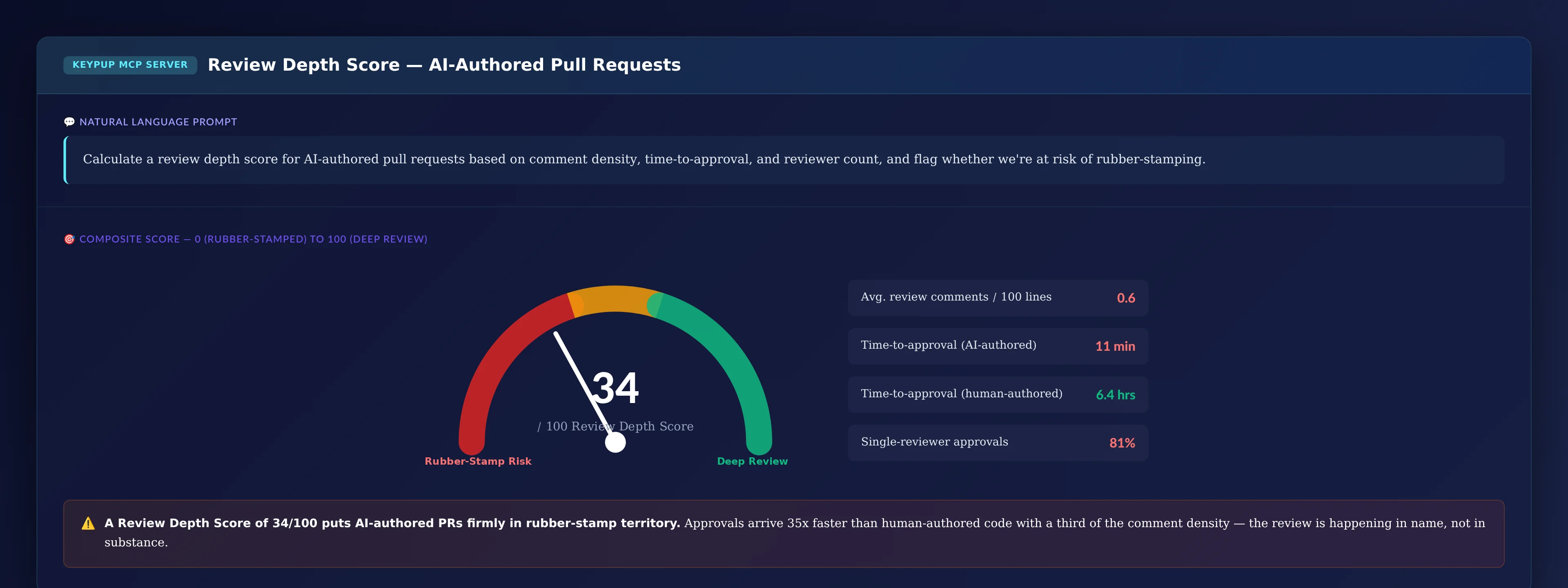
MCP Prompt:
Calculate a review depth score for AI-authored pull requests based on
comment density, time-to-approval, and reviewer count, and flag whether
we're at risk of rubber-stamping.
Key Insight: A Review Depth Score of 34/100 puts AI-authored PRs firmly in rubber-stamp territory. Approvals arrive 35x faster than human-authored code with a third of the comment density — the review is happening in name, not in substance.
3. Mapping Which Teams Are Trading Review Depth for Defect Risk
With rubber-stamp risk confirmed at the aggregate level, leadership needs to see exactly where AI adoption, thin review hours, and post-merge defects are converging on the same teams.
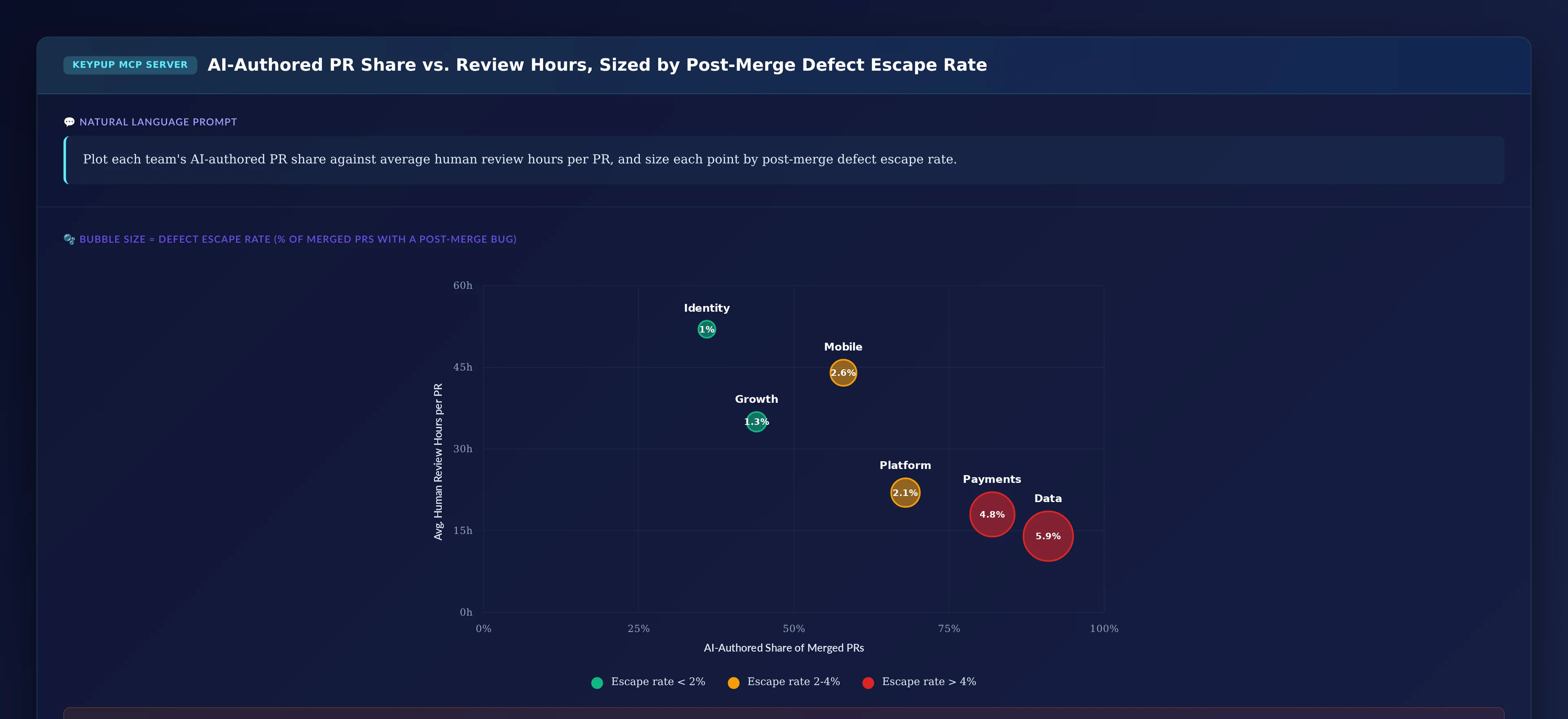
MCP Prompt:
Plot each team's AI-authored PR share against average human review hours
per PR, and size each point by post-merge defect escape rate.
Output: AI-Authored PR Share vs. Review Hours, Sized by Defect Escape Rate
Key Insight: Data and Payments have the highest AI-authored PR share (82-91%) and the lowest review hours per PR — and the highest defect escape rates. The teams adopting AI coding fastest are reviewing the least and shipping the most post-merge bugs, and no dashboard currently connects those three facts.
4. Naming Exactly Which Senior Engineers Are Absorbing the Load
For a retention conversation, leadership needs the receipts on exactly whose workload tripled — not just an aggregate review-hours number.
MCP Prompt:
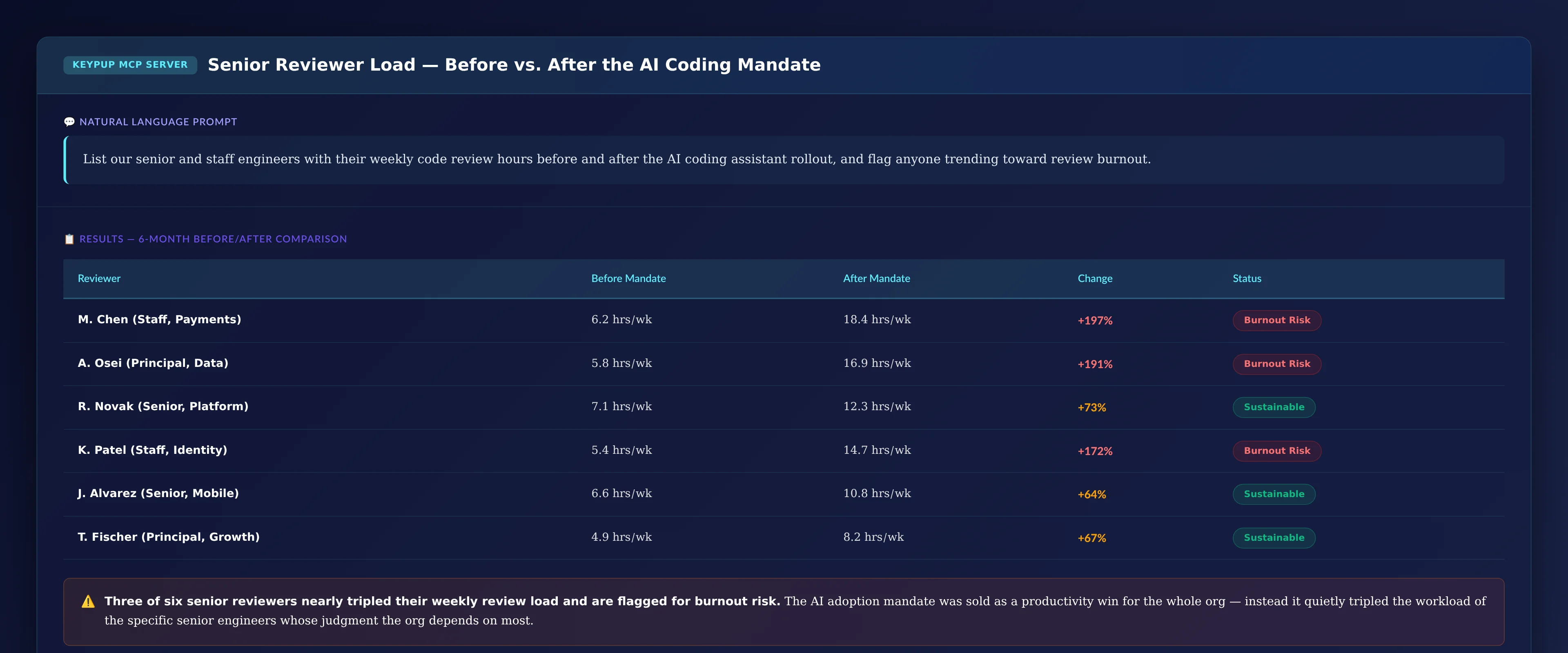
List our senior and staff engineers with their weekly code review hours
before and after the AI coding assistant rollout, and flag anyone
trending toward review burnout.
Output: Senior Reviewer Load — Before vs. After the AI Coding Mandate
Reviewer
Before Mandate
After Mandate
Change
Status
M. Chen (Staff, Payments)
6.2 hrs/wk
18.4 hrs/wk
+197%
Burnout Risk
A. Osei (Principal, Data)
5.8 hrs/wk
16.9 hrs/wk
+191%
Burnout Risk
R. Novak (Senior, Platform)
7.1 hrs/wk
12.3 hrs/wk
+73%
Sustainable
K. Patel (Staff, Identity)
5.4 hrs/wk
14.7 hrs/wk
+172%
Burnout Risk
J. Alvarez (Senior, Mobile)
6.6 hrs/wk
10.8 hrs/wk
+64%
Sustainable
T. Fischer (Principal, Growth)
4.9 hrs/wk
8.2 hrs/wk
+67%
Sustainable
Key Insight: Three of six senior reviewers nearly tripled their weekly review load and are flagged for burnout risk. The AI adoption mandate was sold as a productivity win for the whole org — instead it quietly tripled the workload of the specific senior engineers whose judgment the org depends on most.
5. Proving PR Throughput and Review Latency Are Diverging, Not Improving Together
A single quarter's snapshot is useful. An eight-month trend proves the review bottleneck is compounding as AI adoption deepens, not stabilizing.
MCP Prompt:
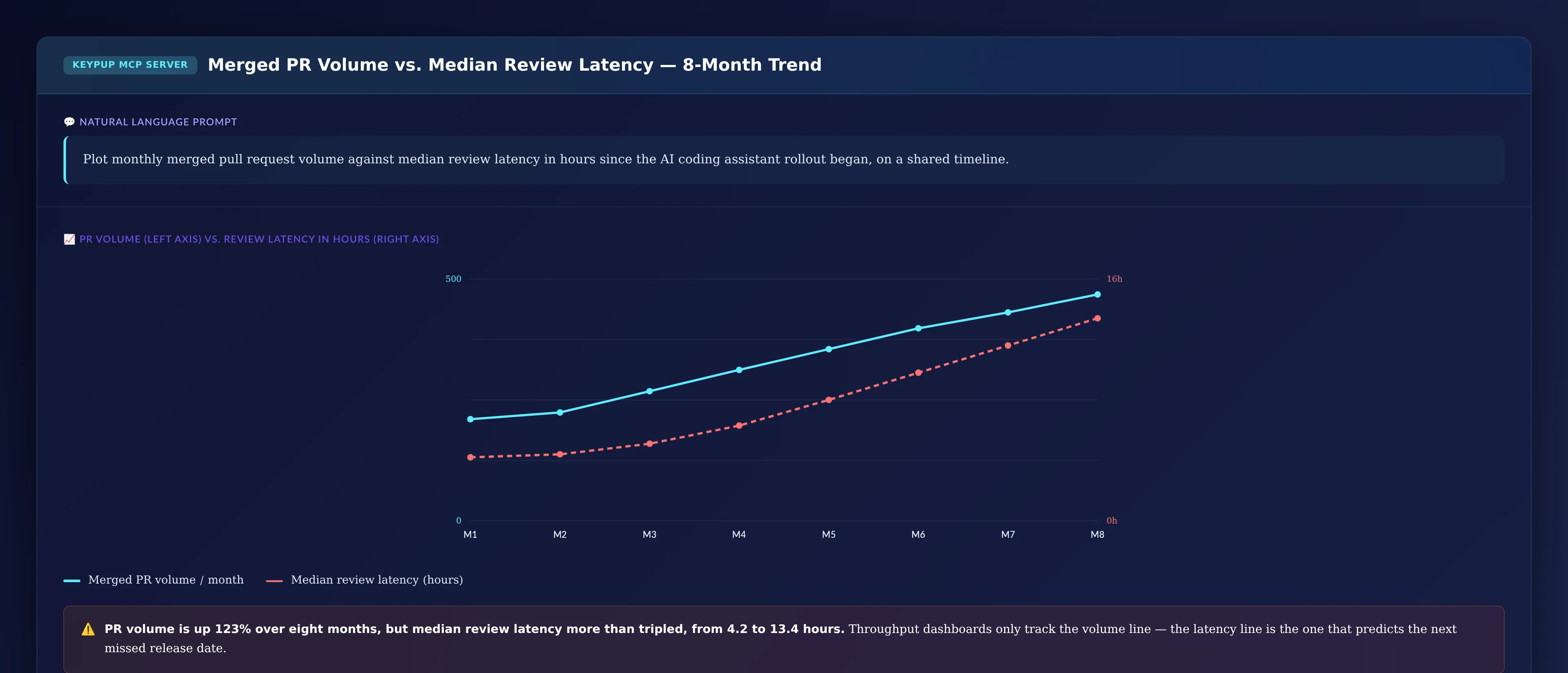
Plot monthly merged pull request volume against median review latency
in hours since the AI coding assistant rollout began, on a shared
timeline.
Output: Merged PR Volume vs. Median Review Latency — 8-Month Trend
Key Insight: PR volume is up 123% over eight months, but median review latency more than tripled, from 4.2 to 13.4 hours. Throughput dashboards only track the volume line — the latency line is the one that predicts the next missed release date.
6. Giving Leadership the Net Capacity Number, Not Just the Gross One
Once the pattern is confirmed, leadership needs a single scorecard that nets the hidden review tax back out of every team's headline velocity number.
MCP Prompt:
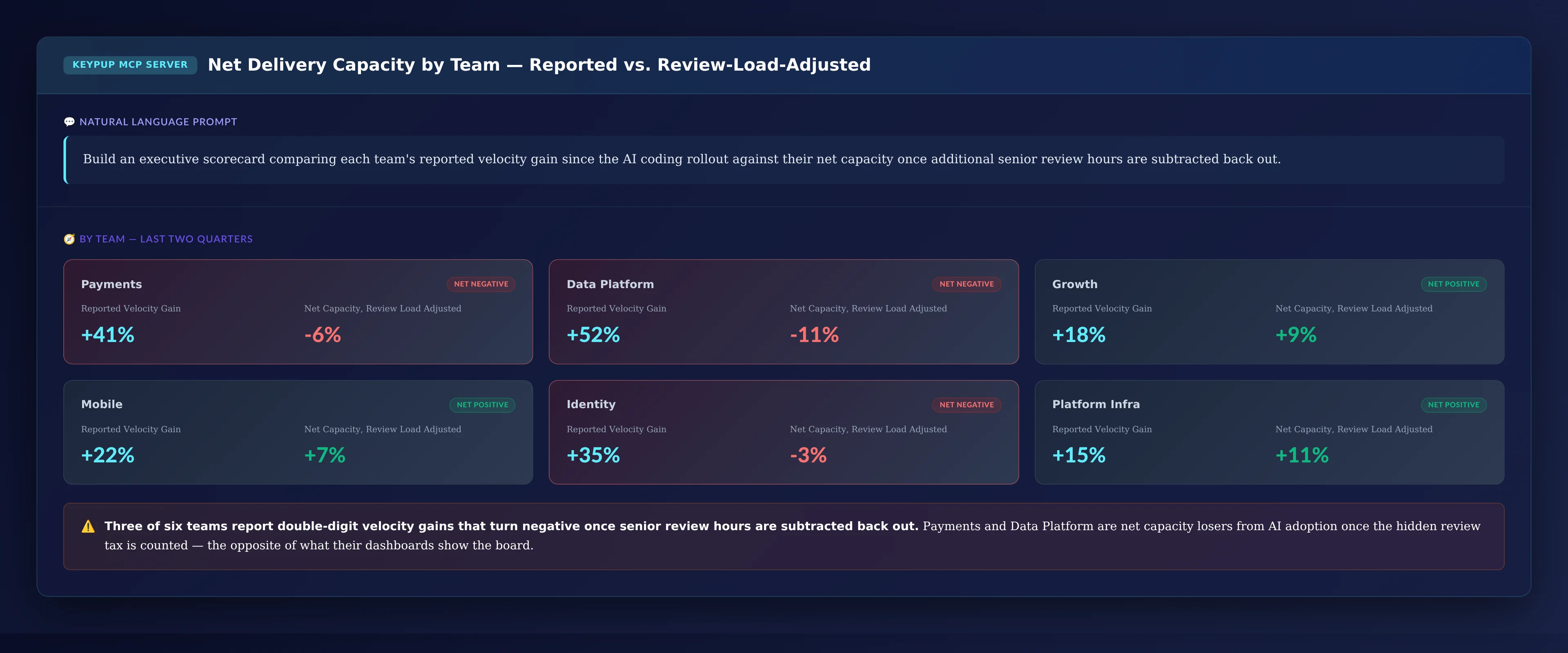
Build an executive scorecard comparing each team's reported velocity
gain since the AI coding rollout against their net capacity once
additional senior review hours are subtracted back out.
Output: Net Delivery Capacity by Team — Reported vs. Review-Load-Adjusted
Key Insight: Three of six teams report double-digit velocity gains that turn negative once senior review hours are subtracted back out. Payments and Data Platform are net capacity losers from AI adoption once the hidden review tax is counted — the opposite of what their dashboards show the board.
The Technical Implementation: How Keypup MCP Separates Review Signal From Adoption Noise
Classifying PRs by Authorship Composition
Keypup MCP cross-references commit metadata, diff patterns, and connected AI tool telemetry (where available) to classify pull requests by how much of their content was AI-generated versus human-written, rather than treating every merged PR as an identical unit of "velocity."
Modeling Review Depth, Not Just Review Speed
Rather than treating "time to approval" as a pure efficiency signal, Keypup MCP combines comment density, reviewer count, and approval latency into a composite depth score — so a fast approval on a trivial change and a fast approval on a 400-line diff are no longer scored identically.
Linking Reviewer Load Back to Individual Engineers
Because burnout risk is a people problem before it's a metrics problem, Keypup MCP tracks review hour trends at the individual contributor level, not just the team level, so retention-critical engineers absorbing disproportionate load can be identified before they leave.
Real-World Impact: Enterprise Case Studies
Case Study 1: Global Payments Platform
Before Keypup MCP:
Leadership reported a 41% velocity gain after the enterprise-wide Copilot rollout, and used it as the headline metric in the annual engineering ROI review
Three staff engineers on the payments team had privately raised concerns about review overload, but there was no data connecting their workload to the AI rollout specifically
A subtle AI-introduced defect in a reconciliation service shipped to production and took two weeks to trace back to a PR that had been approved in under ten minutes
After Keypup MCP:
The reported 41% velocity gain was shown to be a net 6% capacity loss once senior review hours were subtracted back out, reframing the ROI conversation from "is AI working" to "how do we staff the review bottleneck it created"
The three overloaded staff engineers were identified before any of them resigned, and a dedicated senior review rotation was staffed for AI-heavy PRs on the payments team
Review Depth Score on payments PRs rose from 29 to 61 within one quarter of instituting a minimum comment-density threshold for high-risk services
"We were one resignation letter away from finding out the hard way that our AI 'productivity win' was actually a burnout machine for three of our best engineers. The moment we could show the net capacity number instead of the gross one, the conversation with the board changed from 'why isn't this working better' to 'how much headcount do we need to staff the review load we already know is coming.'"
— VP Engineering, Global Payments Platform
Case Study 2: Enterprise Data Platform Company
Before Keypup MCP:
PR volume and merge rate were the only metrics tracked for the AI coding rollout, both trending upward and both reported as unambiguous wins in every leadership update
Post-merge defect rates had crept up over two quarters, but with no connection drawn to AI-authored PR share or review depth, the increase was attributed to "normal variance"
Two principal engineers were each reviewing PRs across three separate squads, with no visibility into how disproportionate that load had become relative to their peers
After Keypup MCP:
The defect escape rate increase was directly correlated to the teams with the highest AI-authored PR share and lowest review hours per PR, giving engineering leadership a concrete root cause instead of "normal variance"
A minimum review-hours-per-PR floor was instituted for AI-authored code above a size threshold, closing the rubber-stamp gap identified by the Review Depth Score
Both overloaded principal engineers had their review scope rebalanced once their individual load trends were visible against team and org benchmarks, without either of them having to escalate it themselves
"Before this, 'is our AI coding rollout actually working' was a debate settled by whichever metric supported whoever was arguing. Now it's one query that shows the gross number, the net number, and exactly which teams are trading review depth for speed. That single change turned a recurring argument into a five-minute scorecard review."
— Director of Engineering, Enterprise Data Platform Company
Implementation: Getting Started with Keypup MCP
1. Connect Your Git Platform and AI Tooling Telemetry First
Before decomposing any velocity metric, connect your GitHub, GitLab, or Azure DevOps data alongside whatever AI coding tool telemetry is available (Copilot metrics, Cursor usage data, or equivalent) — PR authorship classification only works once that context is linked in.
2. Stop Reporting Gross Velocity as the Whole Story
Report reported velocity and review-load-adjusted net capacity as two separate numbers for any team where AI-authored PR share is material, so a rising velocity chart never hides a shrinking net capacity number underneath it.
3. Query in Natural Language, Across Every Team
No manual spreadsheet reconciliation required. Just ask:
"What share of our review hours goes to AI-authored code, by team?"
"Which of our senior engineers has the highest review burnout risk right now?"
"Show me our Review Depth Score trend for the last two quarters"
"Which team's net capacity is negative once review load is accounted for?"
4. Automate Recurring Root-Cause Reporting
Schedule recurring queries for:
Quarterly AI-authored PR share vs. review hour consumption, by team
Review Depth Score tracking, to catch rubber-stamp risk before it ships a defect
Individual reviewer load trends, to protect retention-critical senior engineers
Net capacity scorecards, ahead of every AI ROI conversation with the board
The Bottom Line: An AI Productivity Metric Needs to Account for Both Ends of the Pipeline
A metric that tracks how fast code gets written without tracking how much it costs to review will always overstate the productivity gain from AI coding tools — not occasionally, but in every enterprise where senior engineers are the ones catching what the model gets wrong. Fixing it requires:
✅ Treating AI-authored review load as its own first-class metric, not an invisible cost of an adoption win ✅ Scoring review depth, not just review speed, to catch rubber-stamping before it ships a defect ✅ Tracking reviewer load at the individual level, not just in team aggregates, to protect retention-critical engineers ✅ Reporting net capacity alongside gross velocity, so leadership sees the real number before the board does
Ready to Transform Your Analytics?
Join teams already using AI to make data-driven decisions faster than
ever.
Every enterprise SDLC has issues that span two or more teams — and every one of them quietly loses days waiting on an API contract, a review, or a shared environment slot that no single team's dashboard ever shows as blocked. Discover how Keypup MCP measures the hidden cross-team dependency tax, names the teams causing the most downstream drag, and turns "why does this always take longer than it should" into a precise, fundable staffing conversation.
Every enterprise engineering org absorbs CVE patching, dependency upgrades, and vendor-driven security fixes as "just part of the job" — and none of it shows up on a roadmap. When sprint velocity drops, leadership reads it as a productivity problem. Discover how Keypup MCP surfaces the hidden vulnerability remediation tax, separates it from real engineering decline, and gives leadership the data to staff for it instead of penalizing teams for it.
Acquiring a company means acquiring its engineering org — and its deployment frequency, its review culture, and its three-day-old Bitbucket habit. Here's how to measure the integration gap instead of guessing at it.