The Cross-Team Dependency Tax: Why Your Cycle Time Doubles the Moment Work Crosses a Team Boundary
Every enterprise SDLC has issues that span two or more teams — and every one of them quietly loses days waiting on an API contract, a review, or a shared environment slot that no single team's dashboard ever shows as blocked. Discover how Keypup MCP measures the hidden cross-team dependency tax, names the teams causing the most downstream drag, and turns "why does this always take longer than it should" into a precise, fundable staffing conversation.
Liam Davis
•17 min read
Table of Contents
TL;DR: In any enterprise with more than a handful of teams, a large share of "in progress" work isn't actually being worked — it's sitting blocked waiting on another team's API contract, code review, shared environment slot, or vendor response. Because every team's dashboard only ever tracks the time it owns, this wait time is systematically invisible: reported cycle time looks flat and healthy while true end-to-end cycle time quietly doubles. The Keypup MCP Server decomposes cycle time into active engineering time and cross-team wait time, ranks which teams cause the most downstream drag, and tracks open blockers against a response SLA — turning a recurring "why does everything take so long" frustration into a measurable, staffable problem.
Ask an engineering leader at a large enterprise why a "simple" cross-team feature took six weeks when the actual code changes across all three teams add up to four days of work, and you'll usually get a shrug and a story about a Slack thread that went quiet for two weeks. Every team involved will swear their part was fast. Every team's dashboard will back them up. And the feature will still have taken six weeks.
The Friction: Work That's "In Progress" Everywhere and Actually Happening Nowhere
Standard engineering dashboards are built team-by-team. Cycle time, lead time, and velocity are almost always scoped to the team that owns the ticket — which means the moment work crosses a team boundary, the clock that matters most stops being visible to anyone.
Every team's dashboard only shows its own slice. A checkout feature needs a new fraud-scoring endpoint from the Fraud Platform team. Checkout's dashboard shows the ticket as "blocked" for two days before someone follows up — but nothing tracks how many total days the fraud team took to actually respond, because that time belongs to a different team's board, not Checkout's.
Blockers get logged inconsistently, if at all. Some teams open a ticket in the blocking team's queue; others just ping in Slack and wait; some quietly work around the missing dependency with a stub and never circle back to reconcile it. None of these show up the same way in any rollup.
"Blocked" status hides how long the block has actually lasted. A ticket can sit in a "blocked" column for three weeks while its own team's velocity number stays clean, because velocity only counts committed story points that moved — not the elapsed calendar time the story point sat waiting.
The requesting team absorbs 100% of the reputational cost. When the checkout feature ships six weeks late, it's the checkout team explaining the delay in the steering committee — not the platform team whose API contract took three weeks to finalize. The team that caused the wait is invisible in every conversation about the wait.
The result: teams get systematically penalized for delays they didn't cause and can't measure, while the teams actually generating the most downstream drag look perfectly healthy on paper — because no dashboard was ever built to look across the boundary.
Why This Matters: The Metric Everyone Trusts Is Measuring the Wrong Thing
The Misdiagnosis Problem
When a cross-team initiative slips, the reflexive question is "why is the requesting team so slow?" But if that team's own cycle time has been flat for eight sprints, the honest answer is that they aren't slow — the work simply spent most of its life outside their control, waiting on a dependency nobody was tracking as a distinct category of delay.
The Accountability Vacuum Problem
Without a shared, cross-team view of blocked time, there's no way to know which team is actually generating the most downstream wait. Remediation conversations default to blaming whichever team is presenting the missed deadline, while the team that caused three weeks of silent delay never enters the conversation at all.
The Trust Problem
When a team explains a slip by pointing to "we were blocked on Platform for weeks," without data to back it up, it reads exactly like every other excuse leadership has heard before — even when it's completely true. Nobody can independently verify which team actually held up the work, so the explanation gets discounted and the standoff repeats on the next cross-team initiative.
The Enterprise Discussion: What Engineers Are Actually Saying
This exact frustration is one of the most consistent themes wherever engineers at large, multi-team organizations compare notes on delivery timelines and internal politics.
"Every single retro, someone says 'we were blocked on [other team] for two weeks' and everyone nods and moves on, because there's no way to actually prove it or track it over time. Our own cycle time metrics look great. The feature still took six weeks instead of five days of actual work. Nobody has ever once looked at the other team's response time to us — only ours to them."
"We have a shared platform team that owns three internal APIs the rest of the org depends on. Every product team quietly knows their tickets sit for a week or two whenever they need something from Platform. Platform's own velocity is fine — they're closing their tickets on time. It's just that 'on time' for them means two weeks after everyone else asked, and that gap doesn't exist anywhere in a dashboard."
The pattern holds: engineers already know exactly which team's queue their tickets disappear into — what's missing is a number that turns that shared, silent frustration into a staffing and prioritization decision leadership will actually act on.
How Keypup MCP Solves the Cross-Team Dependency Tax
The Keypup Model Context Protocol (MCP) Server treats cross-team dependency as its own first-class category of delay — decomposing cycle time into active work and cross-team wait, tracking which team is on the other side of every blocker, and quantifying exactly how much downstream drag each team is generating, all through natural-language prompts against your existing Git and issue-tracker data.
1. Decomposing Cycle Time Into Active Work vs. Cross-Team Wait
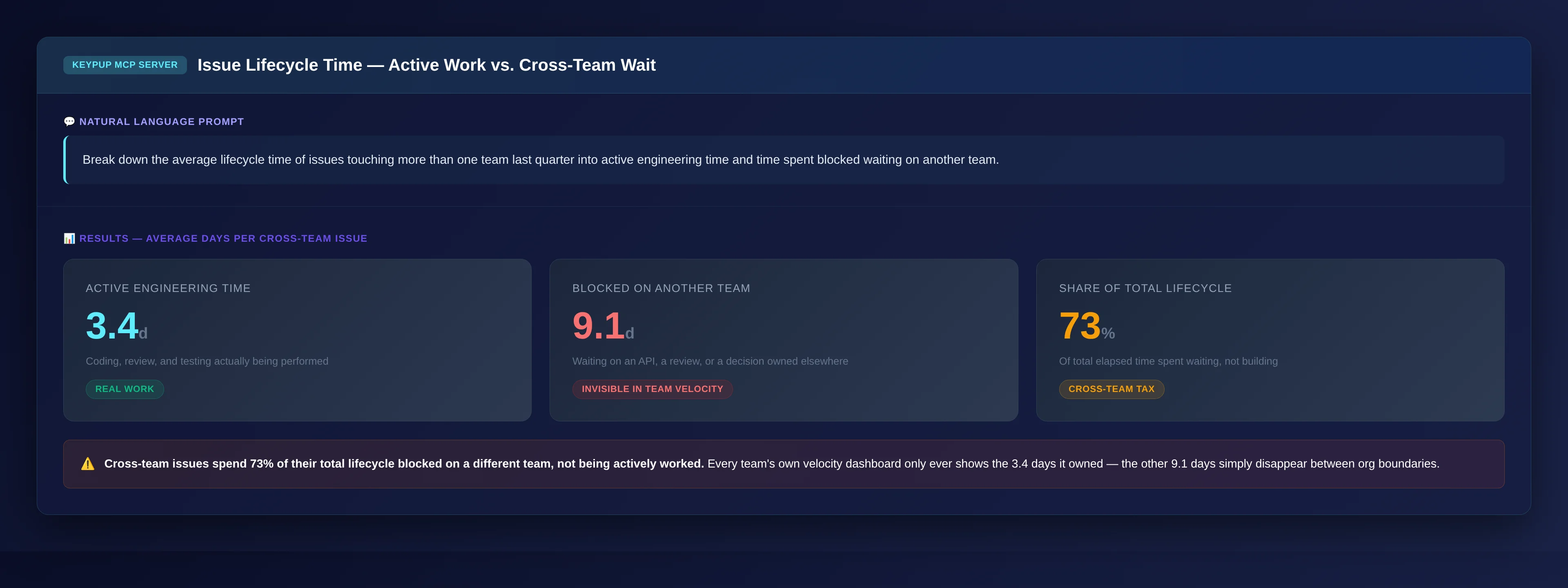
Before anything else, leadership needs to see how much of a cross-team issue's total lifecycle is actually being worked, versus sitting blocked on a different team.
MCP Prompt:
Break down the average lifecycle time of issues touching more than
one team last quarter into active engineering time and time spent
blocked waiting on another team.
Output: Issue Lifecycle Time — Active Work vs. Cross-Team Wait
Key Insight: Cross-team issues spend 73% of their total lifecycle blocked on a different team, not being actively worked. Every team's own velocity dashboard only ever shows the 3.4 days it owned — the other 9.1 days simply disappear between org boundaries.
2. Breaking Down What Cross-Team Blockers Are Actually Waiting On
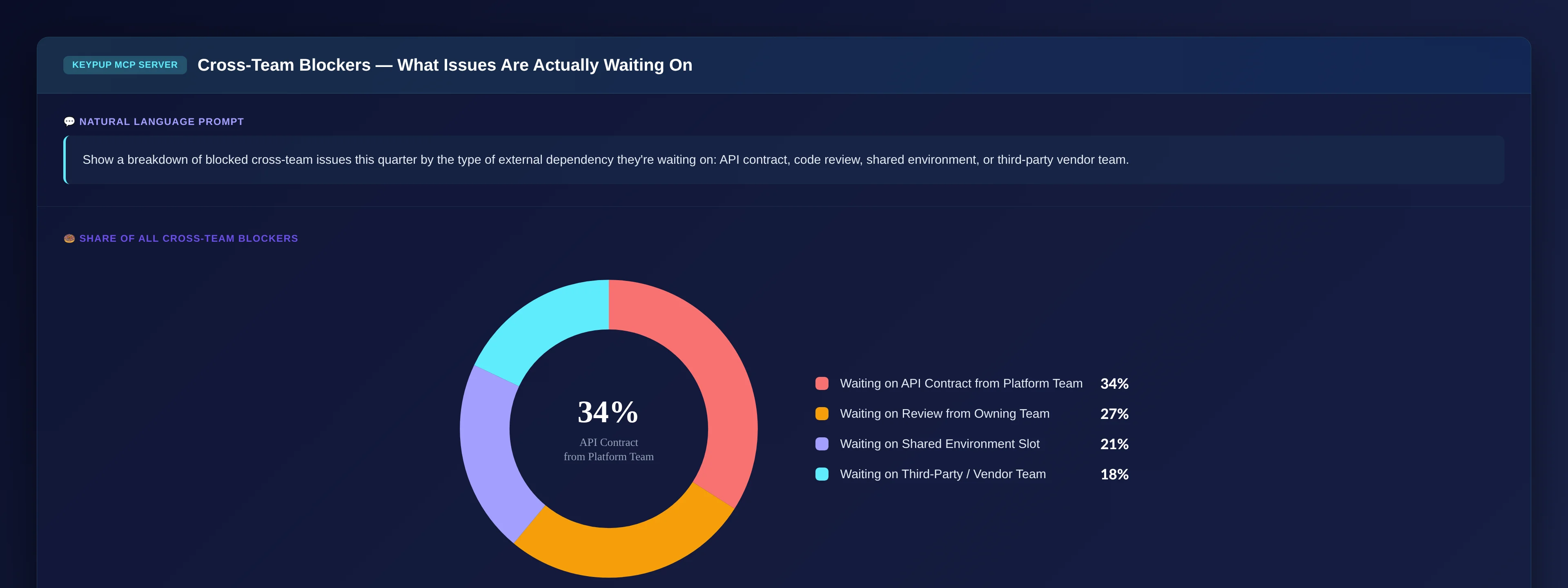
Once wait time is visible as its own category, the next question is what kind of dependency is generating most of it.
MCP Prompt:
Show a breakdown of blocked cross-team issues this quarter by the
type of external dependency they're waiting on: API contract, code
review, shared environment, or third-party vendor team.
Output: Cross-Team Blockers — What Issues Are Actually Waiting On
Key Insight: More than a third of cross-team blockers are teams waiting on an API contract that another team hasn't finalized yet. That single dependency type outweighs code review delays, environment contention, and vendor delays combined.
3. Ranking Requesting Teams by Total Blocked Days
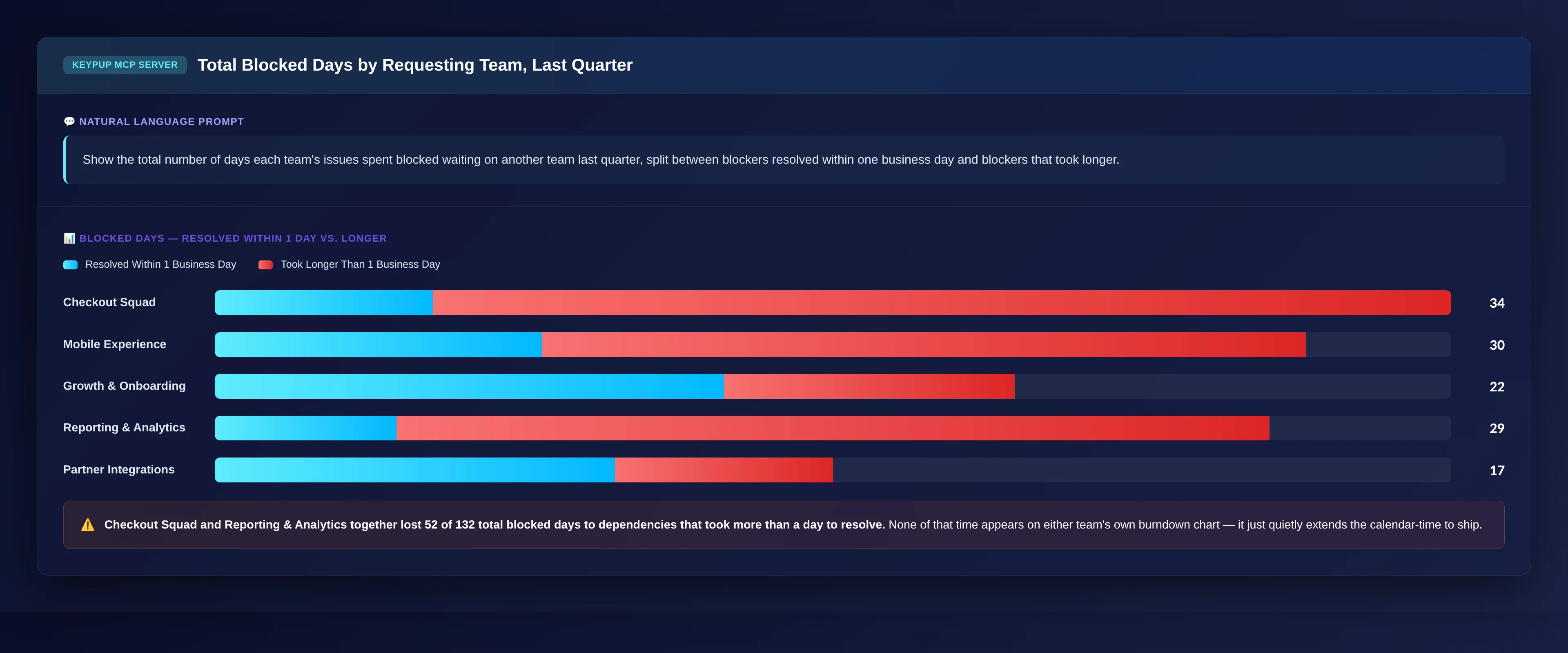
With the dependency type established, leadership needs to know exactly which requesting teams are absorbing the most calendar-time cost.
MCP Prompt:
Show the total number of days each team's issues spent blocked
waiting on another team last quarter, split between blockers
resolved within one business day and blockers that took longer.
Output: Total Blocked Days by Requesting Team, Last Quarter
Key Insight: Checkout Squad and Reporting & Analytics together lost 52 of 132 total blocked days to dependencies that took more than a day to resolve. None of that time appears on either team's own burndown chart — it just quietly extends the calendar-time to ship.
4. Naming the Specific Open Blockers Right Now
For a governance or planning conversation, leadership needs the receipts on exactly which cross-team blockers are open today and how long they've been sitting.
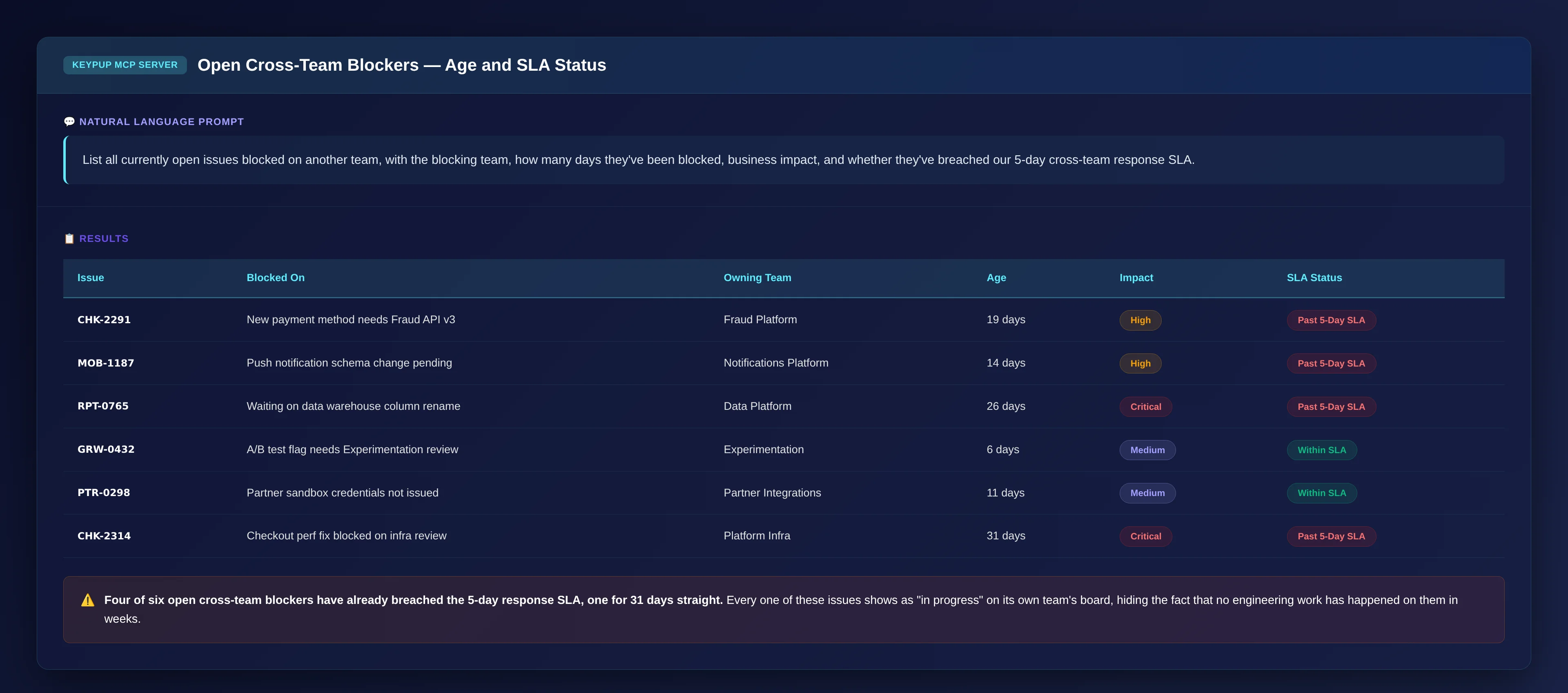
MCP Prompt:
List all currently open issues blocked on another team, with the
blocking team, how many days they've been blocked, business impact,
and whether they've breached our 5-day cross-team response SLA.
Output: Open Cross-Team Blockers — Age and SLA Status
Issue
Blocked On
Owning Team
Age
Impact
SLA Status
CHK-2291
New payment method needs Fraud API v3
Fraud Platform
19 days
High
Past 5-Day SLA
MOB-1187
Push notification schema change pending
Notifications Platform
14 days
High
Past 5-Day SLA
RPT-0765
Waiting on data warehouse column rename
Data Platform
26 days
Critical
Past 5-Day SLA
GRW-0432
A/B test flag needs Experimentation review
Experimentation
6 days
Medium
Within SLA
PTR-0298
Partner sandbox credentials not issued
Partner Integrations
11 days
Medium
Within SLA
CHK-2314
Checkout perf fix blocked on infra review
Platform Infra
31 days
Critical
Past 5-Day SLA
Key Insight: Four of six open cross-team blockers have already breached the 5-day response SLA, one for 31 days straight. Every one of these issues shows as "in progress" on its own team's board, hiding the fact that no engineering work has happened on them in weeks.
5. Proving the Cycle Time Increase Is a Cross-Team Problem, Not a Team Problem
A single quarter's decomposition is useful. A trend across sprints proves the growing delay is systemic and structural, not a change in any one team's output.
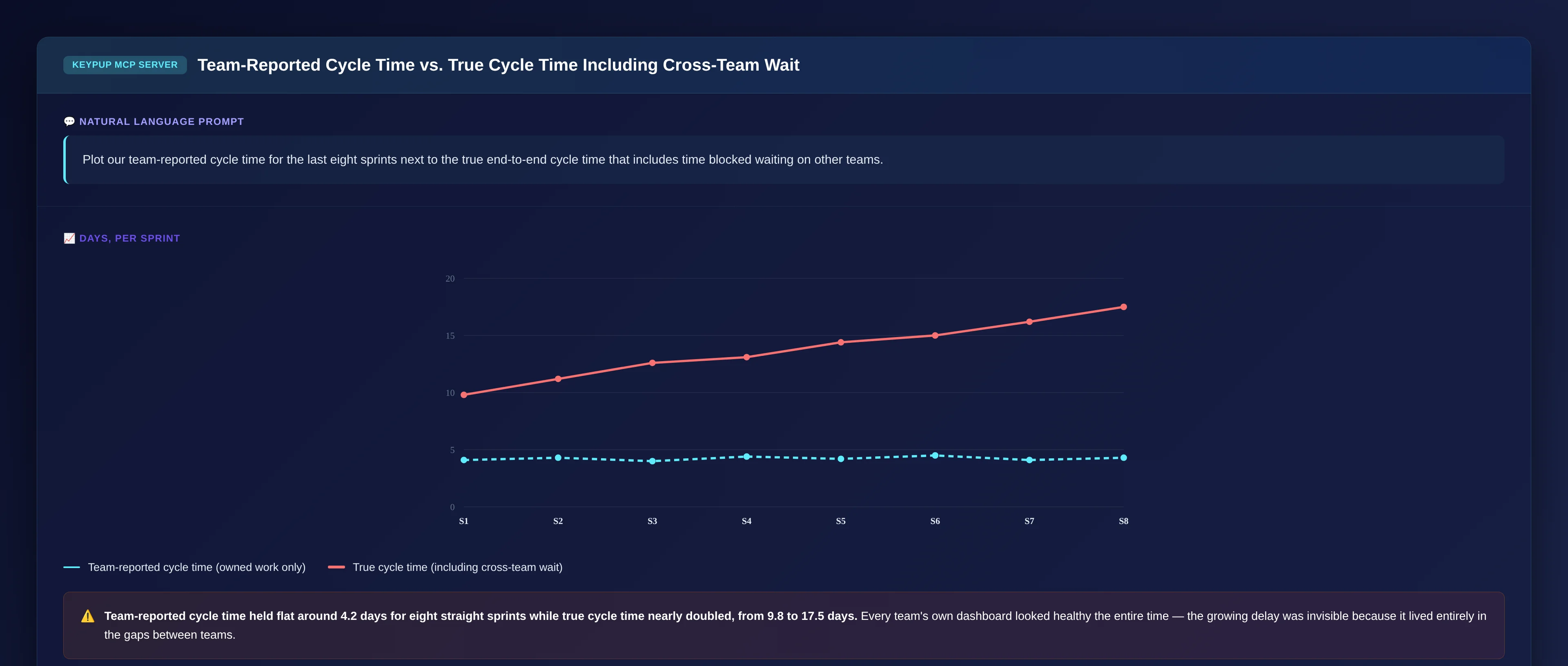
MCP Prompt:
Plot our team-reported cycle time for the last eight sprints next to
the true end-to-end cycle time that includes time blocked waiting on
other teams.
Output: Team-Reported Cycle Time vs. True Cycle Time Including Cross-Team Wait
Key Insight: Team-reported cycle time held flat around 4.2 days for eight straight sprints while true cycle time nearly doubled, from 9.8 to 17.5 days. Every team's own dashboard looked healthy the entire time — the growing delay was invisible because it lived entirely in the gaps between teams.
6. Giving Leadership a Standing View of Who's Actually Causing the Drag
Once the pattern is confirmed, leadership needs an ongoing view of which teams generate the most downstream wait for everyone else, to target process fixes and staffing where they're needed.
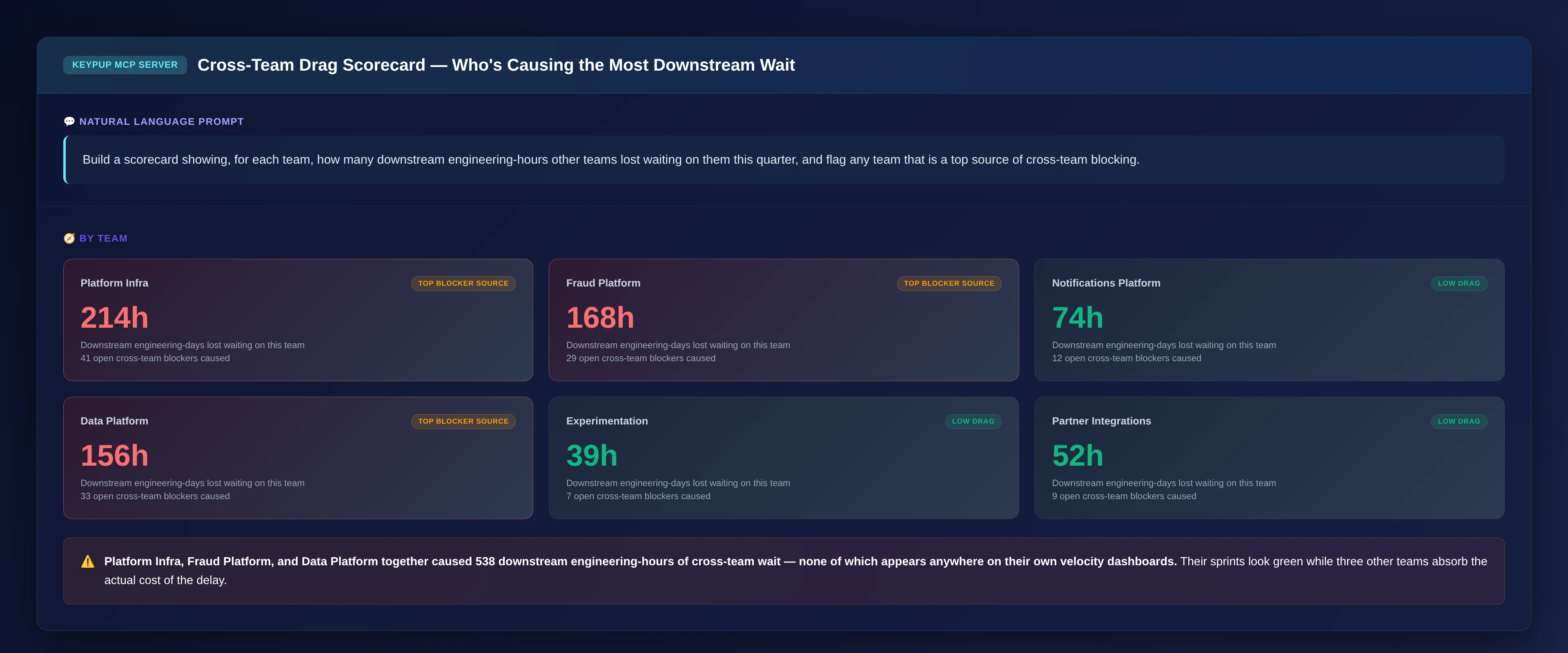
MCP Prompt:
Build a scorecard showing, for each team, how many downstream
engineering-hours other teams lost waiting on them this quarter, and
flag any team that is a top source of cross-team blocking.
Output: Cross-Team Drag Scorecard — Who's Causing the Most Downstream Wait
Key Insight: Platform Infra, Fraud Platform, and Data Platform together caused 538 downstream engineering-hours of cross-team wait — none of which appears anywhere on their own velocity dashboards. Their sprints look green while three other teams absorb the actual cost of the delay.
The Technical Implementation: How Keypup MCP Sees Across Team Boundaries
Linking Blocked Status to the Team on the Other Side
Keypup MCP resolves the actual owning team behind every "blocked" status — whether that dependency was logged as a formal cross-team ticket, an @-mention on a pull request, or a linked issue in a different project — so the wait is attributed to the team actually causing it, not just the team stuck waiting.
Decomposing Lifecycle Time by Ownership, Not Just Status
Rather than treating "in progress" as a single undifferentiated state, Keypup MCP splits each issue's total elapsed time into active engineering time and time attributable to each external team it depended on, so the true cost of a dependency is visible even when the requesting team's own metrics look perfectly normal.
SLA-Aware Cross-Team Response Tracking
Because different dependency types warrant different response expectations, Keypup MCP tracks each open cross-team blocker against a configurable response SLA and surfaces breaches automatically — instead of requiring someone to manually chase a Slack thread to find out how long a request has actually been sitting.
Real-World Impact: Enterprise Case Studies
Case Study 1: Multi-Brand Retail Platform
Before Keypup MCP:
Cross-brand checkout initiatives were routinely slipping by four to six weeks, with the requesting product team repeatedly explaining delays in steering committee meetings
No visibility into how much of the slip was actually caused by a shared Platform team's API review queue versus the requesting team's own execution
The platform team's own velocity dashboard looked healthy the entire time, because their committed tickets were closing on schedule — just not fast enough relative to when they were requested
After Keypup MCP:
Cross-team wait time was isolated as the actual driver, showing the requesting teams' own cycle time had stayed flat while true end-to-end cycle time had crept upward for two quarters
A dedicated fast-track review lane was staffed on the Platform team for cross-team API requests, based on the downstream-hours data, instead of asking product teams to simply "plan further ahead"
True cycle time on cross-brand initiatives dropped by over 40% within one quarter, once the platform team had capacity that was actually built for the incoming request volume
"We'd spent a year having the same argument every steering committee — was it the product team being slow, or were they blocked? Nobody had a number for either side. The moment we could show that a specific team's response time to everyone else had tripled while their own sprint metrics stayed green, the conversation stopped being political and started being about staffing."
— VP Engineering, Multi-Brand Retail Platform
Case Study 2: Global Insurance Technology Group
Before Keypup MCP:
Cross-team blockers were scattered across Slack threads, email, and informal tickets with no consistent tracking, so nobody could say with confidence which team was generating the most downstream delay
One shared data platform team was quietly the bottleneck for nearly every reporting initiative across six product teams, with no data to justify additional headcount for that team
Product leadership and platform leadership had entirely different stories about "how responsive" the platform team actually was, because neither side had a shared, objective measurement
After Keypup MCP:
Downstream wait hours were attributed automatically to the team that owned each blocker, giving product and platform leadership the same numbers for the first time
The data platform team's queue was restructured with a dedicated cross-team request lane, funded directly from the downstream-hours data showing its true organizational impact
Average time-to-unblock for cross-team dependencies improved by more than 35% once the bottleneck team had capacity explicitly allocated for external requests instead of treating them as best-effort
"Every quarter it was the same fight: product teams saying they were blocked, platform saying their velocity was fine. Both were technically true, which is exactly the problem — the metric that mattered was never being measured. Now it's a standing query, and it's the first thing we look at before any cross-team roadmap conversation."
— Director of Engineering, Global Insurance Technology Group
Implementation: Getting Started with Keypup MCP
1. Connect All Team Repositories and Issue Trackers Together
Cross-team attribution only works once Keypup MCP can see every team's Git and issue-tracker activity in one place — connect all repositories and projects, not just the ones for the team running the analysis.
2. Stop Reporting Cycle Time as a Single, Team-Scoped Number
Report active engineering time and cross-team wait time as two separate numbers for any issue that spans a team boundary, so a dependency-heavy quarter never gets misread as a team execution problem.
3. Query in Natural Language, Across Every Team Boundary
No manual Slack-thread archaeology required. Just ask:
"How much of our cycle time increase last quarter was cross-team wait?"
"Which team currently has the oldest open blocker on another team's queue?"
"Show me downstream hours other teams lost waiting on us this month"
"Which team is the biggest source of cross-team blocking right now?"
4. Automate Recurring Root-Cause Reporting
Schedule recurring queries for:
Quarterly cycle-time decomposition into active work and cross-team wait, by requesting team
Open cross-team blocker age and SLA breach tracking, to justify fast-track staffing where it's actually needed
Reported vs. true cycle-time trend lines, ahead of every steering committee
Standing cross-team drag scorecards ahead of headcount and reorganization conversations
The Bottom Line: Cycle Time Needs to See Past Its Own Team's Board
A metric that only measures the time a team owns will always misattribute the cost of cross-team dependency to whichever team is stuck holding the ticket — not occasionally, but every single time work crosses an organizational boundary, in every enterprise with more than one team. Fixing it requires:
✅ Decomposing cycle time into active work and cross-team wait, for every issue that spans a team boundary ✅ Attributing wait time to the team actually causing it, not just the team stuck waiting ✅ Tracking open cross-team blockers against a response SLA, not just an informal Slack thread ✅ Quantifying downstream drag by team over time, so leadership sees it's structural, not anecdotal ✅ Maintaining a standing cross-team drag scorecard, to staff and prioritize fixes before the next steering committee escalation
The Keypup MCP Server turns "why does this always take longer than it should" from a recurring, unresolvable finger-pointing exercise into a precise answer — active work, cross-team wait, or both — giving engineering leaders the data to fix the actual bottleneck instead of asking every team to simply move faster on the part they already control.
Get Started
Ready to stop measuring cycle time with a number that's silently hiding your entire cross-team wait?
Start Free Trial — Connect your engineering stack in minutes and start separating active engineering time from cross-team dependency wait.
Request Demo — See how enterprise engineering leaders use Keypup MCP to quantify and fix the cross-team dependency tax.
View MCP Documentation — Technical details for engineering teams implementing Keypup MCP across multi-team Git and issue-tracker data.
Keywords: cross-team dependency tax, cross-team blocking metrics, cycle time decomposition, hidden wait time SDLC, engineering handoff delays, DORA metrics cross-team, MCP server dependency tracking, enterprise cross-team SLA, downstream engineering drag, cross-functional blocker analytics
Ready to Transform Your Analytics?
Join teams already using AI to make data-driven decisions faster than
ever.
Enterprise AI coding mandates promised a productivity windfall — instead they moved the bottleneck from writing code to reviewing it, and dumped the extra load on the exact senior and staff engineers your org can least afford to burn out. Discover how Keypup MCP separates AI-authored review load from real velocity gains, exposes rubber-stamp risk, and gives leadership the data to fix a review pipeline that's quietly going net-negative.
Every enterprise engineering org absorbs CVE patching, dependency upgrades, and vendor-driven security fixes as "just part of the job" — and none of it shows up on a roadmap. When sprint velocity drops, leadership reads it as a productivity problem. Discover how Keypup MCP surfaces the hidden vulnerability remediation tax, separates it from real engineering decline, and gives leadership the data to staff for it instead of penalizing teams for it.
Acquiring a company means acquiring its engineering org — and its deployment frequency, its review culture, and its three-day-old Bitbucket habit. Here's how to measure the integration gap instead of guessing at it.