From Issue to Merge: How to Track and Optimize Your Pull Request Workflow with AI-Powered Analytics
Unlock efficiency by mastering your pull request workflow. Learn how Keypup's AI unifies Git and Jira data to track, analyze, and optimize your entire issue-to-merge lifecycle.
TL;DR: Untracked pull request workflows lead to bottlenecks, delayed delivery, and developer frustration, severely impacting overall SDLC performance.
Key Point 1: Traditional metrics offer limited visibility, failing to connect PR activity with underlying Jira issues and business value.
Key Point 2: Keypup's AI-powered analytics provides deep, contextual insights into PR cycle time, review efficacy, and the complete issue-to-merge journey.
Key Point 3: Shift from reactive problem-solving to proactive workflow optimization, identifying systemic bottlenecks and driving continuous improvement.
Key Point 4: Leverage actionable recommendations to reduce time to merge, enhance code review quality, and accelerate software delivery.
Introduction: The Critical Path from Idea to Deployment
The journey from a new feature idea – often captured as a Jira issue – to its eventual release in production frequently feels like navigating a dense, unpredictable jungle. Within this journey, the pull request (PR) workflow is the critical, yet often chaotic, path that determines speed, quality, and team morale. Modern software development hinges on efficient pull request workflow optimization, yet many engineering teams struggle with comprehensive visibility, leading to frustrating delays, rework, and ultimately, slower software delivery.
This lack of clarity means engineering leaders often make decisions based on incomplete data, unable to pinpoint exact bottlenecks or measure the true impact of process changes. The result? Extended time to merge, inflated PR cycle time, and a growing disconnect between engineering effort and business outcomes. This article will explore the inherent challenges of managing complex PR workflows, demonstrate how Keypup's AI-powered software development analytics can illuminate these hidden bottlenecks, and provide actionable strategies to optimize your entire issue-to-merge lifecycle. By leveraging AI, engineering leaders can gain the precise insights needed to transform their pull request workflow from a source of frustration into a streamlined engine of value delivery.
Context: The Hidden Costs of an Untracked Pull Request Workflow
Every engineering team strives for agility and rapid delivery, but the reality often falls short. While tools like GitHub, GitLab, and Bitbucket excel at managing code changes, they rarely provide the holistic view needed to understand the true health and efficiency of a pull request workflow. This fragmented visibility creates a fertile ground for inefficiencies that quietly erode developer productivity metrics and inflate PR lead time.
Consider these common pain points: a pull request sits unreviewed for days, developers context-switch between tasks, large PRs become intimidating review burdens, and the critical link between code changes and the original Jira issue often gets lost. These aren't just minor inconveniences; they represent significant hidden costs in terms of delayed delivery, wasted effort, and developer burnout. When the time to merge extends due to review stagnation or rework, it directly impacts project timelines and the team's ability to respond quickly to market demands.
u/frustrated_dev_22 from r/ExperiencedDevs
My biggest pet peeve is PRs sitting for days with no reviews. Then when someone finally picks it up, they leave one small comment, and it goes back into the queue for another eternity. Drives me nuts and totally kills my flow.
This sentiment is echoed across the industry. Teams know their PR cycle time is too high, but without granular data, they're left guessing at the root cause. Is it a coding bottleneck? A reviewer capacity issue? Or perhaps a problem with code review metrics and processes themselves?
u/sdlc_struggles from r/softwaredevelopment
We're always chasing 'cycle time' but nobody can tell me why our PRs take so long. Is it the code? The reviews? The deploys? It's just a black box of 'it takes a while'.
Existing solutions often fall short. Manual data extraction and spreadsheet analysis are time-consuming and prone to errors, offering only a snapshot instead of continuous, actionable insights. Generic BI dashboards provide surface-level metrics but lack the deep contextual understanding that AI-powered engineering metrics platforms can offer, especially when it comes to bridging the Git-to-Jira gap for comprehensive SDLC tracking. Without this unified view, organizations are essentially flying blind, unable to implement effective development process optimization strategies.
Unveiling PR Cycle Time Bottlenecks: Where Your Code Gets Stuck
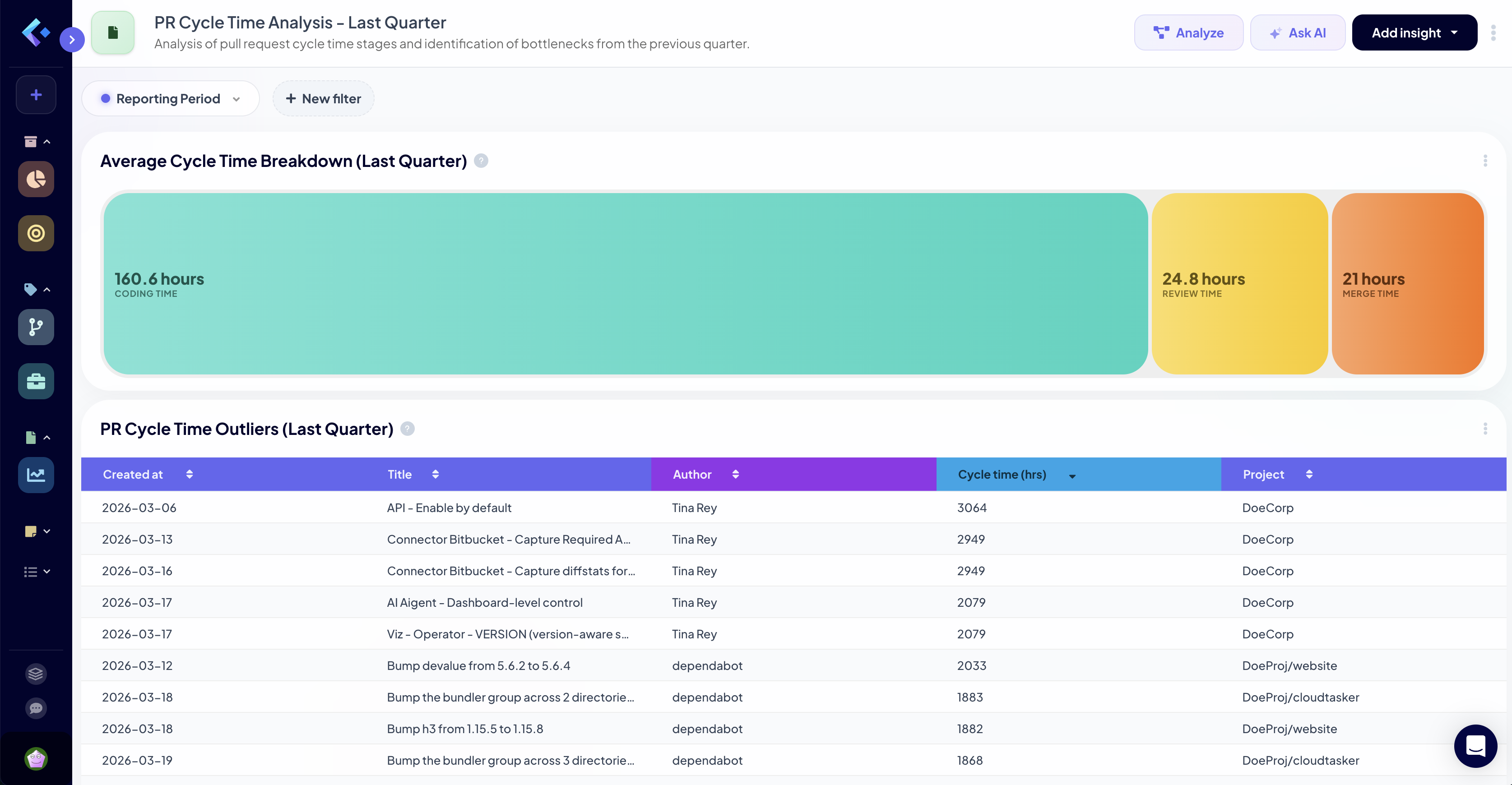
Understanding the full PR cycle time is fundamental to pull request workflow optimization. Many teams know their overall time to merge is high, but they lack the granular data to pinpoint whether delays stem from initial coding, waiting for reviews, or re-work after feedback. This analysis matters because it provides a precise breakdown of the total time a pull request spends in different stages—from creation to merge—allowing engineering leaders to identify specific bottlenecks and implement targeted improvements. This is a critical step towards reducing PR lead time and enhancing software delivery metrics.
Prompt to the Keypup platform
Analyze the average cycle time for all pull requests opened in the last quarter, breaking it down into distinct stages: 'coding time', 'review time', 'rework time', and 'merge time'. Highlight the stage with the longest average duration and identify any significant outliers.
Analysis from Keypup AI
Key Insights 📊
The average PR cycle time for the last quarter was 5.8 days.
'Review time' accounts for 60% (3.5 days) of the total PR cycle time, making it the longest average duration stage.
A cluster of significant outliers (PRs exceeding 10 days) were primarily attributed to extended 'review time' in specific repositories.
⚠️ Bottlenecks and Problem Areas
Prolonged Review Time: The overwhelming majority of pull request workflow delays stem from the review stage. This indicates potential issues with reviewer availability, review capacity, or the complexity of code being reviewed.
Rework Spikes: Although a smaller component, the 'rework time' occasionally spikes for certain PRs, suggesting inconsistent initial code quality or unclear requirements leading to significant post-review changes.
Outlier Management: A small percentage of PRs disproportionately drag down the average time to merge, highlighting a need for better identification and escalation processes for stalled work.
💡 Recommendations
Implement a Service Level Agreement (SLA) for code review metrics, aiming to reduce average 'review time' by 20% within the next sprint cycle.
Encourage smaller, more focused pull requests to streamline reviews and minimize 'rework time'.
Develop automated checks or pre-commit hooks to catch common issues early, reducing the need for extensive rework during review.
🚀 Priority Actions
Immediate action item: Set up automated reminders for reviewers on PRs open for more than 2 business days without activity.
Short-term action item: Conduct a deep dive into the specific repositories and teams contributing to the highest 'review time' outliers to understand their unique challenges.
Long-term action item: Explore initiatives like pair programming or dedicated review rotations to distribute review load more effectively and enhance developer productivity metrics.
Identifying Reviewer Congestion and Stagnant PRs: Optimizing Code Review Metrics
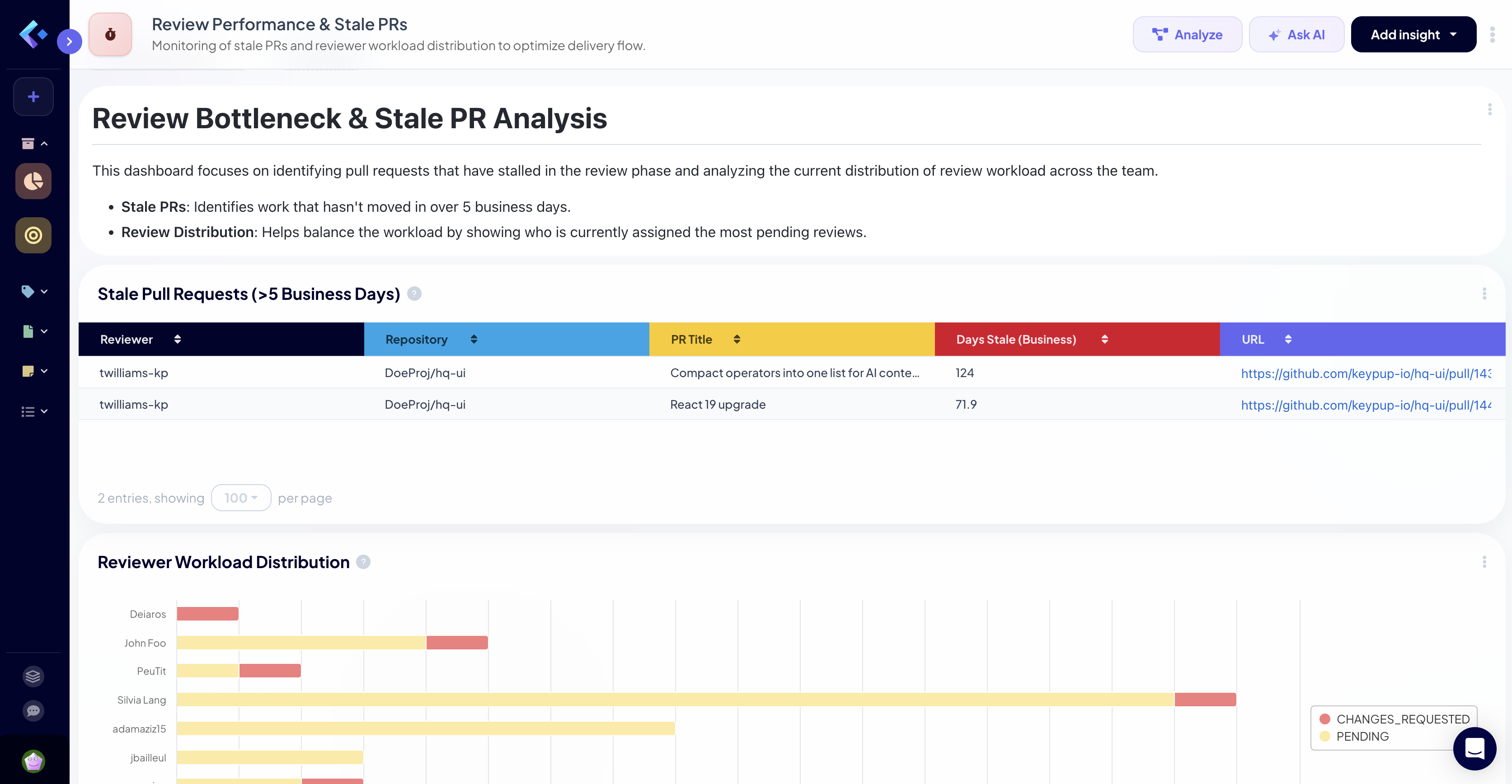
Code review is a critical stage for ensuring quality, fostering knowledge sharing, and maintaining codebase health, but it's also a common choke point in DevOps workflow optimization. This analysis matters because it helps pinpoint stale PRs and identify team members who might be overburdened with reviews. What problem it solves: Stagnant pull requests not only delay delivery but also lead to significant context switching costs for developers, directly impacting developer productivity metrics. Gaining insights into code review metrics and patterns helps optimize review efficiency and ensures timely feedback, crucial for efficient pull request workflow optimization.
Prompt to the Keypup platform
Generate a dashboard displaying all pull requests currently open for more than 5 business days without any new activity, grouped by assigned reviewer and repository. Additionally, show the distribution of active pull requests currently awaiting review across all reviewers for the last 30 days, ordered by average number of pending reviews per reviewer.
Analysis from Keypup AI
Key Insights 📊
There are 15 stale PRs (open > 5 business days without activity), with 7 of these assigned to two specific reviewers (Alex and Sarah).
The average number of pending reviews per reviewer over the last 30 days shows a skewed distribution, with Alex averaging 8 pending reviews and Sarah 6, significantly higher than the team average of 3.
Repository 'ServiceX-Backend' has the highest concentration of stale PRs, with 5 open for more than 7 days.
⚠️ Bottlenecks and Problem Areas
Reviewer Overload: A small number of reviewers are consistently bearing a disproportionate amount of the review load, leading to reviewer congestion and becoming a bottleneck for pull request workflow optimization.
Stagnant Work: The presence of 15 stale PRs indicates a lack of consistent follow-up or a clear process for escalating neglected reviews, directly increasing PR lead time.
Repository-Specific Issues: 'ServiceX-Backend' appears to have systemic code review metrics challenges, possibly due to its complexity or fewer available domain experts for review.
💡 Recommendations
Implement a dynamic review assignment system that considers current reviewer load and expertise to ensure more even distribution.
Introduce a "stale PR" policy with automated notifications for reviewers and authors when a PR exceeds a defined inactivity threshold.
Foster a culture of cross-pollination to build more generalists capable of reviewing code across different repositories, reducing reliance on specific individuals.
🚀 Priority Actions
Immediate action item: Rebalance the current pending review load by reassigning older PRs from Alex and Sarah to other available team members.
Short-term action item: Schedule a working session for the 'ServiceX-Backend' team to identify and address specific code review metrics bottlenecks in their workflow.
Long-term action item: Integrate automated pull request analytics into daily stand-ups to proactively address pending reviews and stale PRs.
Connecting PRs to Business Value: Holistic Issue-to-Merge Tracking
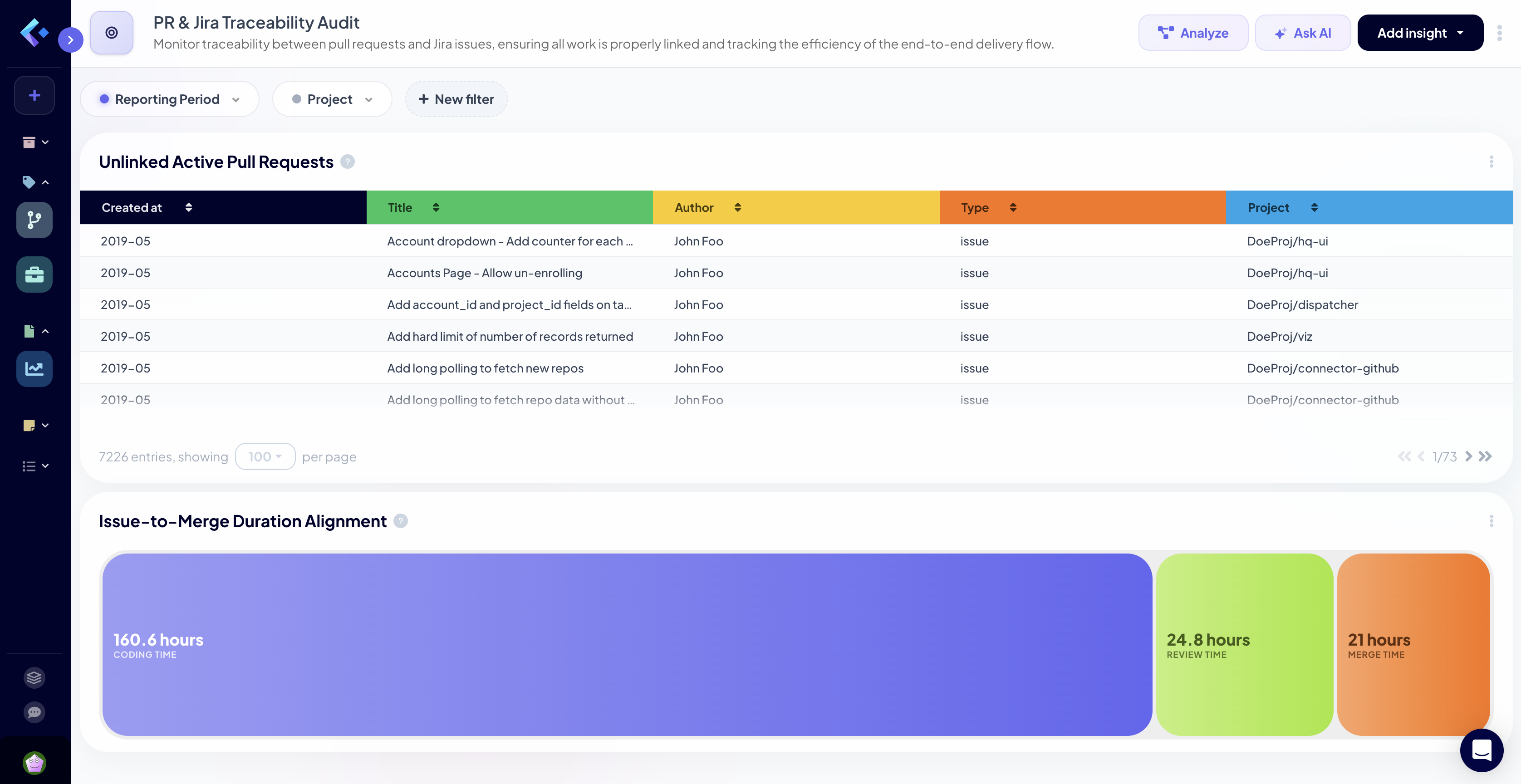
For engineering leaders, connecting technical work (PRs) to project management goals (Jira issues) is crucial for effective SDLC tracking and ensuring software delivery metrics align with business objectives. This analysis matters because it focuses on bridging the Git-to-Jira gap, ensuring every PR is linked to a relevant, active issue. What problem it solves: A common challenge is PRs being merged without a clear link to a project issue, or issues being closed before all related PRs are merged. This creates a critical data disconnect that skews engineering metrics and makes issue to merge tracking unreliable, hindering accurate software development analytics.
Prompt to the Keypup platform
Show all active pull requests that are either unlinked to a Jira issue or linked to a Jira issue not currently in an active sprint over the last 60 days. For linked pull requests, display their average 'issue-to-merge tracking' duration compared to their associated Jira issue status changes.
Analysis from Keypup AI
Key Insights 📊
Over the last 60 days, 18% of active pull requests were found to be either unlinked to a Jira issue or linked to an issue outside of an active sprint.
For properly linked PRs, the average issue-to-merge tracking duration from PR creation to merge was 6.2 days, while the corresponding Jira issue was marked 'Done' an average of 2.1 days after the PR merge.
7% of Jira issues were closed even though their associated pull requests were still open or awaiting merge, indicating a process misalignment.
⚠️ Bottlenecks and Problem Areas
Data Discrepancy: A significant number of PRs operate outside the primary project tracking system, leading to inaccurate SDLC tracking and unreliable engineering metrics.
Process Misalignment: The consistent delay between PR merge and Jira issue closure suggests a lack of automated synchronization or clear guidelines for updating issue statuses, impacting software delivery metrics.
Risk of Scope Creep/Untracked Work: Unlinked PRs could represent unplanned work, technical debt resolution not properly prioritized, or features being developed without clear project alignment, undermining pull request workflow optimization.
💡 Recommendations
Implement mandatory linking of all new pull requests to an active Jira issue to ensure all development efforts are tied to business value.
Automate the synchronization of PR merge status with Jira issue status (e.g., transition Jira issue to 'Ready for QA' upon PR merge) to improve issue to merge tracking.
Conduct regular audits of unlinked PRs and PRs linked to inactive sprints to identify and rectify process gaps and ensure data integrity.
🚀 Priority Actions
Immediate action item: Update developer onboarding and documentation to clearly mandate and demonstrate the process for linking PRs to Jira issues.
Short-term action item: Investigate and implement a tool or process change to automatically update Jira issue status upon PR merge or closure.
Long-term action item: Analyze the impact of unlinked PRs on overall software development analytics to quantify the hidden costs and build a stronger case for process adherence.
FAQ: Your Questions About Pull Request Workflow Optimization Answered
How can I reduce my team's average time to merge?
Reducing time to merge often involves optimizing PR cycle time by targeting bottlenecks in code review metrics and rework. Implement clear review SLAs, encourage smaller pull requests, automate quality checks, and use AI-powered pull request analytics to identify and rebalance reviewer workload.
What are the key code review metrics I should track?
Essential code review metrics include average review time, number of review iterations, comments per PR, and time to first comment. Tracking these provides insights into review efficiency, thoroughness, and potential reviewer congestion, which can then be addressed for better DevOps workflow optimization.
How does AI help in pull request workflow optimization?
Keypup unifies data from Git platforms (GitHub, GitLab, Bitbucket, Azure DevOps) and project trackers (Jira, Azure DevOps Boards, ClickUp, Trello, GitHub Projects), providing contextual insights that manual methods miss. Its AI Agent builds the dashboards that identify stale PRs, highlight reviewer congestion, and correlate PR activity with issue to merge tracking, and its Analyze button comments on a dashboard's results with actionable recommendations for development process optimization. You can also query the same data from Claude, ChatGPT or Cursor through Keypup's read-only MCP server, connected in one click with OAuth.
We use Jira and GitHub. How can I ensure our issue to merge tracking is accurate?
The first step is mandating and facilitating the linking of every pull request to a relevant Jira issue. Keypup links a PR to a Jira issue when the issue key appears in the PR title, the branch name or commit messages, or is referenced with a closing keyword in the PR description. Keypup then goes further by identifying unlinked PRs or those linked to inactive issues, ensuring your engineering metrics accurately reflect project progress and prevent Git-to-Jira gap discrepancies.
How can I improve developer productivity metrics related to PRs without micromanaging?
Shift the focus from individual performance to systemic SDLC bottlenecks. Keypup's AI highlights process inefficiencies, such as extended review times or high rework rates, allowing you to implement team-wide pull request workflow optimization strategies that empower developers rather than scrutinize them.
What if my team has many stale PRs?
Stale PRs are a clear indicator of a bottleneck. Keypup's analytics can identify who is responsible for these reviews, how long they've been stagnant, and in which repositories. This allows you to reallocate review resources, implement automated reminders, or initiate discussions to unblock critical work, accelerating software delivery metrics.
How can I get insights into rework time and its impact?
By breaking down PR cycle time into stages, Keypup's AI quantifies rework time. High rework time often points to unclear requirements, lack of upfront design, or insufficient initial testing. Analyzing this data helps implement upstream process improvements to reduce unnecessary cycles and improve overall development process optimization.
Conclusion: Accelerating Software Delivery with AI-Powered Insights
Mastering your pull request workflow is not just about moving code faster; it's about transforming the entire journey from an idea in Jira to a deployed feature. The challenges of an untracked workflow – from stale PRs and reviewer congestion to the persistent Git-to-Jira gap – create hidden costs that undermine developer productivity metrics and slow down software delivery metrics. Traditional analytics offer only a partial view, leaving engineering leaders to grapple with symptoms rather than root causes.
Keypup's AI-powered software development analytics fundamentally changes this paradigm. By unifying data from your Git repositories and project tracking tools, linked through the issue keys your developers put in PR titles, branch names, descriptions and commits, Keypup provides deep, contextual insights into every stage of your pull request workflow. It moves you beyond raw numbers to understand why your PR cycle time is what it is, where code review metrics fall short, and how to optimize your issue to merge tracking. This shift from reactive firefighting to proactive, data-driven SDLC optimization is the key to accelerating delivery, enhancing quality, and empowering your engineering teams. Leverage AI to finally achieve true visibility and control, transforming your pull request workflow into a seamless, efficient engine for innovation.
Ready to Transform Your Analytics?
Join teams already using AI to make data-driven decisions faster than
ever.
Why do some Jira tickets bounce between engineers and teams for weeks before anyone fixes them? Learn what engineering leaders on Reddit say about ticket reassignment churn at enterprise scale, and how Keypup MCP uses previous assignees, assignment dates, issue types, projects and linked pull request authors to measure how often tickets change hands, what each hand-off costs in cycle time, who actually wrote the code and which open tickets are being passed around right now.
Compare the 6 best engineering analytics tools for Jira and Git in 2026 — Keypup, LinearB, Jellyfish, Swarmia, Faros AI and Pluralsight Flow — across Git and Jira unification, DORA Metrics and cycle time, dashboard customization, AI and natural language, integration breadth, setup speed and security. Find out which platform turns your code and ticketing data into one reporting layer with prescriptive recommendations.
Why do pull requests sit for days before anyone reviews them? Learn what engineering leaders on Reddit say about code review bottlenecks at enterprise scale, and how Keypup MCP uses review request dates, first review dates, approvals, reviewers and lines changed to measure your wait for first review, break cycle time into phases, find when requests get stuck, show who carries the review load and list the pull requests waiting right now.