Data Ownership, Governance, and Inter-Departmental Silos: Who Owns the Definition of a Story Point?
Centralizing SDLC data across ten business units exposes a governance vacuum long before it delivers insight: seven competing "story point" scales, four business units with no named data owner, and a workflow taxonomy nobody was ever assigned to define. This isn't a GDPR problem — it's a political and technical negotiation over who owns what data, and who is accountable when a poorly maintained JIRA board quietly skews a portfolio-wide metric. Discover how Keypup MCP makes data ownership, definition consistency, and governance maturity measurable across every business unit.
TL;DR: Centralizing SDLC analytics across a large organization surfaces a problem no dashboard can paper over: different departments run on different data governance policies, different nomenclature, and different internal processes. Who defines what a "story point" means across 10 business units? Who is accountable when a metric is skewed by a poorly maintained JIRA board in one department? This isn't a privacy problem covered by GDPR — it's an operational and political negotiation over ownership, quality, and a shared data model. The Keypup MCP Server solves this by making definition fragmentation, data quality, ownership gaps, and governance maturity directly queryable and measurable, one business unit at a time.
At the enterprise scale, collecting and centralizing data from various engineering teams and business units quickly exposes deep-seated issues around data ownership, quality, and access. The technology to aggregate the data is rarely the hard part. The hard part is that the data was never meant to be aggregated in the first place.
The Friction: Ten Business Units, Seven Definitions of the Same Metric
Different departments often operate with distinct data governance policies, nomenclature, and internal processes — built up independently, over years, without anyone anticipating a central analytics platform would one day try to compare them side by side. When a central SDLC analytics platform attempts to aggregate this data, it inevitably clashes with existing data ownership structures.
Who defines what a "story point" means across 10 different business units — one team's 5 is another team's 8, and a third team doesn't use points at all
Who is responsible for data quality when a metric is skewed by a poorly maintained JIRA board in one department, with stale statuses and empty required fields
Who owns the workflow status taxonomy when six different business units have each quietly invented their own version of "Done"
Who resolves the political resistance when a department pushes back on sharing what it perceives as "performance" data, regardless of what the data actually shows
This is the standardization fallacy's quieter, earlier cousin: before you can even argue about whether a benchmark is fair, you first have to agree on what the underlying numbers mean — and in a large enough organization, that agreement doesn't exist yet.
Why This Matters: This Isn't a Privacy Problem, It's an Ownership Problem
It's Not GDPR — It's Harder
GDPR and other privacy regulations answer "who is allowed to see this data." They say nothing about "who decides what this data means," "who is accountable when it's wrong," or "who has the authority to make ten business units agree on a shared definition." That's a governance and political problem, not a compliance checkbox — and it takes far more organizational effort to resolve.
The Technical Effort Is Real, But It's Not the Hard Part
Normalizing disparate datasets — reconciling seven different point scales, six competing status taxonomies — is a substantial engineering lift. But it's a solvable one. The genuinely hard part is what comes after the technical normalization: getting business units to actually adopt the unified model, rather than quietly reverting to their own local definitions the moment nobody's watching.
Unowned Data Doesn't Stay Neutral — It Skews Everything Downstream
A data domain with no named owner doesn't just sit there waiting patiently to be fixed. It actively degrades every portfolio-wide rollup that includes it. A poorly maintained JIRA board in one department quietly drags down (or inflates) a company-wide velocity or cycle-time number, and nobody notices until someone asks why the numbers don't add up.
The Enterprise Discussion: What Engineering Leaders Are Actually Saying
This exact tension — the technical effort of normalization colliding with the political effort of ownership — comes up constantly wherever senior engineering leaders compare notes on scaling analytics past a single team.
"We spent three months building the data pipeline and eight months arguing about what a 'story point' means. Every business unit swore their scale was the correct one. In the end we didn't solve it with more engineering — we solved it by finally naming an actual owner for the definition, with the authority to make a call and stick to it."
Director of Engineering Analytics, Global Enterprise (r/devops)
"The political resistance was the real project. Half the pushback on sharing 'performance data' had nothing to do with privacy — it was departments worried their poorly maintained JIRA board would make them look bad compared to a team with pristine data hygiene. They weren't wrong to worry. It just meant we needed a data quality score before we needed a comparison chart."
The pattern is consistent: the aggregation was never the bottleneck — the ownership was. You can build a perfectly normalized data pipeline and still fail, if no one is accountable for keeping the underlying definitions and data quality consistent once the pipeline goes live.
How Keypup MCP Solves Data Ownership, Governance, and Inter-Departmental Silos
The Keypup Model Context Protocol (MCP) Server treats data governance as a first-class, measurable dimension of the platform — not an assumption baked silently into every rollup. It surfaces exactly where definitions fragment, where data quality breaks down, who owns what, and which business units are closing the governance gap versus which ones are falling further behind.
1. Surfacing the Scale of Definition Fragmentation
Before you can fix a governance problem, you need to know how big it actually is — in concrete numbers, not anecdotes from the last leadership offsite.
MCP Prompt:
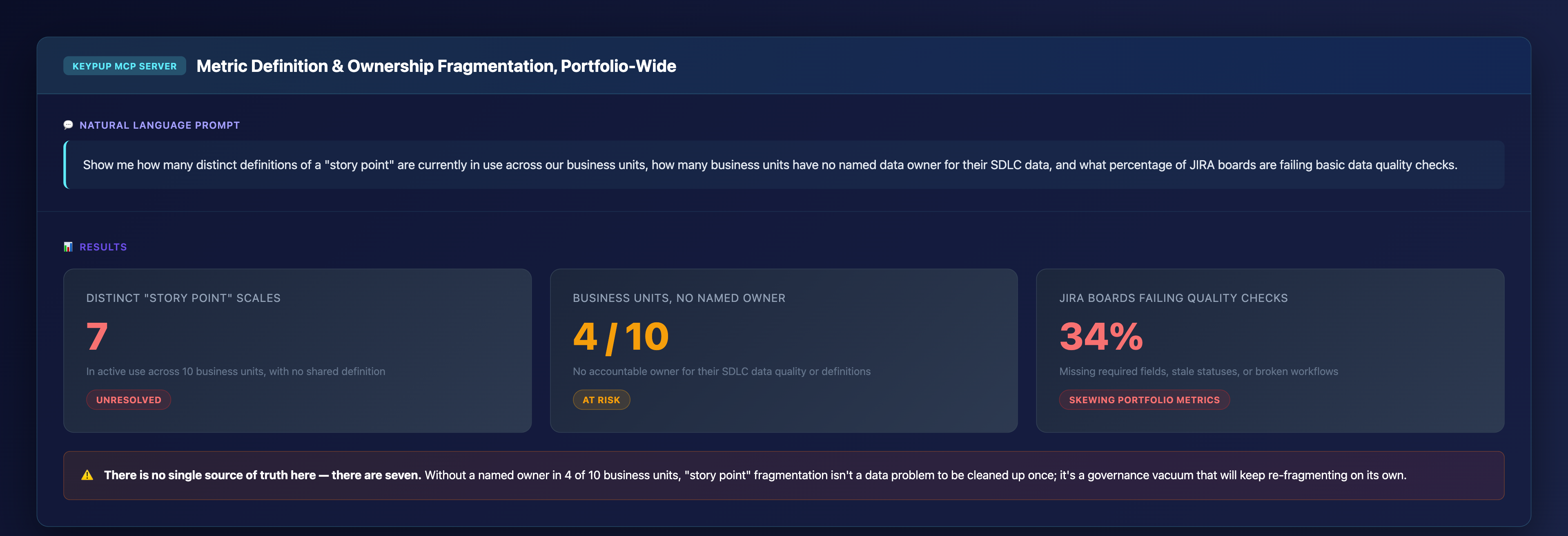
Show me how many distinct definitions of a "story point" are
currently in use across our business units, how many business
units have no named data owner for their SDLC data, and what
percentage of JIRA boards are failing basic data quality checks.
Key Insight: There is no single source of truth here — there are seven. Without a named owner in 4 of 10 business units, "story point" fragmentation isn't a data problem to be cleaned up once; it's a governance vacuum that will keep re-fragmenting on its own.
2. Quantifying Exactly Which Boards Are Skewing the Portfolio
A single portfolio-wide number hides which specific business units are the source of the skew. Breaking data quality out by unit turns a vague complaint into an actionable list.
MCP Prompt:
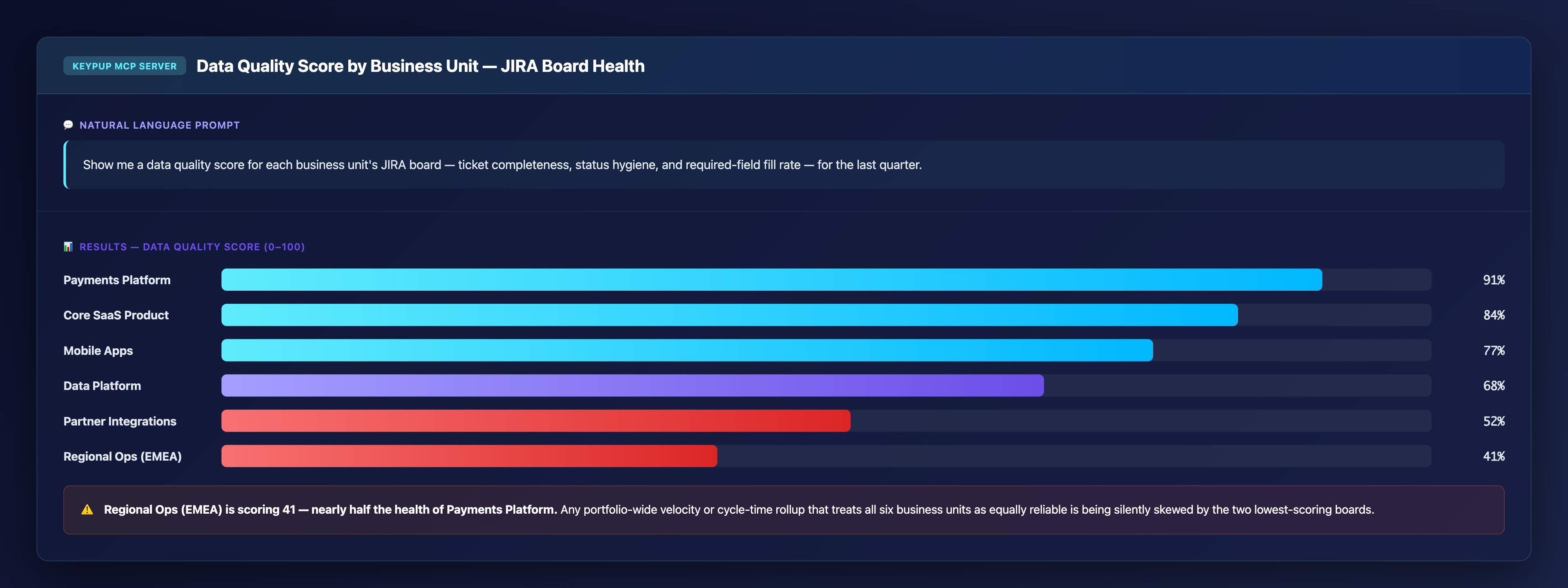
Show me a data quality score for each business unit's JIRA board —
ticket completeness, status hygiene, and required-field fill rate
— for the last quarter.
Output: Data Quality Score by Business Unit
Key Insight: Regional Ops (EMEA) is scoring 41 — nearly half the health of Payments Platform. Any portfolio-wide velocity or cycle-time rollup that treats all six business units as equally reliable is being silently skewed by the two lowest-scoring boards.
3. Naming an Owner for Every Core Data Domain
"Someone should own this" is not a governance policy. A documented owner, review date, and status for every core data domain is.
MCP Prompt:
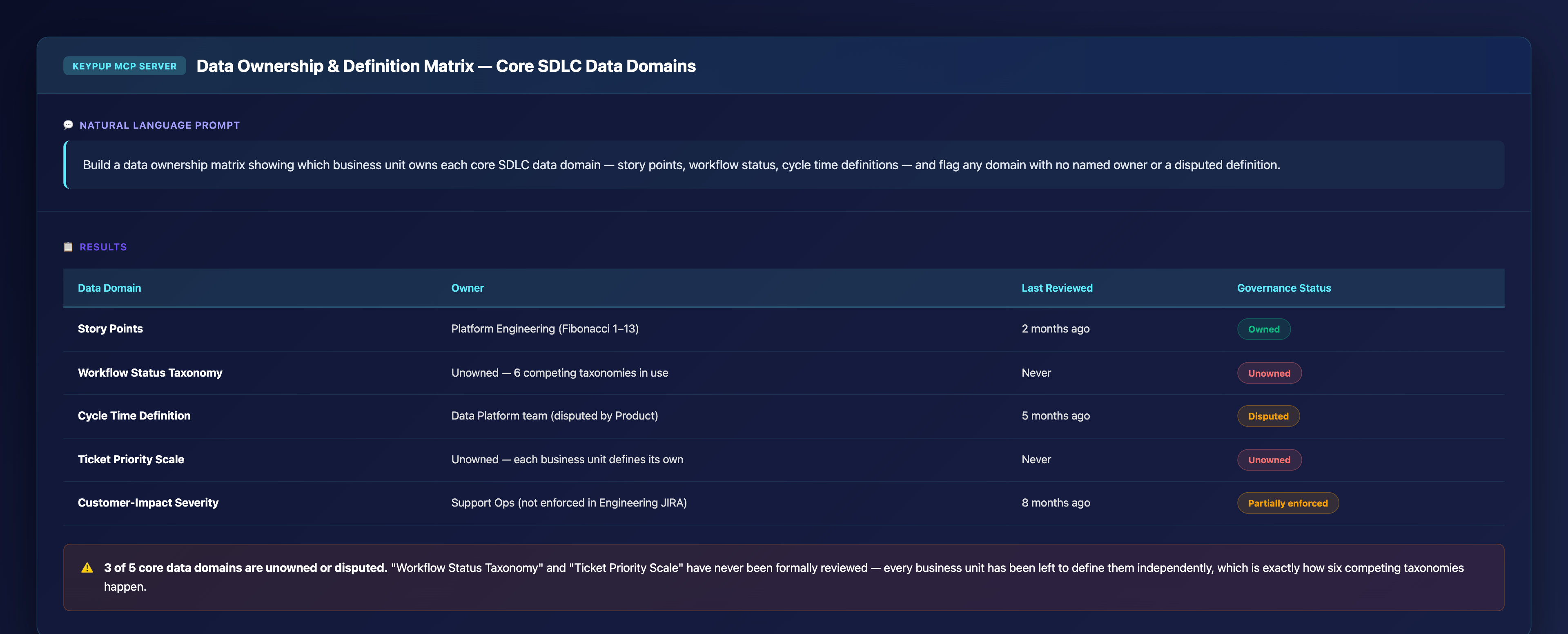
Build a data ownership matrix showing which business unit owns
each core SDLC data domain — story points, workflow status, cycle
time definitions — and flag any domain with no named owner or a
disputed definition.
Output: Data Ownership & Definition Matrix
Data Domain
Owner
Last Reviewed
Governance Status
Story Points
Platform Engineering (Fibonacci 1-13)
2 months ago
Owned
Workflow Status Taxonomy
Unowned - 6 competing taxonomies in use
Never
Unowned
Cycle Time Definition
Data Platform team (disputed by Product)
5 months ago
Disputed
Ticket Priority Scale
Unowned - each business unit defines its own
Never
Unowned
Customer-Impact Severity
Support Ops (not enforced in Engineering JIRA)
8 months ago
Partially enforced
Key Insight: 3 of 5 core data domains are unowned or disputed. "Workflow Status Taxonomy" and "Ticket Priority Scale" have never been formally reviewed — every business unit has been left to define them independently, which is exactly how six competing taxonomies happen.
4. Proving That Governance Structure, Not Time, Drives Adoption
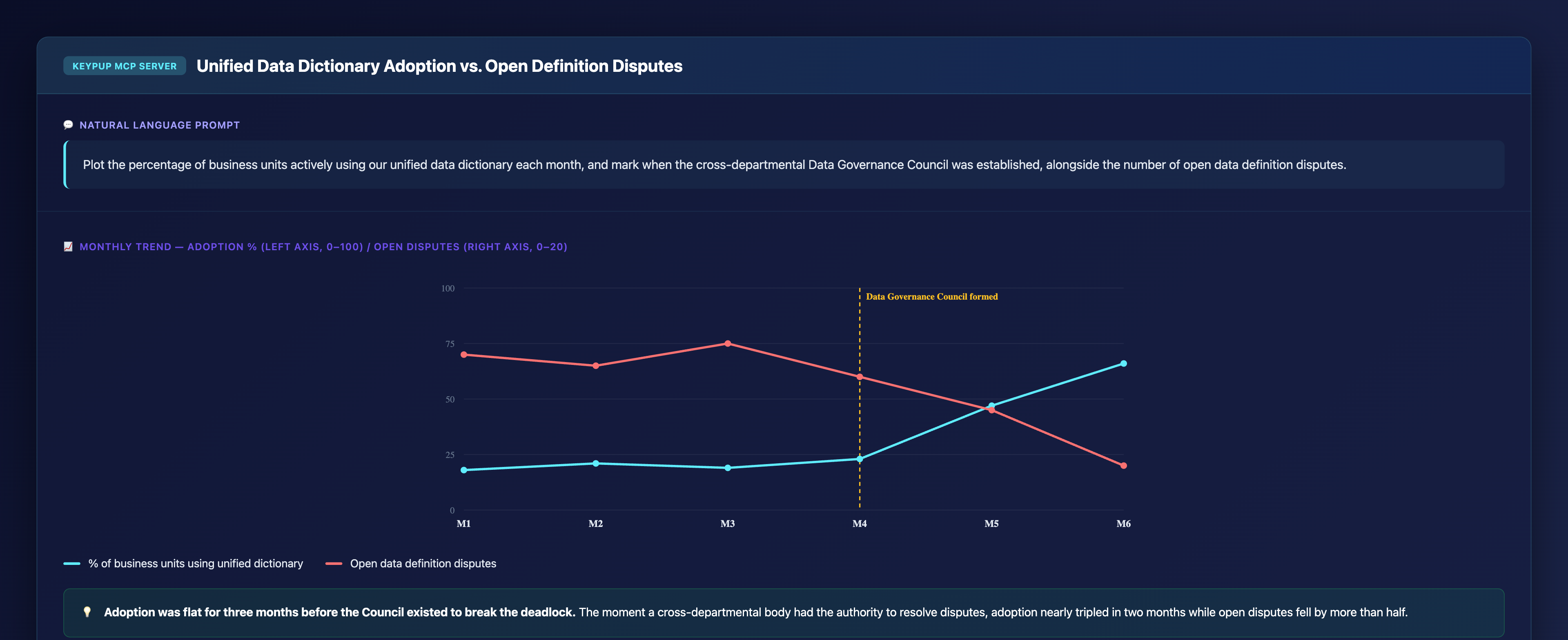
A unified data dictionary sitting in a wiki doesn't adopt itself. Tracking adoption against the moment real cross-departmental authority was established shows what actually moved the needle.
MCP Prompt:
Plot the percentage of business units actively using our unified
data dictionary each month, and mark when the cross-departmental
Data Governance Council was established, alongside the number of
open data definition disputes.
Output: Unified Data Dictionary Adoption vs. Open Disputes
Key Insight: Adoption was flat for three months before the Council existed to break the deadlock. The moment a cross-departmental body had the authority to resolve disputes, adoption nearly tripled in two months while open disputes fell by more than half.
5. Holding Every Business Unit Accountable for Its Own Governance Maturity
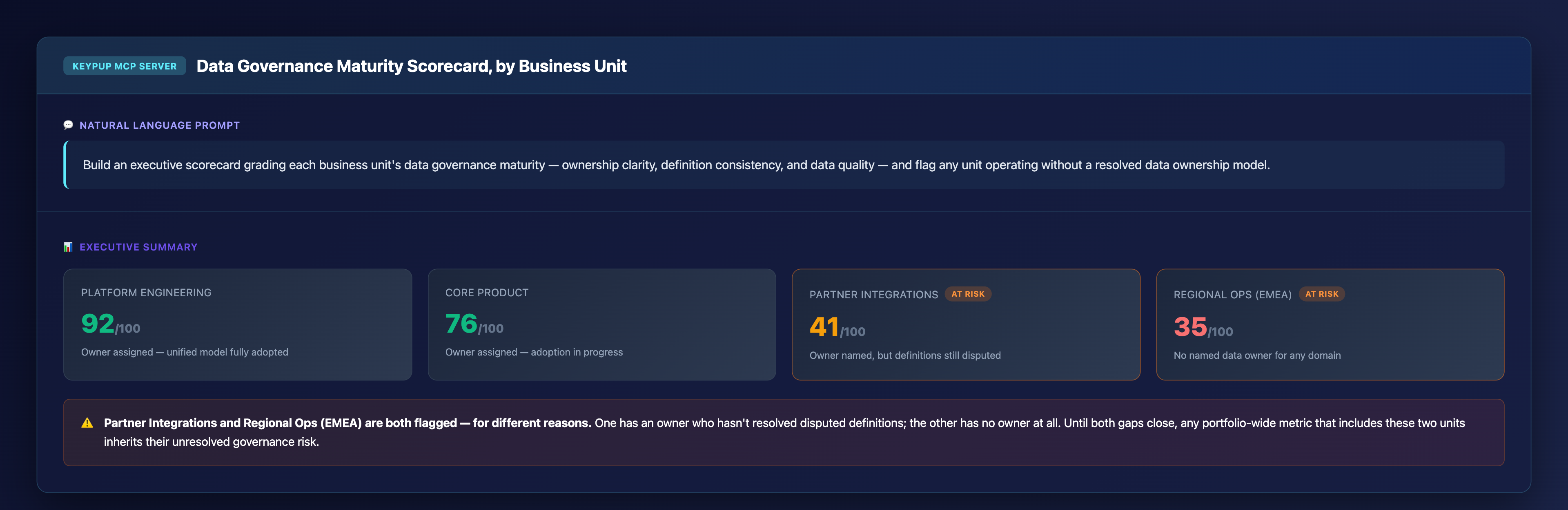
Executives need one view that separates "no owner exists" from "an owner exists but hasn't resolved the dispute" — because the fix for each is completely different.
MCP Prompt:
Build an executive scorecard grading each business unit's data
governance maturity — ownership clarity, definition consistency,
and data quality — and flag any unit operating without a resolved
data ownership model.
Output: Data Governance Maturity Scorecard
Key Insight: Partner Integrations and Regional Ops (EMEA) are both flagged — for different reasons. One has an owner who hasn't resolved disputed definitions; the other has no owner at all. Until both gaps close, any portfolio-wide metric that includes these two units inherits their unresolved governance risk.
The Technical Implementation: How Keypup MCP Tracks Data Governance
Definition Fragmentation Detection
Keypup MCP inspects how fields like story points, workflow statuses, and priority levels are actually configured and used across every connected JIRA, GitHub Projects, or Azure DevOps instance — surfacing where business units have quietly diverged, instead of assuming a single shared schema.
Per-Board Data Quality Scoring
Every connected board gets a data quality score based on ticket completeness, required-field fill rate, and status hygiene — so a poorly maintained board is a documented, quantified risk to downstream metrics, not a vague suspicion raised in a retro.
Ownership and Governance as Tracked Metadata
Data domains can be tagged with a named owner, a last-reviewed date, and a governance status (owned, disputed, unowned), turning "who's responsible for this?" from a recurring meeting agenda item into a queryable field.
Real-World Impact: Enterprise Case Studies
Case Study 1: Global Enterprise SaaS Company
Before Keypup MCP:
Seven different business units each maintained their own definition of a "story point," with no documented owner for the domain
Portfolio-wide velocity comparisons were quietly meaningless, though nobody could prove it without months of manual JIRA archaeology
Attempts to unify the definition stalled for over eight months due to political resistance from units unwilling to change their local convention
After Keypup MCP:
Definition fragmentation report made the scale of the problem undeniable — 7 scales, backed by concrete numbers instead of anecdotes
A named owner was assigned to the story point definition domain within one quarter of the report being shared with leadership
Portfolio-wide velocity reporting resumed with a documented, shared definition instead of an unspoken assumption of consistency
"We'd been arguing about story points for years without anyone actually counting how many different definitions were in play. The moment we saw the number seven in a report, the conversation stopped being philosophical and started being operational."
— VP Engineering, Enterprise SaaS
Case Study 2: Multi-Region Financial Services Organization
Before Keypup MCP:
Regional Ops (EMEA) had no named data owner and the lowest data quality score in the portfolio, but this was invisible in aggregate dashboards
A portfolio-wide cycle time metric was quietly being dragged down by two poorly maintained boards, prompting an unproductive company-wide "efficiency" initiative aimed at the wrong root cause
Departments resisted sharing data for fear it would be used to unfairly compare them, without a data quality baseline to make that comparison fair
After Keypup MCP:
Per-business-unit data quality scoring identified the two boards actually responsible for the skew, ending the unproductive company-wide initiative
Data Governance Council formed with real cross-departmental authority, resolving disputed definitions instead of leaving them open indefinitely
Unified dictionary adoption rose from 18% to 66% within two months of the Council gaining the authority to make binding definition decisions
"The company-wide efficiency initiative was solving the wrong problem — it wasn't that teams were slow, it was that two boards had terrible data hygiene. Once we could see that, we fixed the actual root cause in weeks instead of running a quarter-long initiative aimed at everyone."
— Director of Engineering Analytics, Financial Services
Implementation: Getting Started with Keypup MCP
1. Measure Fragmentation Before Attempting Standardization
Don't start by mandating a single definition. Start by measuring how many definitions currently exist and where the biggest gaps in ownership and data quality actually are — you can't govern what you haven't measured.
2. Assign a Named Owner to Every Core Data Domain
Every domain that feeds a portfolio-wide metric — story points, workflow status, priority, severity — needs one accountable owner with the authority to resolve disputes, not a committee that meets quarterly.
3. Query in Natural Language, From Any Business Unit
No SQL required. Just ask:
"Which business units have no named data owner right now?"
"Show me the data quality score for every connected JIRA board"
"Which data domains have a disputed or unowned definition?"
"Has unified dictionary adoption changed since the Governance Council was formed?"
4. Automate Governance Reporting
Schedule recurring queries for:
Monthly data quality scoring across every connected board
Automatic flags when a data domain goes unreviewed past a set threshold
Quarterly governance maturity scorecards for executive reporting
Adoption tracking for any newly unified data model or dictionary
The Bottom Line: You Can't Aggregate What You Haven't Governed
Data ownership, governance, and inter-departmental silos aren't a side effect of scaling SDLC analytics — they're the first real obstacle to it. Enterprise engineering leaders need to:
✅ Measure definition fragmentation directly, instead of assuming a shared vocabulary that doesn't exist ✅ Score data quality per business unit, so a poorly maintained board is a documented risk, not a vague suspicion ✅ Name an accountable owner for every core data domain, with the authority to resolve disputes ✅ Track adoption against real governance milestones, proving that structure — not time — drives change ✅ Grade governance maturity at the business-unit level, so "no owner" and "disputed owner" get different, correct fixes
Keypup MCP makes data governance measurable in the same way it already makes engineering delivery measurable — turning "who owns this data?" from an unanswered question in a leadership offsite into a tracked, accountable field on every metric that matters.
Get Started
Ready to see exactly where your organization's data ownership gaps are hiding?
Start Free Trial — Connect your engineering stack in minutes and surface definition fragmentation and ownership gaps today.
Request Demo — See how enterprise engineering leaders use Keypup MCP to resolve cross-departmental data governance.
View MCP Documentation — Technical details for engineering and data governance teams implementing Keypup MCP.
Keywords: data governance SDLC analytics, engineering metrics data ownership, story point definition consistency, JIRA data quality enterprise, cross-departmental data silos, engineering data governance maturity, data ownership matrix engineering, unified data dictionary adoption, enterprise engineering analytics governance, MCP server data quality reporting
Ready to Transform Your Analytics?
Join teams already using AI to make data-driven decisions faster than
ever.
Why do some Jira tickets bounce between engineers and teams for weeks before anyone fixes them? Learn what engineering leaders on Reddit say about ticket reassignment churn at enterprise scale, and how Keypup MCP uses previous assignees, assignment dates, issue types, projects and linked pull request authors to measure how often tickets change hands, what each hand-off costs in cycle time, who actually wrote the code and which open tickets are being passed around right now.
Compare the 6 best engineering analytics tools for Jira and Git in 2026 — Keypup, LinearB, Jellyfish, Swarmia, Faros AI and Pluralsight Flow — across Git and Jira unification, DORA Metrics and cycle time, dashboard customization, AI and natural language, integration breadth, setup speed and security. Find out which platform turns your code and ticketing data into one reporting layer with prescriptive recommendations.
Why do pull requests sit for days before anyone reviews them? Learn what engineering leaders on Reddit say about code review bottlenecks at enterprise scale, and how Keypup MCP uses review request dates, first review dates, approvals, reviewers and lines changed to measure your wait for first review, break cycle time into phases, find when requests get stuck, show who carries the review load and list the pull requests waiting right now.