Code Freeze Exception Creep: How Emergency Overrides Are Quietly Defeating Your Change Governance
Enterprise code freezes exist to protect regulated, revenue-critical systems during high-risk windows — but "emergency exception" approvals are quietly becoming the default way to bypass them. Discover what engineers on Reddit say about freeze exception sprawl, and how Keypup MCP reconciles every pull request merged during a freeze against its Jira change request and review trail to close the gap before an auditor finds it first.
TL;DR: Enterprise code freezes — holiday blackout windows, quarter-end change bans, pre-audit lockdowns — exist specifically to protect regulated or revenue-critical systems during high-risk periods. In practice, "emergency exception" approvals quietly become the default way around them, and a growing share of the code merged during a freeze has no change request behind it at all. Release dashboards show that the freeze policy exists; they don't show how many changes went through it anyway, whether anyone independent reviewed them, or what reason the requester gave. The Keypup MCP Server takes the freeze dates you give it, finds every pull request merged into your production branches inside them, and checks each one against its linked Jira change request and its review record — turning "did we actually hold the freeze" from an assumption into a number compliance can verify before the next audit does it for them.
Ask a VP of Engineering whether last quarter's code freeze held, and the honest answer in most regulated enterprises is "mostly, as far as I know." Ask the same question with the merge history in hand, and the number is often uncomfortably different — a third or more of what reached the production branch during the freeze has no change request, no named approver, and no record of why it was considered urgent enough to break policy.
The Friction: A Policy That Exists on Paper, Not in the Pipeline
Code freezes — around Black Friday, quarter-end close, a regulatory audit window, or a major product launch — are one of the most universally adopted change-management controls in enterprise software. They're also one of the most quietly ignored.
Freeze policies live in a wiki page, not in the deployment pipeline. Most freeze windows are enforced by a calendar reminder and a Slack announcement, not by a technical gate that actually blocks a merge or a deploy. Enforcement depends entirely on individual engineers remembering the policy applies to them.
"Emergency exception" has no consistent bar. One team's exception process requires a VP sign-off and a documented business justification; another team's "exception" is a Slack message to a manager who says "sure, go ahead." Both get logged — if they get logged at all — as equally valid overrides.
Self-approval is common and usually invisible. When the person requesting the exception is also the person with merge rights, there's often nothing structurally stopping them from approving their own override, especially under time pressure.
Nobody reconciles the freeze dates against what actually merged. The freeze window closes, the retro moves on to the next quarter, and whether the policy actually held gets taken on faith unless an external audit specifically asks for proof.
The result: a compliance control that every stakeholder believes is working, verified by nothing more than the absence of complaints — right up until a regulator, auditor, or post-incident review asks for the exception trail and finds out how much of the freeze was never actually enforced.
Why This Matters: A Control You Can't Prove Is Working Isn't a Control
The Audit Exposure Problem
SOC 2, ISO 27001, and similar frameworks typically require evidence that change management controls — including freeze windows — are actually followed, not just documented. A freeze policy with no change-level exception trail is a finding waiting to happen: auditors increasingly ask for the reconciliation between the freeze dates and the changes that shipped, and "we believe it held" is not evidence.
The Blast-Radius Problem
Freeze windows exist precisely because the systems they protect are the ones where an incident is most expensive — peak revenue periods, regulatory reporting cycles, high-traffic launches. An unreviewed override during exactly that window is the worst possible time for an untested change to introduce risk, because the freeze was supposed to be the safety margin for when things are already tight.
The Policy Erosion Problem
Every unapproved override that ships without consequence quietly resets the baseline for what "freeze" means on that team. Once engineers learn that bypassing the exception process has no real friction and no real oversight, the freeze stops functioning as a control and starts functioning as a suggestion — and that erosion compounds freeze after freeze.
The Enterprise Discussion: What Engineers Are Actually Saying
This exact pattern is a recurring theme wherever engineers at large, compliance-driven organizations compare notes on release management and audit readiness.
Staff SRE, Regional Bank (r/ExperiencedDevs)
"Every December we announce a hard freeze and every December half my team ships something anyway because 'it's just a config change' or 'it's already tested.' Nobody tracks it as an exception because nobody wants to be the one who has to explain to compliance why we needed one. Then in January the auditors ask for the freeze exception log and it's basically empty, which looks way worse than if we'd just logged the thing honestly."
"We have a real exception process on paper — ticket, business justification, VP sign-off. What actually happens is someone pings their manager on Slack, gets a thumbs up emoji, and deploys. I only found out how often this was happening when I pulled the deploy logs against our freeze calendar for an internal review. The gap between 'process we documented' and 'process we actually follow' was bigger than I expected, and I'd been doing this job for two years."
The pattern holds: engineers already know the freeze isn't holding the way leadership assumes it is — what's missing is a systematic way to quantify the gap before an external reviewer finds it, instead of discovering it retroactively during an audit or a postmortem.
How Keypup MCP Solves Code Freeze Exception Creep
The Keypup Model Context Protocol (MCP) Server gives your AI assistant structured access to the pull requests and issues Keypup imports from GitHub, GitLab, Bitbucket and Jira. You tell it when the freeze ran and which branches you release from; it finds every pull request merged into those branches during that window, checks whether each one is linked to a Jira change request, reads the fields your change requests already carry, and checks the review record on the pull request itself.
1. Quantifying How Much of the Freeze Actually Held
Before anything else, leadership needs a single number: how much of what merged during the freeze had an approved exception behind it.
MCP Prompt:
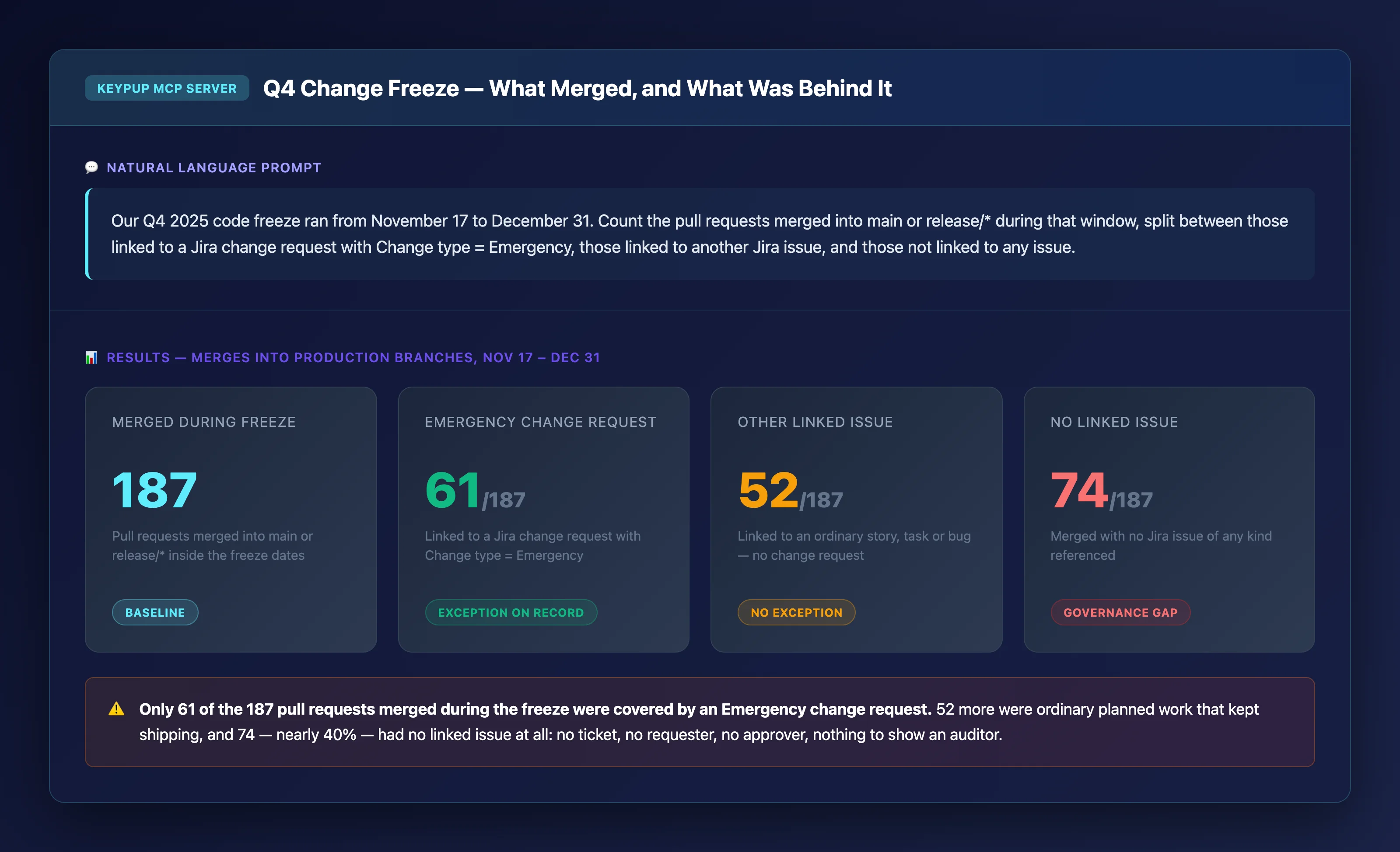
Our Q4 2025 code freeze ran from November 17 to December 31.
Count the pull requests merged into main or release/* during
that window, split between those linked to a Jira change request
with Change type = Emergency, those linked to another Jira issue,
and those not linked to any issue.
Output: Q4 Change Freeze — What Merged, and What Was Behind It
Key Insight: 187 pull requests reached the production branches during the six-week freeze. Only 61 were covered by an Emergency change request. Another 52 were linked to ordinary stories and tasks — planned work that simply kept shipping — and 74, nearly 40%, had no linked issue at all: no ticket, no requester, no approver, and nothing leadership can point to in an audit.
2. Breaking Down Why Emergency Changes Were Requested
For the changes that did go through the exception process, the next question is whether they were genuine emergencies. Jira Service Management change requests already carry a Change reason field filled in by the requester, and Keypup imports it with the rest of the ticket.
MCP Prompt:
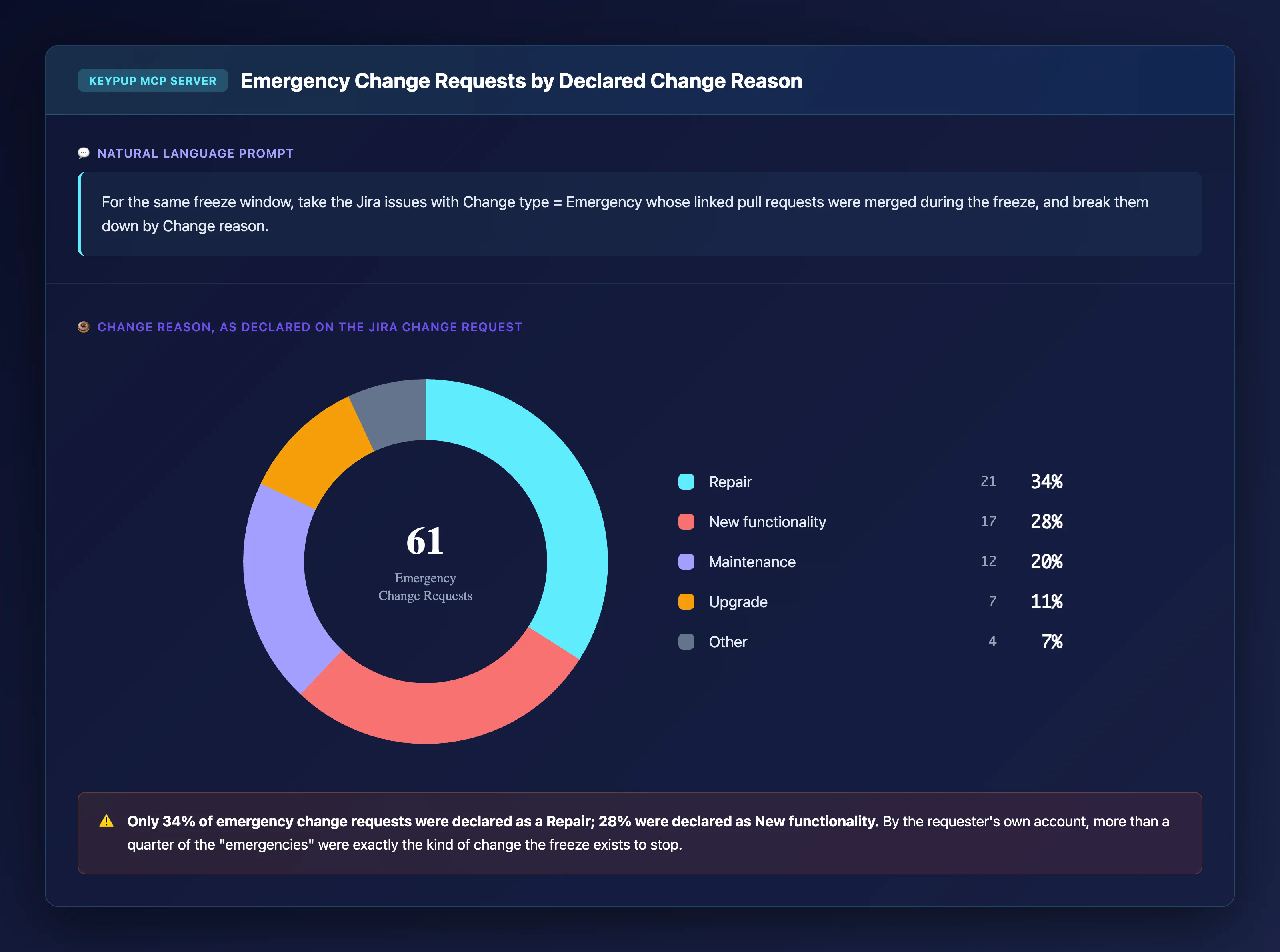
For the same freeze window, take the Jira issues with
Change type = Emergency whose linked pull requests were merged
during the freeze, and break them down by Change reason.
Output: Emergency Change Requests by Declared Change Reason
Key Insight: Only 34% of emergency change requests were declared as a Repair. 28% were declared as New functionality — by the requester's own account, exactly the kind of change the freeze exists to stop. These categories come straight from the Jira tickets; Keypup reports what the requester declared, which makes the gap hard to argue with: nobody had to reinterpret anything.
3. Seeing Where the Untracked Changes Are Concentrated
With the overall pattern confirmed, leadership needs to know exactly where the untracked merges are coming from.
MCP Prompt:
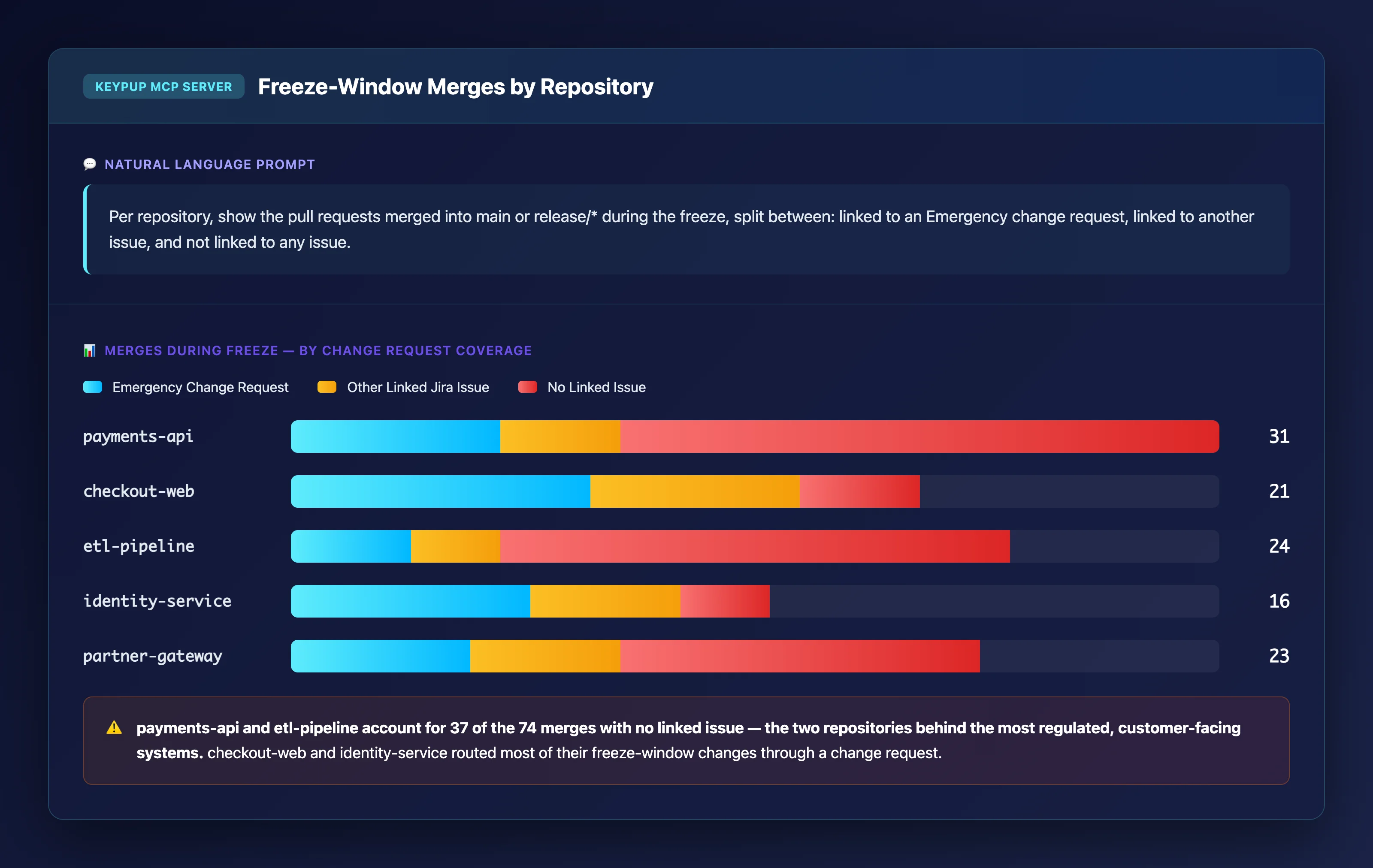
Per repository, show the pull requests merged into main or
release/* during the freeze, split between: linked to an
Emergency change request, linked to another issue, and not
linked to any issue.
Output: Freeze-Window Merges by Repository
Key Insight: payments-api and etl-pipeline account for 37 of the 74 merges with no linked issue — the two repositories behind the most regulated, customer-facing systems. checkout-web and identity-service, by contrast, routed most of their freeze-window changes through a change request.
4. Getting the Receipts on the Hardest-to-Defend Merges
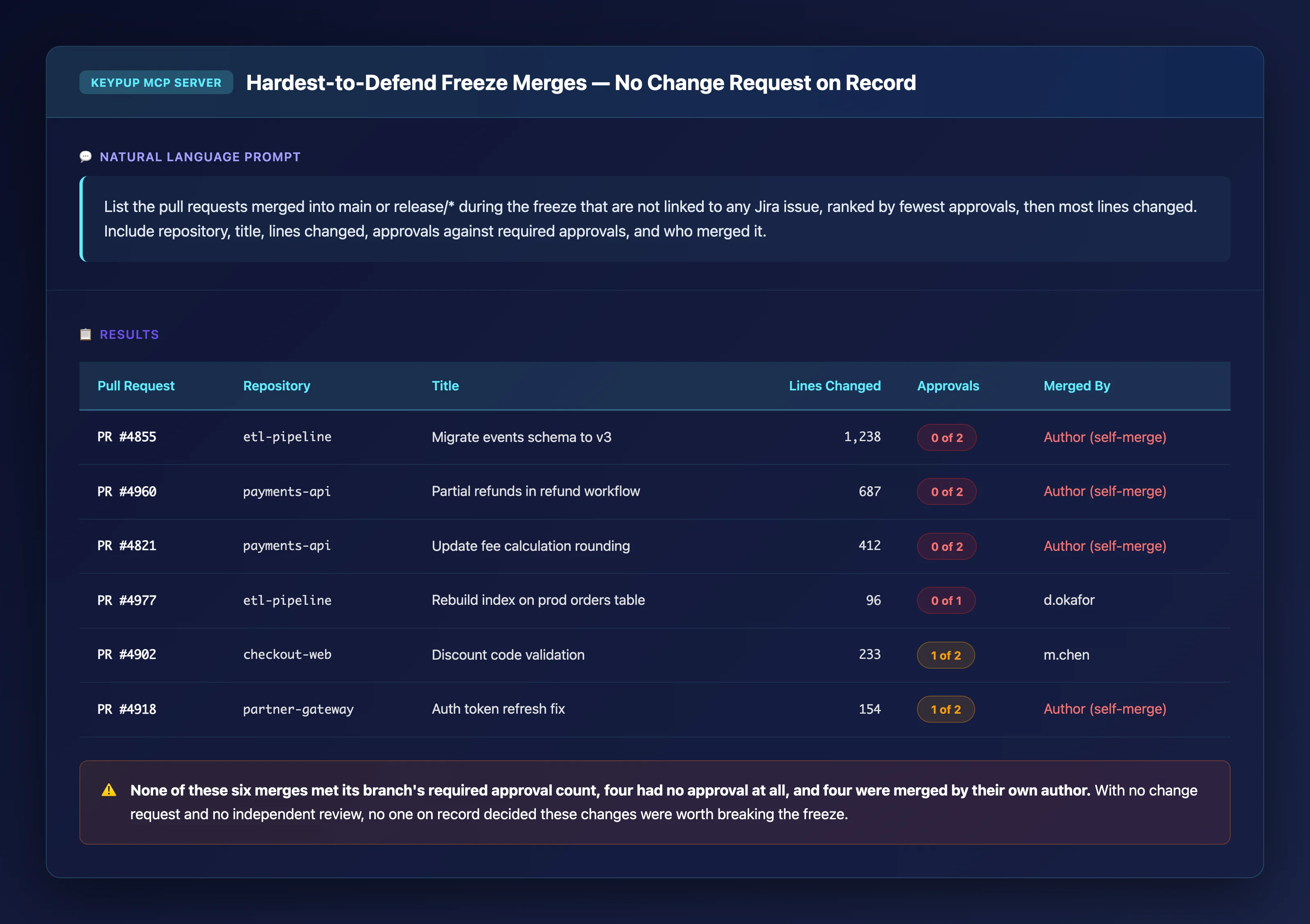
For an audit or governance conversation, leadership needs the exact changes that would be hardest to defend if questioned. Without a change request there's no declared risk level to rank on, so the pull request's own review record does the work: how many approvals it got against how many its branch requires, how big it was, and who merged it.
MCP Prompt:
List the pull requests merged into main or release/* during the
freeze that are not linked to any Jira issue, ranked by fewest
approvals, then most lines changed. Include repository, title,
lines changed, approvals against required approvals, and who
merged it.
Output: Hardest-to-Defend Freeze Merges — No Change Request on Record
Pull Request
Repository
Title
Lines Changed
Approvals
Merged By
PR #4855
etl-pipeline
Migrate events schema to v3
1,238
0 of 2
Author (self-merge)
PR #4960
payments-api
Partial refunds in refund workflow
687
0 of 2
Author (self-merge)
PR #4821
payments-api
Update fee calculation rounding
412
0 of 2
Author (self-merge)
PR #4977
etl-pipeline
Rebuild index on prod orders table
96
0 of 1
d.okafor
PR #4902
checkout-web
Discount code validation
233
1 of 2
m.chen
PR #4918
partner-gateway
Auth token refresh fix
154
1 of 2
Author (self-merge)
Key Insight: None of these six merges met its own branch's required approval count, four had no approval at all, and four were merged by the person who wrote them. Four touch payments or data infrastructure. With no change request and no independent review, there is no one on record who decided these changes were worth breaking the freeze — the exact gap an auditor will flag first.
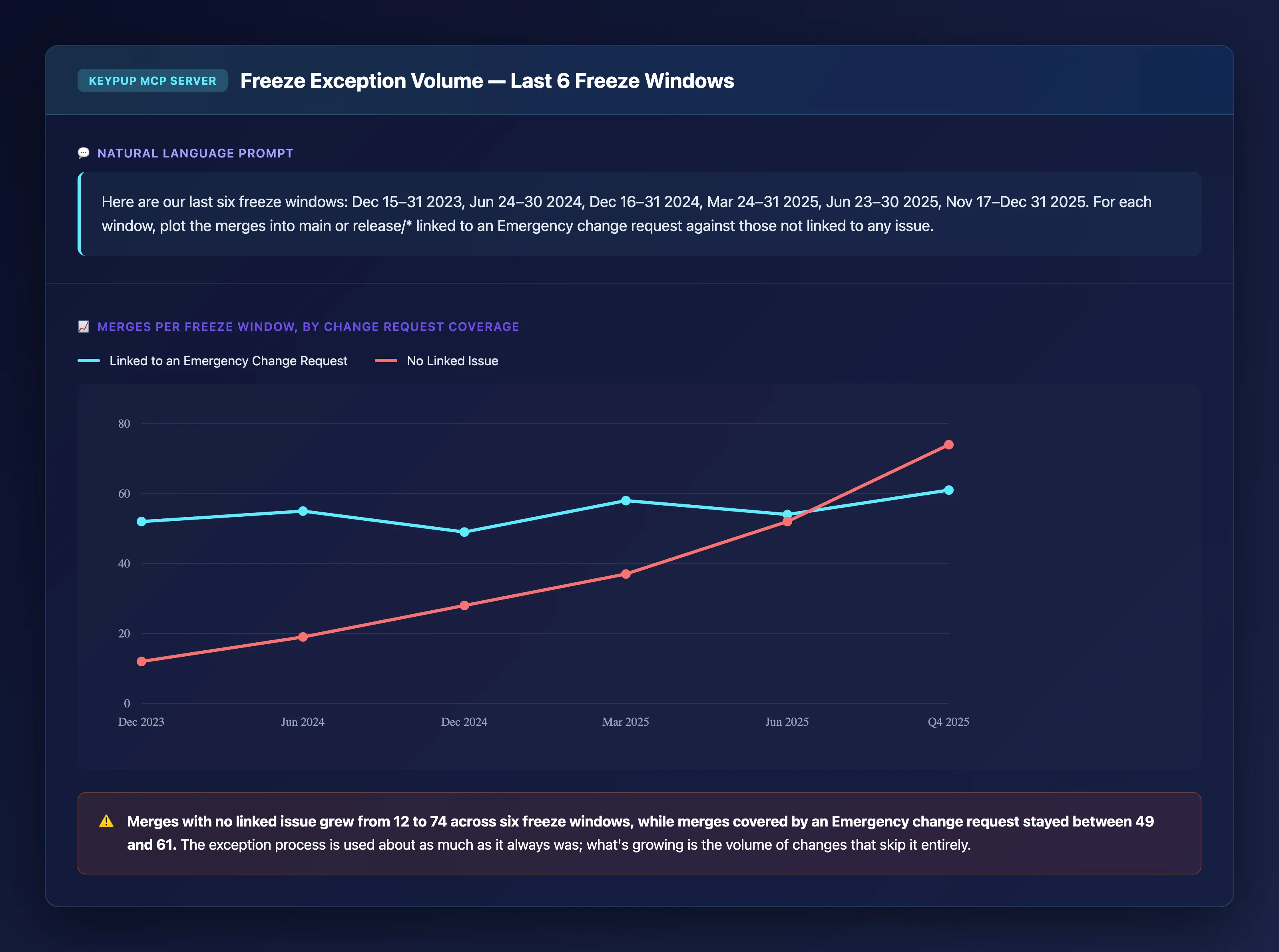
5. Proving the Problem Is Getting Worse, Not Better
A single freeze window's numbers are useful. A trend across freezes proves whether the organization is tightening enforcement or quietly letting it erode further.
MCP Prompt:
Here are our last six freeze windows:
Dec 15–31 2023, Jun 24–30 2024, Dec 16–31 2024,
Mar 24–31 2025, Jun 23–30 2025, Nov 17–Dec 31 2025.
For each window, plot the merges into main or release/* linked
to an Emergency change request against those not linked to
any issue.
Output: Freeze Exception Volume — Last 6 Freeze Windows
Key Insight: Merges with no linked issue have grown from 12 to 74 across six freeze windows, while merges covered by an Emergency change request stayed between 49 and 61. The exception process is being used about as much as it always was; what's growing is the volume of changes that skip it entirely — and that trend line has never been in front of a compliance review.
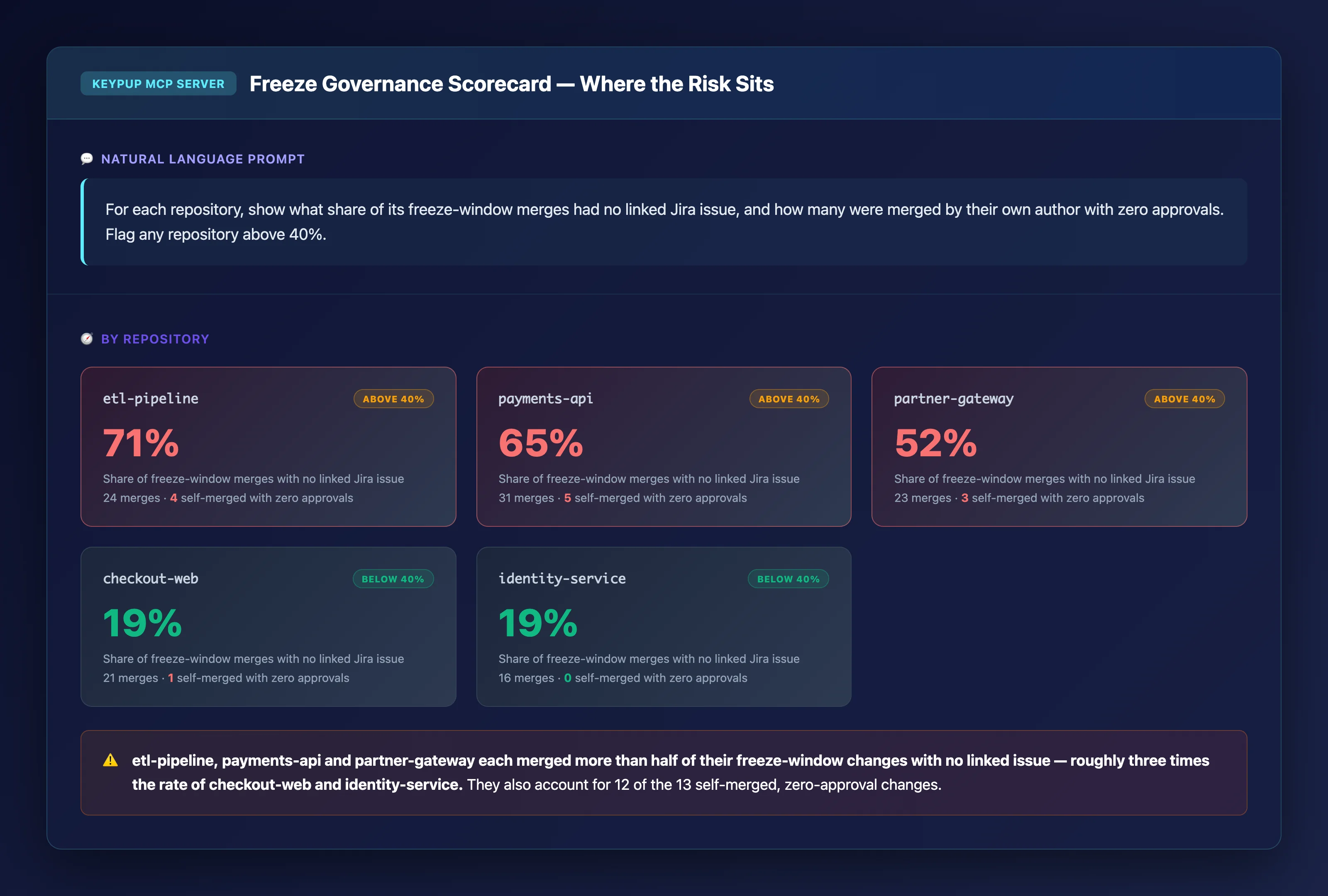
6. Giving Leadership a Standing Governance Scorecard
Once the trend is confirmed, leadership needs an ongoing view of exactly where a tighter enforcement conversation is needed before the next freeze window opens.
MCP Prompt:
For each repository, show what share of its freeze-window merges
had no linked Jira issue, and how many were merged by their own
author with zero approvals. Flag any repository above 40%.
Output: Freeze Governance Scorecard — Where the Risk Sits
Key Insight: etl-pipeline, payments-api and partner-gateway each merged more than half of their freeze-window changes with no linked issue — roughly three times the rate of checkout-web and identity-service — and they account for 12 of the 13 self-merged, zero-approval changes. All three sit closest to regulated or contractual risk, which is exactly where an unreviewed override is most expensive if it goes wrong.
The Technical Implementation: What Keypup MCP Actually Reads
Every number above comes from fields Keypup already imports from your Git platform and Jira. It helps to be precise about what those are — and what they aren't.
Merged Pull Requests Stand In for Deployments
Keypup doesn't import deploy events or environments from your CI/CD pipeline. What it does record for every pull request is when it was merged, which branch it was merged into, who wrote it and who merged it. A pull request merged into the branch you release from is the closest reliable signal of a change entering production: for teams that deploy continuously from main, the two are nearly the same thing; for teams that batch releases, treat the result as "changes that became eligible to ship during the freeze."
The Freeze Window Comes From You
Keypup has no freeze-calendar object. The freeze dates go in the prompt, together with the branches you release from, and the MCP Server turns them into a merge-date filter. Keep the list of past freeze windows somewhere your team can paste from, and every reconciliation — including the six-window trend — is one prompt away.
Exceptions Are Your Jira Change Requests
Keypup links a pull request to the Jira issues it references, so each freeze-window merge either resolves an issue or it doesn't. If your exceptions are raised as Jira Service Management change requests, Keypup imports their fields as they are — Change type (Standard, Normal, Emergency), Change reason, Change risk and Approvers — and you can filter and group on them like any other field. If you don't use change requests, a Jira label such as freeze-exception works the same way.
Keypup doesn't read pull request descriptions to decide whether a change was a real emergency. The reason and risk you see are the ones the requester declared on the ticket. That's what makes them useful in an audit: when an Emergency change request declares New functionality, nobody has to argue about interpretation.
Review Independence: What Can Be Checked
On the pull request itself, Keypup records the author, who merged it, how many approvals it received against how many its branch requires, and who reviewed it. That's enough to flag self-merges, merges below the required approval count, and merges with no review at all — the checks behind the table and scorecard above.
Checking that the person who requested an exception isn't also the person who approved it is a ticket-level check, and it works only where your change requests use the Approvers field. When they do, the MCP Server can compare the ticket's reporter with its approvers for every emergency change in the window.
Real-World Impact: Enterprise Case Studies
Case Study 1: Regional Insurance Carrier
Before Keypup MCP:
The compliance team believed the quarterly freeze was holding based on the absence of incident reports, with no systematic reconciliation against what had actually merged
An external SOC 2 auditor requested the freeze exception trail and found that over half of freeze-window changes had no linked approval
The finding delayed certification and required a remediation plan before the audit could close
After Keypup MCP:
Every freeze-window merge was reconciled against its change request the morning after each freeze closed, instead of in a scramble once the auditor asked
Self-merged and under-approved changes were listed by pull request, so each one could be reviewed retroactively and documented before the next freeze window opened
The following year's audit found a fully reconciled exception trail, with merges lacking a change request reduced by more than 80% compared to the prior freeze cycle
"We used to find out our freeze wasn't holding when the auditor told us. Now we find out the morning after it closes, with the exact pull requests and the exact gap in approval, weeks before the next audit even starts. That's the difference between a finding and a non-event."
— Director of Compliance, Regional Insurance Carrier
Case Study 2: Enterprise Payments Platform
Before Keypup MCP:
Freeze exceptions were requested and approved informally over Slack, with no record linking the approval to the change it covered
Two repositories behind the payments core were quietly responsible for the majority of untracked merges, with no data to support a targeted governance conversation
Engineering and compliance leadership had no shared source of truth for how many freeze-window changes had actually been reviewed
After Keypup MCP:
Emergency changes moved from Slack to Jira change requests linked to their pull requests, giving every override a verifiable record tied to the change it covered
The two highest-risk repositories were given a mandatory independent-approver requirement for any freeze-window change, based directly on the merge data
Untracked merges during the following freeze window dropped by more than 70%, with the remaining exceptions documented on a change request
"Before this, 'did the freeze hold' was a question we answered with confidence and no evidence. Now it's a query we run the morning after the freeze closes, with the exact repositories and pull requests that need a conversation. That single change turned our governance posture from reactive to something we can actually defend."
— VP Engineering, Enterprise Payments Platform
Implementation: Getting Started with Keypup MCP
1. Connect Your Git Platform and Jira
The reconciliation needs both sides: the pull requests from GitHub, GitLab or Bitbucket, and the issues and change requests from Jira. Connect both to Keypup before your next freeze window opens.
2. Give Exceptions a Home in Jira
Raise every freeze exception as a Jira change request — or, at minimum, an issue with a consistent label — and reference its key in the pull request. An exception approved in Slack leaves nothing for Keypup, or an auditor, to find.
3. Write Your Freeze Windows Down as Dates
Keep a simple list of past and upcoming freeze windows, with start and end dates and the branches you release from. That list is all the MCP Server needs to reconcile any freeze, or compare several.
4. Query in Natural Language, Across Every Repository
No manual log-pulling required. Just ask:
"How many pull requests merged into main during the current freeze have no linked Jira issue?"
"Which repository has the most self-merged pull requests during the freeze?"
"Show me every Emergency change request this quarter whose Change reason is New functionality"
"Is the number of untracked freeze merges growing or shrinking compared to last quarter?"
5. Make It a Standing Report
Run the same queries on a schedule:
Freeze-window reconciliation the morning after every freeze closes
A Change reason breakdown of emergency change requests, to catch planned work filed as an emergency
Self-merge and required-approval checks on every freeze-window merge
Requester-vs-approver checks on change requests, where the Approvers field is in use
A repository scorecard ahead of every audit cycle
The Bottom Line: A Freeze Policy Needs a Way to Prove It Held
A change freeze that can't be verified against what actually merged isn't a control — it's a belief, and beliefs don't survive an audit. Fixing it requires:
✅ Reconciling every freeze-window merge against its change request, every time a freeze closes ✅ Reading the declared Change reason on emergency changes, so planned work filed as an emergency stands out ✅ Flagging self-merged and under-approved pull requests, where nobody independent signed off ✅ Tracking whether untracked merges are growing or shrinking, freeze over freeze ✅ Maintaining a standing governance scorecard by repository, to target enforcement where the gap is largest
Keypup MCP turns "did the freeze hold" from an assumption leadership hopes is true into a number compliance can verify before the next audit does it for them — giving engineering and governance teams the evidence to close the gap on their own terms, instead of explaining it defensively after the fact.
Get Started
Ready to stop assuming your code freeze held and start proving it?
Start Free Trial — Connect your engineering stack in minutes and start reconciling every freeze-window merge against its change request.
Request Demo — See how enterprise engineering leaders use Keypup MCP to quantify and close the code freeze exception gap.
View MCP Documentation — Technical details for engineering teams connecting Keypup MCP to their Git platform and Jira.
Keywords: code freeze exception creep, change freeze governance, emergency change approval, release management compliance, SOC 2 change control audit, freeze window change risk, MCP server change management, Jira emergency change request, unapproved production override, self-merged pull requests governance gap
Ready to Transform Your Analytics?
Join teams already using AI to make data-driven decisions faster than
ever.
Chronic sprint carryover quietly turns every enterprise roadmap date into a guess. Discover what engineering leaders on Reddit say about the say/do gap, why velocity charts hide it, and how Keypup MCP measures carryover across Jira sprints and linked pull requests to show where commitments break, why, and which teams need help first.
Compare the 6 best development analytics software platforms for 2026 — Keypup, LinearB, Jellyfish, Swarmia, Appfire Flow and Faros — across DORA Metrics tracking, engineering dashboards, Git-to-ticketing data integration, custom KPI configurability, AI capabilities, setup time and data security. Find out which engineering intelligence platform turns raw Git and Jira data into prescriptive, actionable insights for your team.
Blameless postmortems produce great root-cause analysis and action items that quietly die in the backlog. See what SREs on Reddit say about remediation decay, and how Keypup MCP tracks action item follow-through to stop the same incidents from recurring.