Technical Debt Isn't Just Code: Measuring the Hidden Costs in Your SDLC
Discover how technical debt extends far beyond messy code into your entire software development lifecycle. Learn to identify, measure, and quantify process debt, review debt, testing debt, and documentation debt using Keypup's MCP Server for AI-powered SDLC analysis and cost calculation.
TL;DR: Technical debt isn't limited to code quality—it permeates every aspect of your software development lifecycle. Process debt from manual steps, review debt from rushed approvals, testing debt from flaky tests, and documentation debt from outdated wikis all compound into massive hidden costs. Keypup MCP Server reveals these invisible drags on velocity by analyzing your SDLC data and quantifying the true financial impact of accumulated debt across your development pipeline.
Key Point 1: Process debt—manual deployment steps, slow CI/CD pipelines, and inefficient workflows—costs engineering teams 15-25% of their velocity, equivalent to losing 1-2 engineers per team of 10 to repetitive toil instead of strategic work.
Key Point 2: Review debt manifests as rubber-stamp approvals, missed bugs, and architectural issues that slip through superficial code reviews, creating a compounding tax where each quick approval today creates 3-5× more work downstream when issues reach production.
Key Point 3: Keypup MCP Server transforms technical debt from a vague "we should fix this someday" sentiment into quantified, prioritized work by calculating cycle time impact, bug correlation, and dollar costs, enabling data-driven decisions about when debt paydown delivers better ROI than new features.
Introduction: The Technical Debt You Can't See Is Costing You the Most
When engineering leaders discuss technical debt, the conversation typically centers on code: legacy systems, spaghetti architecture, missing tests, and that 10,000-line class everyone's afraid to touch. Code quality issues are real and measurable—but they're only the tip of the iceberg.
The most expensive technical debt often lives outside your codebase entirely, embedded in your software development lifecycle itself. Manual deployment steps that could be automated. Code reviews that rubber-stamp PRs without catching real issues. Flaky tests that erode confidence and waste CI/CD time. Documentation that's six months out of date, forcing every new developer to reverse-engineer the system.
This is process debt, review debt, testing debt, and documentation debt—and collectively, they cost engineering organizations far more than messy code ever will.
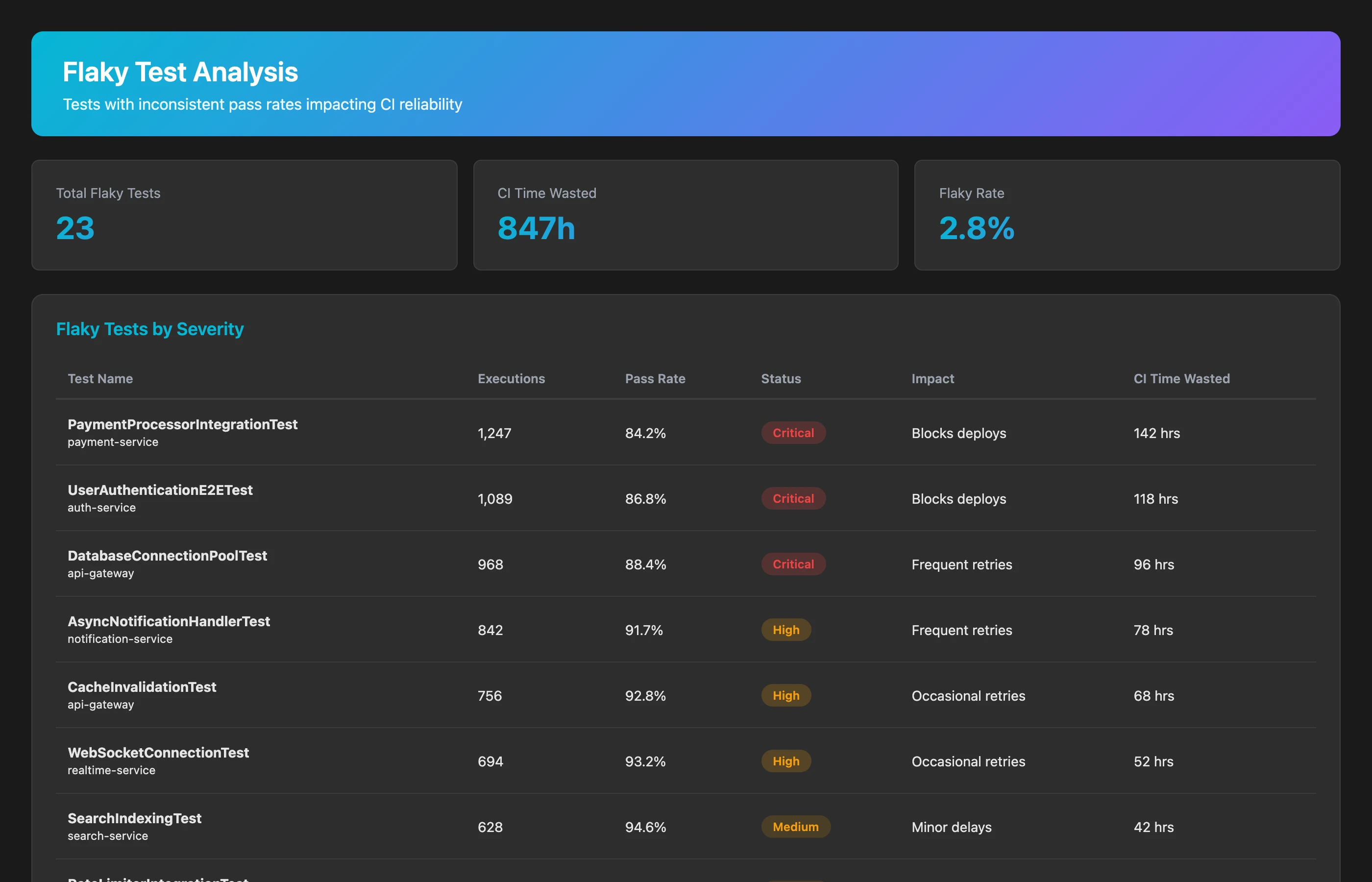
Consider a typical scenario: Your team ships features steadily, but deployment requires 12 manual steps documented in a wiki. Each deployment takes 45 minutes of an engineer's time and fails 15% of the time due to human error. That's process debt. Your code reviews average 8 minutes, and 40% of PRs are approved with only superficial comments. That's review debt. Your CI/CD pipeline has 23 flaky tests that randomly fail, forcing engineers to re-run builds "just to be sure." That's testing debt. Your architecture documentation was last updated 9 months ago, and new engineers spend 3 weeks getting oriented. That's documentation debt.
Each of these debts compounds. Manual processes slow feature delivery. Superficial reviews let bugs through that create emergency work downstream. Flaky tests erode trust, leading teams to merge without waiting for CI. Outdated documentation leads to architectural inconsistencies as developers make incorrect assumptions.
The challenge is that unlike code debt, SDLC debt is invisible to traditional engineering metrics. Your test coverage dashboard won't flag that 40% of code reviews are rubber stamps. Your static analysis tools won't detect that deployments require 12 manual steps. Your velocity charts won't reveal that developers spend 30% of their time working around flaky tests.
This is where Keypup MCP Server changes the game. By analyzing comprehensive SDLC data—issues, pull requests, code reviews, review comments, commits on pull requests, each PR's build status as reported by your Git host, and activity events such as status changes and reassignments—MCP can identify, quantify, and prioritize the hidden technical debt dragging down your velocity and quality. Keypup never reads your source code and does not import CI pipeline runs, test results or deployment logs; where a question needs those, you bring the figures from your CI tool into the conversation and your AI assistant combines them with Keypup's data.
This article explores the four major categories of non-code technical debt, shows you how to measure their true cost, and demonstrates how to use Keypup MCP to transform vague concerns about "process problems" into data-driven decisions about where debt paydown delivers the highest ROI.
Understanding the Four Types of SDLC Technical Debt
Before we can measure and address technical debt, we need a framework for categorizing it. While code debt gets the headlines, SDLC debt often creates more drag on velocity and quality. Let's break down the four major categories.
1. Process Debt: The Automation That Never Happened
Process debt accumulates whenever teams rely on manual steps, slow tooling, or inefficient workflows that could be automated or optimized. It manifests as:
Manual deployment steps: "SSH into production and run these 8 commands in order"
Slow CI/CD pipelines: 45-minute builds that could be 10 minutes with better caching
Environment setup complexity: New developers need 3 days to get a working dev environment
Manual testing steps: QA team manually tests the same 50 scenarios every release
Release coordination overhead: Release requires coordinating 6 teams across 4 time zones
The insidious nature of process debt is that each individual instance seems "not worth fixing right now"—until you calculate the aggregate cost. A manual step that takes 5 minutes but runs 20 times per day costs 1,667 hours per year (almost 1 FTE). A slow CI/CD pipeline that adds 30 minutes per build, across 100 daily builds, costs 750 hours per year.
u/devops_burnout from r/devops
Our deployment 'process' is a 47-step wiki page that's somehow both outdated and overly detailed. Last Friday, a junior dev skipped step 23 (clear the cache on server 4) and took down production for 2 hours. We all know we should automate this, but 'there's never time' because we're too busy doing manual deployments.
2. Review Debt: The Quality Gates That Don't Gate
Review debt occurs when code review processes exist but fail to provide meaningful quality assurance. Common manifestations include:
Rubber-stamp approvals: PRs approved in under 5 minutes without substantive feedback
Review bottlenecks: PRs wait days for review while reviewers context-switch constantly
Superficial review comments: "LGTM" approvals without checking tests, edge cases, or architecture implications
Inconsistent review standards: Some PRs get rigorous scrutiny, others breeze through
Review fatigue: Large PRs (1000+ line changes) that no reviewer actually reads thoroughly
Review debt creates a compounding tax. Quick approvals let architectural problems through that take weeks to unwind later. Missed edge cases become production bugs. Inconsistent standards create codebase chaos where different modules follow completely different patterns.
The paradox: teams implement code review to catch issues early, but poor review practices make reviews a bureaucratic speed bump that catches nothing while slowing delivery.
u/senior_eng from r/ExperiencedDevs
I've been on teams where PRs get 'LGTM'd' in under 3 minutes for 800-line changes. Nobody's actually reading the code. Then two weeks later we're debugging a production issue that any careful reviewer would have caught. Code review theater is worse than no code review because it gives false confidence.
3. Testing Debt: When Your Safety Net Has Holes
Testing debt extends beyond "we should write more tests" to encompass the entire testing infrastructure and culture:
Flaky tests: Tests that randomly fail, forcing engineers to retry builds "just to be sure"
Slow test suites: 45-minute test runs that discourage running tests locally
Low-value tests: Tests that pass even when functionality breaks, providing false confidence
Missing test categories: Great unit tests but zero integration tests, or vice versa
Test maintenance burden: Tests break with every refactoring, creating test-induced fear of change
Flaky tests are the silent killer. Research shows that once flakiness rate exceeds 2%, engineers stop trusting CI entirely. Teams merge without waiting for results, deployment confidence plummets, and the entire CI/CD investment becomes worthless.
Testing debt also includes manual testing burden. If QA manually executes the same regression tests every release, that's testing debt—automation that could happen but doesn't.
u/qa_nightmare from r/softwaredevelopment
We have 12 tests that fail randomly. Not because of bugs—they just fail. So now everyone's learned to hit 'retry' on the CI pipeline until it passes. Last week I saw someone retry 6 times. At this point, the tests are just a 5-minute delay before we can merge, not an actual safety check.
4. Documentation Debt: Knowledge That Lives in Slack Threads
Documentation debt accumulates when knowledge exists only in people's heads or scattered across Slack threads, tribal knowledge, and outdated wikis:
Outdated architecture docs: "How our system works" documentation last updated 18 months ago
Missing runbooks: When the system breaks at 2am, responders reverse-engineer fixes each time
Undocumented decisions: "Why did we choose this database?" lives only in a Slack thread from 2023
Setup instruction rot: Onboarding docs reference tools and processes that no longer exist
API documentation drift: Public API docs don't match actual API behavior
Documentation debt creates exponential costs as teams scale. Every new engineer spends weeks discovering information that should have taken hours to read. Every incident response includes unnecessary detective work. Every architectural decision gets re-litigated because no one remembers the original reasoning.
The challenge: unlike code or tests, documentation has no forcing function. Outdated docs don't break builds or fail deployments—they just slowly drain productivity as confusion compounds.
u/new_eng_confused from r/cscareerquestions
It took me 3 weeks to understand why our auth service works the way it does. The official docs say we use JWT, but we actually migrated to OAuth2 last year. I only figured it out by searching Slack for 'auth migration' and finding a thread from 8 months ago. Our lead engineer left 6 months ago and took all that knowledge with him.
Now that we understand the four categories of SDLC technical debt, let's explore how to identify and measure each type in your own engineering organization using Keypup MCP Server.
Identifying Process Debt: Finding Automation Opportunities
Process debt hides in plain sight—it's the daily friction that teams accept as "just how we work." The first step in addressing it is making the invisible visible through systematic analysis.
Detecting Manual Process Overhead
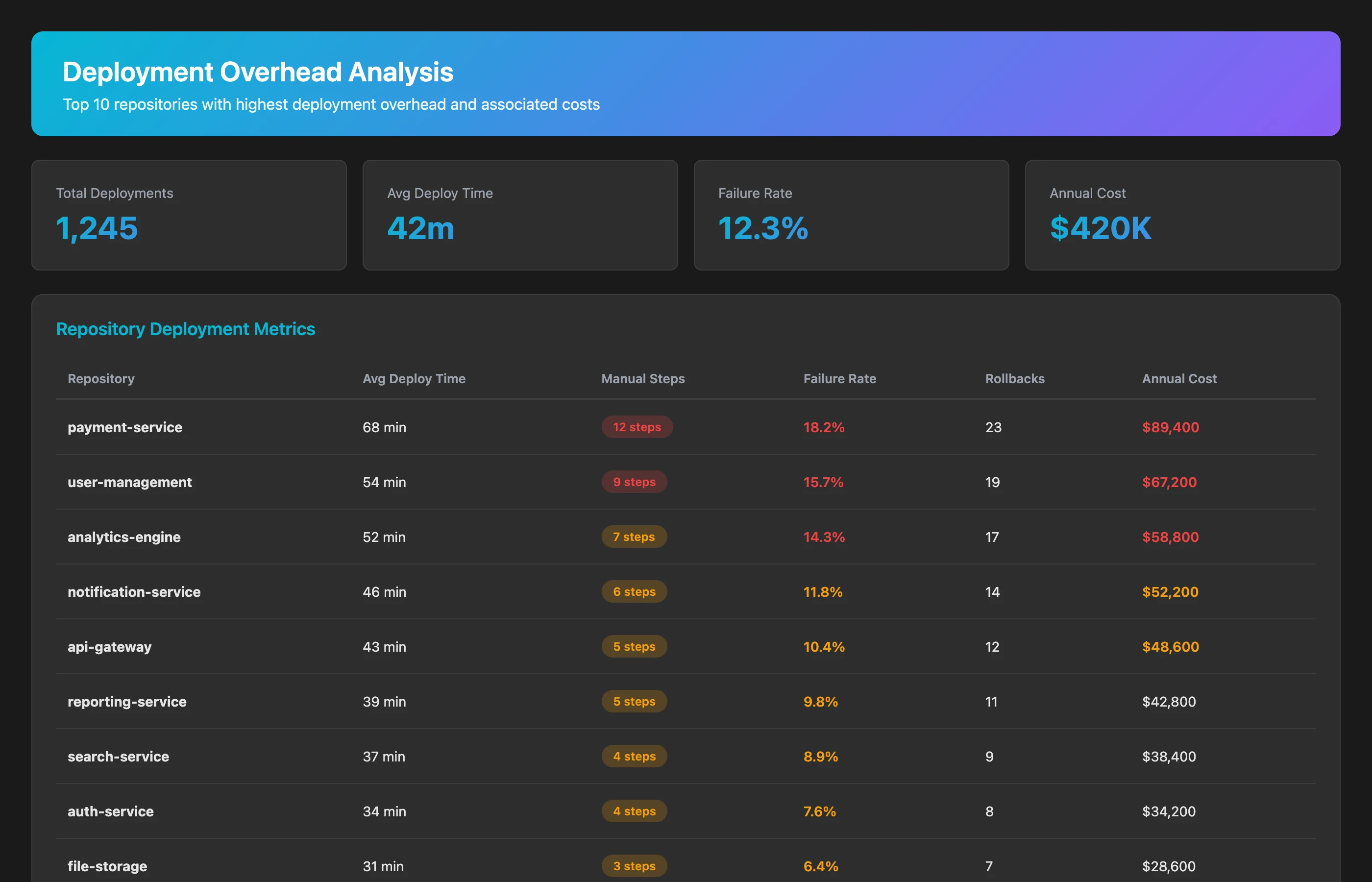
Keypup does not see your deployment pipeline itself, but manual release steps leave traces in delivery data: long waits between approval and merge, merges bunched into release windows, and hotfix or revert PRs. By default, Keypup treats a merged pull request (optionally filtered to your production branch) as a deployment. Start there:
Analyze our path to production over the last 3 months, treating PRs merged to main as deployments. For each repository, calculate: PRs merged per week, average time from approval to merge, how merges are distributed across days of the week, and the share of merged PRs followed within 48 hours by a PR labelled "hotfix" or with "revert" in its title. Identify repositories where approved PRs regularly wait more than a day to merge. Show me the top 10 repositories with the highest post-approval overhead.
This analysis reveals which repositories have painful release processes and quantifies the delay. Look for patterns like:
Approved PRs consistently waiting more than a day to merge (should be minutes or hours)
High hotfix and revert rates (>10%) indicating error-prone release steps
Merges bunched into one or two days a week, suggesting manual release windows
For the deployment steps themselves (durations, failures, rollbacks), use your CI/CD tool's own reports alongside these Keypup signals.
Measuring Build Health
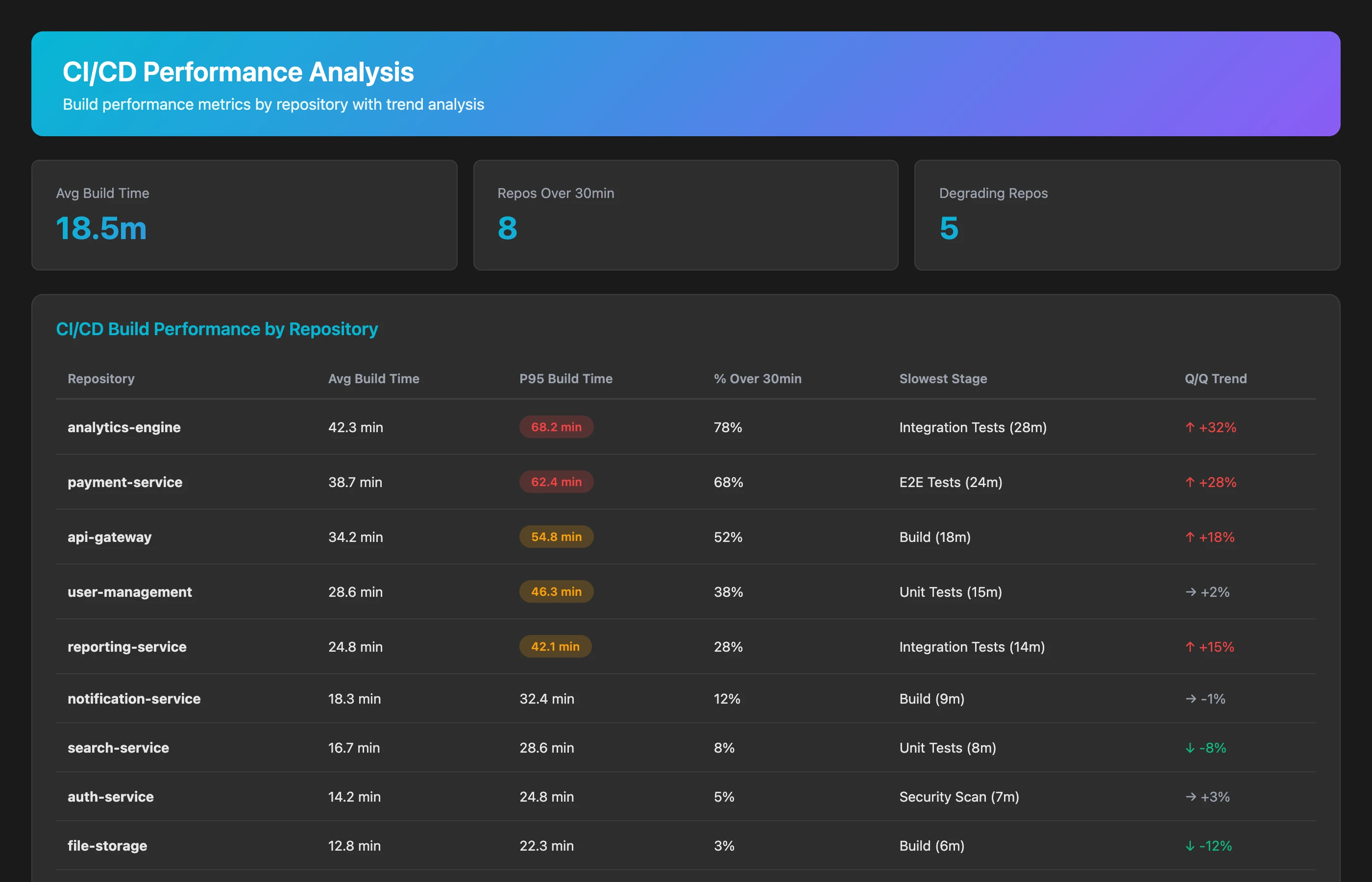
Unreliable CI/CD pipelines act as a hidden tax on every change. Keypup does not import CI runs, so build durations and stage timings stay in your CI tool, but it records the build status your Git host reports on every pull request:
Analyze build health across all repositories for Q2 2026 using each pull request's build status. For each repository, show: the percentage of PRs with a failed build status, the percentage of PRs merged while their build status was FAILURE, the number of open PRs currently blocked on a failing build, and the trend over the quarter (improving vs. degrading). Identify repositories where the share of failed builds increased by more than 25% quarter-over-quarter.
Key indicators of CI/CD process debt:
PRs merged on a red build: The quality gate exists but is bypassed
Degrading build health: A rising share of failed builds suggests accumulating inefficiency or fragile tests
PRs stuck on failing builds: Work waiting on fixes to the pipeline rather than to the code
Pair these with the build durations from your CI tool (builds over 20 minutes discourage running tests locally) for the full picture.
Calculating Process Debt Cost
Once you've identified process inefficiencies, quantify the financial impact:
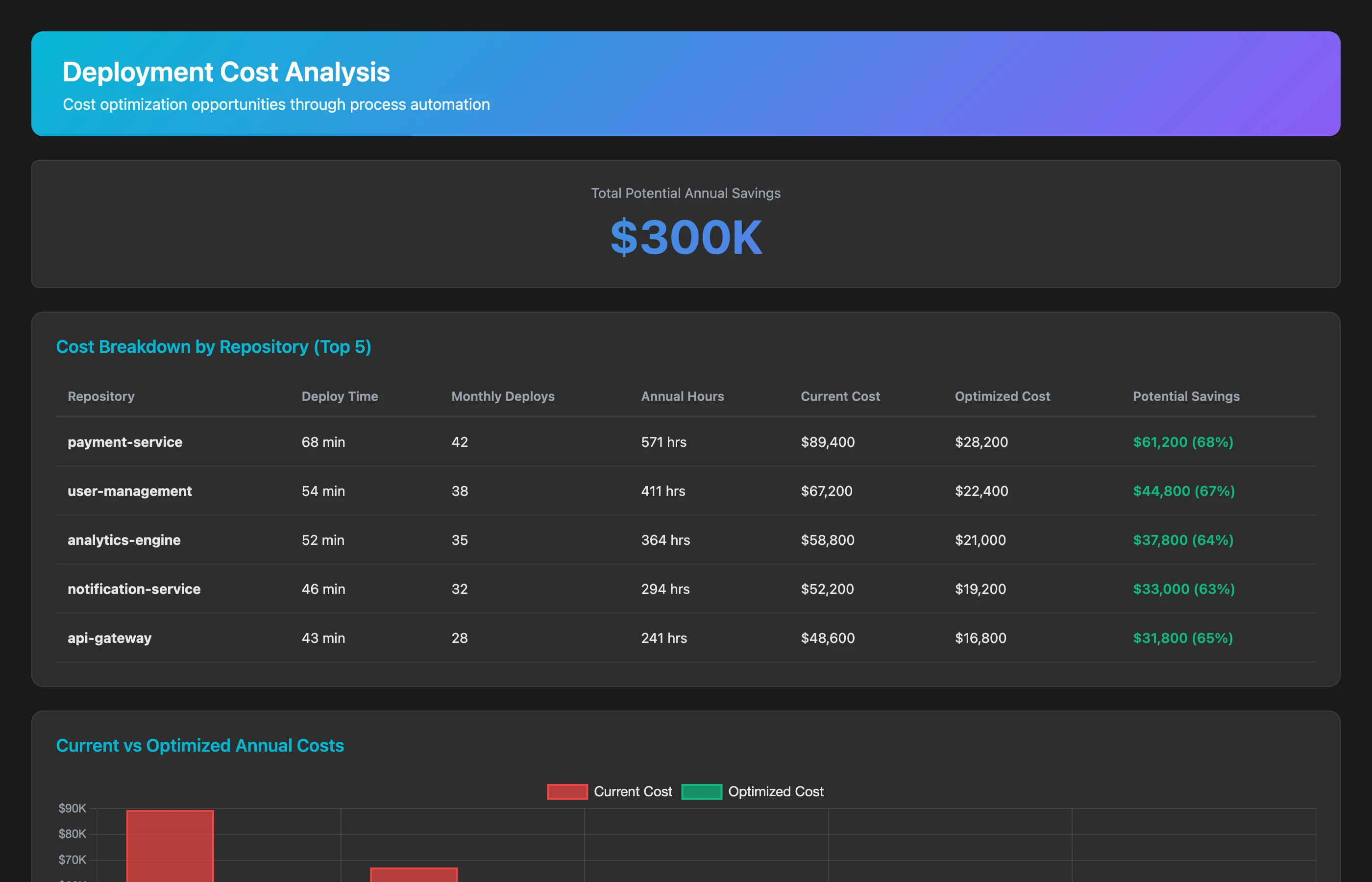
Calculate the cost of process debt for the 5 repositories with the longest approval-to-merge times. For each repository, take from Keypup: PRs merged to main per month (our deployments), and the number and cycle time of hotfix and revert PRs. Combine them with the engineer time per deployment I'm providing from our release logs: estimate annual engineer hours consumed by deployment overhead and hotfix work, cost at $125/hour loaded rate, and potential savings if deployment time dropped to our 15-minute target. Show the total annual cost of deployment process debt.
This cost analysis transforms "deployment is slow" into "our deployment process costs $380K annually and could be reduced to $80K with automation—an ROI of 300K/year." That's a different conversation with leadership than "we should automate deployment someday."
Identifying Toil vs. Strategic Work
Not all manual work is equal. Some is valuable (complex problem-solving), some is toil (repetitive, automatable):
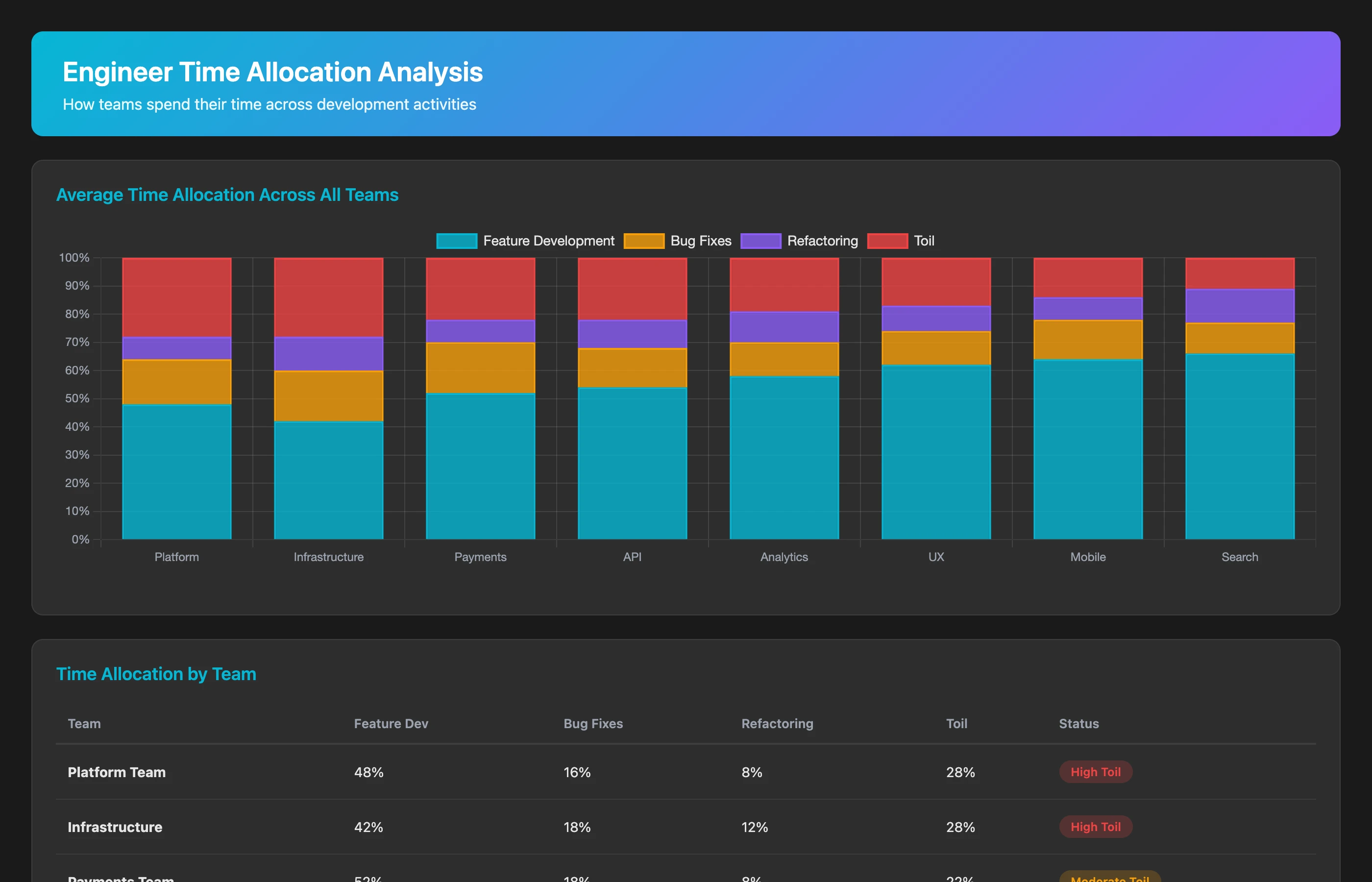
Analyze engineer activity patterns for Q2 2026. Categorize merged PRs as: feature development (PRs introducing new functionality), bug fixes (PRs labelled "bug" or with "fix" in title/description), refactoring (PRs labelled "tech-debt" or with "refactor" or "cleanup"), and toil (PRs with "deploy", "manual", "hotfix", "revert", "config"). For each engineer and team, show the share of merged PRs and lines changed in each category as a proxy for time. Flag teams spending over 20% of their work on toil.
What counts as toil is specific to each team: write your definition (labels, title keywords) into your team's AI Instructions in Keypup, which the MCP Server reads at the start of each conversation, so every analysis uses the same categories. Teams spending over 20% of time on toil are drowning in process debt. That's one engineer in five doing repetitive work that could be automated, rather than building product value.
Uncovering Review Debt: When Code Reviews Don't Review
Code review processes exist in most engineering organizations, but many have accumulated significant review debt—reviews that check boxes without catching issues. Let's surface the patterns.
Detecting Rubber-Stamp Approvals
Quick approvals aren't inherently bad (small PRs should be fast), but patterns of consistently fast approvals without engagement suggest review debt:
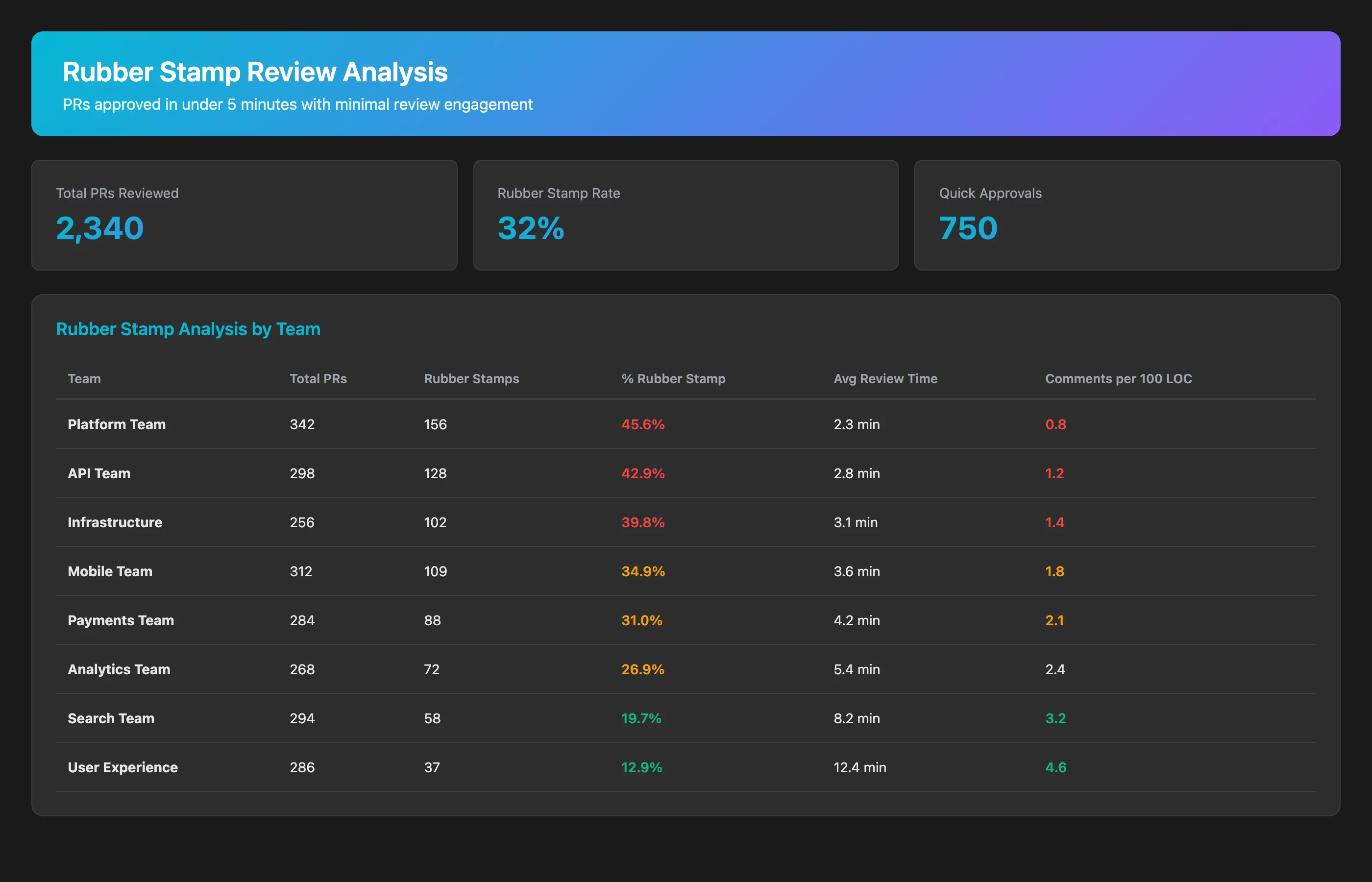
Analyze code review quality for Q2 2026. For each PR, calculate: time from review request to first review, time from first review to approval, number of review comments, reviewer engagement (comments per 100 lines changed), and review states (approved directly vs. changes requested). Identify "rubber stamp" reviews: approved less than 10 minutes after the review was requested, with fewer than 2 comments, on PRs over 100 lines. Show the percentage of rubber-stamp reviews by team and repository.
Keypup records when each review was requested, created and submitted, its state and body, and every review comment, so these patterns are measured rather than guessed. Line counts are not available for GitLab, so use comment counts alone on GitLab repositories.
Warning signs of review debt:
Over 30% rubber-stamp rate: Most reviews provide no meaningful feedback
Large PRs with quick approvals: 500-line PRs approved in 5 minutes weren't actually read
Declining comment rates: Reviewer engagement decreasing over time indicates growing fatigue
Correlating Review Quality with Defect Rates
Poor reviews let bugs through. Let's quantify the correlation:
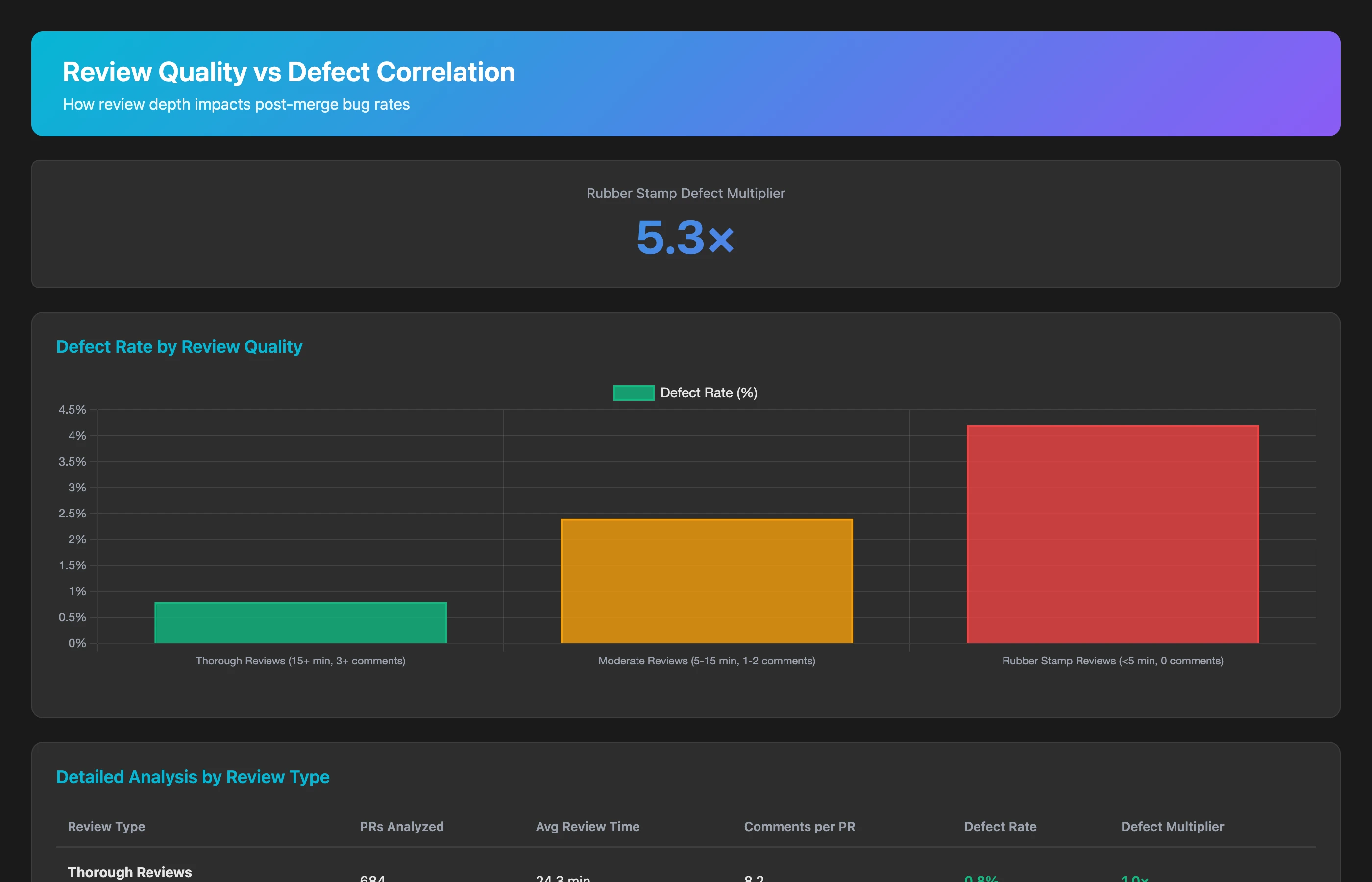
Correlate code review quality with post-merge defects for Q2 2026. For each PR, track: review depth (time from review creation to submission, comments made, and the reviewer's number of past reviews in that repository), and subsequent bug fixes, approximated as PRs labelled "bug" or with "fix" in the title merged in the same repository within 2 weeks. Calculate defect rate for: thorough reviews (over 20 minutes, multiple comments), moderate reviews (10-20 minutes, some comments), and rubber-stamp reviews (under 10 minutes, minimal comments). Show the defect multiplier for quick reviews vs. thorough reviews.
Keypup holds no causal link between a bug fix and the PR that introduced the bug, so treat this as a correlation over time, not an attribution. Teams running this analysis often find that rubber-stamp reviews come with 3-5× higher defect rates than thorough reviews. This correlation demonstrates that review debt doesn't just slow things down—it actively creates more work by letting bugs through.
Identifying Review Bottlenecks
Review debt also manifests as bottlenecks where PRs wait days for review:
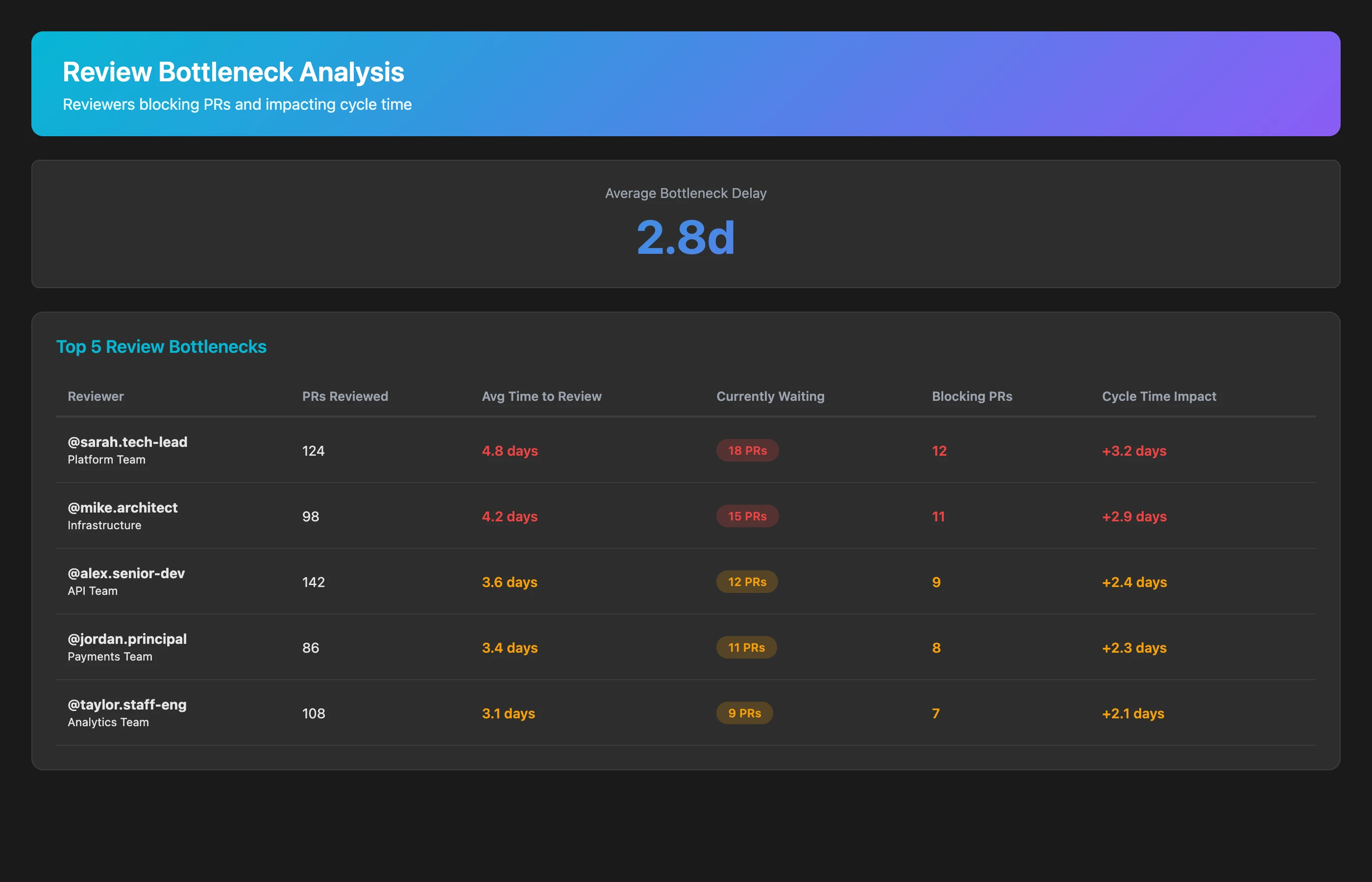
Analyze code review bottlenecks for Q2 2026. For each reviewer, calculate: number of PRs reviewed, average time to first review, number of PRs currently awaiting their review, and percentage of PRs where they are the blocking reviewer (waiting over 24 hours). Identify the top 5 review bottlenecks and estimate the cycle time impact (how much faster PRs would merge if these reviewers responded within 4 hours).
Review bottlenecks create a different form of review debt: delays that force context-switching, stale branches, and merge conflicts. A single bottleneck reviewer can add 2-3 days to every PR they're assigned.
Measuring the Cost of Review Debt
Quantify the financial impact of poor review practices:
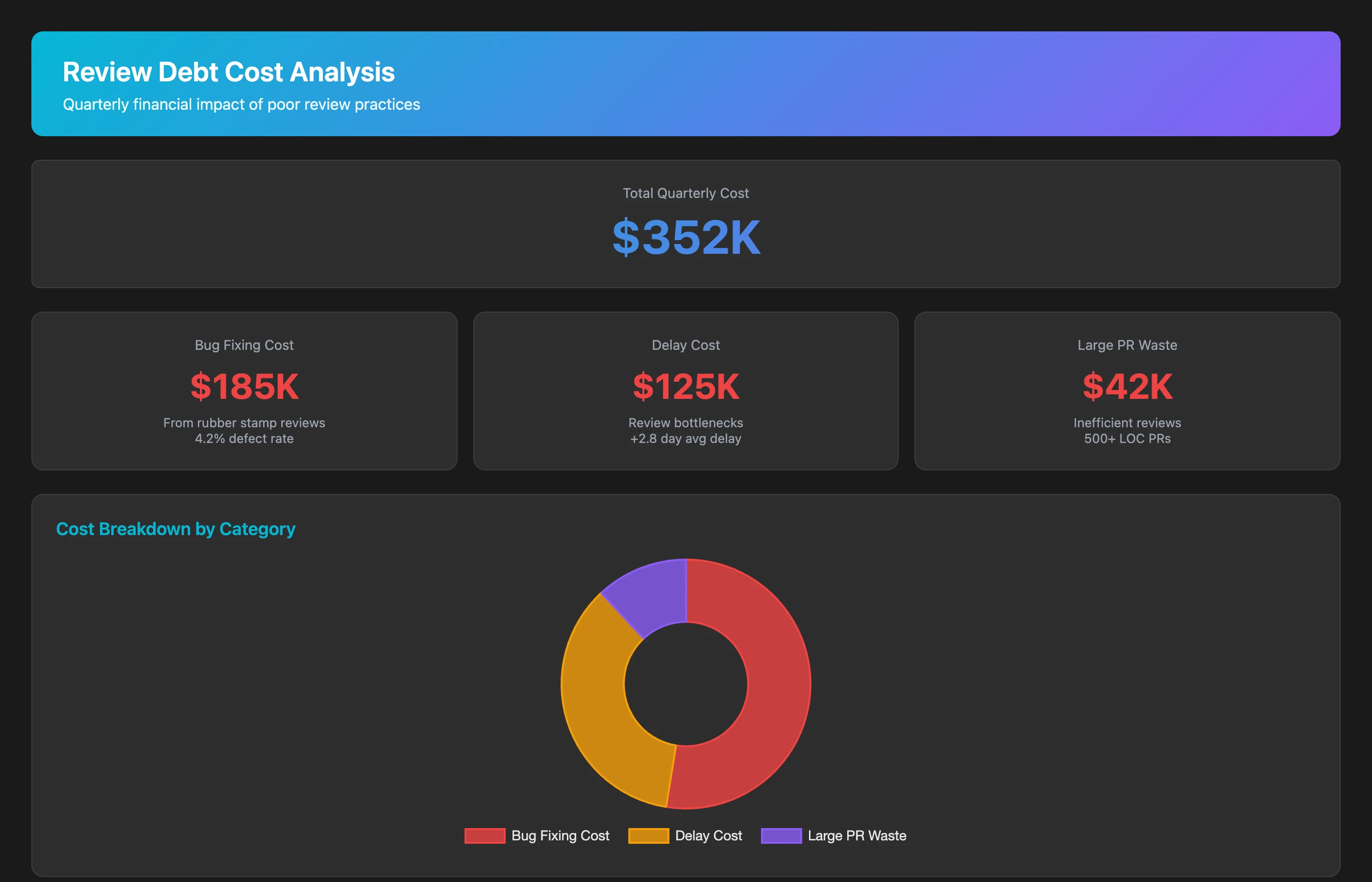
Calculate the cost of review debt for Q2 2026. Estimate: cost of rubber-stamp reviews that let bugs through (bug fix time × number of avoidable bugs × $125/hour), cost of review bottlenecks (cycle time delay × number of PRs affected × opportunity cost), and cost of large-PR review fatigue (time wasted on superficial review of PRs over 500 lines that should have been split). Show total quarterly cost and annual projection.
Review debt typically costs 10-15% of engineering capacity through a combination of bugs introduced, delays caused, and time wasted on ineffective reviews. For a 50-person engineering team, that's 5-7.5 FTE worth of productivity lost.
Quantifying Testing Debt: The CI/CD Confidence Crisis
Testing debt erodes confidence in your safety nets, leading teams to either over-test (slow pipelines) or under-test (production bugs). Keypup holds no test data—no test runs, coverage or durations; those live in your CI and coverage tools. What it does see is the trace testing debt leaves in delivery data: failed builds, PRs merged on red, and bug-fix work. Combine both to identify and measure the patterns.
Detecting Flaky Build Signals
Flaky tests—tests that randomly fail without code changes—are the most toxic form of testing debt. Your CI tool identifies the individual tests; Keypup shows where flakiness is changing behavior:
Identify signs of flaky builds across all repositories for Q2 2026. For each repository, show: the percentage of PRs with a failed build status, the percentage of PRs merged while their build was failing, and the number of PRs and commits whose title or message mentions "flaky", "retry", "rerun" or "skip test". Flag repositories where more than 5% of PRs are merged on a failed build, and list the PRs that mention flaky tests so we can check them in our CI tool.
The insidious impact of flaky tests:
Each flaky test wastes 10-20 re-runs per week across all developers
Flaky test rates over 2% cause teams to stop trusting CI entirely
Developers start merging without waiting for CI, defeating the purpose of automated testing—the one effect Keypup measures directly, as PRs merged with a failed build status
Analyzing Test Coverage vs. Test Value
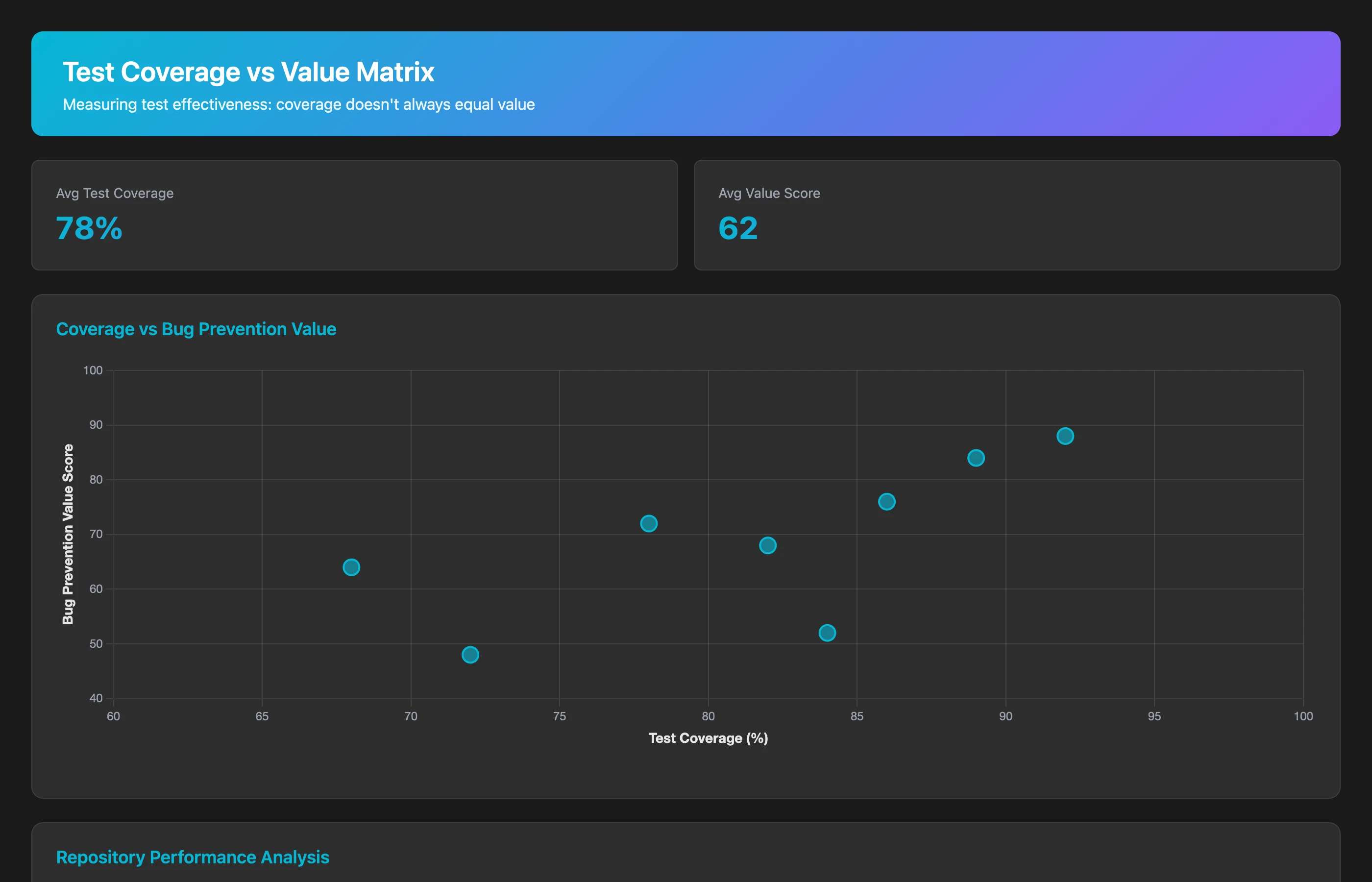
Not all test coverage is created equal. Some tests provide genuine confidence; others just hit coverage targets:
Analyze test effectiveness for our top 10 repositories in Q2 2026. I'm pasting each repository's test coverage percentage from our coverage tool. From Keypup, add for each repository: the share of merged PRs that are bug fixes (labelled "bug" or "hotfix"), the number of Bug issues created, and the average PR size. Identify repositories with high coverage but a high bug-fix share (tests that don't catch real issues) and low coverage but a low bug-fix share.
Testing debt isn't just "we need more tests"—it's "we have tests that don't catch the bugs that actually happen." This analysis reveals repositories where test suites are performative rather than protective.
Measuring Test Suite Performance Degradation
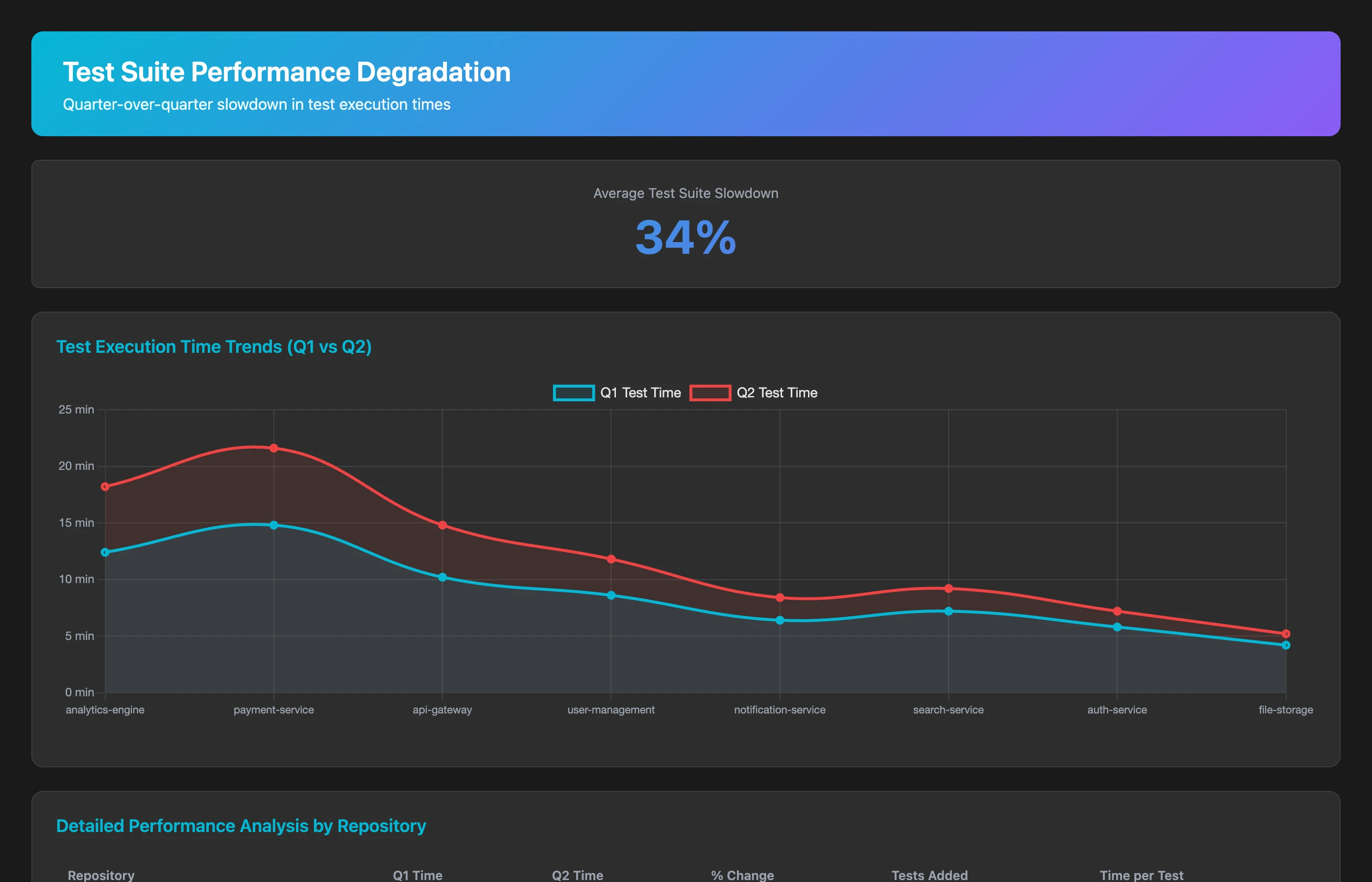
Test suites tend to slow down over time as tests accumulate without optimization:
Track test suite slowdown over Q2 2026. I'm pasting the average test suite duration and test count per repository at the start and end of the quarter from our CI tool. From Keypup, add for each repository: PRs merged per week, average time from approval to merge, and the share of PRs merged with a failed build. Flag repositories where test time increased by more than 50% without a corresponding increase in test count, and check whether approval-to-merge time grew with it.
Test suite slowdown is pure testing debt: teams wrote tests at reasonable speed, but didn't maintain them. Now a 5-minute test suite has become 45 minutes, discouraging developers from running tests locally.
Calculating Testing Debt Cost
Quantify the impact of testing debt on velocity and quality:
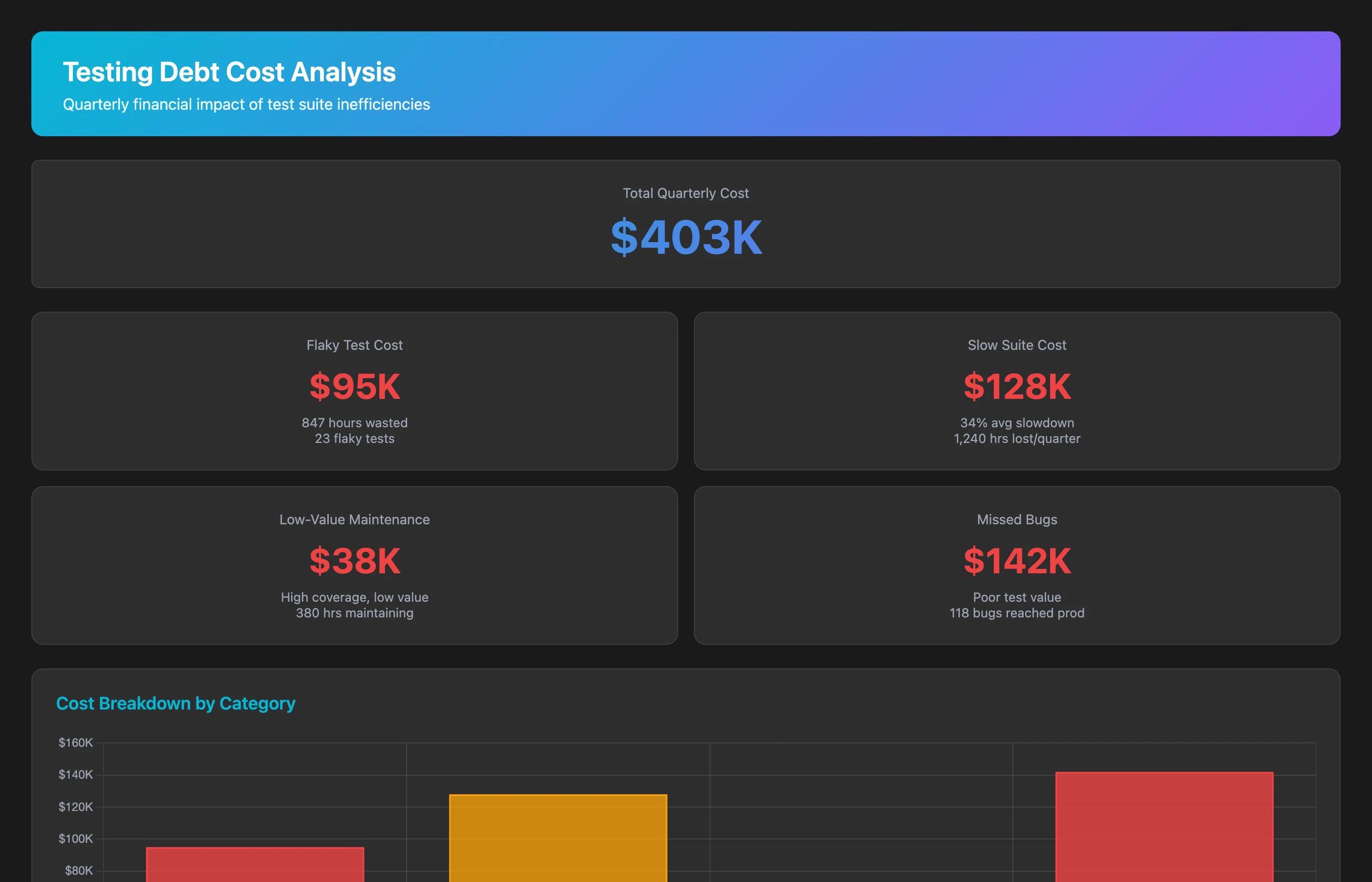
Calculate the cost of testing debt for Q2 2026. Using the figures I'm providing from our CI tool (re-runs per week, minutes per re-run, builds per day, and suite duration vs. our 10-minute target), estimate at $125/hour: the cost of flaky test re-runs and the cost of waiting for slow test suites. From Keypup, add the cost of production bugs that tests should have caught: the number and cycle time of bug-fix PRs and Bug issues. Show total quarterly cost and annual projection.
Testing debt typically costs 8-12% of engineering capacity through slow test suites, flaky test re-runs, and low-value test maintenance. For a 50-person team, that's 4-6 FTE lost to testing inefficiency.
Exposing Documentation Debt: The Knowledge That Doesn't Exist
Documentation debt is the hardest to measure because the absence of documentation doesn't trigger alerts. But its impact is massive, especially as teams scale.
Measuring Onboarding Time as Documentation Proxy
New engineer ramp-up time is a strong proxy for documentation quality:
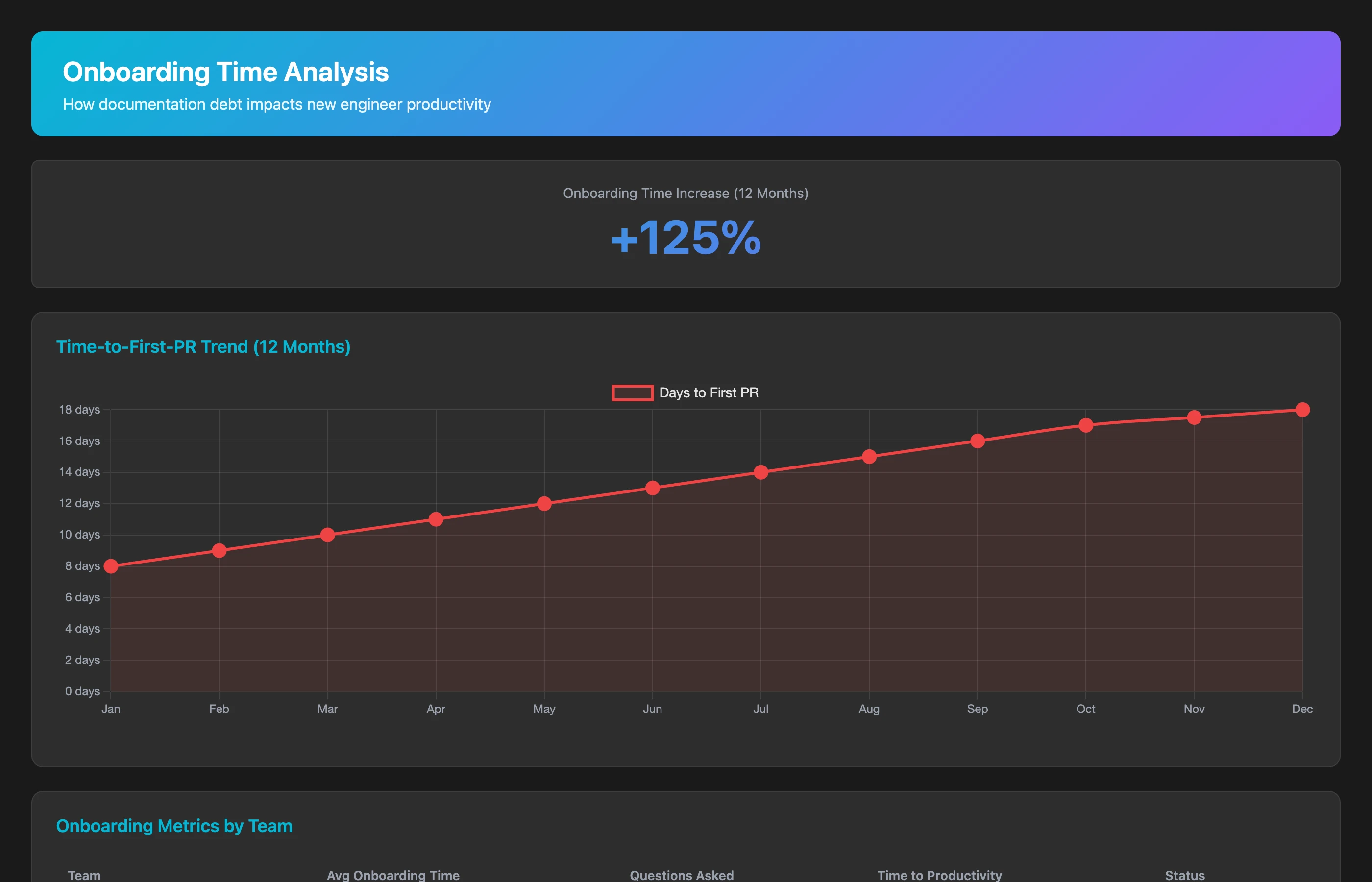
Analyze new engineer onboarding efficiency for the last 12 months. For each engineer whose first pull request appeared in that period, calculate: time from first PR opened to first PR merged, time to first non-trivial feature (PR over 200 lines), number of review comments and change requests received on their PRs during the first month, and comparison to team average. Show the trend over time (is onboarding getting faster or slower?) and identify teams with the longest onboarding times, indicating documentation debt.
Onboarding times increasing over time signal accumulating documentation debt. As the codebase grows more complex, documentation doesn't keep pace, forcing new engineers to reverse-engineer everything.
Identifying Undocumented System Components
Some parts of the system have decent documentation; others have none. Let's find the gaps:
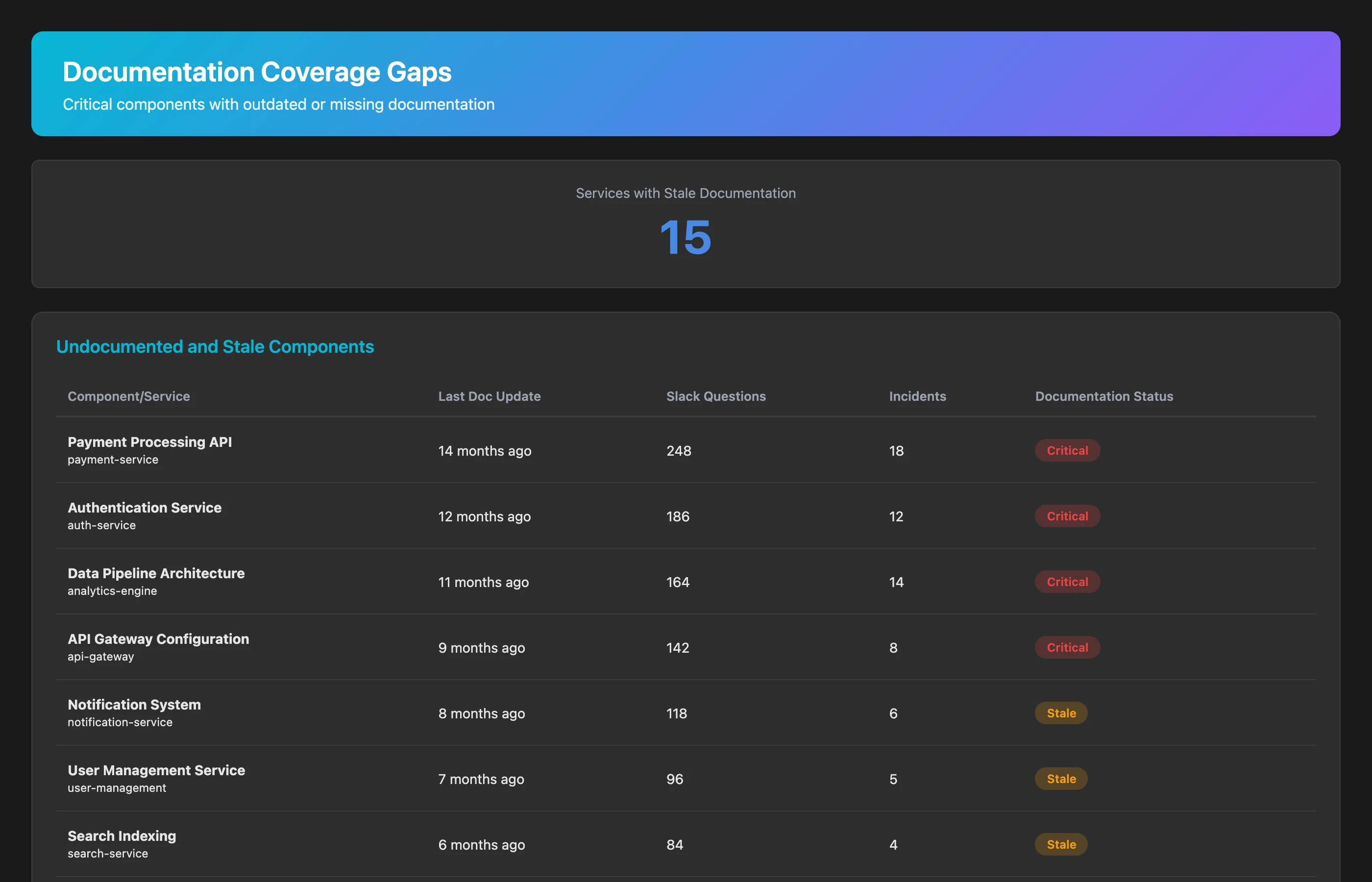
Analyze documentation coverage across our system architecture. For each major repository and service, check: when documentation was last updated (based on the last merged PR labelled "docs", with "docs" in its title, or with commits starting with "docs:"), knowledge concentration (share of PRs authored by the top 1-2 contributors), and incident frequency (issues labelled "incident" for this component, and their time to resolution). Flag components where documentation is over 6 months old or where incident resolution time suggests responders are reverse-engineering solutions each time.
Undocumented components create hidden taxes:
Every incident takes longer because responders start from zero knowledge
Every feature touching that component takes longer as engineers figure out how it works
Knowledge silos form where only 1-2 people understand critical systems
Correlating Documentation Freshness with Developer Productivity
Fresh documentation speeds development; stale documentation slows it:
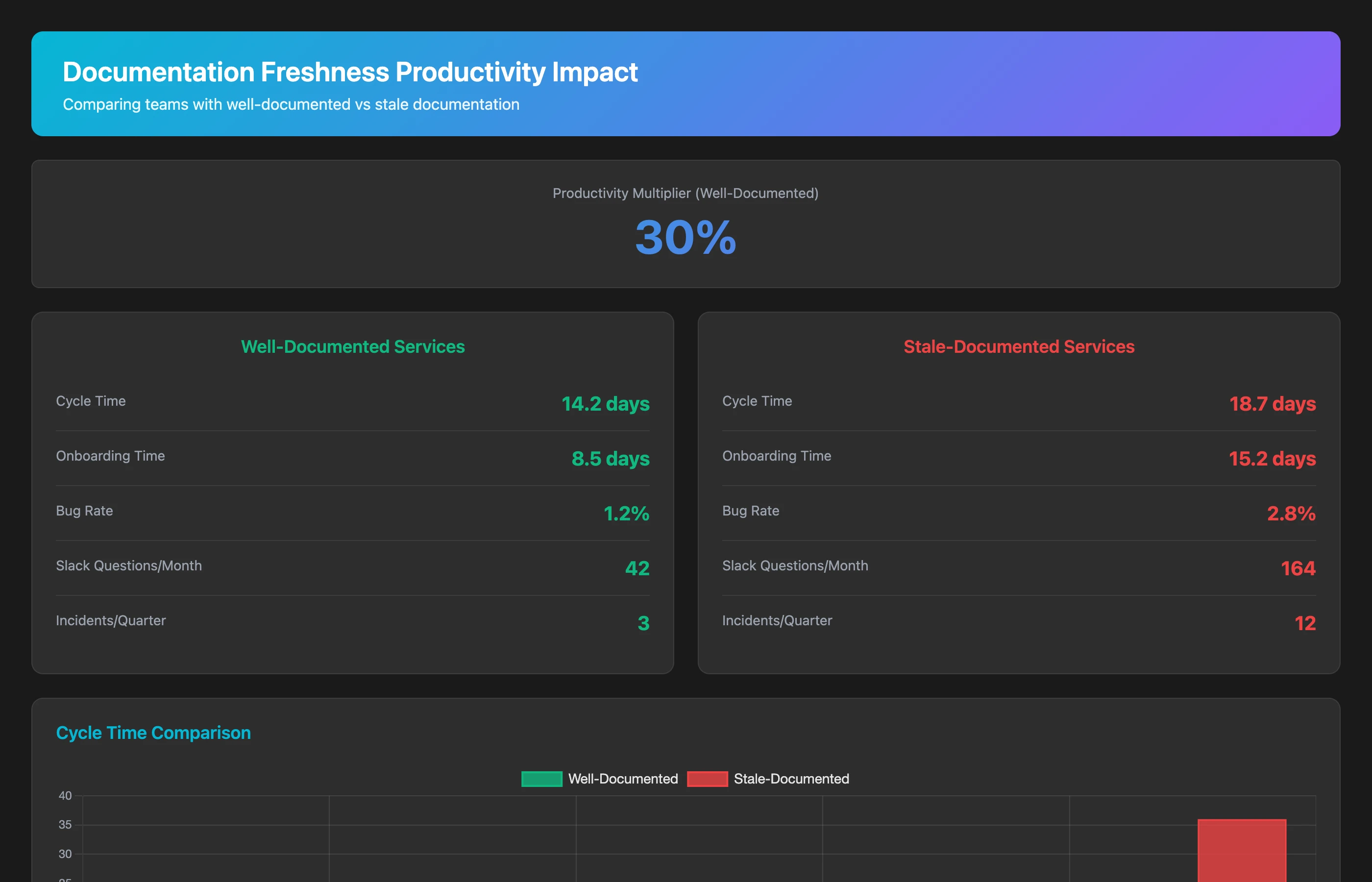
Correlate documentation freshness with developer productivity for Q2 2026. For repositories with active documentation (docs updated within 3 months) vs. stale documentation (docs not updated in over 6 months), compare: average cycle time for PRs, time to first merged PR for new contributors to that repository, number of review comments per PR, and bug rate. Use the documentation activity definition from the previous analysis (PRs labelled "docs" or "docs:" commits). Show the productivity multiplier for well-documented vs. poorly-documented codebases.
Well-documented codebases typically see 20-30% faster development cycles because developers spend less time figuring out "how does this work?" and more time building features.
Calculating Documentation Debt Cost
Quantify the hidden cost of missing and outdated documentation:
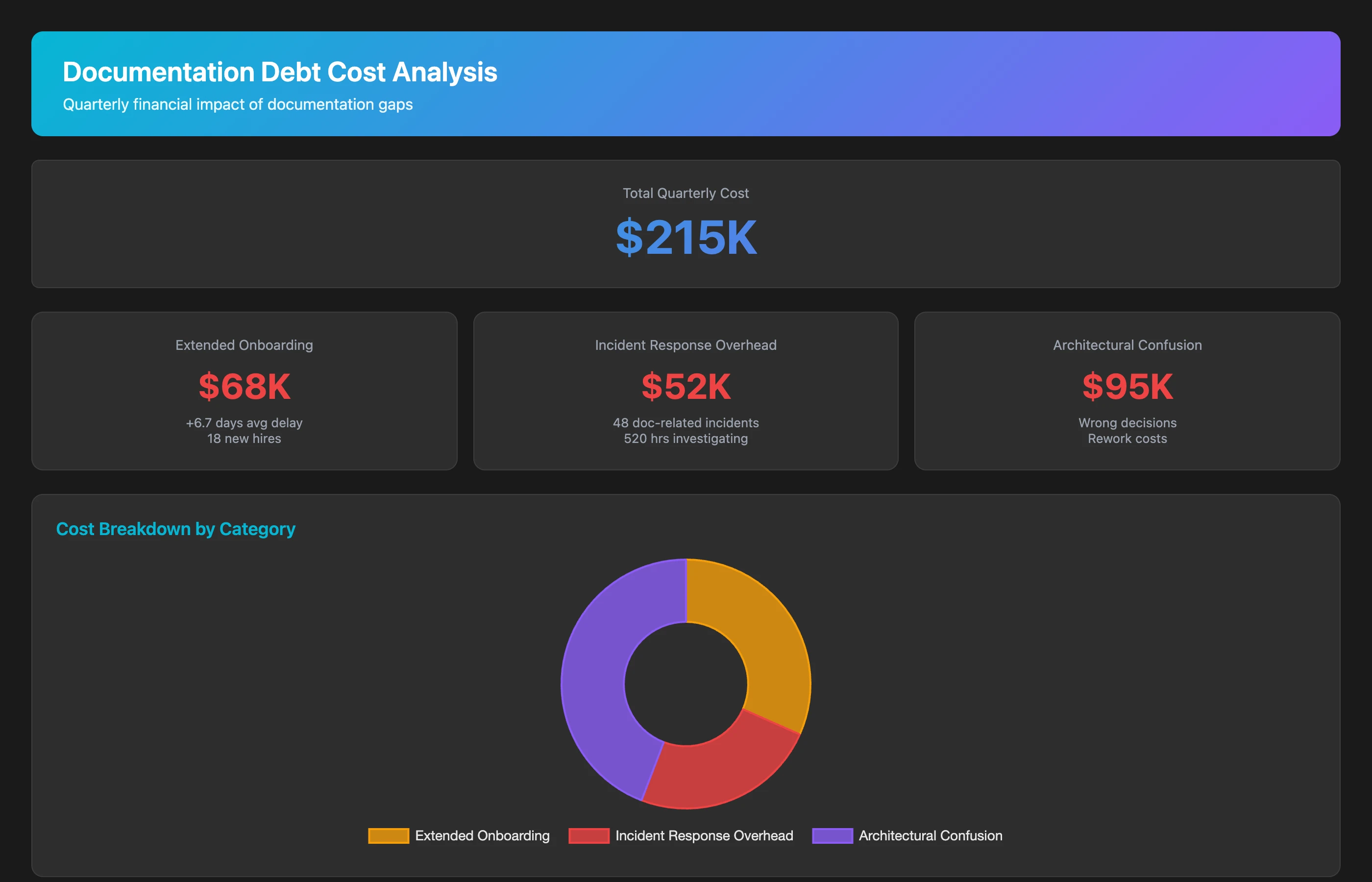
Calculate the cost of documentation debt for Q2 2026. Estimate: cost of extended onboarding time (extra weeks to first merged feature × number of new contributors × $125/hour), cost of repeated incident response discovery work (resolution time of issues labelled "incident" on poorly documented components, above the average for well-documented ones × number of incidents × $125/hour), cost of architectural confusion (PRs that received changes requested more than twice × rework time × $125/hour). Show total quarterly cost and annual projection.
Documentation debt typically costs 5-10% of engineering capacity through extended onboarding, repeated discovery work, and architectural confusion. For a 50-person team growing 20% annually, poor documentation costs 2.5-5 FTE in lost productivity.
The SDLC Debt Signals Keypup Measures Directly
Several of the analyses above combine Keypup data with figures from your CI tool. Some debt signals, however, are fully in Keypup's data and need nothing else:
PRs merged with a failed build: the build status your Git host reports on each pull request shows when the quality gate was bypassed
PRs merged without the required approvals: Keypup compares each PR's required approval count with the approvals it received (Bitbucket no longer exposes the required count, so use review counts there)
The share of work labelled tech-debt or bug: how much capacity goes to paying down debt and fixing defects, by team and over time
PR size: lines changed per PR, where large PRs signal review fatigue (not available for GitLab)
Activity events: status changes, reassignments and reopened issues that reveal churn in your workflow
AI-generated code volume: the AI Usage dataset (GitHub Copilot in production, with Claude Platform, OpenAI Platform and OpenAI Codex Enterprise in beta) shows how many lines AI assistants contribute, which you can set against PR size, review depth and bug-fix work to spot a new kind of code-volume debt
Give me an SDLC debt health check for Q2 2026 using Keypup data only. By team and repository, show: the percentage of PRs merged with a failed build, the percentage merged with fewer approvals than required, the share of merged PRs labelled "tech-debt" or "bug", the average PR size, and the number of issues reopened. Then show monthly AI coding assistant usage (active developers and lines accepted) next to average PR size and bug-fix share over the same period.
For a ready-made view of the compliance side, the Audit & Compliance dashboard template tracks the green build ratio, review coverage and PR compliance, and the AI Usage & Monitoring dashboard covers AI adoption next to pull request outcomes.
Prioritizing SDLC Debt Paydown: Where to Start
You've identified process debt, review debt, testing debt, and documentation debt. You've quantified the costs. Now comes the critical question: what should you fix first?
Not all technical debt is worth paying down. Some debt has low carrying costs and can be safely ignored. Other debt compounds rapidly and demands immediate attention. Let's use data to prioritize.
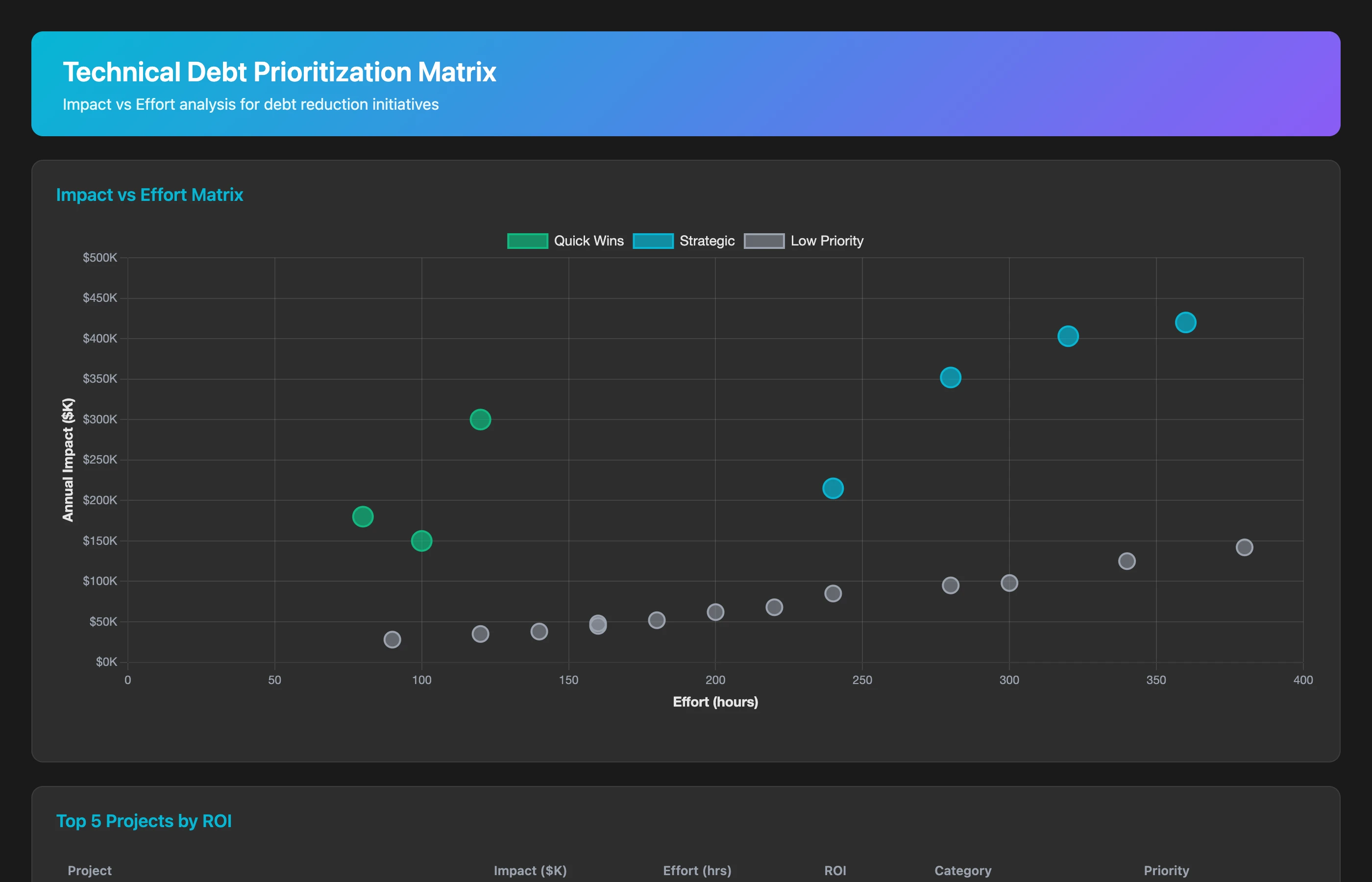
Creating a Debt Prioritization Matrix
Prioritize debt based on two factors: impact (cost to the organization) and ease of remediation:
Create a technical debt prioritization matrix for all SDLC debt issues identified in this conversation for Q2 2026, combining the Keypup analyses above with the CI figures I provided. For each issue (unreliable builds, slow test suite, rubber-stamp review pattern, undocumented component, etc.), calculate: annual cost impact ($), effort to remediate (engineering hours), ROI (annual savings / remediation cost), and velocity impact score (how much faster would we ship if this were fixed?). Rank issues by ROI and flag "quick wins" (high impact, low effort) and "strategic investments" (very high impact, moderate effort).
This prioritization matrix transforms debt paydown from "we should fix everything" to a rational, ROI-based roadmap. Fix quick wins first for momentum, then tackle strategic investments.
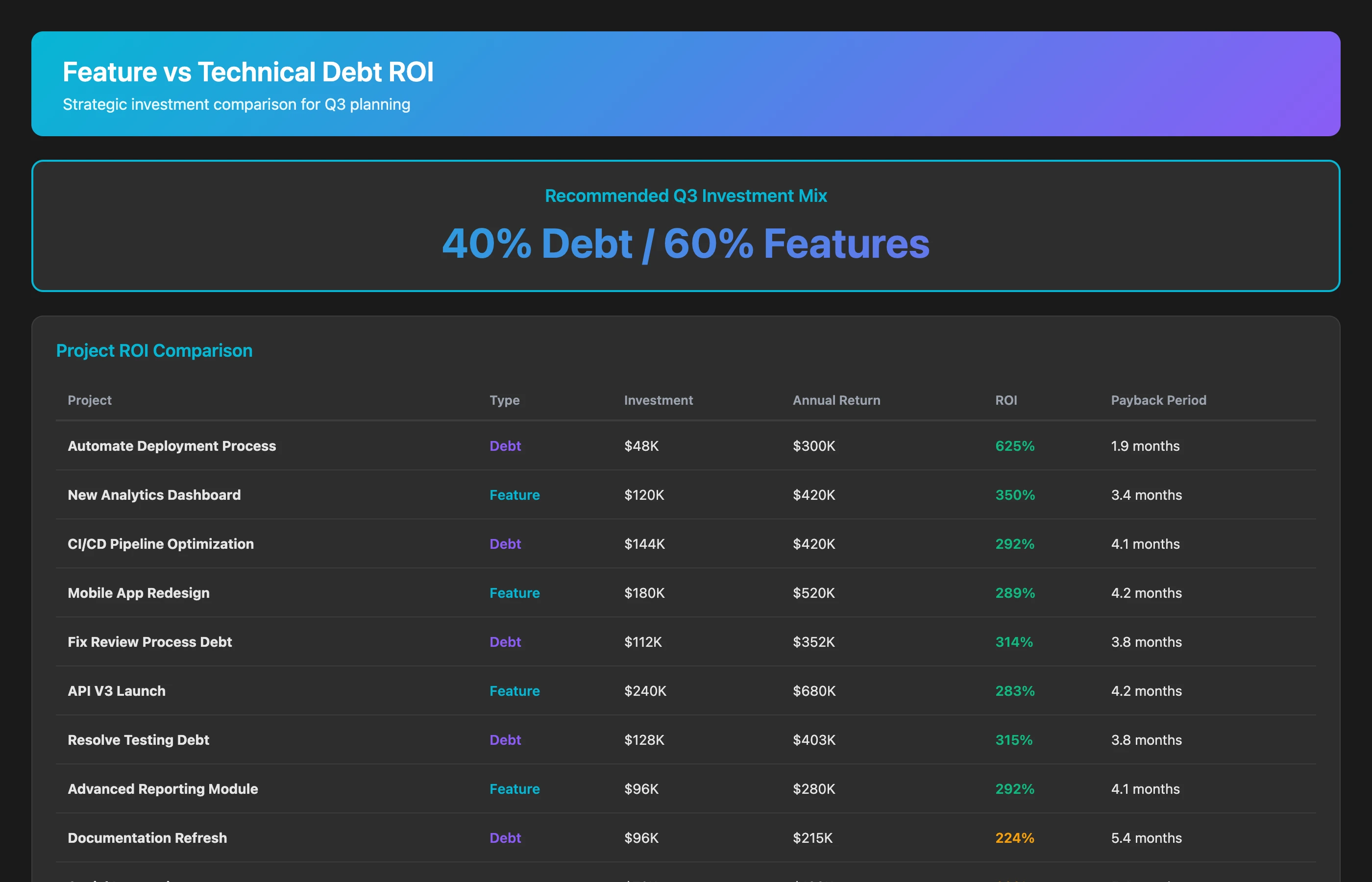
Comparing Debt Paydown ROI vs. Feature Work
The hardest trade-off: should we pay down debt or build new features? Let's quantify:
Compare ROI of technical debt paydown vs. new feature development for Q3 2026 planning. For proposed debt paydown projects (automate deployment, fix flaky tests, improve review process, update documentation), estimate: engineering effort required, velocity improvement, bug reduction, and annual cost savings. For proposed new features, estimate: engineering effort, expected revenue impact (from the estimates I'm providing), and strategic value. Calculate ROI for each initiative and create a recommended Q3 roadmap that balances velocity improvement (debt paydown) with business impact (features).
This analysis often reveals that a few strategic debt paydown projects (e.g., automating deployment) deliver higher ROI than marginal features. Data replaces opinion in the "feature vs. debt" debate.
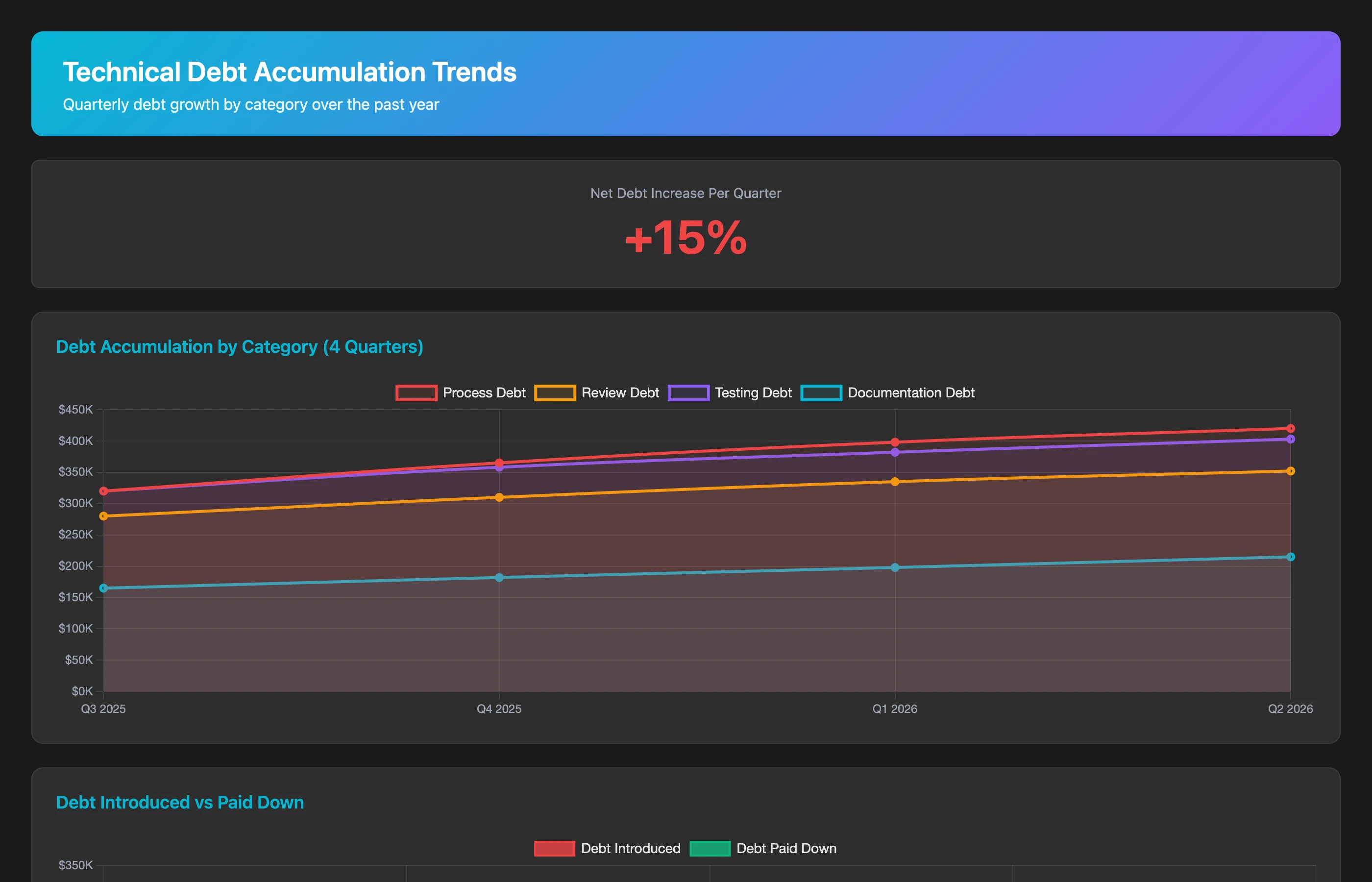
Tracking Debt Accumulation vs. Paydown Velocity
Monitor whether you're winning or losing the debt battle:
Track technical debt trend over the last 4 quarters. For each quarter, calculate: new debt introduced (issues labelled "tech-debt" created, PRs merged on a failed build, rubber-stamp review share, hotfix and revert PRs, repositories with no documentation PR for 6 months), debt paid down (tech-debt issues closed, refactoring and documentation PRs merged), and net debt change. Show the trend by debt category (process, review, testing, documentation) and flag categories where debt is accelerating. Is our debt accumulation rate faster than our paydown rate?
If debt accumulation outpaces paydown, you're slowly drowning. This metric should be reviewed quarterly at the engineering leadership level to ensure sustainable velocity.
Practical Implementation: Building a Debt Reduction Program
Understanding SDLC debt is only valuable if you act on it. Here's how to build a systematic debt reduction program using insights from Keypup MCP.
Establish Debt SLAs
Not all debt must be fixed immediately, but it shouldn't grow unbounded. Set Service Level Agreements for debt accumulation:
Flaky Tests SLA: No test with pass rate under 98% can exist for more than 2 weeks
CI/CD Performance SLA: No repository can have build times over 30 minutes
Review Quality SLA: No team can have rubber-stamp rate over 20%
Documentation Freshness SLA: Critical system documentation must be updated at least quarterly
Keypup has no alerting, so make the SLAs part of a routine: ask the Keypup AI Agent to build a debt dashboard tracking the review quality, build health and approval SLAs, review it in your weekly team meeting, and use your AI assistant with the MCP Server to dig into any breach. Track the flaky test and build time SLAs in your CI tool.
Allocate Debt Capacity
Reserve explicit engineering capacity for debt paydown:
15-20% of sprint capacity for debt work (not just feature development)
One engineer per team as "debt champion" responsible for tracking and prioritizing debt
Quarterly debt sprints where entire team focuses on paydown (no feature work)
Track debt capacity allocation using MCP (for example, the share of completed issues and merged PRs labelled "tech-debt") to ensure teams actually spend this time on debt, not let it get consumed by feature pressure.
Implement Debt Gates
Prevent new debt from accumulating by creating quality gates:
PR merge gates: PRs cannot merge if they introduce flaky tests or skip code review
CI/CD gates: Build time increases over 20% trigger mandatory investigation
Documentation gates: New services cannot launch without documentation meeting standards
These gates are enforced in your Git host and CI (branch protection, required reviews and status checks). Use Keypup to verify that they hold: the Audit & Compliance dashboard tracks PRs merged with a failed build or without review, and the MCP Server answers on demand when you want to investigate a violation, such as PRs merged with fewer approvals than required.
Celebrate Debt Paydown Wins
Make debt paydown visible and rewarded:
Quarterly debt reduction reports showing cost savings from debt paydown
Recognition for high-impact debt fixes (e.g., engineer who fixed 10 flaky tests)
Velocity improvements attributed to debt paydown to demonstrate business value
Use the MCP Server to draft these reports on demand from Keypup data and your cost figures, and keep the recurring metrics on a Keypup dashboard built by the AI Agent, quantifying the business impact of debt work so it's valued as much as feature development.
Connect Your AI Assistant to Keypup
The Keypup MCP Server (https://hq.keypup.io/mcp) works with Claude, ChatGPT, VS Code, Cursor and other MCP-compatible AI assistants. Connecting takes one click with OAuth (API tokens remain available), and the MCP Setup page in the Keypup sidebar gives step-by-step instructions for each client. The server is read-only: it answers questions with your Keypup data and never changes anything. Use your team's AI Instructions to define your debt vocabulary (which labels mean tech debt, what counts as toil, your hotfix and incident conventions) so every conversation applies it. Learn more on the Keypup MCP Server page and in the Using the MCP server documentation.
Conclusion: Transforming Technical Debt from Burden to Strategic Advantage
Technical debt isn't just code—it's embedded in every aspect of your software development lifecycle. Process debt from manual workflows. Review debt from superficial code reviews. Testing debt from flaky test suites. Documentation debt from knowledge that lives in Slack threads.
These hidden debts compound into massive costs: 15-25% of engineering capacity lost to process toil, 10-15% lost to review inefficiencies, 8-12% lost to testing problems, and 5-10% lost to documentation gaps. For a 50-person engineering team, that's 19-32 FTE worth of productivity consumed by SDLC debt instead of building product value.
The challenge has always been visibility. Unlike code debt that triggers compiler warnings, SDLC debt is invisible to traditional metrics. Slow deployments feel normal. Rubber-stamp reviews become culture. Flaky tests become accepted. Documentation rot goes unnoticed until a crisis hits.
Keypup MCP Server changes this by analyzing comprehensive SDLC data and making the invisible visible. Combined with the deployment and CI figures you bring, instead of vague complaints about "deployment is painful," you get "our deployment process costs $380K annually and automation would save $300K/year." Instead of debates about whether to build features or fix tests, you get ROI calculations showing that fixing build reliability delivers 4× better ROI than building feature X.
This transforms technical debt from a morale problem ("we should clean this up someday") into a strategic asset. Teams that systematically identify, measure, and pay down SDLC debt don't just move faster—they move sustainably faster, with quality improving rather than degrading over time.
The organizations that win the next decade of software development won't be those who accumulate the least debt (impossible in any fast-moving engineering culture). They'll be the organizations that measure debt systematically, prioritize paydown ruthlessly, and maintain sustainable velocity by keeping SDLC debt within manageable bounds.
Start measuring your SDLC debt today. Use Keypup MCP to quantify the costs hiding in your processes, reviews, tests, and documentation. Then build a systematic debt reduction program that balances feature velocity with sustainable quality.
Your codebase isn't the only thing accumulating debt. Your entire development lifecycle is. It's time to measure it, manage it, and use it as a competitive advantage.
Ready to Transform Your Analytics?
Join teams already using AI to make data-driven decisions faster than
ever.
Velocity looks fine, until your best engineers quit. Learn what engineering leaders on Reddit say about after-hours commits, weekend work and burnout at enterprise scale, and how Keypup MCP uses commit, review and merge timestamps to measure how much work happens outside working hours, where it concentrates, who is overloaded without naming anyone, and what it costs in skipped reviews.
Your median cycle time looks healthy, yet every release still ends in merge conflicts, rebases and big-bang reviews. Learn what engineering leaders on Reddit say about long-lived branches and the trunk-based vs GitFlow debate at enterprise scale, and how Keypup MCP uses pull request dates, target branches, commits, reviews and mergeability to measure branch lifetime, find where branches live longest and land aging work before it drifts into conflict.
Compare the 6 best engineering metrics tools for multi-team benchmarking in 2026 — Keypup, LinearB, Swarmia, Jellyfish, Faros and Appfire Flow — on cross-team benchmarking, org-level rollups, DORA Metrics, Git-to-ticketing linking, custom KPIs, AI capabilities and data security. See how to compare teams on equal terms and find where your delivery process is broken.