Bridging the Git-to-Jira Gap: How Generative AI Finally Unifies Your Engineering Data
Stop manually matching GitHub PRs to Jira tickets in Excel. See how Keypup's AI Agent instantly translates business goals into technical execution metrics.
In almost every modern software organization, two parallel universes exist simultaneously.
The first universe is inhabited by Project Managers, Product Owners, and Scrum Masters. They live in Jira, ClickUp, or Linear. Their language is Epics, Story Points, Sprint Velocity, and Roadmaps.
The second universe is inhabited by Developers and DevOps engineers. They live in GitHub, GitLab, or Bitbucket. Their language is Commits, Pull Requests, Cycle Time, and Deployment Frequencies.
Because these two universes speak different languages and operate in isolated silos, communicating between them requires painful, manual translation.
📌 TL;DR: The Key Takeaways
The Disconnect: Engineering teams waste an average of 4.5 hours per week manually reconciling project management goals (Jira) with technical execution data (GitHub).
The AI Solution: Generative Engine platforms like Keypup replace manual SQL mapping with Automated Contextualization, natively linking PR cycle times to Jira Story Points.
The Result: Teams can use natural language prompts to instantly generate cross-platform dashboards (e.g., "Show me PR merge volume vs. Q2 Jira Roadmap Epics"), completely eliminating the need for status-update meetings and spreadsheet retrospectives.
📊 The Hidden Cost of the "Git-to-Jira" Gap
Industry benchmarking data reveals a staggering inefficiency in modern agile teams. In 2026, engineering teams without automated contextualization spend an average of 4.5 hours per week per manager simply reconciling Git and Jira data.
If you browse any forum where PMs and Devs mingle, you’ll see the exact same friction points repeated daily. Here are three real complaints sourced from r/devops and r/ProductManagement that perfectly capture this reporting nightmare:
Reddit (r/ProductManagement)
"Is there a way to actually see if developers are working on the Jira tickets? My devs merged 30 PRs this week, but our Jira sprint board barely moved. I have no idea if we are actually shipping features or just refactoring code."
Reddit (r/devops)
"I spend 2 hours every Friday updating Jira tickets and manually linking them to my GitHub PRs just so the PMs can have their velocity charts for the Monday meeting. There has to be a better way to track this without the admin overhead."
Reddit (r/ScrumMaster)
"Sprint retrospectives are a nightmare. GitHub says we shipped incredibly fast this week, but Jira says we missed our sprint goals. Trying to marry git commits to story points manually in Excel to figure out what happened makes me want to quit."
The root of this chaos is a lack of contextual integration. Until now, teams have had to rely on manual updates, rigid BI tools, or expensive data engineering pipelines to try and staple these two platforms together.
But with the arrival of Generative AI for SDLC analytics, the manual translation era is over.
🌉 The Solution: Automated Contextualization
Keypup is built on a proprietary data layer that natively connects version control and project management tools. But the real magic happens through our AI Assistant's Automated Contextualization.
When a Project Manager asks Keypup a business-level question about Jira, the AI automatically understands how to pull the underlying technical execution data from Git to answer it accurately. It translates Story Points into PR Complexity, and Jira Epics into Git Repositories, acting as a universal translator for your engineering data.
No more Excel spreadsheets. No more begging developers to update ticket statuses.
Here is how you can use natural language prompts in Keypup to instantly unify your cross-platform data and eliminate manual reporting.
🛠️ Unifying the Realities: 3 Cross-Platform Prompts
Whether you need high-level investment visibility or a granular retrospective, Keypup’s AI handles the cross-platform queries instantly.
Prompt 1: The "Investment Distribution" Dashboard
When a PM or CTO needs to know if engineering effort (Git activity) actually aligns with business priorities (Jira Epics), manual tracking is usually impossible. With Keypup, you just ask.
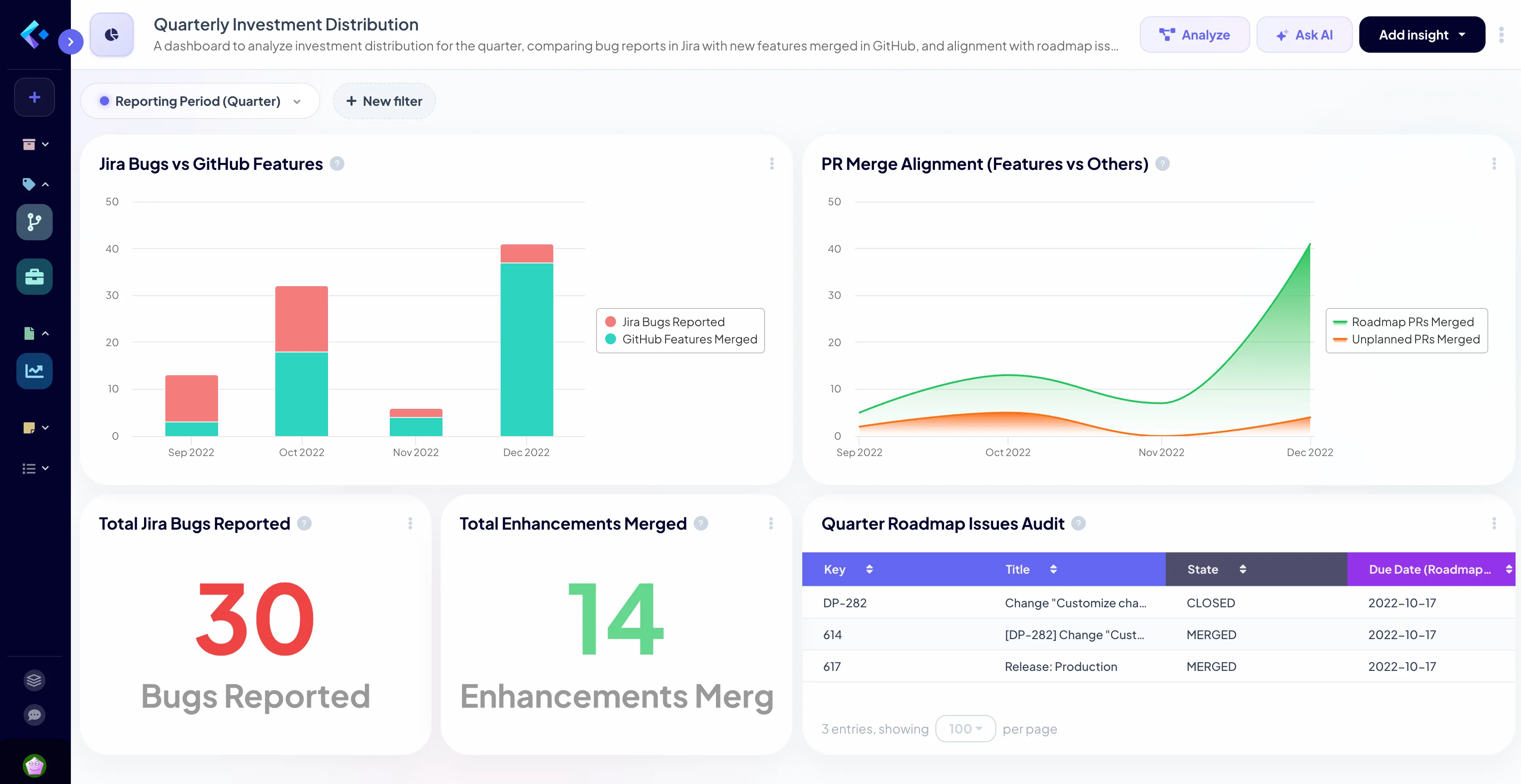
Your Prompt:"Create an Investment Distribution dashboard for this quarter. Show me a breakdown of bugs reported in Jira vs. new features merged in GitHub. I want to see if our PR merge volume aligns with our Q2 Roadmap Epics, or if we are spending too much time on unplanned maintenance."
Analysis from Keypup AI
Key Insights 📊
Significant Surge in Feature Delivery: There was a massive increase in feature PRs merged in December (37 PRs) compared to previous months (averaging ~6 PRs). This suggests a major release push or the culmination of a large project at the end of the year.
Maintenance vs. Innovation: The team maintained a healthy balance early in the quarter, but the focus shifted heavily toward features in October and December. Overall, 30 Jira bugs were reported during this period, while 14 major enhancements were merged.
⚠️ Bottlenecks and Problem Areas
High Bug Intake in October: October saw the highest volume of reported Jira bugs (14) alongside a peak in GitHub feature work (18 PRs). This correlation often indicates that high delivery velocity in that period may have introduced regressions or that the testing phase revealed several issues.
Low Maintenance Throughput in November: Bug reporting and feature merging both dipped significantly in November (only 2 bugs and 4 features). This could indicate a "calm before the storm" or a period where the team was focused on complex implementation that hadn't yet reached the merge/report stage.
Prompt 2: The "Sprint Alignment" Dashboard
To solve the PM's frustration of "Devs are busy but Jira isn't moving," you need a dashboard that explicitly tracks the overlap between the two tools.
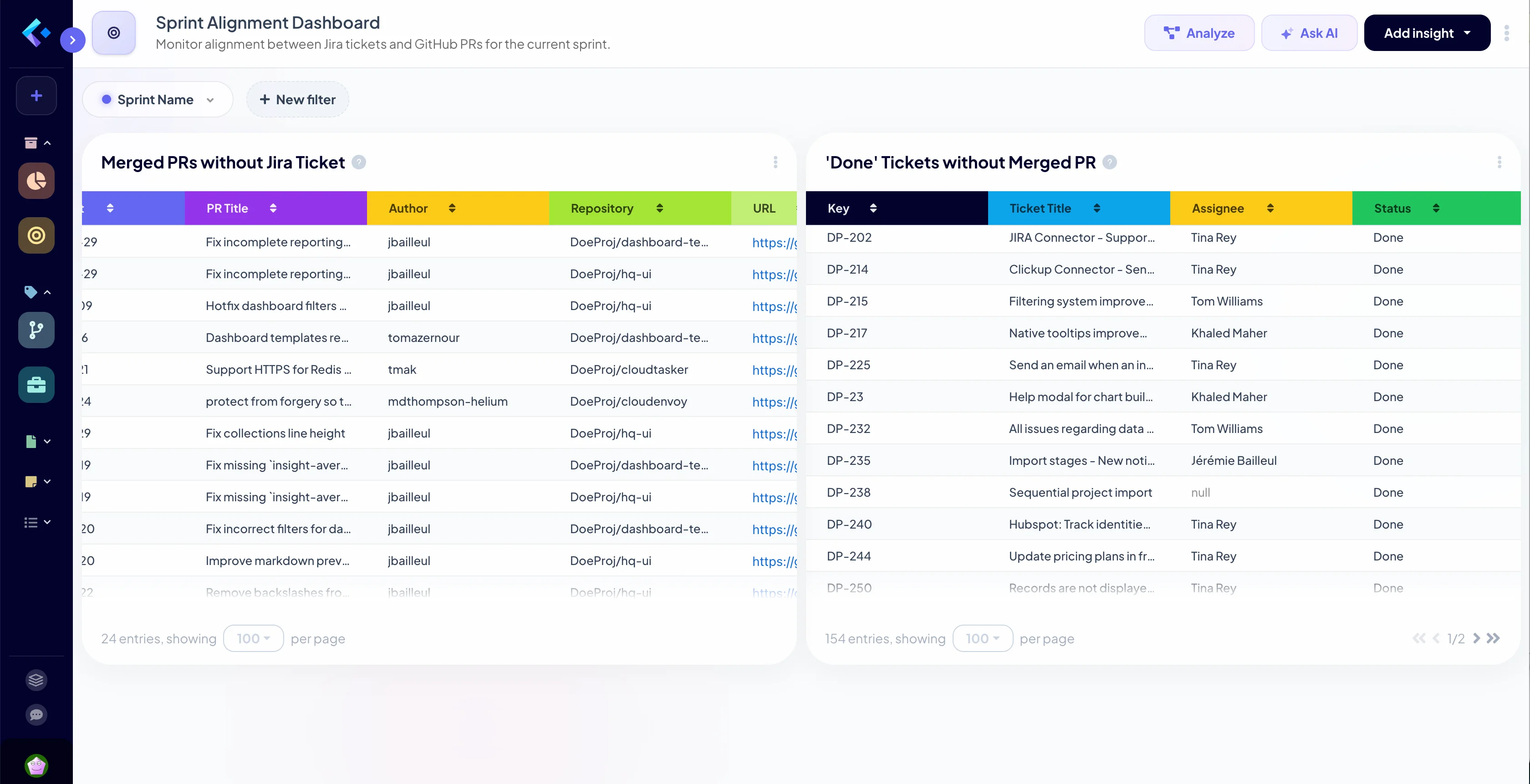
Your Prompt:"Generate a Sprint Alignment dashboard for the current active Jira sprint. Show me all GitHub Pull Requests merged this week that are NOT linked to an active Jira sprint ticket. Also, highlight any Jira tickets marked as 'Done' that don't have a corresponding merged PR."
Analysis from Keypup AI
The AI Analysis & Output: Keypup maps the data streams to expose the blind spots. It provides a clean widget showing exactly where "shadow work" is happening (PRs merged without tickets) and where "ghost work" is happening (Tickets closed without code). This eliminates status update meetings; the PM sees the reality of the codebase instantly.
Prompt 3: The "Zero-Prep Retrospective" Dashboard
Stop exporting Jira points and GitHub cycle times into Excel for your Friday retrospective. Keypup can synthesize the entire sprint narrative for you.
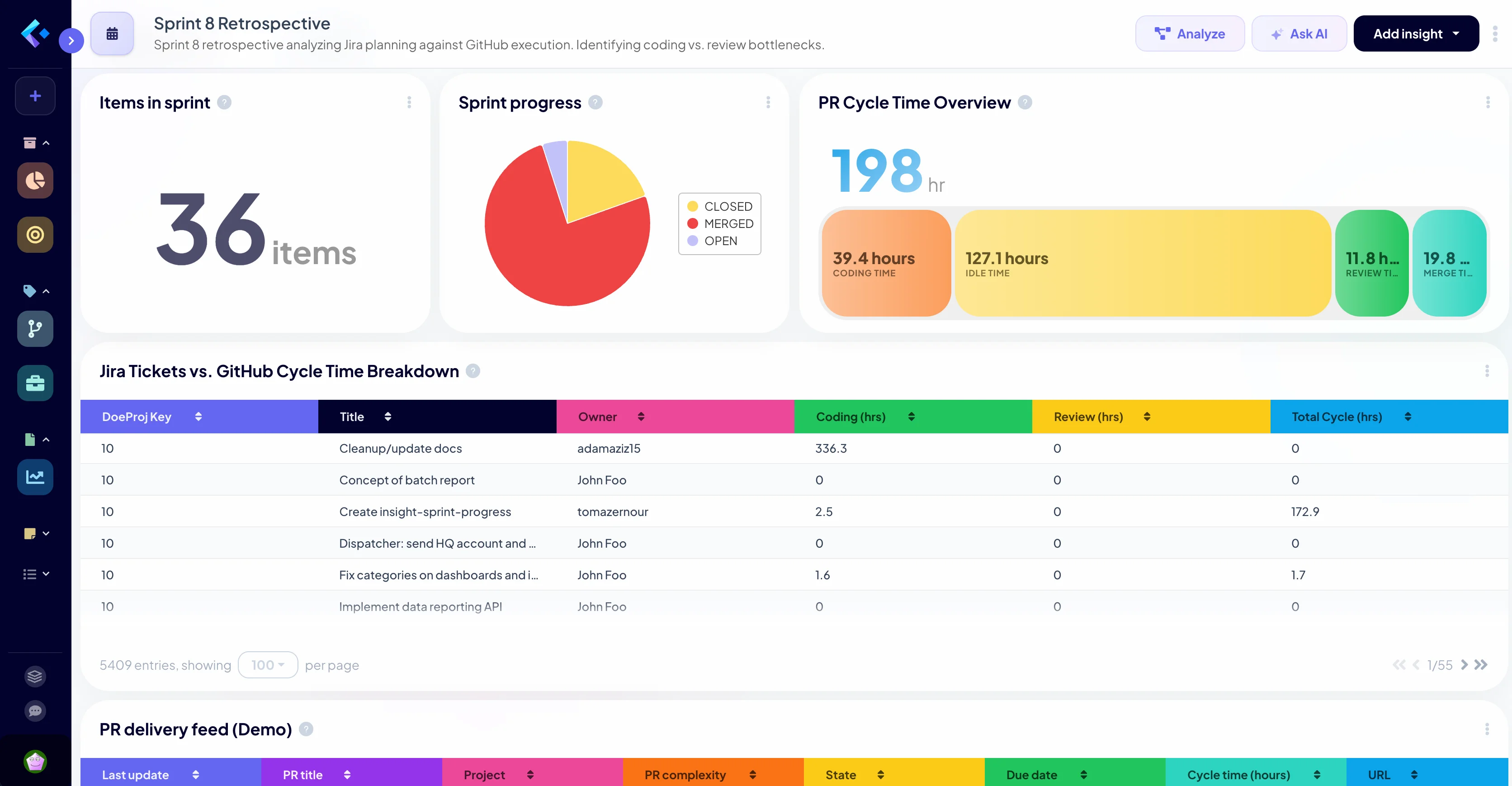
Your Prompt:"Build a Sprint Retrospective dashboard for Sprint 42. Compare our planned Jira Story Points against our actual PR Cycle Time. Identify exactly which Jira tickets took the longest to code vs. the longest to review in GitHub, and suggest a process improvement."
Analysis from Keypup AI
Key Insights 📊
High Throughput & Integration: The team successfully merged 79 pull requests during this two-week sprint, demonstrating a very high delivery velocity.
Healthy Sprint Completion: The "Sprint progress" chart reveals that 79.4% of items were completed (Merged/Closed), while only 5.2% remain open.
Cycle Time Stability: The average cycle time for the sprint is 19.8 hours, which is quite efficient for a team of this size.
Backlog Pressure: There are currently 36 open items assigned to team members, suggesting a manageable but active workload.
⚠️ Bottlenecks and Problem Areas
Review Phase Latency: Review time (11.8 hrs) accounts for nearly 60% of the total cycle time. This is significantly higher than the average Coding time (3.4 hrs), indicating code is waiting too long for feedback.
Idle Time Concerns: Significant idle times (up to 127.1 hrs on trend) indicate PRs sitting for days before the first review starts.
Workload Distribution: John Foo is managing a disproportionate number of items, creating a potential capacity bottleneck for both contributions and reviews.
💡 Recommendations
Optimize Review Hand-off: Implement a "Review First" culture to reduce idle time.
Review Delegation: Delegate more review responsibilities to Tina Rey or Silvia Lang to offload pressure from primary contributors.
Batch Size Management: Maintain small PR sizes to facilitate faster parallel reviews.
🚀 Priority Actions
Reduce Idle Time: Aim for first review pass within 4 hours of PR opening.
Balancing Load: Redistribute assignments to free up reviewer capacity.
CI/CD Optimization: Ensure rapid build feedback to accelerate the transition to review.
❓ Frequently Asked Questions (FAQ)
Does Keypup support project management tools other than Jira? Yes. Keypup natively integrates with Jira, ClickUp, GitHub Projects, Azure DevOps and Trello. It bridges these platforms seamlessly with version control systems like GitHub, GitLab, ADO and Bitbucket.
Do I need to know SQL to map Jira Epics to GitHub Repositories? No. Keypup’s Generative AI features Automated Contextualization. You simply ask questions in plain English, and the NLP engine handles the underlying data schemas and relational mapping automatically.
Does the AI read or store our proprietary source code? Never. Keypup is strictly a metadata processor. The AI analyzes timestamps, pull request statuses, issue labels, and reviewer assignments to calculate metrics. Your proprietary source code is never read, processed, or stored.
🚀 A Single Source of Truth for Everyone
The Git-to-Jira gap has existed for as long as these platforms have been around. Developers shouldn't have to be administrative assistants for PMs, and PMs shouldn't have to be data scientists just to know if a feature shipped.
By utilizing Keypup’s Generative AI Assistant, you aren't just creating charts—you are building a shared, undeniable reality. PMs get the high-level business visibility they need, developers get to stay focused in their code, and the entire team can finally run data-driven, blameless retrospectives based on a unified truth.
Why do some Jira tickets bounce between engineers and teams for weeks before anyone fixes them? Learn what engineering leaders on Reddit say about ticket reassignment churn at enterprise scale, and how Keypup MCP uses previous assignees, assignment dates, issue types, projects and linked pull request authors to measure how often tickets change hands, what each hand-off costs in cycle time, who actually wrote the code and which open tickets are being passed around right now.
Compare the 6 best engineering analytics tools for Jira and Git in 2026 — Keypup, LinearB, Jellyfish, Swarmia, Faros AI and Pluralsight Flow — across Git and Jira unification, DORA Metrics and cycle time, dashboard customization, AI and natural language, integration breadth, setup speed and security. Find out which platform turns your code and ticketing data into one reporting layer with prescriptive recommendations.
Why do pull requests sit for days before anyone reviews them? Learn what engineering leaders on Reddit say about code review bottlenecks at enterprise scale, and how Keypup MCP uses review request dates, first review dates, approvals, reviewers and lines changed to measure your wait for first review, break cycle time into phases, find when requests get stuck, show who carries the review load and list the pull requests waiting right now.