Automating R&D Capitalization & Tax Credits with Git Data: A CTO’s Guide
📌 Executive Summary for Engineering Leaders:
- The Conflict: Finance teams require granular "effort hours" for tax compliance (SR&ED, R&D Tax Relief, ASC 985), while Engineering teams view manual time tracking as a primary "Developer Experience" (DevEx) killer.
- The Solution: Shift from subjective estimates (time cards) to objective metadata (Git commits, PRs, and Jira transitions).
- The Implementation: Classify work at the Epic level, correlate with Git activity, and use Engineering Intelligence to generate audit-proof R&D capitalization reports.
- The Outcome: Millions of dollars in tax savings, zero manual time tracking, and total audit transparency.
1. The Invisible Tax on Engineering Organizations
As CTOs, we are primarily measured by our ability to ship innovative products. Yet, every year, a "tax" is levied on our most talented engineers. This isn't a government tax; it is the administrative tax of manual time tracking.
Whether your company is pursuing SR&ED in Canada, R&D Tax Relief in the UK, or ASC 350-40 (Internal-Use Software) capitalization in the US, the requirement is the same: You must prove exactly how much time your team spent on "innovative research and development" versus routine maintenance.
Historically, this meant forcing developers to fill out weekly time-sheets—a practice that is notoriously inaccurate, universally hated, and fundamentally incompatible with the fluid nature of modern Agile development.
At Keypup, we realized that the "Ground Truth" for R&D isn't found in a spreadsheet; it’s found in the Git metadata. Every commit, every pull request, and every code review is a digital fingerprint of innovation. By automating the extraction of this data, we can satisfy Finance without ever interrupting a developer’s flow.
2. Why Manual Time Tracking is a Risk, Not a Resource
If you are still relying on developers to manually log hours against Jira tickets, your R&D tax claim is built on sand.
The Accuracy Gap
Developers rarely log time in real-time. Usually, they "guess" on Friday afternoon or at the end of the month. This leads to "Smoothing," where hours are evenly distributed across tickets to look compliant, rather than reflecting the actual intensity of R&D work.
The Audit Risk
Tax authorities (like the IRS, HMRC, or CRA) are becoming increasingly sophisticated. They no longer accept high-level estimates. They want to see contemporaneous evidence. If your time-sheets claim 100 hours of R&D but your GitHub logs show zero activity on those dates, your claim will be rejected.
The DevEx Impact
Top-tier engineering talent values autonomy and focus. Forcing them into "Time-Tracking surveillance" signals a lack of trust and creates unnecessary cognitive friction. In a market where developer retention is key, removing time-sheets is a massive competitive advantage.
3. The Regulatory Framework: ASC 985, ASC 350-40, and SR&ED
To automate capitalization, we first must understand the stages of software development that qualify. Accounting standards generally divide software development into three phases:
- Preliminary Project Stage: Researching alternatives, evaluating technologies. (Usually expensed, not capitalized).
- Application Development Stage: Coding, hardware installation, testing. (This is the "Gold Mine" for R&D tax credits and capitalization).
- Post-Implementation/Operation Stage: Training, routine maintenance, bug fixes. (Expensed).
The challenge for the CTO is to objectively separate Phase 2 from Phase 3. Keypup solves this by creating a direct link between the Jira issue type and the Git activity duration.
Automating this process requires a three-tier mapping strategy: Classification, Correlation, and Calculation.
Step A: Classification (Jira/Linear Layer)
We ensure that every Epic or Story is categorized by its "R&D Eligibility."
- Eligible: New Feature Development, Architecture Refactoring, Performance Optimization.
- Ineligible: Bug Fixes, Support Tickets, Security Patches, Technical Debt (Maintenance).
Step B: Correlation (The Git Layer)
Keypup unifies your Git repositories with your project management tools. We don't just look at when a ticket was "Done"; we look at the Active Development Period:
- The moment the first branch was created for that ticket.
- The frequency and volume of commits.
- The intensity of the Pull Request review cycle.
Step C: Calculation (The Intelligence Layer)
By aggregating this data, Keypup calculates the Effort Share. If your team performed 1,000 "Coding Events" this month and 750 were linked to "Eligible" Epics, Finance can confidently capitalize 75% of the engineering payroll for that period.
5. 5 examples of AI Agent Prompts for Audit-Ready R&D Reporting
With Keypup's AI Agent, CTOs no longer need to build these reports manually. You can simply query your SDLC data in plain English to generate the evidence needed for Finance.
🤖 AI Prompt 1: The High-Level R&D Split
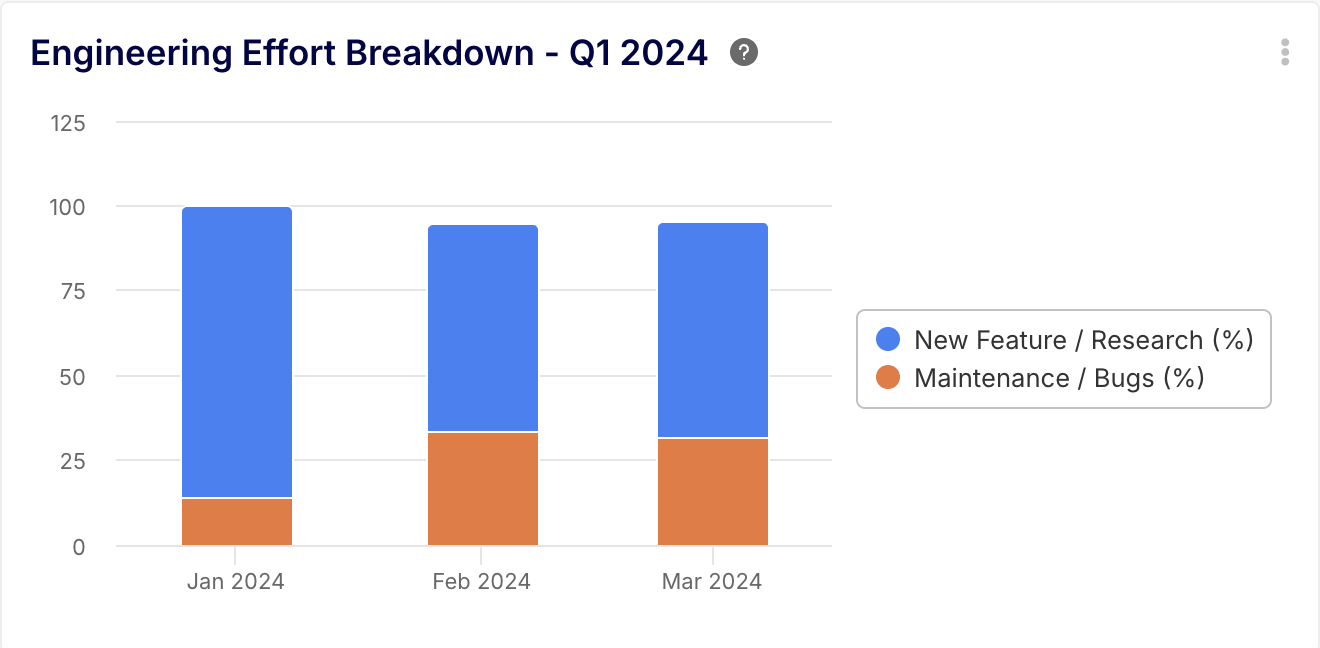
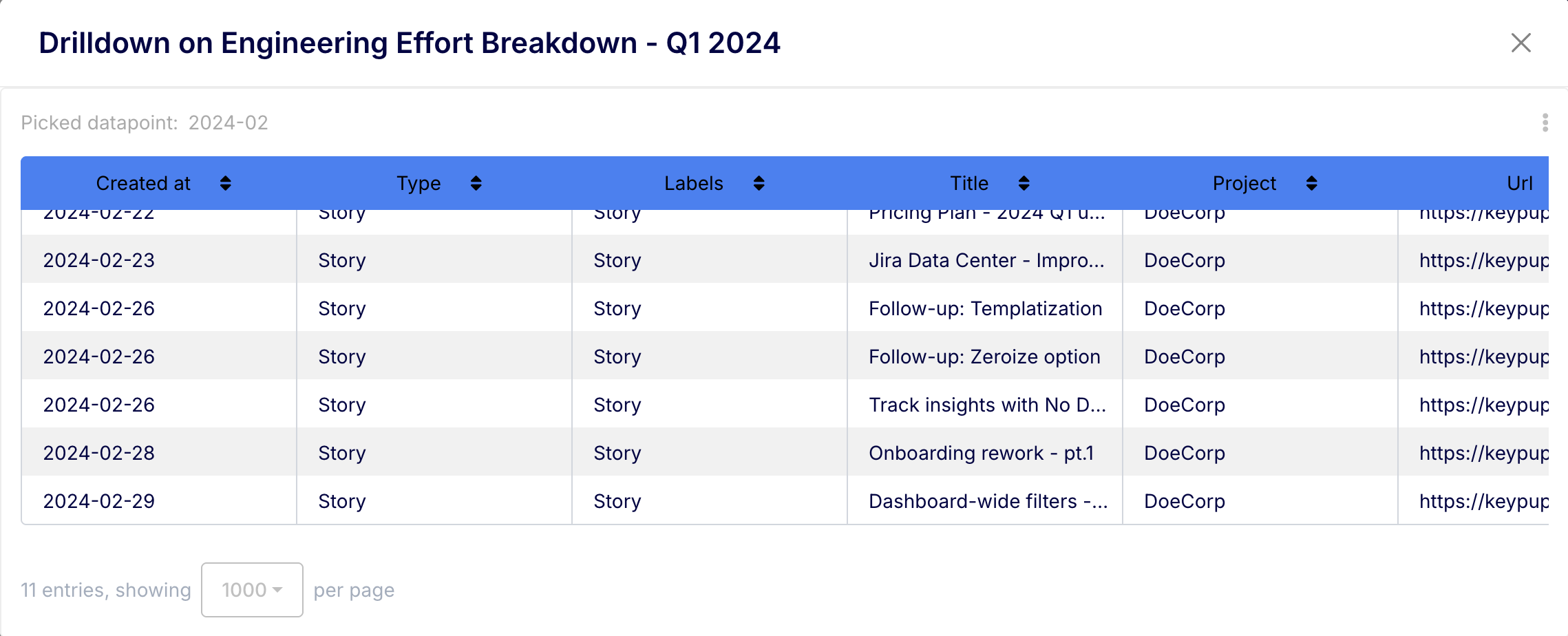
"Calculate the percentage of total engineering effort spent on 'New Feature' and 'Research' Epics vs. 'Maintenance' and 'Bugs' across all repositories for Q1. Present this as a monthly breakdown."
🤖 AI Prompt 2: Contemporaneous Audit Evidence
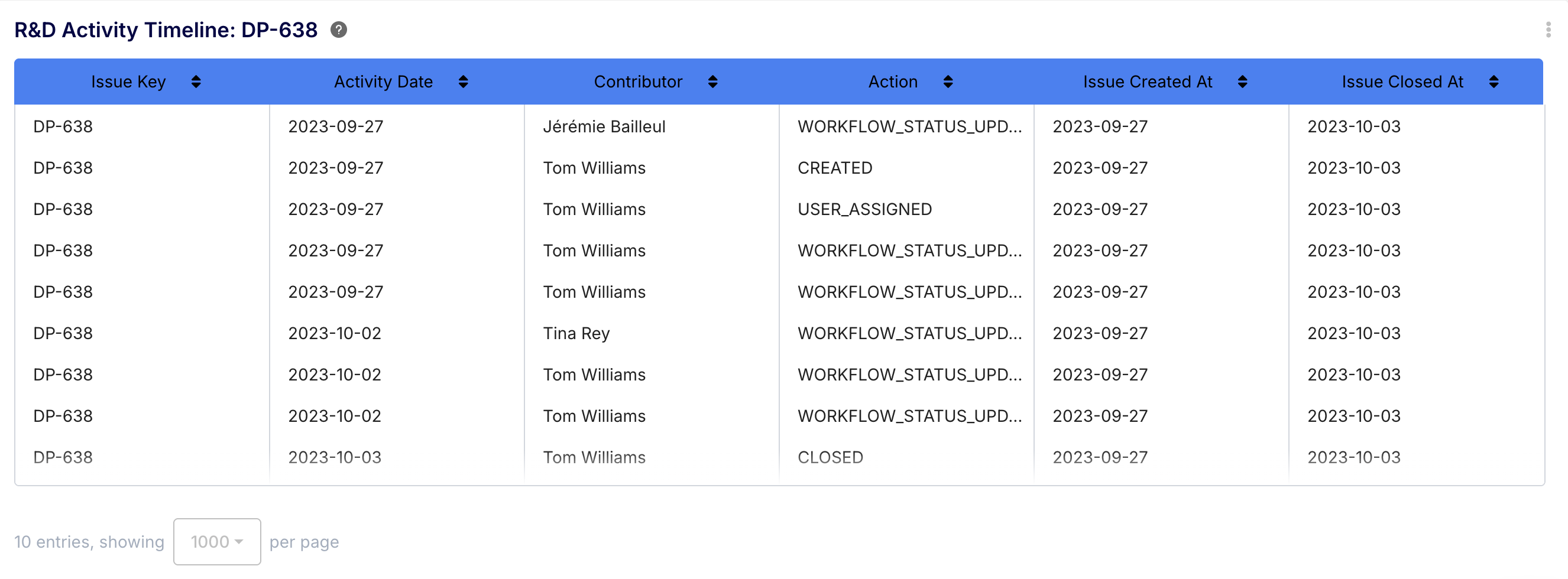
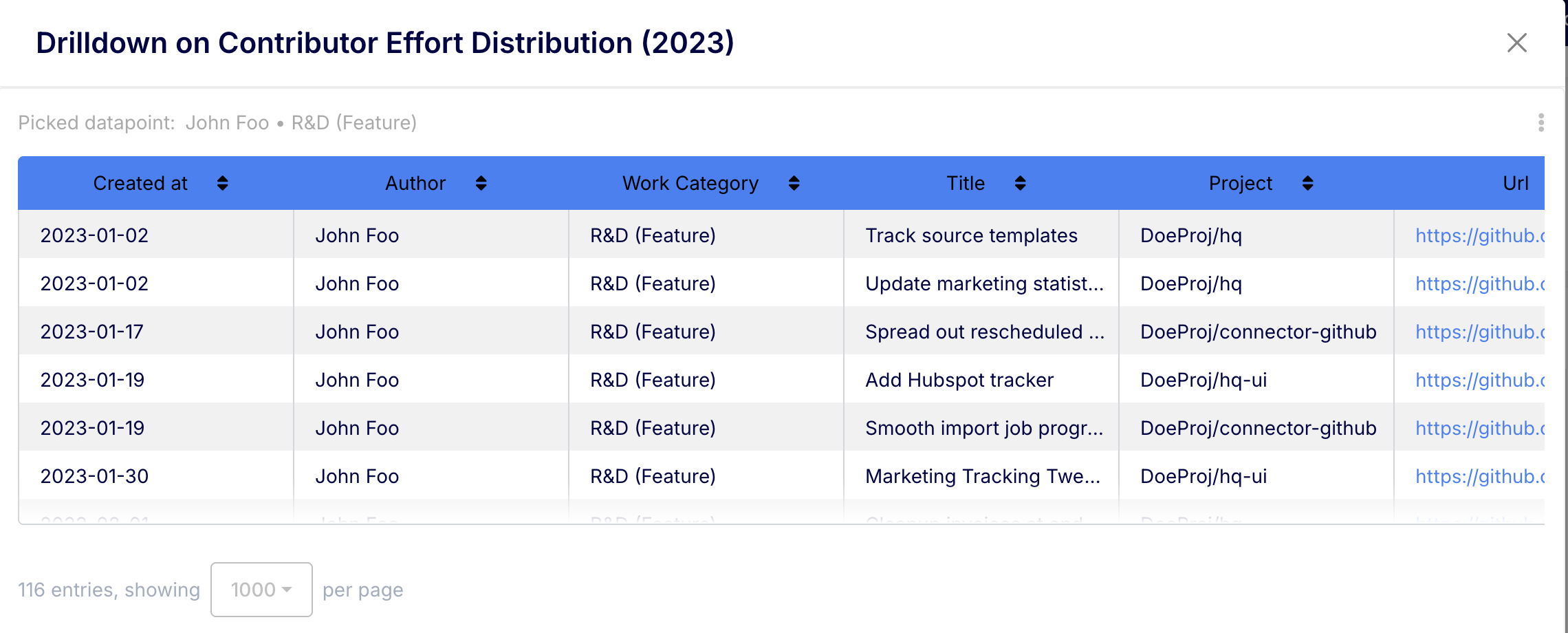
"For Epic DP-638, provide a timeline of all Git activity including first commit date, last merge date, and a list of all participating contributors. This is for R&D tax credit verification."
🤖 AI Prompt 3: Resource Allocation by Project
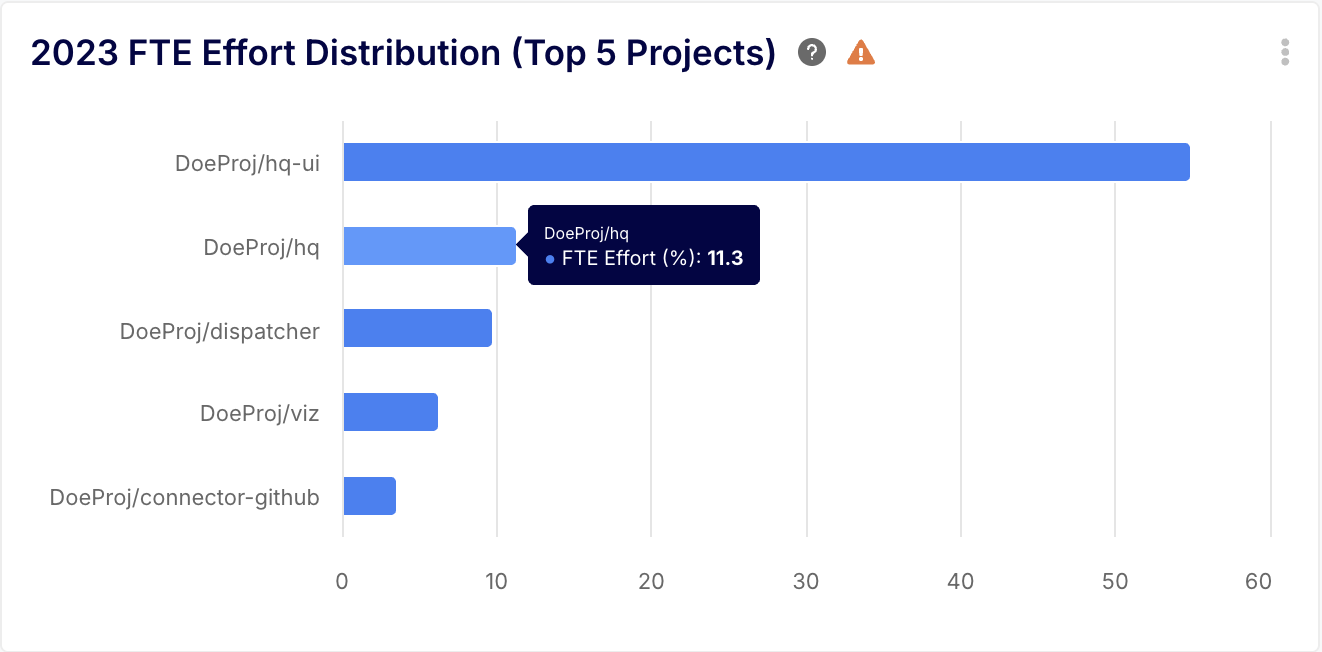
"Show the distribution of 'Full-Time Equivalent' (FTE) effort across our top 5 most expensive projects in 2023 based on Git commit volume and PR activity."
💡 The Keypup Insight: This allows Finance to assign specific salary costs to specific R&D projects with mathematical precision, rather than "finger-in-the-air" estimates.
🤖 AI Prompt 4: Identifying 'Shadow R&D'
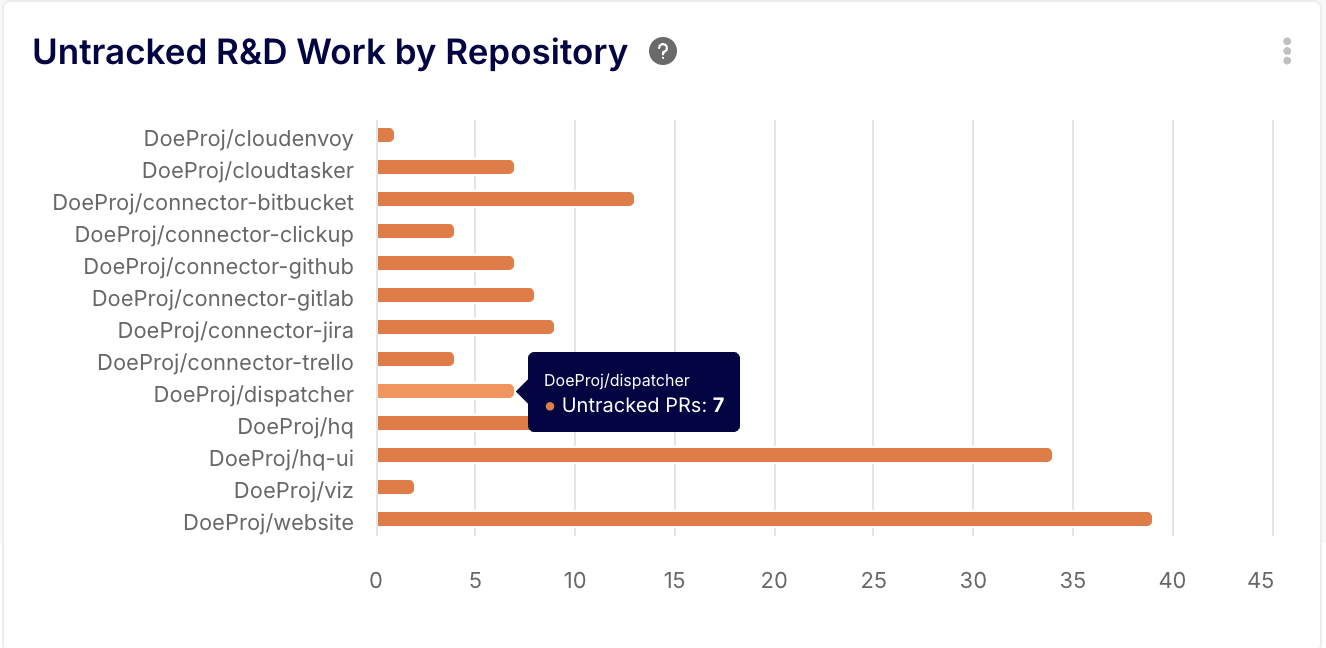
"List all repositories with high commit activity this quarter that are NOT currently linked to a Jira Epic. We need to identify untracked R&D work."
🤖 AI Prompt 5: Individual R&D Effort Allocation (FTE Calculation)
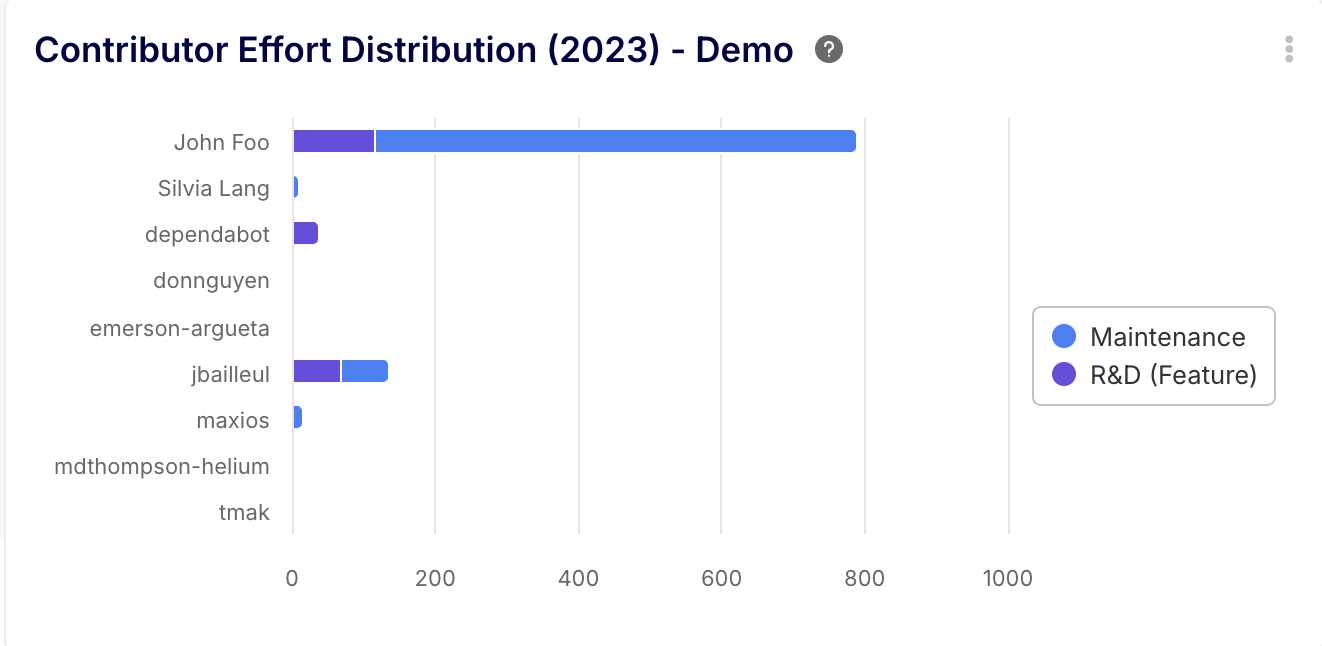
"Generate a report showing each contributor's effort distribution for the last fiscal year, calculating the exact percentage of their Git activity dedicated to R&D-eligible Epics versus non-qualifying maintenance. This is required to justify individual salary allocations in our tax credit claim."
6. Managing the Audit: Transparency as a Defense
If an auditor knocks on your door, they are looking for traceability.
With Keypup, your defense is built-in. Every dollar capitalized is linked to a Jira Epic, which is linked to a series of Pull Requests, which are linked to specific lines of code. This "Chain of Evidence" is impossible to replicate with manual time-tracking.
By moving to an Engineering Intelligence model, you provide Finance with the precision they require while protecting the Engineering culture you have worked so hard to build.
7. Conclusion: The CTO’s New Strategic Role
The role of the CTO is evolving. We are no longer just "the head of code"; we are strategic partners in the financial health of the company. By automating R&D capitalization, you aren't just saving money—you are freeing your team to do the one thing they were hired to do: Innovate.
At Keypup, we believe that the best data is the data that requires zero effort to collect. Let the Git logs do the talking, and let your engineers do the building.
Ready to automate your R&D reporting?
Connect Keypup to your GitHub and Jira today and generate your first audit-ready report in minutes.